How to choose a Bay Area real estate agent
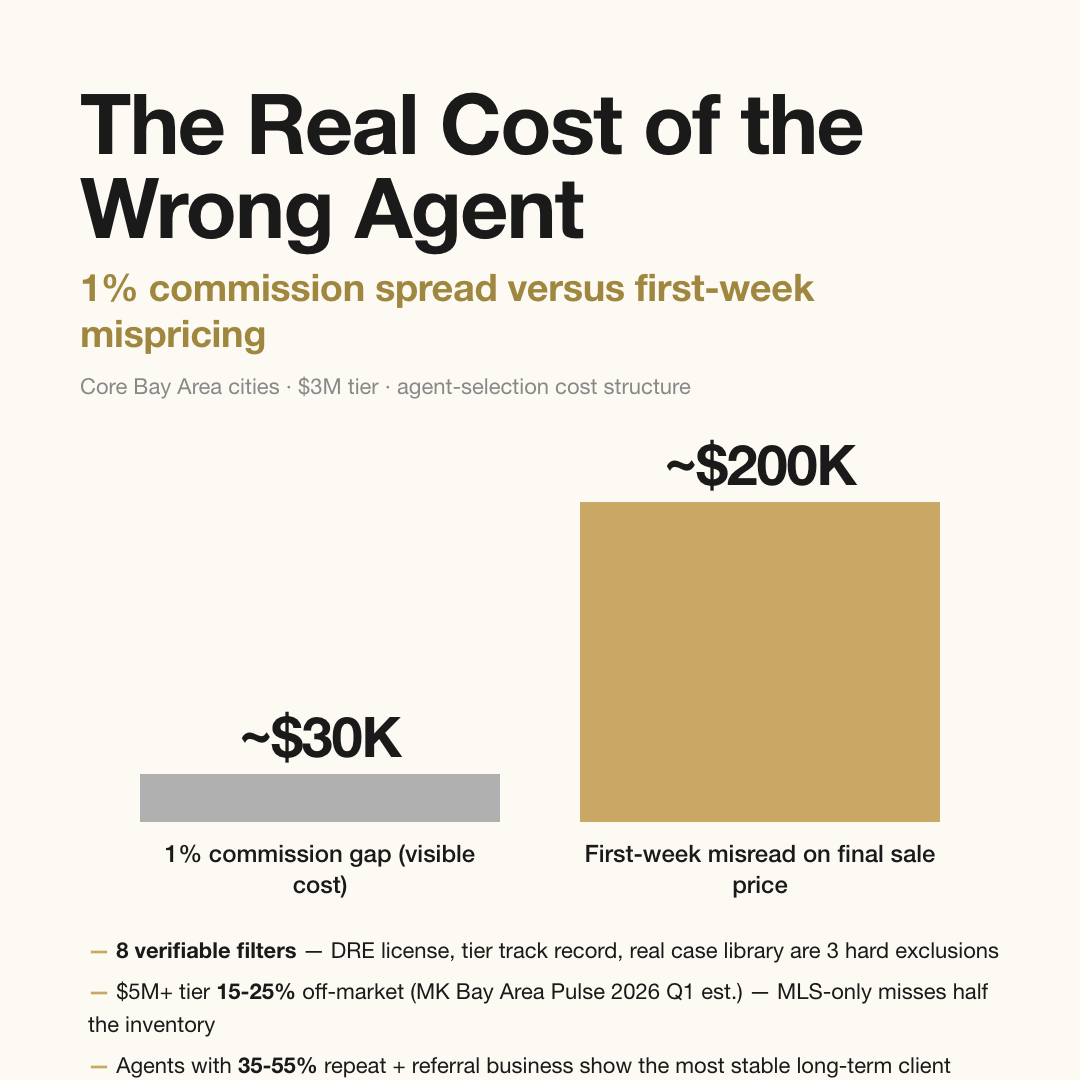
The right way to choose a Bay Area real estate agent is not "who did a friend recommend" or "who returned my call fastest." It is to put every candidate through eight verifiable dimensions: active DRE licensing and continuing education; demonstrated experience in your target price tier; a real, documented case library matched to your buyer profile; team structure and the bench of partners they actually work with; bilingual capability and cross-cultural fluency; a data-driven approach to pricing and negotiation; the technical capability to run complex closings (cross-border, trust, all-cash); and the share of business coming from repeat clients and referrals. All eight can be tested inside a single 30-minute consultation plus a 30-minute records check. The cost of picking the wrong agent in the Bay Area is rarely the one or two commission points being negotiated — it is the few hundred thousand dollars in real money that gets quietly lost when the first-week pricing window is misread, the staging is wrong for the tier, or the buyer-side negotiation strategy is tuned for the wrong segment.
Who this article is for
This article is written for households preparing to buy or sell in the Peninsula and Silicon Valley core — Palo Alto, Atherton, Hillsborough, Los Altos, Cupertino, Menlo Park — and for cross-border buyers from Mainland China, Hong Kong, Singapore and elsewhere who need to navigate all-cash compliance and trust-vehicle ownership. It is equally relevant for families whose primary buying motivation is a specific school district (PAUSD, FUHSD, CUSD, LASD, MPCSD) and for $5M+ buyers and sellers who expect off-market access. If your target home is under $1M or outside the Bay Area, some of the dimensions here — luxury-tier muscle memory, cross-border capability — are less load-bearing, but the underlying filters (active DRE, real case evidence, cross-cultural fluency) still apply.
Dimension 1: Active DRE license and continuing education
This is the first filter, and it is non-negotiable. California real estate licensing breaks into two tiers: Salesperson and Broker. A Salesperson must operate under a Broker's roof; a Broker can run their own brokerage. The California DRE public registry at dre.ca.gov/PublicASP/pplinfo.asp lets anyone look up an agent by name and verify: license number, expiration date, current brokerage affiliation, and any record of disciplinary action. Three red flags warrant immediate disqualification: a license inside its final renewal window, a recent disciplinary record, or three or more brokerage changes in the last 24 months. Beyond the baseline license, look at continuing education depth. California requires 45 hours of CE every four years, but whether the agent has chosen courses in Trust and Probate, 1031 Exchange, FIRPTA, or Fair Housing is a direct indicator of professional depth. In a $5M+ Peninsula transaction those topics are not academic — they determine whether the deal closes cleanly or runs into a tax or compliance wall at escrow.
Dimension 2: Track record at your specific price tier
This dimension is consistently underweighted by buyers and sellers, and it is the one that most reliably separates the agent who looks experienced on paper from the agent who is actually fluent in your segment. An $800K Fremont starter home and an $8M Atherton estate are both "selling a house" in name only — the operational paths barely overlap. The $800K agent is fluent in FHA financing, buyer credit-repair timelines, and down-payment assistance programs. The $8M agent is fluent in off-market channels, family-office buyer profiles, all-cash documentation and FinCEN compliance, cross-border wire pathways, and trust-to-trust grant deeds. Asking the $1M–$2M generalist to run an $8M transaction routinely produces a familiar set of failures: pricing built only on public MLS comps (ignoring that off-market activity at the $5M+ tier runs an estimated 15–25% above MLS volume per the MK Group Pulse 2026-Q1 industry estimate), staging budgets that miss the tier-appropriate standard by a factor of two or three, negotiation rhythm that doesn't account for the diligence cadence of a family-office buyer, and missed opportunities to structure tax planning for cross-border principals ahead of close. The diagnostic: ask candidates for a transaction list of every closing in the last 24 months within ±30% of your target price band. Vague answers — "I work all over Palo Alto" — are an exclusion signal. If a candidate has closed only zero or one deal in your tier in the past 24 months, this is not a knock on their character — it is a statement about muscle memory, which only stays sharp with repetition.
Dimension 3: A real case library, not a marketing reel
"I got my client $300K over asking." "My clients never lose a bidding war." "I've worked Palo Alto for 10 years." These are slogans. They are not cases. A real case library has structure: the specific neighborhood (down to the attendance area), the price range, the client profile (first-time buyer, upsize, family office, cross-border principal), the inflection point in the decision, and the closing facts (final price relative to list, days on market, number of offers). A team with 200+ closings under their belt should be able to surface three to five matched-profile cases within five minutes of being asked, and walk through the actual decision logic of each — not just say "yeah, that one went really well." Negative signal: every case in the candidate's reel is from the last six months with no three-to-five-year depth; every case ends triumphantly with no acknowledgement of a hard call or a difficult outcome; specific dollar figures, vague processes. Positive signal: the candidate can explain why a particular client "didn't sell," why the team recommended waiting, why a particular property was wrong for the buyer — case material that requires the agent to have valued the long-term relationship over the immediate commission.
Dimension 4: Team structure and bench of partners
A Bay Area transaction is a coordination problem more than a salesmanship problem. Every $5M deal pulls in eight to twelve independent specialists inside a 14-day escrow: staging firm, professional photographer, video crew, repair contractor, pre-listing inspector, escrow officer, title officer, lender, estate attorney, CPA. Solo agents reliably fall behind on coordination during peak season. The opposite extreme — a 50-agent "team" brokerage — frequently produces the bait-and-switch experience where the senior agent wins the listing pitch and a junior runs the execution. The diagnostic is three questions. First: do you have long-standing relationships with staging, photography and video crews who can mobilize inside 24 hours? Second: which pre-listing inspector do you typically use, and what is their average turnaround? Third: if the transaction involves a trust, an LLC, or cross-border funds, do you have working attorney and CPA partners who can plug in alongside you? If two of those three answers come back vague — "depends on the situation" or "we'll find someone" — the bench is unstable. MK Group's operating standard is that with the staging, photography and repair partners locked, taking a property from pre-listing inspection to live MLS in one week is the normal cadence, not a miracle.
Dimension 5: Cross-cultural negotiation fluency
For households where part of the decision happens in Mandarin — first-generation principals, overseas-based parents helping with down payment, multi-generational families coordinating across time zones — "speaks Chinese" is a baseline threshold, not a differentiator. A genuinely bilingual agent needs three competencies layered on top of language. First, dual-language professional vocabulary: the agent can explain Contingency, Escrow, Pre-underwriting, FIRPTA, and Prop 13 cleanly in both English and Mandarin, not switch into English fragments every time a term gets technical. The version that leaves clients half-comprehending is the version that produces post-close disputes. Second, cultural-context calibration: the agent recognizes that a family viewing 15+ homes before deciding is exercising a different cultural decision style from the local family that commits after three, and adjusts the pace and the data packaging accordingly. Third, multi-party decision coordination: cross-border and immigrant Bay Area buyers regularly run decisions through three to five voices — parents in another country contributing capital, the local couple, and the children whose schooling drives the geography. The agent has to keep the conversation aligned across that constellation without losing momentum. A bilingual-on-paper agent who can chat about restaurants but reverts to "this is just normal" when a buyer asks about Contingency removal is one of the more expensive hires a household can make.
Dimension 6: Data-driven, not gut-driven
"Pricing on instinct" and "pricing on data" are two different methodologies, and in the Bay Area they produce two different outcomes. The data-driven seller-side agent walks into a pricing conversation with: median Sold Price (not List Price) for the relevant attendance area over the trailing 30–60 days, current competitive inventory and average days on market, the influence of the last three FOMC meetings on rate expectations, and the seasonal demand curve for your specific neighborhood. On the buy side they bring: average over-list percentage on offers in your target area over the trailing 90 days, the distribution of contingency structures the winning offers carried, and the listing agent's preferred escrow timeline. The diagnostic: ask a specific scenario question during the consultation. "If I list a Palo Alto Midtown 3-bed at $3.2M this Thursday, how many showing groups and how many offers should I expect in the first week?" The data-driven candidate gives you a defensible number from recent MLS comps — "20 to 30 showing groups, five to eight offers." The candidate working on intuition says "it depends on the market," which usually means they are not tracking the same-tier data with any discipline.
Dimension 7: Capability with complex closings — cross-border, trust, all-cash
For high-net-worth and cross-border households this is the dimension where the cost of mismatch is highest and the diligence is most often skipped. A $5M+ Peninsula transaction frequently involves: an all-cash cross-border close requiring FinCEN review, a Source of Funds Declaration, and a vetted wire pathway — any missing document at escrow can stop the close cold; a trust or LLC ownership structure (Revocable Living Trust, Irrevocable Trust, Single-Member LLC) where the choice of vehicle materially changes capital-gains treatment and can cost hundreds of thousands in unrecovered exemptions; FIRPTA exposure for foreign sellers requiring a 15% withholding posture, withholding-certificate applications, and reconciliation with the principal's home-country tax treaty; family-office and multi-generational planning that requires the listing or buying agent to coordinate with the estate attorney, the family's CPA, and the wealth manager in parallel. If your transaction sits in this segment or touches any of these patterns, the question for a candidate is not "can you handle this" but "did you actually run a transaction like this in the past 12 months — name it." This section is decision-support, not legal or tax advice; specific execution should be confirmed with a partner attorney and CPA.
Dimension 8: Repeat clients and referrals over the long arc
This is the dimension that is hardest to manufacture and most revealing of long-run capability. A genuinely strong Bay Area agent should be able to surface three to five examples from the last five years of a former client returning to buy a second home or referring a family member into the practice. The reason this filter matters: it excludes the "one-and-done" operator who can muster real intensity for a single transaction but doesn't sustain the follow-through afterward — the move-in experience, the post-close debrief, the second-home consultation years later. The diagnostic: ask directly, "What percentage of your closings in the past two years came from repeat clients or referrals?" A healthy answer is 35–55%. Under 25% typically signals a long-tail client-satisfaction problem; above 70% is also worth probing — it can mean the brand is underexposed and new-client acquisition is weak, which becomes a disadvantage when you need off-market deal flow. Ask the reverse-direction question too: "Will you put me in touch with two or three clients from the last 12 months as references?" The candidate who agrees and produces them within 24 hours is operating a real relationship business.
Eight-dimension scoring grid
The headline number: of the eight dimensions, three function as immediate disqualifiers — active DRE, price-tier experience, and a real case library. Any one missing and the candidate is out. The remaining five are graded as "meets / needs work / missing" for an overall read. The grid below maps directly to a consultation call.
| Dimension | Meets the bar | Red flag |
|---|---|---|
| DRE license | 2+ years to renewal, no disciplinary record, stable brokerage | 3+ brokerage changes in 24 months, disciplinary history |
| Price-tier experience | 5+ closings in your tier (±30%) in the last 24 months | Zero or one tier closing, vague answers |
| Case library | 3–5 matched-profile cases produced inside 5 minutes, with decision logic | All cases from last 6 months, no depth, every case "triumphant" |
| Team and bench | Staging, photography, repair on site inside 24 hours; attorney and CPA on call | Two of three "we'll find someone" answers |
| Bilingual capability | Explains Contingency, Escrow, FIRPTA cleanly in both languages | Reverts to "this is just normal" on technical terms |
| Data-driven | Pricing built from Sold Price medians, inventory data, seasonal curve | "It depends on the market," no specific numbers |
| Complex closings | 1+ cross-border, trust, or all-cash transaction in last 12 months | "We can help with that" but no actual case |
| Repeat and referral | 35–55% of business from repeat or referred clients, will share references | Under 25%, declines to provide references |
The pattern to remember: dimensions three, six, and eight together filter out roughly 80% of candidates. Agents who can produce specific cases, defend specific numbers, and put you in touch with specific recent clients are a minority of the practicing Bay Area population — not the majority. The real differentiator is not "I've worked Palo Alto for 10 years." It is how a candidate responds to those three demands.
MK Group field notes: two cases pointed in different directions
Case A — A Sunnyvale 94087 owner consulted three agents about upsizing; all three said list now. MK Group said don't sell. The owner held a 1,800 sqft 3-bed/2-bath single-family in the Sunnyvale/Cupertino corridor, Homestead school zone, carrying a 2020-2022-era mortgage locked between 2.5% and 3.5%. Their goal was an upsize into Los Altos. Two unresolved problems sat behind the brief: a capital gap relative to Los Altos entry pricing, and an undefined target city and timeline. Marie Wang and Kevin Mo, after walking the property and the brief, returned the opposite recommendation: don't sell yet. The reasoning was concrete. First, selling permanently surrenders the 2.5%-3.5% rate; in the current 6%+ environment that rate cannot be reconstructed. Second, an undefined next move means the household is statistically likely to spend a long stretch "waiting for the market" after the sale — MK Group has seen households go more than two years between sale and next purchase under exactly this fact pattern. Third, the alternative path is structurally cleaner: hold the low-rate property, draw a HELOC to fund the down payment on the upsize, and rent the original home. Even rent-at-breakeven is worth holding, because Bay Area rents step up year over year and the eventual cash position turns positive. The owner's reaction was the diagnostic moment: "You're the only one who told them not to sell." This isn't a closing case. But it reveals more about how an agent's judgment is wired than a hundred closings could. It maps to dimensions three, six, and eight — case material that requires client-long-term framing, data-driven reasoning, and the willingness to walk away from immediate commission.
Case B — A family-office buyer purchased three Silicon Valley homes simultaneously and discovered six months in that the plan didn't add up. The family office acquired three properties at once — one primary residence, two for investment — under a decision logic that came down to "this area is well-known" and "expensive equals quality." Six months later, the structural problems surfaced. The primary home sat 30 minutes' drive from the children's school each way. Daily life — school runs, the principal's VC meetings, social commitments, errands — turned into a constant geographical strain. The two investment properties exposed a different failure: the neighborhoods chosen for "prestige" carried structurally weak rent-to-price ratios; layered with property tax, maintenance, and insurance, the cash flow profile reduced to "passively waiting for appreciation" rather than generating return. The lesson maps to dimensions two and four. A $5M+ tier agent should be running a daily-life map exercise with a primary-residence buyer before any offer goes in — overlaying the children's school, the principal's professional geography, the household's social circuit and medical and shopping centers — and they should be modeling property-by-property rent yields and holding costs before any investment property is approved. Family-office capital is not exempt from local diligence; if anything, the higher the budget, the more the household needs an agent who has demonstrably handled buyers of that profile rather than an agent claiming "I work Atherton." Both cases point at the same underlying lesson from opposite directions: the agents who hold the line for the client's long-arc interest, even at the cost of immediate transaction volume, are the ones who compound trust.
5 Common Pitfalls
Pitfall 1: "A friend's recommendation must be reliable"
Personal referrals are useful as a top-of-funnel signal — they verify "active DRE license, basic professional courtesy." They do not verify capability in your specific tier, neighborhood, or transaction type. The classic misuse: a friend's agent from a $1.5M Sunnyvale starter home purchase three years ago gets reused for a $6M Atherton transaction today. These are different markets with different muscle memory; the agent's pattern recognition does not carry across. Treat referrals as the source of candidates, not as the selection criterion. Then run the eight dimensions.
Pitfall 2: "The agent with the lowest commission is the best deal"
The Bay Area seller-side commission baseline runs 5%-6% (split 2.5%-3% per side), and the post-NAR-settlement environment has expanded the negotiating room on the buyer side. Optimizing for the cheapest commission is the wrong target. On a $3M home, a one-percentage-point commission difference is $30K. The price differential from a misread first-week pricing window, off-tier staging, or a poorly structured offer can be $150K-$300K. The right sequence is: use the eight dimensions to filter down to three candidates who meet the capability bar, then compare commission structures among the three. "Low commission, sub-bar capability" is the most expensive hidden cost in Bay Area real estate.
Pitfall 3: "Big social media following equals strong professional capability"
Social reach measures content production and brand exposure, both of which correlate with — but do not equal — transactional capability. Some high-follower agents are excellent communicators but light on luxury-tier execution; some low-profile agents work entirely off-market at $10M+ and don't post at all. The right way to use social channels: read them as a public sample of the agent's professional thinking. Has the agent walked through Pre-underwriting mechanics, the trade-offs inside contingency removal, or the tax differential between Trust and LLC vehicles in their content? If yes, the substance underneath is usually real. If the content is vlogs and room tours, verify capability separately.
Pitfall 4: "The brokerage name is enough"
The major Bay Area brokerages — Compass, Sotheby's International Realty, Keller Williams, Coldwell Banker, Christie's — each carry distinct positioning, but the brokerage shingle does not equal individual capability. Inside any single one of them you will find $50M+ producers and licensees still in their first year. The brokerage name is properly used as compliance backstop — does the firm have a clean escrow protocol, errors and omissions insurance, internal compliance review — not as a substitute for evaluating the individual.
Pitfall 5: "Young agents are hungrier; senior agents have gotten lazy"
This is a false frame. Bay Area transactional capability tracks the density of closings at your price tier over the last 24 months, not the agent's age. Many senior agents reinvest aggressively in new clients precisely because their book is built on repeat business and referrals — the metric they care about most. Many young agents work hard but lack the pattern recognition that compounds with reps. Replace "hungry vs. lazy" with two objective measures: closings in the last 24 months at your tier, and the share of business from repeat or referred clients. The subjective impression is unreliable.
Next steps
- Build a candidate list of three to five names drawn from personal referrals, agent content quality, public transaction records, and curated agent directories. Cast wider than feels comfortable.
- Verify each candidate's license on the California DRE site (dre.ca.gov/PublicASP/pplinfo.asp). Immediately remove anyone with a disciplinary record or multiple brokerage changes in the last 24 months.
- Schedule 30-minute consultations with each remaining candidate. Work the eight dimensions in turn. Record how concretely each candidate responds — specific numbers, specific cases, specific decision logic.
- For the two to three candidates who survive, request a transaction list at your target price tier from the last 24 months plus references for two or three recent clients. Candidates who can deliver inside 24 hours move forward.
- Run a final 60-minute deep-dive with the agent themselves — not their assistant. Talk through your actual buying or selling brief. Watch for whether they proactively flag potential weaknesses in your plan. That willingness to push back is the strongest signal that the agent will represent your interests rather than push for the deal.
Frequently Asked Questions
What is the typical real estate commission in the Bay Area?
The traditional seller-side commission structure is 5%-6%, split 2.5%-3% per side. Post-NAR-settlement, buyer-side commission has more negotiating room and in some transactions is paid directly by the buyer. But "lowest commission" is the wrong optimization. On a $3M home, a one-percentage-point commission gap is $30K — and the price differential from sub-bar agent capability typically runs $150K-$300K. Use the eight dimensions to filter to capable candidates first; then negotiate commission among comparable candidates.
How do I check whether a Bay Area agent holds a valid DRE license?
Go to dre.ca.gov/PublicASP/pplinfo.asp and search by name or license number. The result shows license number, expiration date, current brokerage affiliation, and any disciplinary action history. Three red flags are immediate disqualifiers: license inside its final renewal window, recent disciplinary action, or three or more brokerage changes in the last 24 months. License verification is the first filter for every candidate; an unlicensed candidate or one with a disciplinary record should not advance.
Does bilingual capability really matter to households where some of the decision happens in Mandarin?
It matters significantly — but "speaks Chinese" is a baseline threshold, not a differentiator. A genuinely bilingual agent demonstrates three competencies: clean dual-language professional vocabulary across Contingency, Escrow, Pre-underwriting, FIRPTA, and Prop 13; cultural-context calibration that recognizes a household reviewing 15+ properties is exercising a different decision style from the local norm; and multi-party coordination across overseas-based parents contributing capital, the local couple, and children whose schooling drives the geography. An agent fluent in casual conversation but reverting to "this is just normal" on technical terms is one of the more expensive hires a cross-border household can make.
How do I tell whether an agent genuinely puts the client's interests first?
The strongest signal is a documented record of recommending against a transaction when the timing or fundamentals are wrong. Commission-driven agents push every consultation toward closing. Long-horizon agents will tell a client to wait when the household's goals aren't defined, the rate environment is hostile, or the market window is unfavorable — even at the cost of immediate revenue. Ask directly during the consultation: "In the last 12 months, have you recommended a prospective client not transact yet? Why?" Candidates who can name specific situations typically have the strongest long-term client relationships as well.
What's different about choosing an agent for the $5M+ luxury segment?
Beyond the eight baseline dimensions, three capabilities require extra scrutiny at the $5M+ tier: off-market channel access (off-market activity at this tier is estimated at roughly 15–25% above public MLS volume per MK Group Pulse 2026-Q1 — does the candidate have direct relationships, or only public MLS searches?); proven capability with cross-border and all-cash documentation (FinCEN review, Source of Funds documentation, compliant wire pathways); and substantive working knowledge of trust and LLC ownership-vehicle taxation (Revocable Trust vs. Irrevocable Trust vs. LLC can swing capital-gains treatment by hundreds of thousands). These are specializations that mid-tier generalists typically have not built, and the cost of mismatch is meaningfully larger than the commission negotiation.
Related Reading
The buying process
By city
By buyer profile / tier