This Pulse issue analyzes 3,670 SFR closings across the Bay Area in Q1 2026 (53 cities, 3 counties), with the first hard year-over-year comparison versus the Q1 2025 baseline now archived. Three headline findings: mortgage rates fell 72 bps YoY yet $10M-$20M cash share rose 20.7pp (68.8% → 89.5%), confirming luxury credit decoupling longitudinally; $20M+ Q1 closings jumped from 2 to 8 (4×) with median DOM compressing from 144 days to 9 days; $10M+ closings rose 50% YoY (18 → 27) while total volume rose only 1.3%, moving the Bay Area K-shaped split from trend to structural fact. Sourced from MLSListings and FRED, with full methodology transparency.
Scroll the PDF for the full report; the web version below adds clickable links and embedded charts.
- Mortgage rates fell 72 bps YoY (6.83% → 6.11%), yet $10M-$20M cash share moved the opposite way — from 68.8% to 89.5%. Lower rates didn't pull mortgage buyers back into luxury; they pushed mid-tier capital further up the ladder.
- $20M+ closings jumped from 2 (Q1 2025) to 8 (Q1 2026); median DOM compressed from 144 days to 9 days; median sale/original climbed from 90.7% to 100% — the same band shifted from seller-concession clearance to list-tight competition within 12 months.
- $10M+ luxury closings rose 50% YoY (18 → 27) while total volume rose only 1.3% — the Bay Area's K-shaped split moved from trend to structural fact in Q1 2026.
1. The 30-Second Read
This issue draws on 3,670 single-family residence (SFR) closings in the Bay Area during Q1 2026 (CloseDate January 1 through March 31), spanning 3 counties and 53 cities, sourced from MLSListings.
- Q1 SFR median sale price $1.65M, median days on market 8, median sale-to-list ratio 104% — a structurally tight seller's market continues.
- All-cash share rises step-wise with price: under $1.5M, 16%; $5M–$10M, 48.9%; $10M–$20M, 89.5%; $20M+, 100%.
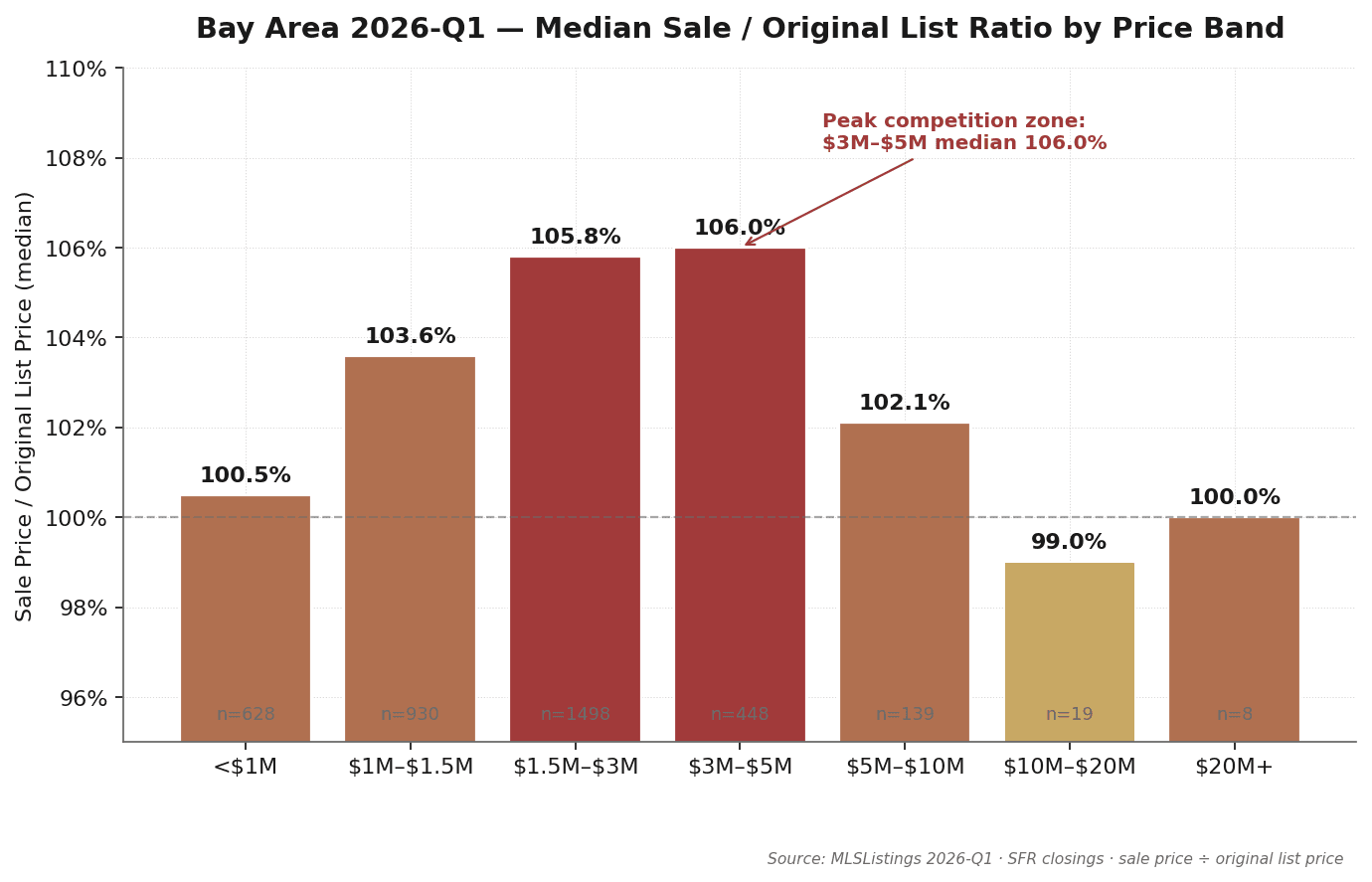
- The most competitive price band is $3M–$5M, with median sale-to-original-list ratio at 106.0% — above every higher band.
- Only 8 transactions over $20M closed in the entire Bay Area in Q1. Median DOM 9 days.
- Palo Alto Q1: 74 closings, median $4.03M, 46% cash. The premier school-tier segment is past majority all-cash.
Source: MLSListings Q1 2026 SFR closings · MK Group · Field definitions in Section 9.
2. Bay Area Fundamentals: Four Baseline Numbers
Q1 2026 Bay Area SFR market is summarized most accurately by four numbers:
| Metric | Q1 2026 Median | Interpretation |
|---|---|---|
| Total closings | 3,670 | 3 counties, 53 cities combined |
| Median sale price | $1.65M | All price bands aggregated |
| Median DOM | 8 days | List date to offer acceptance |
| Median sale-to-list | 104% | Typical small premium over list |
Together these four numbers point to one read: Q1 remains a structurally tight seller's market. A median DOM of 8 days means a properly-priced listing is typically under contract within a week; a 4% median premium means buyers are still willing to bid above ask in mainstream price tiers. But region-wide averages mask substantial city- and tier-level differentiation. The remainder of this report unpacks that.
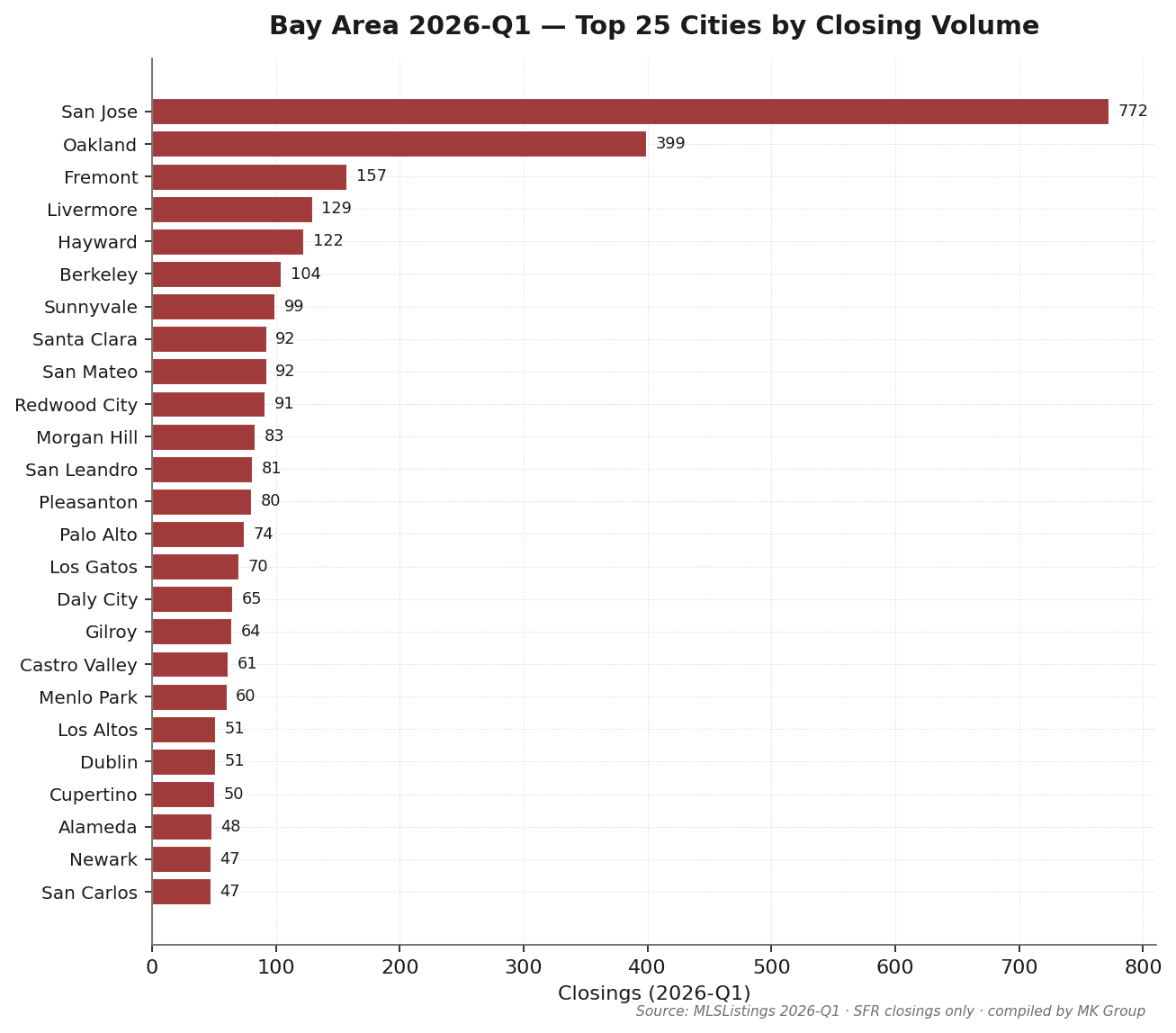
San Jose recorded 772 Q1 closings — 21.0% of the regional total. Oakland (399) and Fremont (157) follow. Among MK Group's core service cities: Palo Alto 74, Menlo Park 60, Los Altos 51, Cupertino 50 — low volume but high price.
Source: MLSListings Q1 2026 SFR closings · excludes condo, multi-family, and records with sale price below $100K.
3. YoY Comparison vs Q1 2025: 12-Month Longitudinal Validation
The Q1 2025 dataset was formally archived on 2026-05-20, enabling the first true longitudinal comparison for this report series. A single-quarter snapshot can only describe what happened now; a 12-month YoY delta answers whether this is structural or seasonal noise. The Q1 2026 vs Q1 2025 comparison gives a clear answer: luxury credit decoupling is not a snapshot artifact — it deepened over a full market cycle. Mortgage rates fell 72 bps, yet the $10M-$20M all-cash share rose 9.8pp. That combination is anomalous under standard macro frameworks and fully coherent under the three-pool capital model (AI/IPO liquidity, cross-border family-office capital, local generational wealth).
| Indicator | Q1 2025 | Q1 2026 | YoY Change |
|---|---|---|---|
| 30-yr fixed mortgage avg | 6.83% | 6.11% | −72 bps |
| S&P 500 quarter return | −4.59% | −4.63% | 相近 |
| Case-Shiller SF HPI YoY | +1.53% | +1.03% | 放缓但正增长 |
| Total in-quarter closings | 3,624 | 3,670 | +1.3% |
| $10M–$20M cash share | 68.8% | 89.5% | +20.7 pp |
| $5M–$10M cash share | 52.9% | 48.9% | −4.0 pp |
| $3M–$5M cash share | 22.9% | 27.5% | +4.6 pp |
| $1.5M–$3M cash share | 17.2% | 19.4% | +2.2 pp |
| $20M+ closings | 2 | 8 | 4× |
| $20M+ median DOM | 144 天 | 9 天 | −135 天 |
| $20M+ median sale/orig | 90.7% | 100.0% | +9.3 pp |
| $10M+ total closings | 18 | 27 | +50% |
Sources: MLSListings Q1 2025 (archived 2026-05-20) & Q1 2026 · Cash transaction definition aligned across both periods (Buyer Financing = "All Cash No Loans" or "Cash to Existing Loan")
1. Rate transmission failure: Mortgage rates fell 72 bps YoY — theoretically stimulating mortgage-financed buyers to re-enter luxury. Instead, $10M-$20M cash share rose from 68.8% to 89.5% (+20.7pp). Lower rates didn't pull mortgage buyers back into this tier; they pushed mid-tier capital further up the price ladder. This is 12-month longitudinal confirmation of luxury credit decoupling.
2. $20M+ character flip: The same band shifted from seller-concession clearance (2025: 144-day median DOM, 90.7% sale/orig, 2 closings) to list-tight competition (2026: 9-day median DOM, 100.0% sale/orig, 8 closings) within 12 months. Not gradual evolution — a character flip within one annual cycle.
3. K-split becomes structural: $10M+ closings rose 50% YoY (18 → 27) while total volume rose only 1.3% (3,624 → 3,670). Luxury grew at 38× the rate of the overall market. A divergence of this magnitude means the Bay Area is no longer a single market — it is two market logics operating inside the same geographic boundary.
4. The Cash Ladder: Luxury's Decoupling from Credit
| Indicator | This Quarter | vs Prior Q | YoY |
|---|---|---|---|
| 30-yr fixed mortgage avg | 6.11% | −0.12 pp | −0.72 pp |
| 15-yr fixed mortgage avg | 5.48% | −0.01 pp | −0.54 pp |
| 10-yr Treasury yield avg | 4.20% | +0.10 pp | −0.26 pp |
| CA unemployment rate | 5.40% | −0.13 pp | −0.03 pp |
| S&P 500 close (period-end) | 6,528.5 | −4.63% | +16.33% |
| Case-Shiller SF HPI | 361.6 | +0.12% | +1.03% |
Sources: Freddie Mac PMMS / U.S. Treasury / BLS / S&P Global / S&P CoreLogic (via FRED API) · fetched 2026-05-16
This is the most important data cluster in this issue. Q1 macro backdrop: 30-yr mortgage rate 72 bps below a year ago, S&P 500 down 4.6% in the quarter, Case-Shiller SF HPI +1% year-over-year. In an environment of cheaper credit, lower equity wealth, and flat prices, the behavior of the luxury tier is genuinely anomalous.
| Price Band | Closings | Cash % | Median Sale | DOM |
|---|---|---|---|---|
| <$1M | 628 | 17.8% | $790K | 14 |
| $1M–$1.5M | 930 | 15.1% | $1.28M | 12 |
| $1.5M–$3M | 1,498 | 19.4% | $1.98M | 8 |
| $3M–$5M | 448 | 27.5% | $3.57M | 8 |
| $5M–$10M | 139 | 48.9% | $6.13M | 8 |
| $10M–$20M | 19 | 89.5% | $11.71M | 7 |
| $20M+ | 8 | 100.0% | $25.74M | 9 |
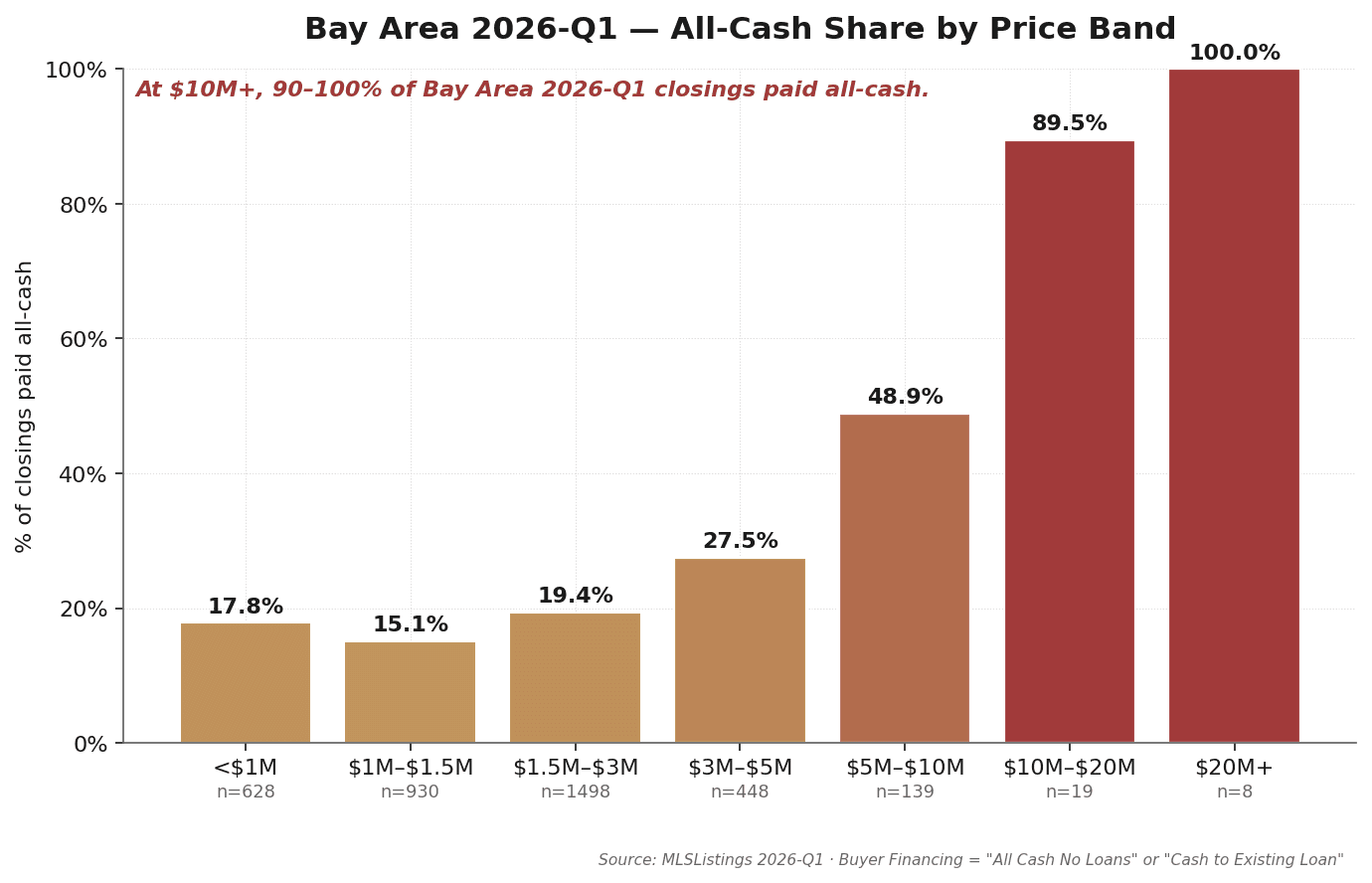
YoY note: $10M–$20M all-cash share rose from 68.8% (Q1 2025) to 89.5% (Q1 2026), a +20.7pp YoY increase — see Section 3 for longitudinal context.
Observation 1: Cash share is a phase transition, not a gradual trend
From 19% in the $1.5M–$3M tier to 48.9% at $5M–$10M and 92.6% at $10M+ — this is not a smooth curve. It is a phase transition at the $5M threshold. Below $5M: dual-income tech households on jumbo loans. Above $5M: AI/IPO liquidity, cross-border family office capital, and generational wealth — none of which depend on mortgage rates.
Observation 2: The $10M+ tier has effectively decoupled from credit markets
When 92.6% of transactions require no mortgage, rate moves have negligible impact on volume or pricing. The 30-yr rate fell 72 bps year-over-year in Q1 2026. If credit cost were the binding constraint, that should have boosted activity. Instead: of the 27 $10M+ closings, 25 were all-cash (92.6%). Volume did rise year-over-year, from 18 to 27 — but these buyers never enter the mortgage market, so the 72 bps does not explain the increase. That is the decoupling in evidence form.
Observation 3: Three independent capital pools
- AI/IPO secondary liquidity — OpenAI tender, Databricks $100B+ valuation, xAI/Anthropic secondary markets — these created large pockets of liquid wealth for Bay Area tech executives and early employees over the past 12 months.
- Cross-border family office capital — primarily from China, East Asia, and India, held through trust/LLC structures, completely outside U.S. credit markets.
- Local generational wealth transfer — Bay Area families who bought in the 1980s–2000s are passing assets through Living Trust + step-up basis structures; the next generation converts to cash equity rather than home equity loans.
Source: MLSListings Q1 2026 · "Buyer Financing" field = "All Cash No Loans" or "Cash to Existing Loan" classified as cash · field completeness 99.1%
5. Mid-Tier Squeeze: The $3M–$5M Segment
If the luxury story is decoupling, the mid-tier story is compression.
The data
$3M–$5M: 448 closings, median sale-to-original-list 106.0% — the highest of any band. $1.5M–$3M follows at 105.8%. These two bands together (1,946 closings, 53% of Q1 total) show that the Bay Area's volume engine typically closes at 4–7% above original list. By contrast: $10M+ median sale/original is 99.0–100.0% — essentially at ask, almost no bidding war.
Why the mid-tier is the most contested
$3M–$5M is the entry threshold for Bay Area GreatSchools 10/10 districts — Palo Alto Unified (most ZIP codes), Cupertino Union core ZIPs, Los Altos/Saratoga mid-tier — all concentrated in this range. The buyer profile is remarkably homogeneous: age 30–45, FAANG/AI mid-manager or senior engineer, RSU/pre-IPO equity but limited liquid cash, kids in elementary or middle school with hard school-zone requirements. On the supply side, existing owners typically locked in at 2.5–3.5% in 2018–2022; trading up means nearly doubling their mortgage rate. That rate-lock effect is strongest precisely here.
Source: MLSListings Q1 2026 · Sale Price ÷ Original List Price · median (not mean)
6. $20M+ Ultra-Luxury: Eight Transactions, Decoded
YoY note: Q1 2025 saw only 2 $20M+ closings with median DOM 144 days and median sale/orig 90.7% — seller-concession territory. Q1 2026's 8 closings at median DOM 9 days and 100.0% sale/orig represent a character flip within a single annual cycle. See Section 3 for full longitudinal data.
The entire Bay Area produced 8 public MLS closings above $20M in Q1 2026. That number is itself a data point.
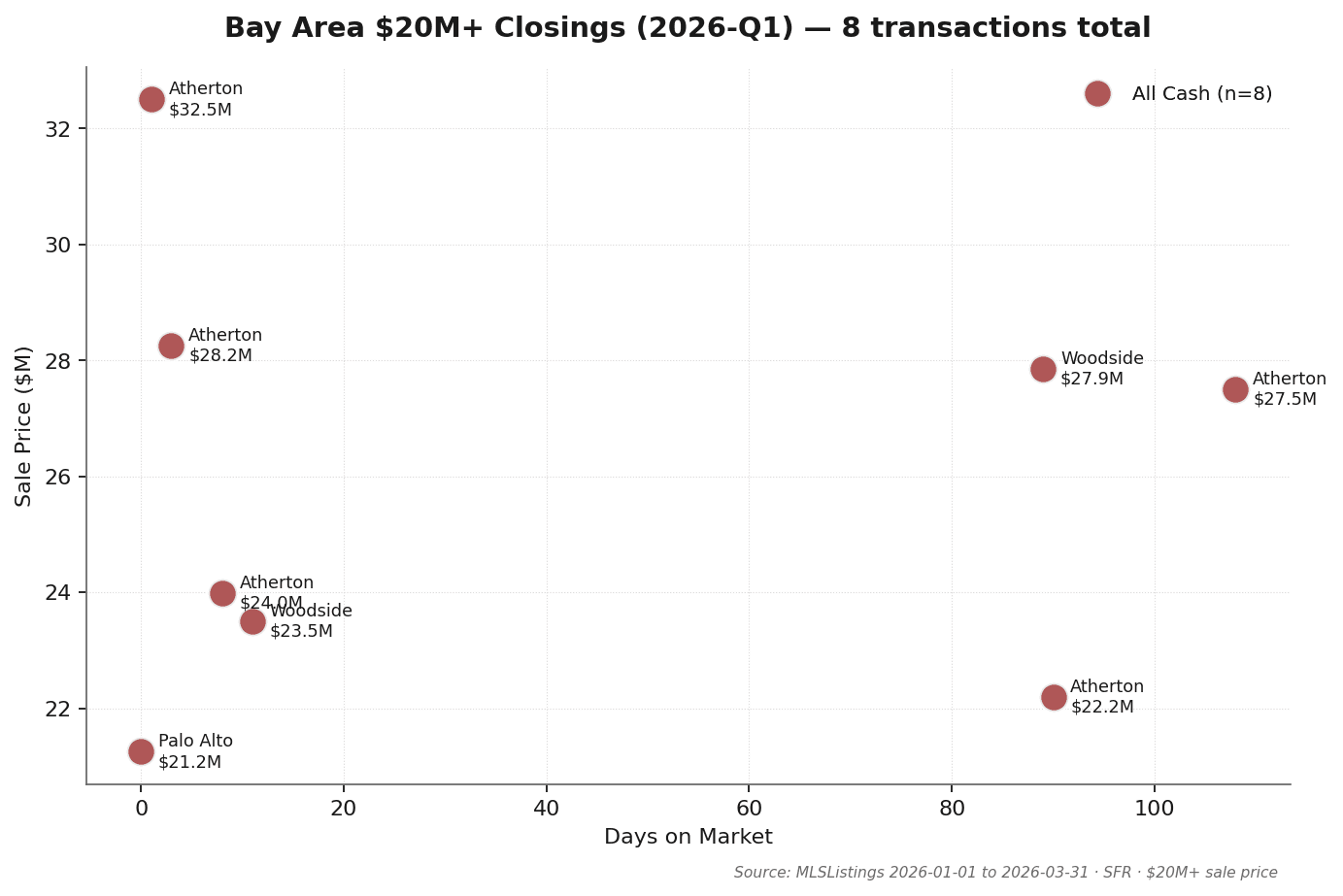
Transaction detail (Q1, in-quarter · 8 total)
| City | Address | Sale Price | Orig List | DOM | Cash | Close Date |
|---|---|---|---|---|---|---|
| Atherton | 190 Almendral Ave | $32.50M | $32.00M | 1 | ✓ | 2026-03-30 |
| Atherton | 273 Austin Ave | $28.25M | $27.00M | 3 | ✓ | 2026-01-06 |
| Woodside | 100 Canada Rd | $27.85M | $29.50M | 89 | ✓ | 2026-02-05 |
| Atherton | 54 Barry Ln | $27.50M | $27.50M | 108 | ✓ | 2026-02-24 |
| Atherton | 35 Barry Ln | $23.99M | $23.99M | 8 | ✓ | 2026-03-25 |
| Woodside | 6 Cedar Ln | $23.50M | $23.50M | 11 | ✓ | 2026-02-06 |
| Atherton | 291 Atherton Ave | $22.20M | $23.89M | 90 | ✓ | 2026-01-22 |
| Palo Alto | 1700 Waverley St | $21.25M | $25.95M | 0 | ✓ | 2026-02-09 |
All 8 closed in-quarter (CloseDate 2026-01-01 to 2026-03-31).
Three observations
1. Eight closings confirms genuine scarcity. Atherton accounts for 5 of 8, Woodside 2, Palo Alto 1 — ultra-luxury is highly geographically concentrated.
2. DOM is bimodal. Five closings at DOM ≤ 11 (effectively instant); three closings at DOM 89+. Ultra-luxury is either immediate or long-term stale — the middle outcome barely exists.
3. 100% cash. None of the eight used financing. This is a purely relationship-driven market; conventional buyer's agents and loan officers play almost no role. Off-market share is likely even higher: these 8 are public MLS records; true $20M+ volume would include pocket listings not on MLS.
7. City Tiers: Six Groups, Six Narratives
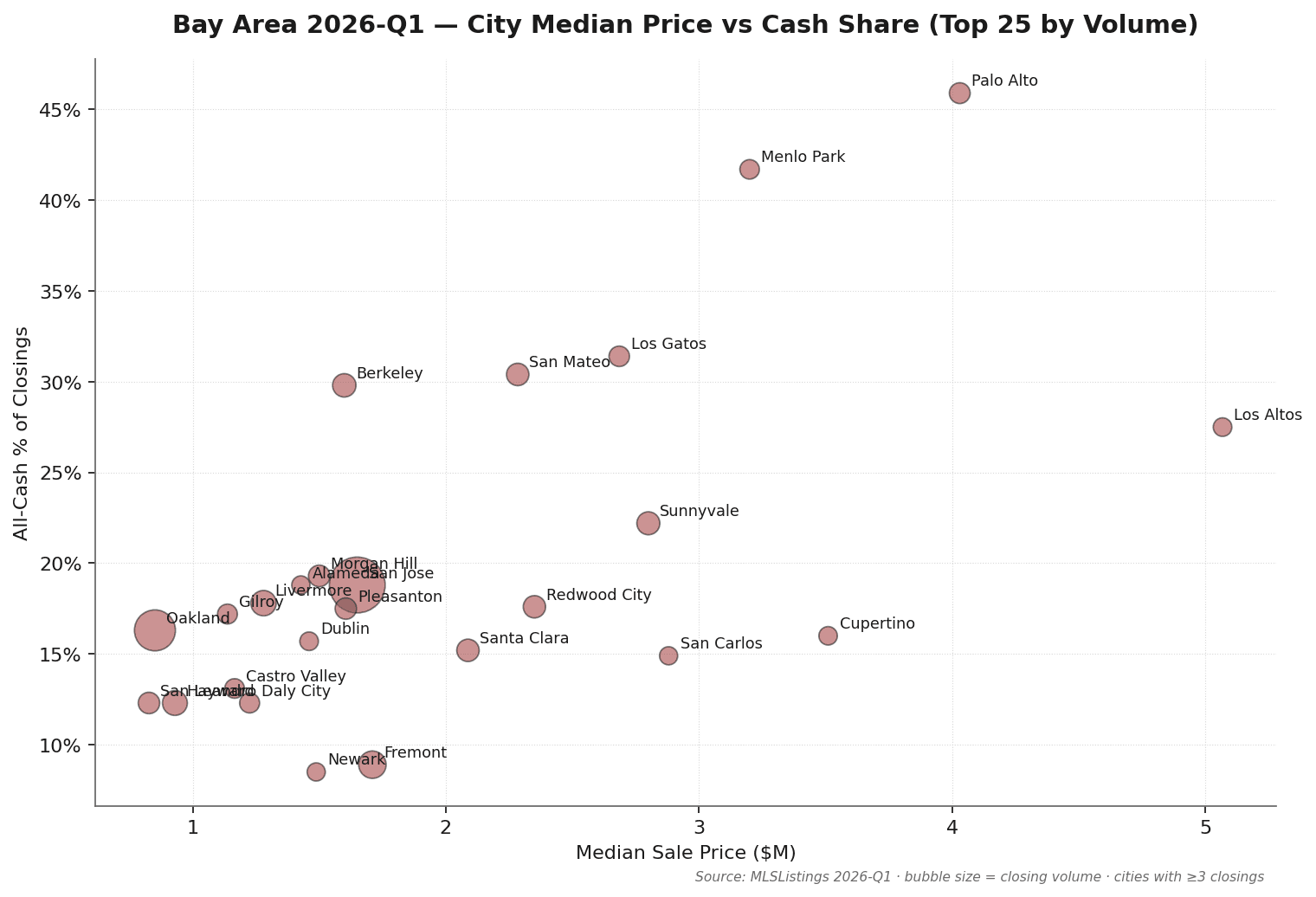
Plotting Q1 data on a city scatter (median price × cash share × volume), the Bay Area resolves into six distinct city clusters.
Tier 1 · Ultra-Luxury Anchor (Atherton / Hillsborough / Woodside / Los Altos Hills)
Median sale price $5M+, all-cash share 50%+, very low volume (fewer than 30 public closings per city per quarter). Off-market share is substantial; MLS data meaningfully understates true activity in Atherton and similar markets.
Tier 2 · Premium School-District Core (Palo Alto / Los Altos / Cupertino / Menlo Park)
Median $3.2M–$5.1M, 16–46% all-cash, strong seller's market (sale/list 105%+). The most contested school-district segment. Palo Alto: 74 closings, median $4.03M, 46% cash.
Tier 3 · Tech Corridor Core (Sunnyvale / Mountain View / Santa Clara)
Median $2.0M–$3.0M, high FAANG/AI employee concentration, sale/list 107–112%. Sunnyvale: 99 closings, median $2.80M, sale/original 110.1% — the sweet spot for mid-career tech buyers.
Tier 4 · Mainstream Housing Market (San Jose / Fremont / San Mateo / Redwood City)
The volume engine of the Bay Area market. San Jose: 772 closings (21.0% of regional total), median $1.65M, 19% cash. Sale/list typically 103–111%, DOM 7–9 days.
Tier 5 · East Bay Expansion (Oakland / Berkeley / Hayward / Pleasanton / Livermore)
Widest internal spread. Berkeley: median $1.60M, sale/original 121.6% (highest of the 20 cities in this issue's table). Oakland: median $851K, 399 closings (No.2 by volume). Pleasanton: median $1.61M but sale/original 100% — East Bay is effectively its own segmented market.
Tier 6 · Coastal / Outer Suburbs (Pacifica / Half Moon Bay / Gilroy / Morgan Hill)
Median $1.1M–$1.9M, DOM 9–39 days (noticeably slower than core), cash share under 10%. Most mortgage-dependent segment; most rate-sensitive of the six tiers.
City data (20 representative cities)
| City | Count | Median Sale | Cash % | DOM | Sale/Orig % |
|---|---|---|---|---|---|
| San Jose | 772 | $1.65M | 18.8% | 8 | 104.0% |
| Oakland | 399 | $851K | 16.3% | 14 | 106.1% |
| Fremont | 157 | $1.71M | 8.9% | 8 | 104.3% |
| Livermore | 129 | $1.28M | 17.8% | 8 | 101.1% |
| Hayward | 122 | $930K | 12.3% | 13 | 100.6% |
| Berkeley | 104 | $1.60M | 29.8% | 14 | 121.6% |
| Sunnyvale | 99 | $2.80M | 22.2% | 8 | 110.1% |
| Santa Clara | 92 | $2.09M | 15.2% | 8 | 107.7% |
| San Mateo | 92 | $2.28M | 30.4% | 7 | 110.4% |
| Redwood City | 91 | $2.35M | 17.6% | 9 | 103.8% |
| Pleasanton | 80 | $1.61M | 17.5% | 11 | 100.0% |
| Palo Alto | 74 | $4.03M | 45.9% | 8 | 105.7% |
| Los Gatos | 70 | $2.69M | 31.4% | 8 | 102.6% |
| Menlo Park | 60 | $3.20M | 41.7% | 8 | 107.3% |
| Los Altos | 51 | $5.07M | 27.5% | 8 | 104.3% |
| Cupertino | 50 | $3.51M | 16.0% | 8 | 106.9% |
| San Carlos | 47 | $2.88M | 14.9% | 8 | 103.2% |
| Mountain View | 45 | $2.97M | 26.7% | 7 | 111.7% |
| Saratoga | 43 | $4.21M | 32.6% | 8 | 104.3% |
| Burlingame | 36 | $3.21M | 38.9% | 9 | 107.9% |
Source: MLSListings Q1 2026 · cities with 3+ closings in quarter (53 cities ranked)
8. Takeaways for Sellers, Buyers, and Cross-Border Investors
For sellers
- Mid-tier ($1.5M–$5M) remains a strong seller's market; price at market and expect a premium. Median sale/original is 106%+ — pricing at ask typically closes at 4–7% above. Do not list low to generate bidding wars; Q1 data shows that strategy consistently underperforms.
- $5M+ requires 8–10 weeks of pre-listing preparation and active evaluation of off-market private channels. Luxury closes fast (median DOM 7–9 days), which means all preparation must precede the listing date. Buyer pools at this tier are heavily relationship-driven; public MLS alone is not the optimal reach strategy.
- Do not let the "wait for rates" narrative delay decisions. Q1 data shows clearly: $3M+ buyers are not rate-sensitive — cash share is already 30%+, and mortgage rates are not the primary decision variable.
For buyers
- Mid-tier ($3M–$5M): plan for 5–10% above list, and prioritize all-cash or fast-close capability. These advantages outperform incrementally higher bids at ask price.
- Luxury ($5M+): your real resource is off-market relationships, not MLS scanning. $10M+ generated only 27 public closings. True volume is much higher. Two or three first-tier agent relationships are worth more than daily MLS alerts.
- School-zone buyers: the $3M–$5M band is the most contested; consider Tier 2 districts with a trade-up path. Cupertino, Los Altos, and parts of Sunnyvale offer better value efficiency; a 5–7 year trade-up window may be easier on household finances than fighting for Palo Alto core today.
For cross-border investors
- All-cash advantage is more differentiated at $5M+ than at $3M. At $5M–$10M, 48.9% of buyers are already cash — you are level with half the competition. At $3M–$5M, only 27.5% are cash — scarcity premium is smaller.
- Establish trust/LLC holding structure before the offer stage. FIRPTA withholding (15% for foreign sellers), estate tax exposure, and FinCEN BOI filing requirements are all costly to restructure post-signing.
- Cross-border buyer flow into $5M+ remains active in Q1 2026. MK Group's direct observations confirm high-net-worth buyers from China, East Asia, and India are active, with relatively mature compliance pathways (lawful exchange + third-party offshore routing + U.S. escrow settlement).
⚠️ Tax and legal content in this section is for general informational purposes only and does not constitute professional advice. Consult a qualified tax attorney or CPA for your specific situation.
9. Methodology & Definitions
Data source
Core data sourced from MLSListings (the primary Bay Area MLS, covering Santa Clara, San Mateo, Santa Cruz, and Monterey counties, with regional agreements extending coverage to Alameda, Contra Costa, San Francisco, Marin, and Solano). The $20M+ tier was individually verified by Marie Wang and Kevin Mo against public closing records.
Time windows
- Q1 primary data: CloseDate [2026-01-01, 2026-03-31], 3,670 records
- QTD supplement withdrawn: the former Section 8 ("Q2 Early Signals") was extracted on the contract-acceptance frame, inconsistent with the close-of-escrow frame this report moved to on 2026-07-30, so the chapter has been removed; see /pulse/2026-q2 for the full quarter
Property type
Single Family Residential (SFR) only. Condos, multi-family, and land excluded.
All-cash definition
MLSListings "Buyer Financing" field value of "All Cash No Loans" or "Cash to Existing Loan" classified as cash. All other values (Conventional, FHA, VA, Private, etc.) classified as financed. Field completeness: 99.1% in this dataset.
Price band classification
Based on Sale Price (actual close price), not List Price. All medians are statistical medians, not means.
Exclusions
- Status = Cancelled / Expired / Withdrawn: excluded
- Sale Price < $100,000: excluded (likely family/trust/divorce transfers)
Known limitations
- Off-market transactions not on MLS are excluded. Industry estimates suggest $5M+ off-market volume adds 15–25% on top of public MLS counts. The 8-transaction $20M+ figure reflects only public closings.
- YoY comparison added in the 2026-05-20 update — Q1 2025 data formally archived and field definitions aligned across both periods. See Section 3 for full longitudinal context.
- School-zone-level breakdowns not included in this issue; planned for a subsequent report once the data clears validation.
10. About MK Group
MK Group (Meridian Keystone Real Estate Group) is a Bay Area real estate team based in Cupertino, co-founded by Marie Wang (DRE# 02110980) and Kevin Mo (DRE# 02127623), operating with Keller Williams Realty.
The team focuses on the $3M–$30M+ buy and sell market across the SF Peninsula and South Bay, with deep specialization in cross-border buyer advisory. MK Group is one of the few Bay Area teams with both deep English-language market fluency and native Chinese-language service capability — 68K+ combined YouTube subscribers (@MarieWang 44K+ / @KevinMoRE 24K+), plus Xiaohongshu and WeChat reach.
About the MK Bay Area Pulse Series
Pulse is a quarterly market intelligence report grounded in complete MLS closing data, County Recorder cross-reference, and direct transaction observations from 200+ client engagements. It is designed to serve buyers, sellers, investors, media, and researchers who need data-driven, source-transparent, cross-tier Bay Area market analysis.
Citation
Please cite as: "MK Bay Area Pulse 2026-Q1, MK Group"
For high-resolution charts, full dataset, or press inquiries, contact Marie Wang(marie@mkbayarea.com) or Kevin Mo(kevin@mkbayarea.com), write to team@mkbayarea.com, or use the form at mkbayarea.com/contact
Next issue
Q2 2026 Pulse Report was published on 2026-07-10 — see /pulse/2026-q2.
Questions about your specific situation?
Data provides context — your decision depends on your timeline, budget, and goals. Reach out to Marie Wang or Kevin Mo directly. First consultation is always free and carries no obligation.