Direct Answer: What you must know before buying in Hillsborough
Buying in Hillsborough means deploying capital at the Peninsula's apex tier — same league as Atherton, governed by a different rulebook. Five core facts must be understood up front: (1) Median sale around $5-8M for single-family homes (MLSListings 2025-2026); $10M+ concentrates in Historic District and Country Club; $20M+ surfaces around the Carolands area (the original 1910s-1920s estate corridor). (2) Historic District's Architectural Review Committee (ARC) is among the strictest on the Peninsula — any ground-up or major exterior change (roofline, facade material, window layout, fence height) requires ARC approval, with a typical 12-18 month permit cycle (versus 6-9 months in Menlo Park and 12+ months in Atherton). (3) Hillsborough City School District (K-8) is one of the Peninsula's strongest, but no "Hillsborough High School District" exists — almost all Hillsborough students feed Burlingame High in the San Mateo Union High School District; some families choose Crystal Springs Uplands, Nueva, or other private schools. (4) All-cash share at $5M+ runs roughly 50-70%, rising to 80-95% at $10M+ (MK Bay Area Pulse 2026 Q1 estimate). (5) Off-market share at $5M+ runs roughly 40-70%, rising to 80-95% at $15M+ — pocket listings are the norm at the $10M+ tier in Hillsborough, not the exception. These are not decorative details — they determine that a Hillsborough buyer must use a "same tier, different rules" strategy versus Atherton. This is the framework Marie Wang and Kevin Mo at MK Group have repeatedly validated through Hillsborough buyer-circle interactions.
Who this article is for
This guide is written for five Hillsborough buyer profiles:
- Family-office buyers: deploying long-term Peninsula luxury capital, targeting estate-grade assets but preferring Hillsborough's classical-architecture legacy plus Crystal Springs natural setting plus the lower-key culture versus Atherton; budgets $10M-$30M+, priorities in Historic District and Country Club.
- Pre-IPO and secondary-market tech founders or early employees: deploying capital from a one-time liquidity event; budgets $8M-$25M, targeting Country Club, Historic District, or Lower Hillsborough top-tier benchmark assets or ground-up new builds.
- Cross-border high-net-worth families: allocating Peninsula assets from China, Singapore, Hong Kong, or Taiwan; valuing Hillsborough City School District's K-8 strength, classical-architecture culture, and SFO connectivity (30 minutes); needing to complete decisions within a 14-30 day viewing window while handling FinCEN GTO, AML compliance, and trust-structure vesting.
- Bay Area upgrade buyers already holding a Peninsula home: currently in Burlingame, San Mateo, or Foster City; upgrading directly to Hillsborough — typically starting with Lower Hillsborough or Crocker Estates entry tier before considering Country Club or Historic District.
- Historic District classical-architecture enthusiasts: strong preference for 1910s-1930s Tudor, Spanish Revival, Mediterranean, or Colonial styles; willing to accept ARC review constraints and a 12-18 month permit cycle in exchange for the Peninsula's most historically rich residential asset.
The core decision framework is the same across all five — only the density, ARC preparedness, and cross-border compliance complexity at each step change.
Hillsborough sub-market differences (decide which area you're buying)
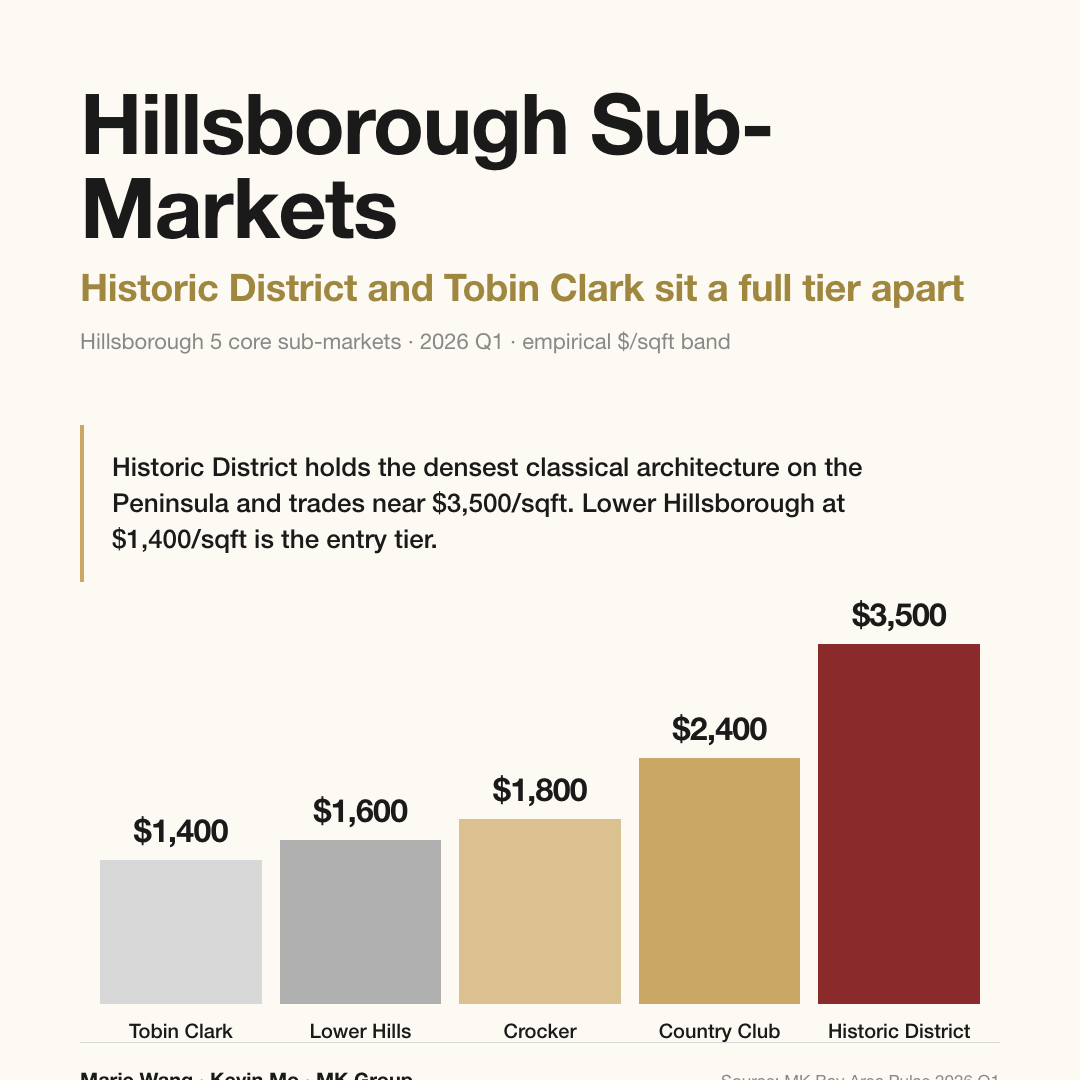
Hillsborough is not a homogeneous market. Houses labeled "Hillsborough 94010" diverge sharply on price, lot size, streetscape culture, ARC stringency, and buyer demographics by sub-community. The five core sub-market profiles:
Historic District (including Carolands area): northwestern Hillsborough on the slopes above Crystal Springs Reservoir, the most historically rich sub-area. Lots typically 1-acre+, some approaching or exceeding 2-acre; list prices $15M-$50M (ultra-trophy historic estates can reach $30M-$80M). Architecture is dominated by 1910s-1930s Tudor, Spanish Revival, Mediterranean, and Colonial styles; Carolands Chateau (built in the 1910s; the former Carolands estate, parts of which still trade as sub-parcels) anchors the district. Critical constraint: any ground-up or major exterior change requires Architectural Review Committee (ARC) approval, with a typical 12-18 month permit cycle. Buyer demographics are dominated by family offices, multi-generation high-net-worth households, and classical-architecture enthusiasts. Hillsborough City School District (K-8) plus Burlingame High.
Country Club (around Burlingame Country Club): central Hillsborough, the high-end residential band around Burlingame Country Club. Lots predominantly 1/2-1 acre, some approaching 1.5-acre; list prices $8M-$25M. Architecture spans 1920s-2020, mixing traditional Mediterranean and Colonial with modern ground-up new builds. ARC stringency is lower than Historic District (parts of Country Club fall outside the Historic District boundary), giving design more flexibility. Buyers include tech executives, cross-border families, and golf-club members seeking "Hillsborough tier plus more new-build flexibility." Hillsborough City School District plus Burlingame High.
Lower Hillsborough: southeastern Hillsborough, adjacent to El Camino Real and the Burlingame border. Lots predominantly 1/2 acre (some 1/4-1/2 acre); list prices $5M-$10M; the entry tier of the Hillsborough segment. Architecture is dominated by 1950s-1980s traditional homes, with a recent wave of ground-up rebuilds. ARC constraints are looser than Historic District. Buyers include younger tech families and upgrade households seeking "Hillsborough address plus Hillsborough City School District plus entry budget." Hillsborough City School District plus Burlingame High.
Crocker Estates: central-western Hillsborough, the high-end band adjacent to Burlingame's western boundary. Lots 1/2-1 acre; list prices $7M-$15M. Architecture is dominated by 1960s-1990s traditional homes, with a portion of substantial renovations or ground-up rebuilds in the past decade. ARC stringency is medium (part of Crocker Estates falls within the Historic District boundary requiring ARC, part does not). Buyers seek "Country Club–neighbor culture at a slightly lower price point." Hillsborough City School District plus Burlingame High.
Tobin Clark (Hillsborough's newer southern segment): southern Hillsborough, adjacent to San Mateo's northern boundary; the most recently developed of Hillsborough's five sub-areas. Lots predominantly 1/4-1/2 acre (some approaching 1/2 acre); list prices $4M-$8M. Architecture is dominated by 1970s-2000s modern homes. ARC constraints are the loosest (most of Tobin Clark falls outside the Historic District boundary). Buyers seek "Hillsborough address plus newer construction plus lower entry tier." Important note: school assignment for some Tobin Clark streets requires verification — most remain in Hillsborough City School District, but a few boundary streets may fall into San Mateo-Foster City School District; street-level attendance-area diligence is critical.
Core data: Hillsborough's five sub-markets — price, lot, ARC stringency, buyer profile
Core numbers first: across Hillsborough's five sub-markets, the median price in Historic District (around $20M+) is roughly four times that of Tobin Clark (around $5M), and Historic District's 1-acre+ standard far exceeds Tobin Clark's 1/4-1/2 acre. Yet all five sub-areas share the "Hillsborough 94010" ZIP — meaning the ZIP alone cannot determine tier or ARC stringency. Diligence must drop to the specific street and sub-area boundary.
| Sub-market | List price band | Typical lot | ARC stringency | Typical buyer profile |
|---|---|---|---|---|
| Historic District | $15M-$50M+ | 1-2+ acre | Very strict (12-18 mo) | Family office / classical-architecture |
| Country Club | $8M-$25M | 1/2-1.5 acre | Medium (partial ARC) | Tech executive / cross-border |
| Crocker Estates | $7M-$15M | 1/2-1 acre | Medium | Country Club neighbor |
| Lower Hillsborough | $5M-$10M | 1/4-1/2 acre | Looser | Upgrade / younger tech |
| Tobin Clark | $4M-$8M | 1/4-1/2 acre | Loose | Newer-construction preference |
Key difference to remember: Historic District and Tobin Clark share the Hillsborough 94010 ZIP, but median prices differ nearly fourfold and ARC stringency ranges from "12-18 month review" to "essentially no Historic constraint." That is the largest structural difference across Hillsborough's five sub-markets — defaulting to "just start with Historic District" or "prepare Historic District using Tobin Clark experience" both lead to costly missteps. Data source: MLSListings 2025-2026 / Town of Hillsborough zoning and Historic District map / Hillsborough City School District boundaries / GreatSchools / MK Bay Area Pulse 2026 Q1. Updated: 2026-06. Scope: buy-side decision framework for single-family homes across Hillsborough 94010's five core sub-markets, $4M-$50M+ tier.
Hillsborough entry strategy: the real paths at $5M, $10M, and $15M+
Hillsborough buyer strategy diverges sharply by budget tier — not "higher tier means harder," but "higher tier means narrower channels, more critical ARC preparedness, and shorter decision windows."
$5M-$8M tier (Hillsborough entry): this tier dominates Tobin Clark, Lower Hillsborough, and Crocker Estates entry listings. On-market share is roughly 50-60% — MLS visibility is still a meaningful channel. But Hillsborough closings in the $5M-$8M band only run 25-40 per year town-wide, with inventory scarcity already far exceeding Burlingame or San Mateo at the same price band. Public-channel platforms (Zillow / Redfin / Compass) are an effective starting point, but the buyer's agent must simultaneously open off-market channels. Typical buyer profile: upgrade households, families driven by Hillsborough City School District, and tech executives seeking "Hillsborough address plus entry budget."
$10M-$15M tier (Hillsborough mainstream): this tier dominates Country Club, Crocker Estates, and Historic District entry listings. Off-market share is roughly 60-70% — most closings bypass public MLS, flowing through Top Agent Network (TAN), Keller Williams Exclusive Properties, local trophy-broker private email lists, or introductions. Seller motivations for off-market: privacy (avoid Zillow exposure to neighbors), Historic District sellers avoid stale-listing pressure from ARC-curious browsers, and matching cross-border buyers. Watching MLS alone at this tier forfeits most of the inventory. Unlocking off-market requires the buyer's agent to operate inside TAN, KW Exclusive Properties, and the local trophy-broker network.
$15M-$50M+ tier (Hillsborough estate): this tier sits almost entirely in Historic District and top Country Club; town-wide annual closings run 10-20. Off-market share is 80-95% — inventory at this tier essentially never touches MLS, flowing through TAN, local trophy-broker private networks, direct builder outreach (ground-up projects start sourcing buyers during ARC review), and introductions inside legacy-wealth circles. "Watching MLS yourself" at this tier is effectively self-elimination. To access this inventory, the buyer needs: (1) a buy-side agent with 5+ years in the Hillsborough trophy circle; (2) alignment with the agent on profile 60-90 days before searching; (3) Historic District buyers must additionally understand the ARC process — before locking the lot, conduct a feasibility study with a local ARC-experienced architect; (4) all-cash, pre-underwritten, clean contingency stack is the entry baseline, not a competitive advantage.
Hillsborough Historic District deep-dive: why this sub-area is unique
Historic District is the sub-area Hillsborough buyers most often underestimate in difficulty. On the surface, Historic District reads as "most expensive plus most classical plus most prestigious." In practice, for buyers with ground-up or major renovation plans, it operates under an independent rulebook — different from Hillsborough's other sub-areas and entirely different from Atherton.
Architectural Review Committee (ARC) workflow: Hillsborough's Historic District is regulated by the Town of Hillsborough Architectural Review Committee. All ground-up new construction, facade alterations, roof replacement, window layout changes, fence height adjustments, driveway redesign, and major landscape changes require ARC pre-review plus formal approval. The flow: Conceptual Review (initial review, 1-3 months) → Design Review (design review, 3-6 months) → Final Approval (2-4 months) → Permit issuance (1-2 months). Typical total cycle 12-18 months; some complex projects extend to 24+ months. ARC is not a rubber stamp — historically it has rejected designs inconsistent with Historic District character (overly modern facades, mismatched roof pitches, inappropriate material choices).
What can and cannot be changed: Historic District interior renovations (kitchen, bath, flooring, interior walls) are essentially unconstrained by ARC and can be freely modernized. ARC governs externally visible elements: roofline, facade material (stucco vs brick vs stone), window layout and material, porch design, fence height and material, driveway form, front-yard landscape (rear yards relatively flexible). Critical clarification: many buyers assume "buying in Historic District means you can only preserve the original and cannot change anything." That is a misunderstanding. Substantial renovation is permitted, but it must flow through ARC, and the direction must harmonize with Historic District's overall character.
Historic preservation tiers: certain sub-parcels around Carolands plus a handful of 1910s-1920s original estates carry a higher level of protection on the Town of Hillsborough Historic Inventory (effectively landmark status) — for these assets, the ARC process is more stringent, and certain key exterior elements are essentially unchangeable. Before submitting an offer, buyers must check the Hillsborough Historic Inventory and the ARC history for the target property to confirm its protection tier.
Real impact on buyers: (1) Time cost — the 12-18 month ARC cycle means "you cannot occupy and renovate immediately after closing"; the buyer family must plan for 1-2 years post-escrow rather than 6 months. (2) Design cost — the architect must have Hillsborough Historic District ARC experience (only a handful of local firms can navigate ARC competently, including Klopf Architecture, Conrad, Aleck Wilson Architects, and Sand Studios among those with Historic District experience). (3) Cash flow during construction — Historic District tear-down rebuild projects typically need $200K-$500K of front-end design and consultant fees during ARC, and holding costs (property tax, maintenance, insurance) during the build are far longer than other sub-areas. (4) Resale risk — if the ARC-approved design is not executed per the approved scope, Title may require restoration to the approved design or impose penalties on resale. This section concerns Town of Hillsborough architectural-review and historic-preservation rules — consult a local Historic District ARC-experienced architect and legal counsel before execution.
The actual Hillsborough buyer process (7 steps, 60-120 days)
The full Hillsborough buyer process has 1 more structural step than Atherton (Historic District buyers' ARC feasibility pre-review), driven by the elevated tier, Historic District's unique constraints, the higher share of cross-border / trust-structure buyers, and the heavier weight of off-market channels.
Step 1: Lock broker + sign buyer rep agreement (Day 1-7). The Hillsborough buy-side bar is materially higher than Burlingame or San Mateo — 5+ years in the Hillsborough trophy circle, access to TAN / KW Exclusive Properties, and first-hand data on $/sqft and ARC stringency across the five sub-areas. Sign the buyer representation agreement (the 2024 NAR settlement standard).
Step 2: All-cash POF or pre-underwritten plus trust structure prep (Day 1-21). At $10M+, you need bank statements (POF), source-of-funds documentation (especially for cross-border buyers), Certification of Trust for trust-held assets, EIN / W-8BEN-E / Form 5472 if using an LLC or offshore entity, and a pre-screened wire path (AML compliance typically 5-15 business days). At the Hillsborough tier, what sellers care about is not the offer headline number — it's whether you can close in 14-21 days.
Step 3: Off-market channel activation + Historic District ARC feasibility pre-review (Day 7-30). This is the largest structural difference between the Hillsborough process and the Atherton process. After receiving the buyer profile, the buyer's agent enters TAN / KW Exclusive Properties and begins sending "buyer search" signals to Hillsborough trophy-broker listing agents. Critical: if your target is in Historic District and you plan ground-up or major exterior work, this step must include an "ARC feasibility pre-review" — a 2-4 week feasibility study with a local Historic District ARC-experienced architect, confirming whether your intended changes can pass ARC and estimating the ARC process timeline and cost. Skipping this step before locking the lot, then discovering ARC will not approve your design vision, results in extremely high sunk cost.
Step 4: Tour + evaluate + second look (Day 21-60). $5M-$10M typically requires viewing 8-15 properties; $10M-$20M typically 5-10; $20M+ commonly 3-7. Each property must be evaluated on scarcity (position within the last 12 months of same-sub-market same-tier comps) the same day, not in retrospect. Historic District second looks should include the architect (preliminary judgment on ARC change feasibility), a structural engineer, and heritage tree condition verification.
Step 5: Submit offer + negotiate contingency / earnest money (Day 30-75). The Hillsborough $10M+ standard offer structure: earnest money $150K-$500K (cashier's check or wire deposited within 24 hours), inspection contingency 5-7 days (retained but shortened), disclosure contingency 5 days, appraisal contingency typically waived on all-cash offers. Historic District buyers should retain an independent "Historic District contingency" — permitting withdrawal if ARC pre-review fails (standard 14-21 day window).
Step 6: Escrow + funding + COE (Day 60-120). All-cash Hillsborough escrow runs 14-21 days; financed runs 30-45 days (Hillsborough-tier jumbo loans typically require 25-30% down and 6-12 months of reserves). Cross-border buyers also need: FinCEN GTO filing (Title must report beneficial ownership for $300K+ all-cash purchases), W-8BEN-E / Form 5472 submission, vesting confirmation for offshore / trust structures, and FIRPTA withholding planning (relevant at future resale). The Title company in Hillsborough Historic District must additionally review deed restrictions and heritage-tree documentation.
Step 7: ARC process launch (if applicable, Day 0-60 post-COE). If you bought in Historic District and plan changes, engage the architect plus ARC immediately post-COE to launch Conceptual Review. This step happens after escrow but belongs to the "complete buyer decision cycle" — a typical 12-18 month permit cycle stacked on top of 12-18 months of construction means Historic District tear-down rebuild projects routinely run 30-36 months from offer to Certificate of Occupancy.
Seasonality, bidding cadence, and builder outreach: Hillsborough-specific variables
Hillsborough seasonality is partially driven by the Hillsborough City School District (K-8) and Burlingame High calendar, but to a lesser degree than Palo Alto — Hillsborough's share of school-driven families is lower than PA's. Cadence: closings cluster roughly 30-35% across March-May, 35-40% across June-October, and 25-30% across November-February. The $5M-$10M tier suits the spring first-week cadence (maximizing bidding premium). The $15M+ Historic District tier suits both windows, and many estates list essentially to "wait for 1-3 qualified buyers" — seasonality matters less.
Builder outreach: a meaningful share of Hillsborough $10M+ closings involve "lot + tear-down rebuild" or "existing lot + ground-up," meaning the buyer must prepare a builder shortlist before locking the lot. Builders commonly shortlisted for Hillsborough Historic District projects include Pacific Peninsula Group, Devcon Construction, and Pacific Coast Land Design / Build — all with project experience across Atherton and Hillsborough Historic District. See the companion piece for a detailed builder comparison and city-zoning experience differences: Atherton / Hillsborough / Woodside $10M+ luxury builder roster. This section involves Historic District architectural review — coordinate with a local architecture firm and legal counsel before execution.
MK Group field observations: three Hillsborough buyer decision patterns repeatedly validated
Across MK Group's Peninsula apex-tier engagements, three Hillsborough buyer decision patterns are repeatedly validated by Marie Wang and Kevin Mo.
Observation 1: Hillsborough vs Atherton — "same tier, different rules". Hillsborough and Atherton sit at the same Peninsula tier — $10M+ budgets overlap heavily, and buyer profiles share substantial overlap (family offices, cross-border entrepreneurs, Pre-IPO founders). But the two towns operate on entirely different rulebooks: Atherton is 1-acre minimum zoning, zero town-wide commercial activity, no Historic District constraint, and high new-build flexibility. Hillsborough is layered 1/2-2+ acre zoning by sub-area, strict Historic District ARC enforcement, and classical-architecture culture dominance. Buyers who "prepare Hillsborough as Atherton" — particularly Historic District buyers wanting modern design — get sent back during ARC pre-review. When MK runs the profile-matching exercise for Hillsborough buyers, the first question is always "can you accept Historic District's 12-18 month ARC cycle?" If not, Country Club, Lower Hillsborough, or Tobin Clark — sub-areas with looser ARC constraints — are the better fit.
Observation 2: Hillsborough City School District is one of the Peninsula's strongest K-8, but the absence of a Hillsborough High School District is a routinely underestimated fact. Many new buyers assume that since Hillsborough's school district is so expensive, it must have its own high school. In reality, Hillsborough has no independent high school district — almost all Hillsborough students feed Burlingame High (San Mateo Union High School District). Burlingame High is a strong public high school on the Peninsula, but not at the level of Palo Alto High, Gunn, or Menlo-Atherton. This means buyer families with high school expectations at the "M-A / Gunn / Palo Alto High" tier cannot satisfy them through Hillsborough's public system alone. Common resolution paths: (1) accept the Burlingame High tier; (2) move to private schools (Crystal Springs Uplands, Nueva, Sacred Heart Schools are top Peninsula private schools where Hillsborough families concentrate); (3) cross-city relocation when children enter high school (some families relocate to Atherton or Palo Alto). This tier choice must be settled before buying, not discovered in 8th grade.
Observation 3: Historic District is a "long-hold-dominated" market — lower liquidity but stronger value preservation. Hillsborough Historic District $15M+ estate sellers typically hold 15-30+ years, not 5-7. Reason: Historic District assets carry extremely high "turnover cost" (ARC constraints make customization investment heavy, and the next-buyer pool that matches the culture is narrow), so buyers enter with a "generational holding" mindset. This contrasts with Atherton's $20M+ West Atherton tier (also long-hold but with slightly higher turnover frequency) and Palo Alto's $5M+ tier (7-10 year turnover cycle). Implication for buyers: Historic District buyers should plan asset allocation, cash flow, and children's education on a "hold 15+ years" baseline assumption, not the Palo Alto 5-7 year turnover cadence.
5 Common Pitfalls
Pitfall 1: "Prepare Hillsborough as Atherton — assume ARC constraints are similar to Atherton"
Wrong. Atherton has no Historic District constraint; major exterior work only requires standard permits (typically 12+ months, but no ARC design review). Hillsborough's Historic District ARC is an independent design-review layer with a typical 12-18 month cycle, and ARC can reject your design direction (overly modern, mismatched with Historic District character). An Atherton $20M+ client coming to view Historic District ground-up projects with the Atherton "flexible new-build" mindset, planning a modern facade, gets sent back at the first round of Conceptual Review. Correct approach: before locking a Historic District lot, complete a feasibility study with a local ARC-experienced architect, confirming your intended change direction can pass ARC.
Pitfall 2: "Historic District properties can be substantially changed — therefore I can change anything"
Wrong. Historic District interior renovation (kitchen / bath / flooring / interior walls) is essentially unconstrained by ARC and can be freely modernized. But externally visible elements — roofline, facade material, window layout, porch, fence, driveway, front-yard landscape — any change requires ARC review, and the direction must harmonize with Historic District character. Many buyers are misled by "interior is unrestricted" into assuming the entire house can be freely redesigned, then discover post-close that the modern facade vision will not pass ARC — extremely high sunk cost. Correct approach: before submitting an offer, check the Hillsborough Historic Inventory and ARC history to confirm the target property's protection tier and ARC change envelope.
Pitfall 3: "Skip school-district high-tier research and assume Hillsborough has its own high school"
Wrong. Hillsborough has no independent high school district — almost all Hillsborough students feed Burlingame High in the San Mateo Union High School District. Burlingame High is a strong public option but does not sit at the level of Palo Alto High, Gunn, or Menlo-Atherton. Families with top-tier high-school expectations typically resolve through accepting Burlingame High, moving to Crystal Springs Uplands / Nueva / Sacred Heart private, or cross-city relocation when children enter high school. This tier choice must be planned before buying.
Pitfall 4: "Assume 1/2-acre is the Hillsborough town-wide minimum"
Wrong. Hillsborough zoning is layered by sub-area: Historic District typically 1-acre+ (some approaching 2-acre); Country Club and Crocker Estates 1/2-1 acre; portions of Lower Hillsborough and Tobin Clark 1/4-1/2 acre. Within the same "Hillsborough" 94010 ZIP, lot standards differ 4-8x. Before submitting an offer, the buyer must check the Town of Hillsborough zoning map to confirm the specific minimum lot size and setback requirements for the target parcel — these directly affect buildable area, ADU feasibility, and subdivision potential.
Pitfall 5: "Cross-border + Historic District buyers fail to budget extra timeline"
Cross-border buyers' FinCEN GTO filing, trust-structure vesting, and cross-border AML wire compliance typically consume 2-4 weeks of escrow. Historic District buyers planning ground-up rebuild add 12-18 months of ARC on top. Stacking the two means cross-border + Historic District buyers routinely run 24-36 months from offer to occupancy, rather than Palo Alto's 30-90 day pace. If the family does not plan cash-flow, temporary housing, and children's education continuity for this timeline, mid-cycle cash-flow disruption or education gaps are common outcomes. Correct approach: cross-border + Historic District buyers must complete full 30-36 month timeline planning 60-90 days before submitting offers. This section concerns tax, cross-border funding compliance, and Historic District architectural review — consult counsel, CPA, and local architect before execution.
FAQ
What should I know before buying a home in Hillsborough CA?
Five core facts must be understood before buying in Hillsborough: (1) Hillsborough is the Peninsula's apex tier (same league as Atherton, governed by different rules), with median sale around $5-8M (MLSListings 2025-2026); $10M+ concentrates in Historic District and Country Club; $20M+ surfaces around the Carolands area. (2) Historic District's ARC is one of the strictest on the Peninsula — any ground-up or major exterior change requires a 12-18 month ARC review. (3) Hillsborough City School District (K-8) is one of the Peninsula's strongest, but no "Hillsborough High School District" exists — almost all students feed Burlingame High in the San Mateo Union High system. (4) All-cash share runs 50-70% at $5M+, rising to 80-95% at $10M+. (5) Off-market share runs 40-70% at $5M+, rising to 80-95% at $15M+ — pocket listings are the norm at $10M+. The most common pitfall is "preparing Hillsborough as Atherton" — Historic District constraints are materially tighter.
Which Hillsborough sub-community is best for family buyers?
Depends on budget, family profile, and cultural preference. $5M-$8M with priorities on "Hillsborough address + Hillsborough City School District + newer construction": Tobin Clark and Lower Hillsborough are mainstream. $7M-$15M with priorities on "Country Club–neighbor culture + 1/2-1 acre lot": Crocker Estates and entry Country Club are classic. $10M-$25M with priorities on "mid Country Club + new-build flexibility + looser ARC": Country Club is the primary choice. $15M-$50M+ with preferences for Historic District classical architecture + 1-2+ acre lot + acceptance of the 12-18 month ARC cycle: Historic District is irreplaceable. Younger tech families driven by Hillsborough City School District: Lower Hillsborough is the most practical option in the Hillsborough segment.
What are Hillsborough's median price and price-band distribution?
Per MLSListings 2025-2026 data, Hillsborough single-family median sale lands roughly in the $5-8M range (with substantial variation by sub-area). Sub-area distribution: Tobin Clark / Lower Hillsborough ($4M-$10M) closes 30-50 transactions per year; Crocker Estates / entry Country Club ($7M-$15M) closes 25-40; upper Country Club / entry Historic District ($15M-$25M) closes 10-20; top Historic District ($25M-$50M+) closes 3-8, concentrated around Carolands and the Historic District core. All-cash share at $10M+ is approximately 80-95% (MK Bay Area Pulse 2026 Q1 estimate).
How does the Hillsborough Historic District ARC process actually work?
Historic District's Architectural Review Committee (ARC) flow is four steps: Conceptual Review (initial review, 1-3 months) → Design Review (3-6 months) → Final Approval (2-4 months) → Permit issuance (1-2 months). Typical total cycle 12-18 months; complex projects extend to 24+ months. ARC review scope: roofline, facade material, window layout, porch, fence, driveway, front-yard landscape — interior renovation is unrestricted. Before locking a Historic District lot, the buyer should retain an ARC-experienced architect for a 2-4 week feasibility pre-review confirming the intended changes can pass ARC. The pool of local Hillsborough Historic District ARC-experienced architecture firms is small — selecting the wrong firm can add 6-12 months to the ARC cycle. This section concerns Town of Hillsborough architectural-review rules — consult a local architect and legal counsel before execution.
What extra documents do cross-border buyers need in Hillsborough?
Beyond standard escrow, cross-border buyers need: (1) FinCEN GTO report — for $300K+ all-cash purchases, Title must file beneficial ownership; (2) AML compliance — large cross-border wires undergo US bank anti-money-laundering screening, typically 5-15 business days for funds to land; (3) LLC / Trust / offshore-entity holding documentation — EIN application, W-8BEN-E / Form 5472 IRS filings, written Title acceptance of the offshore structure; (4) cross-border tax planning — FIRPTA withholding (15% on future resale), California state tax residency determination, treaty coordination with China / Singapore / Hong Kong / Taiwan; (5) Hillsborough Historic District–specific: Historic Inventory protection-tier verification, heritage tree documentation, private road maintenance agreements. For Historic District ground-up rebuild plans, cross-border buyers typically run 24-36 months from offer to occupancy, requiring a team with combined cross-border and Historic District experience (Title, attorney, CPA, architect). This section concerns cross-border funding compliance and tax planning — consult counsel and CPA before execution.
Next steps
- Lock the budget tier — clarify $5M-$10M / $10M-$15M / $15M-$50M+. Pre-approval or proof of funds first (all-cash needs bank statements and source-of-funds). $10M+ financed buyers should directly engage Pre-underwriting, not just Pre-approval.
- Pre-screen 2-3 candidate sub-communities — based on family profile (classical-architecture preference / ARC tolerance / high-school tier expectations / lot-size needs), pick 2-3 from Historic District / Country Club / Lower Hillsborough / Crocker Estates / Tobin Clark for deeper diligence. Do not default to "just start with Historic District" unless you can accept the 12-18 month ARC cycle.
- Run street-level zoning + school diligence on each candidate — check the Town of Hillsborough zoning map to confirm minimum lot size and ARC boundary; check Hillsborough City School District boundaries (some Tobin Clark boundary streets may fall into San Mateo-Foster City). Do not trust the listing description or the ZIP.
- Launch off-market sourcing — at $10M+, align with the buyer's agent on profile 60-90 days in advance and enter TAN / KW Exclusive Properties / local trophy-broker circles. At $15M+ Historic District, also monitor the ground-up builder shortlist (Pacific Peninsula Group / Devcon / Pacific Coast) — some projects begin buyer outreach during the ARC stage.
- Historic District buyers: run an ARC feasibility pre-review before locking the lot — engage a Hillsborough Historic District ARC-experienced architect for a 2-4 week feasibility study confirming your intended changes can pass ARC. The pool of local ARC-experienced architecture firms is small; the wrong firm adds 6-12 months to the ARC cycle.
- Cross-border / trust / family-office buyers: stand up the team 60-90 days in advance — Title company (must have Hillsborough Historic District + cross-border experience), cross-border attorney, CPA, banking wealth manager, ARC-experienced architect. At $10M+, prepare trust structure / offshore entity holding, EIN, W-8BEN-E / Form 5472, and FIRPTA withholding planning.
- Plan the full 30-36 month timeline (if Historic District + ground-up) — 14-21 day escrow + 12-18 month ARC + 12-18 month construction. Coordinate cash flow, temporary housing, and children's education continuity. Do not prepare a Hillsborough Historic District project using Palo Alto's 30-90 day cadence.