Direct Answer: What you must know before selling in Hillsborough
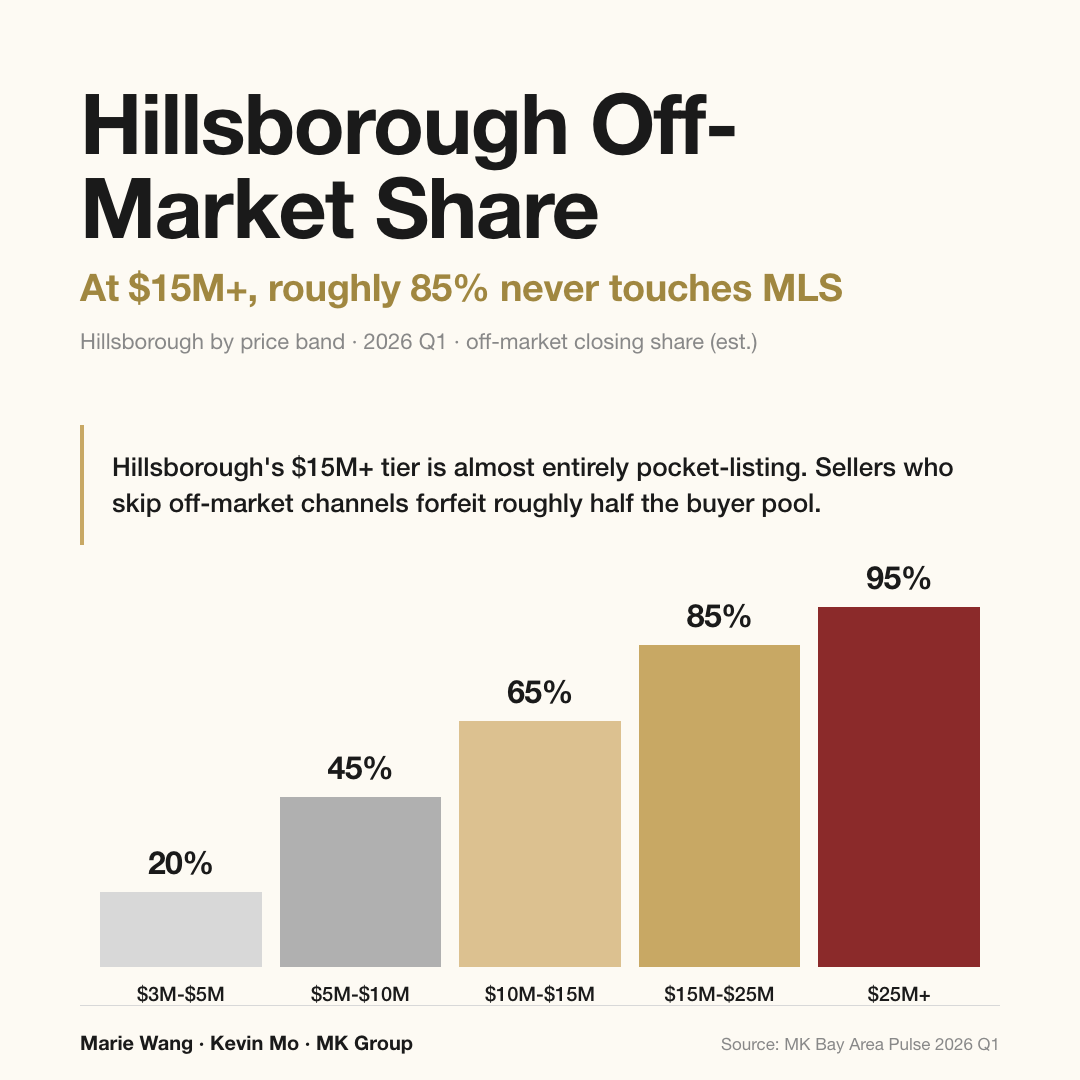
Selling in Hillsborough means deploying capital at the Peninsula's apex-tier exit — the decision framework diverges sharply from Palo Alto, Burlingame, or San Mateo. Five core facts up front: (1) Median DOM 25-50 days (MLSListings 2025-2026, Hillsborough overall), but the $20M+ tier routinely sits 90+, and some $25M+ Historic District estates may sit 180-365 days (not failure — that is the normal cadence at the top of this tier). (2) 40-70% of $5M+ closings happen off-market (MK Bay Area Pulse 2026 Q1 estimate); at $15M+, off-market share rises to roughly 85-95%. Pocket listings are the norm in Hillsborough, not the exception. (3) Historic District sellers price by $/lot, not $/sqft — Carolands-area 1-2 acre historic parcels carry $/lot multiples 2-3x the building-$/sqft model, the largest valuation-structure difference between Hillsborough Historic District and any other sub-area. (4) Cross-border buyers dominate the $10M+ tier — high-net-worth families from China, Singapore, Hong Kong, Taiwan, and Chinese AI-company founders close a far higher share of Hillsborough $10M+ inventory than they do in Burlingame or San Mateo at the same tier. (5) Zillow valuations are almost entirely wrong in Hillsborough Historic District — Zillow's $/sqft model isn't calibrated to Historic District's land-value-driven logic, Carolands-area historic estates trade as one-offs (no comparable comp), and off-market comps are completely invisible. These are not decorative details — they determine that a Hillsborough seller must use a different strategy than a Palo Alto or Burlingame seller. MK Group field observation from Marie Wang and Kevin Mo: the most routinely underestimated step for Hillsborough Historic District sellers is archival photography (period images, ARC history, historical-change archive) — this is core decision material for estate-tier buyers, and skipping it effectively halves the buyer pool.
Who this article is for
This guide is written for five Hillsborough seller profiles:
- Family-office portfolio rebalancing: Hillsborough Historic District or Country Club estate held 10-30+ years, exiting on a portfolio reconfiguration, targeting maximum price, minimum public exposure, and flexible timing.
- Retired downsizers: Hillsborough large estate held 20-40 years; children independent; downsizing to a mid-tier Burlingame or San Mateo home, Carmel, Lake Tahoe, or an out-of-state smaller estate.
- Bay Area exit sellers: relocating for work (Austin, Seattle, Miami, cross-border), family reasons, or tax considerations (California versus other states).
- Inheritance sellers: Hillsborough property received through trust, estate, or inheritance; needing to handle step-up basis, trust grant deed, multi-heir coordination, and the family CPA and estate attorney workflow.
- Historic District sellers: holding Historic District property; understanding ARC constraints' impact on the buyer pool; needing to prepare archival photography, buyer culture-matching, and 12-18 month ARC change envelope evaluation in advance.
The core decision framework is the same across all five — only the density, tax implications, and privacy requirements at each step change.
Hillsborough seller pricing: Historic District vs standard SFH — completely different models
Hillsborough seller pricing is not a single model — it runs two parallel models: Historic District plus standard SFH. The two diverge on $/lot, building weight, comparable-comp scope, and Zillow-bias magnitude.
Historic District model (Carolands-area plus upper Country Club Historic sub-parcels): Hillsborough Historic District sellers should price by $/lot, not $/sqft. Logic: the core value of Historic District assets is "1910s-1930s original architectural heritage + 1-2+ acre large lot + Historic District cultural endorsement"; the building area itself is not the primary weight. Specific data points: Carolands-area 1-2 acre Historic parcels run roughly $10-25M per acre $/lot empirically (the Carolands estate itself is higher and trades as a one-off); Historic District non-Carolands sub-areas run roughly $7-15M per acre. Building $/sqft is only a secondary reference — same-area Historic District construction runs $2,500-$4,000+ per sqft empirically, but this number is not the pricing spine.
Standard SFH model (entry Country Club / Crocker Estates / Lower Hillsborough / Tobin Clark): these sub-areas price by $/sqft with lot adjustment. $/sqft empirical bands: entry Country Club $2,000-$2,800, Crocker Estates $1,600-$2,200, Lower Hillsborough $1,400-$1,900, Tobin Clark $1,200-$1,700. Lot adjustment factors: 1/2-acre versus 1/4-acre typically a 15-25% spread, 1-acre versus 1/2-acre typically 25-40%. Zillow Zestimate error is relatively smaller in these sub-areas (typically ±10-15%), though Zestimates near Historic District boundary streets still diverge meaningfully.
Three structural reasons Zillow misses: first, Zillow's Zestimate model is built on public MLS plus regional $/sqft regression, with no calibration for Hillsborough Historic District's land-value-driven logic. Second, 40-70% of Hillsborough $5M+ closings happen off-market — those comps are completely outside Zillow's database. Third, Hillsborough's Historic Inventory protection tiers, ARC change envelope, heritage tree constraints, and private road maintenance agreements are entirely absent from Zillow's model.
Real pricing data comes from: (1) MLS public closings (only 30-60% of true closings but a foundation reference); (2) off-market comp data — closings only accessible through agents inside TAN, KW Exclusive Properties, or local trophy-broker private networks; (3) Hillsborough sub-area $/lot benchmarks; (4) builder ground-up project data — completed cost-per-sqft plus land cost decomposition from Pacific Peninsula Group, Devcon, Pacific Coast on $10M-$30M+ Hillsborough projects. Data source: MLSListings 2025-2026 / Town of Hillsborough public closing records + Historic Inventory / MK Bay Area Pulse 2026 Q1 / Top Agent Network off-market sharing / local trophy builder project data. Updated: 2026-06. Scope: seller pricing framework for single-family homes across Hillsborough 94010's five core sub-markets, $4M-$50M+ tier.
Hillsborough seller listing paths — $5M-$10M MLS-hybrid vs $10M+ off-market dominant
Hillsborough sellers have three basic listing paths, chosen by tier, Historic District sub-area, privacy requirement, and timing flexibility.
Path A: Public MLS (on-market). Suited to $4M-$8M Tobin Clark / Lower Hillsborough / Crocker Estates entry listings. This tier still has a meaningful number of mainstream buyers searching MLS (upgrade households, families driven by Hillsborough City School District, tech executives wanting "Hillsborough address plus entry budget"), and public MLS can still produce multi-offer competitive bidding. Pros: maximum buyer-pool reach, transparent pricing, dense first-week Open House + Offer Deadline cadence. Cons: privacy exposure, stale-listing risk, permanent Zillow history of the closing price.
Path B: Pure off-market / pocket listing. Suited to $15M-$50M+ top Historic District estates and upper Country Club. Inventory at this tier flows through TAN, KW Exclusive Properties, local trophy-broker private email lists, legacy-wealth introductions, and direct builder outreach — and never touches MLS. Pros: maximum privacy (high-profile families, cross-border entrepreneurs, family offices are highly sensitive); Historic District sellers avoid repeated disruption from ARC-curious browsers; flexible timing control ("test private channels 6-12 months before deciding on MLS"). Cons: smaller buyer pool; pricing depends on agent's grasp of off-market comps; Historic District sellers need archival photography and other extra materials to complete buyer persuasion through private channels.
Path C: Hybrid (off-market warm-up + MLS conversion). Suited to $8M-$15M Country Club mainstream / upper Crocker Estates / top Lower Hillsborough homes. Flow: 30-60 days of off-market warm-up first (release signals to TAN and private network, run 1-3 selective broker previews); if private-channel offers are qualified, close off-market; if not, convert to public MLS with the standard first-week cadence. Hybrid is increasingly the mainstream choice in the Hillsborough $10M-$15M tier.
Decision matrix: prioritize Path A at $4M-$8M, Path C at $8M-$15M, Path B at $15M-$50M+. Historic District sub-area at any tier should prioritize Path B or C — Historic District buyer culture places high value on privacy plus archival package; public MLS can attract ARC-curious browsers without genuine purchase intent, lowering closing efficiency. This section involves pricing strategy, privacy management, and Historic District cultural matching — coordinate with your listing agent, Title company, and family CPA before execution.
The actual Hillsborough seller process (8 steps, 3-9 months)
The full Hillsborough seller process has 2-3 more structural steps than Palo Alto or Burlingame, driven by the higher tier, the requirement for Historic District archival photography, the higher share of cross-border / trust / family-office sellers, and the larger weight of off-market channels.
Step 1: Lock the listing agent (Day 1-14). The Hillsborough listing-agent bar is materially higher than other cities — 5+ years in Hillsborough's trophy circle, access to TAN / KW Exclusive Properties, first-hand data on $/lot, Historic District ARC history, and cross-border buyer demographics across the five sub-areas. The listing agreement should specify commission structure, exclusivity, a 6-9 month window (versus PA's 3 months), and the off-market option.
Step 2: Valuation (Day 14-28). Pricing does not rely on Zillow. Cross-validate against three data sets: (1) MLS public closings (same sub-area, same $/lot tier, last 90-180 days); (2) off-market comps (private-network closings from the agent); (3) Historic District sellers should commission independent land + architecture archival valuation (a $/lot, Historic Inventory protection tier, ARC change envelope, and heritage tree value assessment by an appraiser with Historic-asset experience), distinct from the building appraisal.
Step 3: Prep — pre-listing inspection + cross-border materials + Historic District archival photography (Day 14-60). Pre-listing inspection is effectively required in Hillsborough ($1,500-$3,000). A large share of $10M+ Historic District estates was built between 1910 and 1930, with high latent-issue density (cast-iron drains, single-pane windows, knob-and-tube wiring, foundation settling, roof age, heritage-tree health risk, private-road maintenance terms). At $10M+, also prepare bilingual materials (English plus Chinese) — cross-border buyer share at this tier is very high. Critical step for Historic District sellers: prepare the archival photography package — period images (1910s-1920s original architecture photos, sourced where possible from the Town of Hillsborough Historic Inventory, family archives, or San Mateo County Historical Association), ARC history (all ARC modifications and approvals over the past 30 years), historical-change archive (owner family history, original architect identity, historical events). This package is core decision material for Historic District estate-tier buyers — skipping it effectively halves the buyer pool.
Step 4: Staging + photography + video (Day 28-60). Hillsborough staging tiers: $4M-$8M at $20K-$40K; $8M-$15M at $40K-$80K; $15M-$50M+ at $80K-$200K+. Historic District staging is not "place furniture" but "compose estate-grade lifestyle plus classical-architecture culture" — outdoor landscape, garden staging, wine cellar, gym, primary great room scene-building, period-appropriate classical furniture (avoiding overly modern styling, which would clash with Historic District culture). Photography + drone video + virtual tour are standard at the Hillsborough tier; Historic District should additionally produce archival photography reproduction (period images compared with current state, showing asset continuity).
Step 5: Pre-marketing pocket (Day 60-90). This is the largest structural difference between the Hillsborough seller process and the Palo Alto or Burlingame process. Before going live on MLS, the listing agent runs a 30-60 day off-market warm-up — releasing signals through TAN / KW Exclusive Properties / local trophy-broker private email lists / Historic District classical-architecture enthusiast circles / cross-border buyer agent networks, plus 1-3 selective broker previews. Historic District sellers should additionally run a "culture-matched buyer preview" — only accepting potential buyers confirmed to identify with Historic District culture (avoiding ARC-curious browsers).
Step 6: MLS launch (if applicable, Day 90-120). If Path A or C is chosen and the listing converts to public, the standard first-week cadence (adjusted for the Hillsborough tier versus PA's template): Thursday afternoon MLS, Friday Broker Preview (luxury tier often 12-3 PM rather than 11-1 PM), Saturday public showing by appointment (Hillsborough top tier does not run walk-in Open Houses), Sunday second tour plus private showings, Tuesday next-week 5 PM Offer Deadline (a 7-10 day Deadline rather than PA's 5-6 days at $10M+).
Step 7: Showings + Offer review + negotiation (Day 120-180). Hillsborough $10M+ typically receives 2-6 offers (versus 5-15 in PA at the same tier), but each offer is higher quality (pre-underwritten, clean contingency, flexible rent-back, 80-95% all-cash). Sellers should choose buyers on execution certainty plus cultural matching rather than pure offer number. Historic District sellers should additionally prioritize buyers with cultural affinity for Historic District (reducing downstream ARC modification conflict risk).
Step 8: Escrow + funding + COE (Day 180-270). All-cash Hillsborough escrow 14-21 days; financed 30-45 days. $15M+ Historic District estate scenarios with multi-party coordination (estate attorney, family CPA, wealth manager, Title officer, cross-border legal counsel) may extend escrow. Cross-border buyer FinCEN GTO filing, trust vesting confirmation, and AML wire compliance typically run in parallel during this step.
Extra steps for cross-border, trust, and family-office sellers
Hillsborough sellers holding property cross-border, in trust structures, or through family offices represent a notably higher share than in Palo Alto or Burlingame. Extra steps these scenarios require: (1) FIRPTA withholding — non-US-resident sellers on transactions over $300K are subject to a 15% federal withholding on gross sale price (a Withholding Certificate can reduce this in some situations); start the filing 60-90 days before listing. FIRPTA withholding amounts at the Hillsborough tier typically run $750K-$4.5M, with a significant cash-flow impact on the seller. (2) Grant deed preparation for trust-held property — Revocable Living Trust documents, Certification of Trust, Successor Trustee authorization (if applicable) must be synchronized with the title officer 30-60 days in advance. (3) Historic Inventory protection tier verification — certain Carolands-area sub-parcels carry higher Town of Hillsborough Historic Inventory protection; the seller should verify the protection tier before listing to avoid buyers discovering restricted modification envelope during inspection contingency and using it to negotiate down. (4) 1031 Exchange timeline — if the seller plans to roll proceeds into a like-kind exchange, the Qualified Intermediary must be designated before close, Identification completed within 45 days post-close, and Acquisition within 180 days. (5) Cross-border capital repatriation pathway — SAFE filings (for China-resident sellers), use of tax treaties, and FX settlement caps require advance planning. This section is for decision-education purposes only and does not constitute legal or tax advice; consult counsel and CPA before execution.
Hillsborough sub-market seller comparison
Core numbers first: across Hillsborough's five sub-markets, Historic District and upper Country Club drive the $10M+ tier (over 60% of $10M+ closings concentrate in these two), with the highest off-market share; Crocker Estates and entry Country Club anchor the mid tier ($8M-$15M); Lower Hillsborough and Tobin Clark form the entry tier ($4M-$8M) where staging scales down to $20K-$40K. The table below summarizes seller strategy by sub-area; specific numbers are experience-based estimates drawn from prior Hillsborough closings.
| Sub-market | Core price tier | Typical DOM | Staging tier | Typical buyer profile | Strategy emphasis |
|---|---|---|---|---|---|
| Historic District | $15M-$50M+ | 30-365 days | $80K-$200K+ | Family office / classical-architecture / cross-border | Pure off-market + archival photography |
| Country Club | $8M-$25M | 30-120 days | $50K-$120K | Tech executive / cross-border | Off-market warm-up + selective MLS |
| Crocker Estates | $7M-$15M | 25-90 days | $40K-$80K | Country Club neighbor | Hybrid (Path C) |
| Lower Hillsborough | $5M-$10M | 20-60 days | $25K-$50K | Upgrade / school-driven | Public MLS still has bidding premium |
| Tobin Clark | $4M-$8M | 20-60 days | $20K-$40K | Newer-construction preference | Public MLS dominant |
Key difference to remember: Historic District and Tobin Clark share the Hillsborough 94010 ZIP, but staging investment tiers differ 4-10x and DOM ranges differ 5-6x. Listing a $15M+ Historic District estate is essentially "finding 1-3 culture-matched potential buyers" rather than "finding 30 walk-ins" — that is the largest strategic divergence between Hillsborough Historic District and Palo Alto or Burlingame.
MK Group field observations: three Hillsborough seller decision patterns repeatedly validated
Across MK Group's Peninsula apex-tier engagements, three Hillsborough seller decision patterns are repeatedly validated by Marie Wang and Kevin Mo.
Observation 1: Historic District archival photography is core decision material for estate-tier buyers. The largest seller-side difference between Hillsborough Historic District and Atherton / Palo Alto top-tier estates is that Historic District buyers (especially family offices, classical-architecture enthusiasts, and cross-border entrepreneurs) base 30-40% of their decision on the asset's "historical archive" — 1910s-1920s original architecture photos, ARC history, owner family history, and architect identity. These materials are not decorative; they are a core component of estate-tier asset value. When MK runs listing prep for Historic District sellers, most of the first 30 days are spent on archival research (sourcing materials from the Town of Hillsborough Historic Inventory, San Mateo County Historical Association, private family archives, and original architecture firm archives) rather than staging or photography. A Historic District listing missing this archival package sees its buyer pool effectively halved — top-tier culture-matched buyers feel "this property's history isn't told clearly; as the next steward, I don't know what I'm preserving."
Observation 2: Hillsborough $5M+ off-market is more mainstream than Palo Alto's same tier, but slightly less than Atherton's same tier. Empirical off-market shares across the three Peninsula cities at $10M+: Atherton roughly 90%, Hillsborough roughly 80%, Palo Alto roughly 30-40%. Reason: Atherton's top tier is fully estate-grade plus legacy-wealth culture, where off-market is the default. Hillsborough Historic District is influenced by ARC constraints — sellers don't want repeated disruption from ARC-curious browsers, which drives off-market. Palo Alto's top tier still has a meaningful share of tech-IPO buyers prioritizing speed, where public MLS remains mainstream. Implication for Hillsborough sellers: even in the $5M-$10M entry tier, run at least 30-60 days of off-market warm-up (Path C hybrid) rather than going directly to MLS — Hillsborough's privacy culture and cross-border buyer preferences lean off-market, and skipping this step forfeits part of the buyer pool.
Observation 3: Hillsborough Historic District's "long hold" character reflects in seller timing flexibility — you can wait. Hillsborough Historic District $15M+ estate sellers typically hold 15-30+ years (see the companion buy-side guide), which also means seller timing windows are far more flexible than Palo Alto or Burlingame. PA sellers typically aim for 30-90 day closings. Hillsborough Historic District sellers can accept 6-12 month windows; some ultra-trophy assets are willing to wait 18+ months for a culturally aligned "generational steward" next buyer. Strategic implication: do not let Palo Alto's 21-45 day seller cadence pressure a Hillsborough Historic District listing — "selling fast" at the Historic District tier frequently means "selling low." Before listing, align with the family CPA and wealth manager on a 6-12 month patience window rather than pushing for 30-60 day closing.
5 Common Pitfalls
Pitfall 1: "Price Historic District by $/sqft using the Country Club or Crocker model"
Wrong. Historic District is a $/lot-driven market; Carolands-area 1-2 acre historic parcels carry $/lot multiples 2-3x what the $/sqft model would suggest. The core value of Historic District assets is "1910s-1930s original architectural heritage + 1-2+ acre large lot + Historic District cultural endorsement"; the building area itself is not the primary weight. Pricing Historic District assets using the entry Country Club or Crocker Estates $/sqft model typically understates by 20-40% — the seller quietly leaves seven-figure value on the table. Correct approach: Historic District valuation must include independent land + architecture archival valuation by an appraiser with Historic-asset experience.
Pitfall 2: "Trust Zillow and price the listing at the Zestimate"
Zillow is almost entirely wrong in Hillsborough Historic District for three reasons: the $/sqft model is not calibrated to Historic District's land-value-driven logic; Carolands-area historic estates trade as one-offs (no comparable comp); 40-70% of Hillsborough $5M+ closings are off-market and outside Zillow's database. Pricing a Hillsborough Historic District listing at the Zestimate typically understates Carolands-area estates by 25-40%, and even entry-tier Tobin Clark / Lower Hillsborough listings see 10-15% bias. Correct approach: cross-validate against MLS public closings + off-market comps (the agent's private network) + Historic District independent land appraisal.
Pitfall 3: "Historic District sellers skip archival photography and only prepare standard photography + staging"
This is the most common pitfall for Historic District sellers. Historic District estate-tier buyers (family offices, classical-architecture enthusiasts, cross-border entrepreneurs) base 30-40% of their decision on the asset's "historical archive" — 1910s-1920s original architecture photos, ARC history, owner family history, architect identity. A listing missing this archival package causes buyers to feel "this property's history isn't told clearly," buyer pool is effectively halved, and the closing price reflects it. Correct approach: 30-60 days before listing, run archival research (sourcing materials from the Town of Hillsborough Historic Inventory, San Mateo County Historical Association, private family archives, and original architecture firm archives) in parallel with standard staging + photography.
Pitfall 4: "Off-market channel selection errors — connect to only 1-2 local listing agents instead of entering the full circle"
Many Hillsborough sellers assume "off-market equals find one listing agent with a circle." In practice, Hillsborough $10M+ off-market is a multi-layered circle: TAN (Top Agent Network) + KW Exclusive Properties + local trophy-broker private email lists + Historic District classical-architecture enthusiast circles + cross-border buyer agent networks. Connecting to only 1-2 layers effectively forfeits 60-80% of the potential buyer pool. Correct approach: before signing the listing agreement, confirm the agent can simultaneously enter TAN / KW Exclusive Properties / cross-border buyer circles / Historic District cultural circles — all four layers, none missing.
Pitfall 5: "Don't prepare bilingual materials for cross-border buyers — assume the English version is enough"
At $10M+ Hillsborough, cross-border buyer share (China, Singapore, Hong Kong, Taiwan) is very high. If the information sheet, Disclosure Package, and Property Highlight Sheet are English-only, the family CPA, cross-border attorney, and remote-decision family members (potentially the spouse or parents) face a substantial reading barrier. Result: their conviction is weakened, the decision cycle stretches, and the final offer price drops. Correct approach: at $10M+, listings require bilingual materials — English + Simplified Chinese + Traditional Chinese (if target buyers include Hong Kong or Taiwan), completed by a professional real-estate translator (not Google Translate), with bilingual Property Highlight Sheets covering land-value decomposition, Historic Inventory protection tier, ARC change envelope evaluation, heritage tree information, and private road agreements — Hillsborough-specific data.
FAQ
How do I sell a home in Hillsborough California?
Selling in Hillsborough requires following an 8-step process (3-9 months, versus Palo Alto's 21-45 days): (1) lock the listing agent — needs 5+ years in Hillsborough + TAN / KW Exclusive Properties access + first-hand data on $/lot across the five sub-areas + Historic District ARC history command; (2) valuation — does not rely on Zillow; Historic District also requires independent land + architecture archival valuation; (3) prep — pre-listing inspection ($1,500-$3,000) + Historic District archival photography + cross-border bilingual materials at $10M+; (4) staging + photography + drone video ($20K-$200K+ by tier); (5) pre-marketing pocket 30-60 days (critical step); (6) MLS launch (if applicable); (7) showings + Offer review + negotiation; (8) escrow + funding + COE. 40-70% of $5M+ closings happen off-market and 85-95% at $15M+; Historic District sellers must price by $/lot not $/sqft; cross-border buyers and trust-structure vesting require 30-60 days of advance preparation.
How much should I budget for staging when selling in Hillsborough?
By sub-area and tier: Tobin Clark / Lower Hillsborough $4M-$8M tier $20K-$40K entry; Crocker Estates / entry Country Club $7M-$15M tier $30K-$80K standard; upper Country Club $10M-$25M tier $50K-$120K mid-high; Historic District $15M-$50M+ estate tier $80K-$200K+ (some projects require period-appropriate classical furniture, art rental, long-term furniture programming). Historic District staging is not "place furniture" but "compose estate-grade lifestyle plus classical-architecture culture" — period-appropriate styling, outdoor landscape, wine cellar, primary great room scene-building. Critical: Historic District staging must align with classical-architecture culture — overly modern staging clashes with Historic District buyer preferences and reduces closing price.
What is the best season to sell in Hillsborough?
Hillsborough seasonality is partially driven by the Hillsborough City School District (K-8) and Burlingame High calendar, but to a lesser degree than Palo Alto. Cadence: closings cluster roughly 30-35% across March-May, 35-40% across June-October, and 25-30% across November-February. The $5M-$10M tier suits the spring first-week cadence (maximizing bidding premium); the $15M+ Historic District tier suits both windows, and many estates list essentially to "wait for 1-3 culture-matched potential buyers" — seasonality matters less. Holiday season (late November to January) and mid-summer (July-August) see public MLS viewing density drop significantly, but off-market channels stay active (cross-border buyers often fly in for concentrated viewing during Chinese New Year + summer breaks).
How do I choose between off-market and public MLS in Hillsborough?
Choose by tier + sub-area + privacy requirement + timing flexibility: $4M-$8M prioritize public MLS (Path A); $8M-$15M prioritize hybrid (Path C); $15M-$50M+ prioritize pure off-market (Path B). Historic District sub-area at any tier should prioritize Path B or C — Historic District buyer culture places high value on privacy plus archival package; public MLS can attract ARC-curious browsers without genuine purchase intent. Hillsborough $5M+ tier sees 40-70% off-market closings and 85-95% at $15M+ (MK Bay Area Pulse 2026 Q1 estimate) — pocket listings are the norm in Hillsborough. To run off-market, the listing agent must simultaneously access TAN / KW Exclusive Properties / cross-border buyer circles / Historic District cultural circles.
How far ahead should I plan tax / 1031 / FIRPTA when selling in Hillsborough?
Launch tax planning 60-90 days before listing. Specific timelines: (1) 1031 Exchange must designate the Qualified Intermediary before close, complete Identification within 45 days post-close, and Acquisition within 180 days; (2) FIRPTA withholds 15% for non-US-resident sellers (amounts typically $750K-$4.5M); a Withholding Certificate can reduce this; launch filing 60-90 days before listing; (3) trust grant deed and title review front-loaded — Revocable Living Trust documents, Certification of Trust, Successor Trustee authorization, synchronized with the title officer 30-60 days before listing; (4) family-office capital-gains tax-year selection involving current-year-versus-next-year trade-off analysis; (5) cross-border repatriation SAFE filing, treaty use, and FX settlement cap planning. This section is for decision-education purposes only and does not constitute legal or tax advice; consult counsel and CPA before execution.
Next steps
- Verify your property's sub-area and Historic District boundary — determine whether it sits in Historic District / Country Club / Crocker Estates / Lower Hillsborough / Tobin Clark; if near the Historic District boundary, confirm whether it falls within ARC jurisdiction — this directly affects comp scope and target buyer profile.
- Pull 60-90 days of same-sub-area same-$/lot-tier off-market + on-market comp data — not Zillow Zestimate or Hillsborough's town-wide median. Historic District also requires independent land + architecture archival valuation.
- Complete pre-listing inspection 60-90 days before listing ($1,500-$3,000) to identify 1910s-1930s Historic estate latent issues — cast-iron drains, single-pane windows, knob-and-tube wiring, foundation settling, roof age, heritage tree health risk, private road maintenance terms — and prioritize repair decisions by ROI.
- Historic District sellers: launch archival research 30-60 days before listing — source 1910s-1930s original architecture photos, ARC history, owner family history, and architect identity from the Town of Hillsborough Historic Inventory, San Mateo County Historical Association, private family archives, and original architecture firm archives. This is core decision material for Historic District estate-tier buyers.
- Set staging investment by sub-area culture — Historic District "period-appropriate classical" $80K-$200K+, upper Country Club mid-traditional $50K-$120K, Crocker / entry Country Club $40K-$80K, Lower Hillsborough / Tobin Clark $20K-$50K. Staging must align with sub-area culture — overly modern in Historic District clashes.
- Select listing path by tier — $4M-$8M public MLS (Path A); $8M-$15M hybrid (Path C, 30-60 day off-market warm-up first); $15M-$50M+ pure off-market (Path B). Historic District at any tier prioritize Path B or C.
- $10M+ tier: prepare bilingual materials — English + Simplified Chinese + Traditional Chinese (if target buyers include Hong Kong or Taiwan), professionally translated, with bilingual Property Highlight Sheets covering land-value decomposition, Historic Inventory protection tier, ARC change envelope evaluation, heritage tree information, and private road agreements.
- Cross-border / trust / family-office sellers: stand up the team 60-90 days before listing — estate attorney, family CPA, wealth manager, Title company (must have Hillsborough Historic District + cross-border vesting experience). Launch FIRPTA filing, 1031 Exchange planning, trust grant deed prep, and tax-year selection analysis.