Direct Answer: What you must know before selling in Atherton
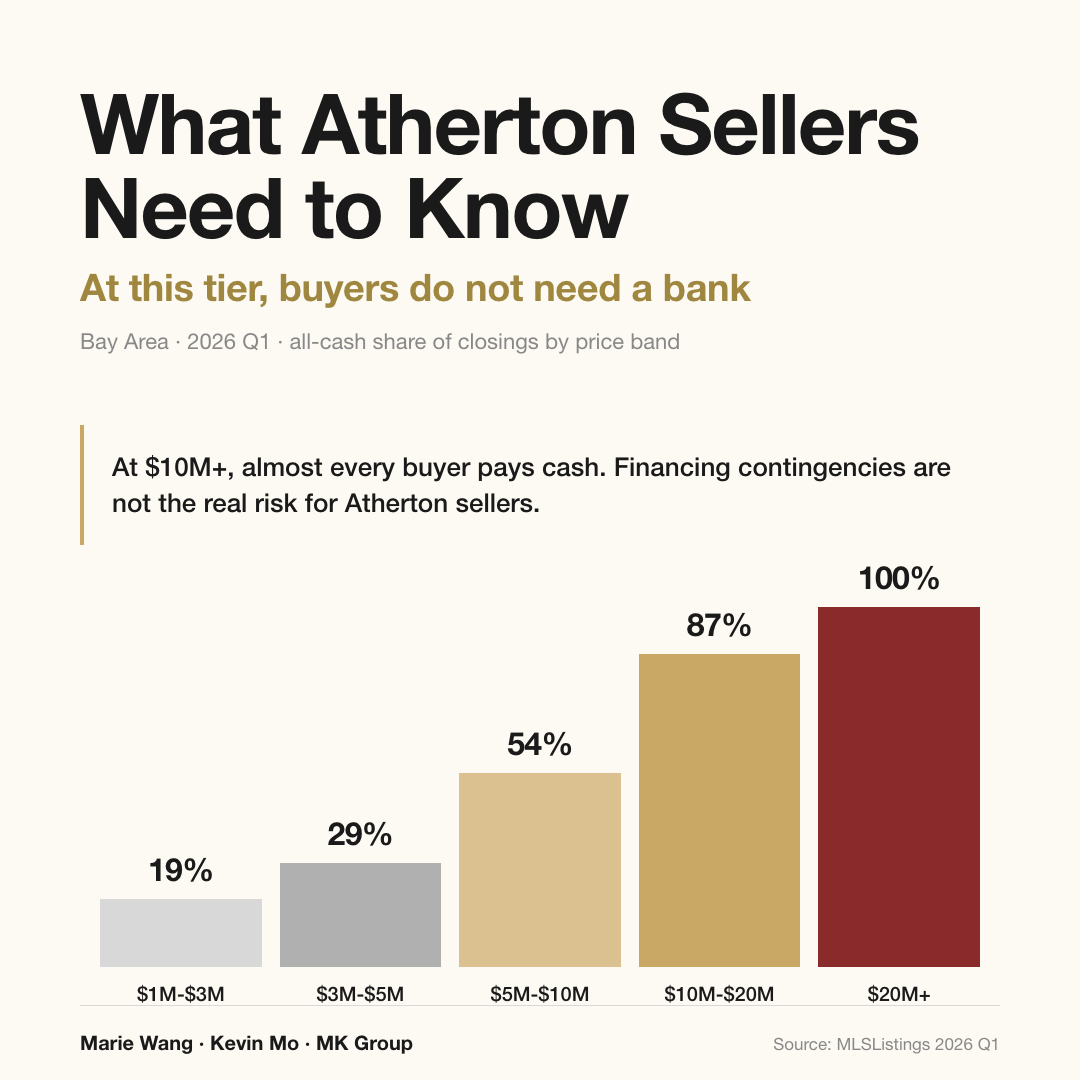
Selling in Atherton means deploying capital at the apex luxury exit — the decision framework diverges materially from Palo Alto and Menlo Park. Five core facts must be understood up front: (1) Median DOM is 30-60 days, but the $20M+ tier routinely sits 90+, and some $25M+ estates may sit 180-365 days before closing (not a failure — that is the normal cadence at the top of this tier). (2) Over 50% of $10M+ closings happen off-market (MK Bay Area Pulse 2026 Q1 estimate); at $15M+, off-market share rises to roughly 85-95%. Pocket listings are the norm in Atherton, not the exception — public MLS is the minority path at the upper tiers. (3) Cross-border buyers dominate the $15M+ tier — high-net-worth families from China, Singapore, Hong Kong, Taiwan, and Chinese AI-company founders close a far larger share of Atherton estate-tier inventory than they do in PA or Menlo Park at the same tier. (4) Zillow valuations are almost entirely wrong in Atherton for three reasons: Zillow's $/sqft model is not calibrated to Atherton's land-value-driven logic, off-market comps are completely invisible to Zillow, and the 1-acre zoning plus lot-size weighting is not modeled. (5) Price by $/lot, not $/sqft — Atherton is a land-value-driven market; in West Atherton, roughly 90% of valuation reflects land, not the building. These are not decorative details — they determine that an Atherton seller must use a different strategy than a Palo Alto or Menlo Park seller. MK Group field observation from Marie Wang and Kevin Mo: a West Atherton 7,000 sqft legacy home bought 3 years ago at $12M now carries a market value of roughly $18M — the 50% appreciation reflects land almost entirely, decoupled from building age.
Who this article is for
This guide is written for five Atherton seller profiles:
- Family-office portfolio rebalancing: Atherton estate held 5-15 years, exiting on a portfolio reconfiguration, targeting maximum price, minimum public exposure, and flexible timing.
- Retired downsizers: Atherton large estate held 20-30 years; children are independent; downsizing to a mid-tier Hillsborough or Menlo Park home, Carmel, Lake Tahoe, or an out-of-state smaller estate.
- Bay Area exit sellers: relocating for work (Austin, Seattle, Miami, cross-border), family reasons, or tax considerations (California versus other states).
- Inheritance sellers: Atherton property received through trust, estate, or inheritance; needing to handle step-up basis, trust grant deed, multi-heir coordination, and the family CPA and estate attorney workflow.
- 2-acre owners considering subdivision strategy: holding an Atherton 2-acre+ large parcel, wanting to unlock secondary development value (keep 1-acre for residence, sell the other 1-acre), needing to understand city constraints, SB9 / SB10, and heritage-tree restrictions.
The core decision framework is the same across all five — only the density, tax implications, and privacy requirements at each step change.
Atherton seller pricing: why Zillow gets it wrong and where real data comes from
Zillow valuations are almost entirely wrong in Atherton because of three structural problems. First: Zillow's Zestimate model is built on public MLS data and regional $/sqft regression, with no calibration for Atherton's land-value-driven valuation logic. In West Atherton, the same 7,000 sqft single-family home closes at $20M on a 1.5-acre lot but $12M on a 1-acre lot — the $8M gap reflects nearly entirely the 0.5-acre land difference ($10-16M per acre), with no relation to building area. Zillow's model averages this gap by $/sqft, severely understating the 1.5-acre parcel and slightly overstating the 1-acre. Second: Over 50% of Atherton $10M+ closings happen off-market, and those comps are completely outside Zillow's database — Zillow only sees a survivorship-biased MLS sample, missing the off-market segment (often higher quality and higher price). Third: Atherton-specific variables like 1-acre minimum zoning, heritage tree protection, private road maintenance agreements, and historic deed restrictions are entirely absent from Zillow's model.
Real pricing data comes from: (1) MLS public closings (only 30-50% of true closings but a foundation reference); (2) off-market comp data — closings only accessible through agents inside TAN, KW Exclusive Properties, or local trophy-broker private networks, including $/lot unit prices, sale-vs-ask deviations, buyer source, and deal structure (all-cash vs financed); (3) Atherton sub-market $/lot benchmarks — top West Atherton at $10-16M per acre, mid Lindenwood at $8-12M per acre, entry Lloyden Park at $4-8M per acre, Atherton Oaks "correct side of school boundary" at $4-7M per acre versus "wrong side" at $2.5-4.5M per acre; (4) builder ground-up project data — completed cost-per-sqft plus land cost decomposition from Pacific Peninsula Group, Devcon, Pacific Coast on $10M-$30M+ Atherton projects, from which land-value-versus-building-value weighting can be reverse-engineered. Data source: MLSListings 2025-2026 / Town of Atherton public closing records / MK Bay Area Pulse 2026 Q1 / Top Agent Network off-market sharing / local trophy builder project data. Updated: 2026-06. Scope: seller pricing framework for single-family homes in Atherton 94027's five core sub-markets, $5M-$30M+ tier.
Atherton seller listing path choice: on-market vs off-market vs hybrid
Atherton sellers have three basic listing paths, chosen by tier, privacy requirement, and timing flexibility.
Path A: Public MLS (on-market). Suited to $5M-$10M Lloyden Park / Atherton Oaks / eastern Central Atherton entry homes. This tier still has a meaningful number of mainstream buyers searching MLS (upgrader households, family-office-prep tier, tech executives wanting "Atherton address at the entry budget"), and public MLS can still produce multi-offer competitive bidding. Pros: maximum buyer-pool reach, transparent pricing, first-week cadence can run a dense Open House and Offer Deadline schedule. Cons: privacy exposure, "stale listing" penalty if the home sits, permanent Zillow history of the closing price (which some sellers dislike).
Path B: Pure off-market / pocket listing. Suited to $15M-$30M+ West Atherton / top Lindenwood estate inventory. Inventory at this tier flows through TAN, KW Exclusive Properties, local trophy-broker private email lists, introductions inside legacy-wealth circles, and direct builder outreach — and never touches MLS. Pros: maximum privacy (high-profile families, cross-border entrepreneurs, family offices are highly sensitive), no stale-listing penalty risk, seller can flexibly control the timing window ("test private channels for 6 months, then decide on MLS"). Cons: smaller buyer pool, pricing depends on agent's grasp of off-market comps, sale price typically lands 3-7% below a hypothetical public MLS — but for high-privacy or time-flexible sellers, this trade-off is acceptable.
Path C: Hybrid (off-market warm-up + MLS conversion). Suited to $10M-$15M Lindenwood / Central Atherton mainstream homes. Flow: 30-60 days of off-market warm-up first (release signals to TAN and private network, run 1-3 selective broker previews), and if private-channel offers are qualified, close off-market; if private-channel offers don't materialize, convert to public MLS with the standard first-week cadence. Pros: combines privacy and buyer-pool breadth. Cons: more complex flow, requires agent precision on cadence transitions. Hybrid is increasingly the mainstream choice in the Atherton $10M-$15M tier — sellers don't want to forgo MLS competitive-bidding premium, but they want to test the market in private channels first.
Decision matrix: prioritize Path A at $5M-$10M, Path C at $10M-$15M, Path B at $15M-$30M+. Sellers with high privacy sensitivity (high-profile families, cross-border entrepreneurs, family offices) can consider Path B or C even at the $5M-$10M tier. This section involves pricing strategy, privacy management, and cross-border compliance — coordinate with your listing agent, Title company, and family CPA before execution.
The actual Atherton seller process (8 steps, 4-9 months)
The full Atherton seller process has 2-3 more structural steps than Palo Alto or Menlo Park, driven by the higher tier, larger off-market channel weight, higher share of cross-border / trust / family-office sellers, and higher Title-stage complexity.
Step 1: Lock the listing agent (Day 1-14). The Atherton listing-agent bar is materially higher than other cities — 5+ years in Atherton's trophy circle, access to TAN / KW Exclusive Properties, first-hand data on $/lot unit prices, off-market comps, and buyer demographics across the five sub-markets. The listing agreement should specify commission structure, exclusivity, a 6-9 month window (versus PA's 3 months), and the off-market option.
Step 2: Valuation (Day 14-28). Pricing does not rely on Zillow. Cross-validate against three data sets: (1) MLS public closings (same sub-market, same $/lot tier, last 90-180 days); (2) off-market comps (private-network closings from the agent, including sale-vs-ask deviation, buyer source, deal structure); (3) builder ground-up project decomposition to weight land-value versus building-value. At $15M+, also commission an independent land appraisal (separate $/lot valuation by a third-party appraiser), distinct from the building appraisal.
Step 3: Prep — pre-listing inspection + repair decisions + cross-border materials (Day 14-60). Pre-listing inspection is effectively required in Atherton ($1,500-$3,000). Reason: a large share of $10M+ estate stock was built between 1950 and 1970, and latent-issue density is high (cast-iron drains, single-pane windows, knob-and-tube wiring, foundation settling, roof age, heritage-tree health risk, private-road maintenance terms). Letting the buyer discover these during inspection contingency is the worst possible negotiation point for the Atherton seller. At $15M+, also prepare bilingual materials (English plus Chinese) — cross-border buyer share at this tier is high.
Step 4: Staging + photography + video (Day 28-60). Atherton staging investment tiers: $5M-$10M at $25K-$50K; $10M-$20M at $40K-$100K; $20M-$30M+ at $80K-$200K+ (some projects require art rental, professional staging designer, long-term furniture programming). Staging at the Atherton tier is not "place furniture" — it is "compose estate-grade lifestyle," covering outdoor landscape, garden, wine cellar, gym, primary great room. Photography plus drone video plus virtual tour are standard at the Atherton tier.
Step 5: Pre-marketing pocket (Day 60-90). This is the largest structural difference between the Atherton process and the PA / Menlo Park process. Before going live on MLS, the listing agent runs a 30-60 day off-market warm-up — releasing signals through TAN / KW Exclusive Properties / local trophy-broker private email lists / legacy-wealth-circle introductions, plus 1-3 selective broker previews. If a qualified offer arrives in this step, the home can close off-market (Path B or C logic). Even if the listing eventually goes to MLS, the pre-marketing-stage accumulation of interest tightens the first-week cadence.
Step 6: MLS launch (if applicable, Day 90-120). If Path A or C is chosen and the listing converts to public, the standard first-week cadence (adjusted for the Atherton tier versus PA's template): Thursday afternoon MLS, Friday Broker Preview (luxury tier often 12-3 PM rather than 11-1 PM), Saturday public showing by appointment (Atherton top tier does not run walk-in Open Houses; only verified-buyer appointments are accepted), Sunday second tour plus private showings, Tuesday next-week 5 PM Offer Deadline ($10M+ frequently uses a 7-10 day deadline versus PA's 5-6 days, giving cross-border and high-net-worth buyers extra diligence time).
Step 7: Showings + Offer review + negotiation (Day 120-180). Atherton $10M+ typically receives 3-8 offers (versus 5-15 in PA at the same tier), but each offer is higher quality (pre-underwritten, clean contingency, flexible rent-back, ~95% all-cash). Sellers should choose the buyer on execution certainty rather than pure offer number — 14-21 day closing certainty plus a clean contingency stack frequently outweighs a 1-2% higher offer.
Step 8: Escrow + funding + COE (Day 180-270). All-cash Atherton escrow runs 14-21 days; financed runs 30-45 days. $15M+ estate-tier scenarios involving multi-party coordination (estate attorney, family CPA, wealth manager, Title officer, cross-border legal counsel) can extend escrow further. Cross-border buyers' FinCEN GTO filing, trust vesting confirmation, and AML wire compliance typically run in parallel during this step. A 30-60 day post-COE rent-back is a common Atherton seller arrangement — giving the seller time to find the next property.
Extra steps for cross-border, trust, and family-office sellers
The share of Atherton sellers who hold property cross-border, in trust structures, or through family offices is notably higher than in PA / Menlo Park. Extra steps these scenarios require: (1) FIRPTA withholding — non-US-resident sellers on transactions over $300K are subject to a 15% federal withholding on gross sale price (a Withholding Certificate can reduce this in some situations); start the filing 60-90 days before listing to avoid escrow-stage delays. FIRPTA withholding amounts at the Atherton tier typically run $1.5-$4.5M, with a significant cash-flow impact on the seller. (2) Grant deed preparation for trust-held property — Revocable Living Trust documents, Certification of Trust, Successor Trustee authorization (if applicable) must be synchronized with the title officer 30-60 days in advance to avoid escrow-stage title-review delays. Multi-heir trusts also require written consent across heirs. (3) 1031 Exchange timeline — if the seller plans to roll proceeds into a like-kind exchange, the Qualified Intermediary must be designated before close, Identification completed within 45 days post-close, and Acquisition within 180 days. Atherton $10M+ 1031s typically target California / Hawaii / out-of-state estate properties, and the timeline coordination is highly complex. (4) Multi-party coordination for family-office portfolio reallocation — estate attorney, family CPA, wealth manager must be aligned on pricing and tax-impact analysis before listing to avoid the discovery after close that the deal closed in the wrong tax year. (5) Cross-border capital repatriation pathway — SAFE filings (for China-resident sellers), use of tax treaties, and FX settlement caps require advance planning. This section is for decision-education purposes only and does not constitute legal or tax advice; consult an attorney or CPA before execution.
Atherton sub-market seller comparison
Core numbers first: across Atherton's five sub-markets, West Atherton and Lindenwood carry the highest concentration of $10M+ closings (over 70% of recent sales) and the highest off-market share; Central Atherton and Lloyden Park drive the mid tier ($5M-$15M); Atherton Oaks anchors the entry tier ($5M-$10M), where staging can scale down to $25K-$50K but street-level school-boundary diligence is critical. The table below summarizes seller strategy by sub-market. Specific numbers are experience-based estimates drawn from prior Atherton closings; actual pricing should reference the most recent 60-90 day off-market plus on-market comps.
| Sub-market | Core price tier | Typical DOM | Staging tier | Typical buyer profile | Strategy emphasis |
|---|---|---|---|---|---|
| West Atherton | $15M-$30M+ | 30-180 days | $80K-$200K+ | Family office / hedge-fund / cross-border entrepreneur | Pure off-market + builder outreach |
| Lindenwood | $10M-$20M | 30-90 days | $50K-$120K | Quiet legacy wealth / multi-generation | Off-market warm-up + selective MLS |
| Central Atherton | $8M-$18M | 30-75 days | $40K-$80K | Traditional-estate preference / cross-border | Hybrid (Path C) |
| Lloyden Park | $5M-$12M | 20-60 days | $30K-$60K | Younger families / walkability-oriented | Public MLS still has bidding premium |
| Atherton Oaks | $5M-$10M | 20-60 days | $25K-$50K | Atherton address + entry budget | School-boundary diligence critical |
The difference to remember: West Atherton and Atherton Oaks both sit inside 94027, but the staging investment differs 4-8x and DOM differs up to 3x. Listing at the $15M+ tier in Atherton is essentially "finding 1-3 potential buyers" rather than "finding 50 walk-ins" — and that is the largest strategic divergence between Atherton's upper tier and PA / Menlo Park.
MK Group field notes: three Atherton seller-relevant cases
Across recent Atherton seller, holder, and asset-planning engagements, three scenarios best illustrate this framework.
Scenario one: West Atherton 7,000 sqft legacy home, 50% appreciation in 3 years — land is the real asset anchor. Three years ago MK Group helped a high-net-worth buyer lock 1-acre West Atherton inventory and acquire a 7,000 sqft legacy home at roughly $12M. A comparable new build (8,000 sqft) on the same submarket was asking $20M. The buyer chose the "legacy home + later renovation" path, banking the 1,000 sqft delta plus depreciation cost as savings. MK's pricing logic: West Atherton valuation reflects roughly 90% land, not building — for the same 1-acre lot, the difference between a new build and a 30-year-old home is renovation plus build cost, not land value. Three years later the market value: roughly $18M (+50%), consistent with Atherton's overall +38% YoY median appreciation. Implication for Atherton sellers: price by $/lot not $/sqft; the upper-tier West Atherton hold-period ROI confirms that "low liquidity ≠ low appreciation" — turnover is lower, but pricing on exit is firm. Full case → West Atherton 7,000 sqft legacy home, 3-year 50% appreciation
Scenario two: 2-acre Atherton owner subdivision strategy — city constraints determine releasable value. An Atherton owner held a 2-acre estate originally used as a single estate. MK Group's evaluation: subdivide — split into two 1-acre parcels, keep one for residence, sell the other. Atherton 1-acre median sale runs $10-20M, making the asset-release upside meaningful. MK proactively called the Town of Atherton planning department for subdivision requirements and surfaced two hard constraints: (1) independent driveway entry — the new 1-acre parcel cannot share the existing driveway, requiring a separate curb cut (which affects layout and buildable area); (2) two protected-species trees on the lot cannot be removed — the tree positions directly constrain the new home's footprint and orientation. MK then quantified the actual releasable value and walked through with the owner whether the post-subdivision design and listing strategy stood up. Implication for Atherton sellers: large-lot Atherton owners have the subdivision option for asset release, but city constraints (curb cut, protected trees, setbacks) often determine feasibility — not every 2-acre owner can simply bisect; Atherton's review-cycle advantage: relative to Hillsborough, Atherton's feedback turnaround is faster (1 week versus 1 month). Full case → 2-Acre Atherton asset subdivision strategy
Scenario three: a family office bought three homes in one move and only realized six months later the plan didn't fit (contrast reference). A family-office client purchased three Bay Area homes in one decision — one for residence, two for investment. Decision problem: bought quickly, primarily on "this place is famous" and "expensive equals good" heuristics, without seriously checking the daily-movement fit of the residence or the rental-yield reality of the investment homes. Six months later: the school commute from the residence was 30 minutes (worse in traffic), and the daily flow was awkward; the two investment homes sat in neighborhoods with low gross-rent-to-price, where taxes, maintenance, and insurance reduced the owner to "passively waiting for appreciation" with weak true cash flow. Implication for Atherton sellers (in reverse): if you are a family office planning to "sell the Atherton estate and buy three mid-tier investment homes," do the three-layer map (movement + rental yield + holding cost) before pricing on prestige. If you currently hold Atherton, "hold + renovate + subdivide" frequently beats "sell and buy three mid-tier" because Atherton land value growth itself is the most stable asset anchor. Full case → Family office bought three homes, realized six months later the plan didn't fit
5 Common Pitfalls
Pitfall 1: "Trust Zillow and price off the Zestimate"
Zillow valuations are almost entirely wrong in Atherton. Three reasons: Zillow's $/sqft model is not calibrated to Atherton's land-value-driven logic; off-market comps are completely outside Zillow's database; 1-acre zoning, heritage tree protection, and private road agreements are not modeled. Pricing an Atherton listing off the Zestimate typically understates West Atherton / Lindenwood top tiers by 20-40% and slightly overstates the "wrong side of school boundary" Atherton Oaks by 10-15%. Correct approach: cross-validate three data sets — MLS public closings, off-market comps (the agent's private network), and builder ground-up project decomposition. At $15M+, also commission an independent land appraisal.
Pitfall 2: "Rush to MLS and miss the pocket-buyer pool"
Atherton runs over 50% off-market at $10M+ and 85-95% at $15M+. Going directly to MLS at the $10M+ tier frequently misses the pocket-buyer pool — these buyers are active in private channels but pull back once the listing is public because they read "already seen by the market" as a loss of edge. Correct approach: at $10M-$15M, run Path C (hybrid) — 30-60 days of off-market warm-up first, close off-market on qualified private-channel offers; at $15M-$30M+, run Path B (pure off-market). Even when the listing eventually goes to MLS, the pre-marketing-stage interest accumulation tightens the first-week cadence.
Pitfall 3: "Don't bother with bilingual materials"
The $15M+ Atherton tier closes a high share with cross-border buyers (China, Singapore, Hong Kong, Taiwan). If the information sheet, disclosure package, and Property Highlight Sheet are English-only, the family CPA, cross-border attorney, and remote household decision-makers (spouse or parents) face a meaningful reading barrier. Result: lower conviction, slower decision cycle, lower final offer. Correct approach: at $15M+, listings should include bilingual materials — English plus Simplified Chinese plus Traditional Chinese (if Hong Kong / Taiwan buyer demographics matter), done by a professional real estate translator (not Google Translate), with a bilingual Property Highlight Sheet including land-value decomposition, heritage tree information, and private-road agreement language.
Pitfall 4: "Underestimate the complexity of trust-structured buyer timelines"
A meaningful share of Atherton $10M+ buyers vest through trust / LLC / foreign entity; the escrow-stage vesting confirmation, Title acceptance of the foreign structure, and cross-border AML compliance routinely absorb 2-4 weeks of escrow. Sellers anchoring on Palo Alto's 30-day escrow muscle memory get repeatedly delayed. Correct approach: at the listing stage, require offers to include the detailed vesting structure, source-of-funds narrative, and AML pre-clearance evidence; choose a Title company with Atherton cross-border vesting experience (not every Title can handle foreign structures cleanly); align with the buyer-side agent on a realistic escrow timeline at offer time, not at escrow time.
Pitfall 5: "Over-spec staging that conflicts with Atherton estate-grade culture"
Atherton-tier staging is not "more spend = better." Successful $15M+ estate staging is "composing estate-grade lifestyle" — outdoor landscape, garden, wine cellar, gym, primary great room scene-set so the buyer can imagine 5-10 years of family life. But some sellers or agents push toward "hotel-grade" staging (emphasizing "modern luxury showroom"), which conflicts with the Atherton top-tier buyer culture (family offices, quiet legacy wealth, multi-generation households) — these buyers prefer "lived-in elegance" over "showroom perfection." Result: $150K-$200K in staging investment but a lower closing price, because the buyer reads "this was staged for someone else, not for our family." Correct approach: align staging with sub-market culture — West Atherton estate-grade can run $80K-$200K but must read "lived-in," Lindenwood "quiet legacy wealth" uses $50K-$120K neutral traditional, Lloyden Park younger families uses $30K-$60K modern fresh.
Frequently Asked Questions
How do I sell a home in Atherton California?
Selling in Atherton follows an 8-step process over 4-9 months (versus 21-45 days in Palo Alto): (1) Lock the listing agent — 5+ years in Atherton, TAN / KW Exclusive Properties access, first-hand $/lot data across the five sub-markets. (2) Valuation — do not rely on Zillow; cross-validate MLS public closings, off-market comps, and builder ground-up decomposition. (3) Prep — pre-listing inspection ($1,500-$3,000), repair decisions, plus bilingual materials at $15M+. (4) Staging plus photography plus drone video ($25K-$200K+ by tier). (5) Pre-marketing pocket of 30-60 days (the critical step). (6) MLS launch (if applicable). (7) Showings, offer review, negotiation. (8) Escrow, funding, COE. At $10M+, 50%+ of closings are off-market; price by $/lot rather than $/sqft; cross-border buyers and trust-structured vesting need 30-60 day advance preparation.
What does staging investment typically run for selling an Atherton home?
By sub-market and tier: Atherton Oaks $5M-$10M $25K-$50K entry tier; Lloyden Park / Central Atherton $5M-$15M $30K-$80K standard tier; Lindenwood $10M-$20M $50K-$120K mid-upper tier; West Atherton $15M-$30M+ $80K-$200K+ estate tier (some projects need art rental, professional staging designer, long-term furniture programming). Atherton staging is not "place furniture" — it is "compose estate-grade lifestyle," covering outdoor, garden, wine cellar, gym, primary great room scene-set. Critical: staging must align with sub-market culture — West Atherton estate-grade "lived-in elegance," Lindenwood "quiet legacy wealth," Lloyden Park younger families "modern fresh." Over-spec breaks cultural fit with the buyer and depresses the closing price.
When is the best season to sell in Atherton?
Atherton is not strongly bound by the PAUSD school calendar (M-A High and Las Lomitas school-driven family shares are lower than PA), so the spring peak is gentler than in PA. Concrete cadence: March-May accounts for roughly 35-40% of annual closings, June-October roughly 30-35%, November-February roughly 25-30%. $5M-$15M does well in spring first-week cadence (maximizing competitive-bidding premium); $15M-$30M+ estates work in either window, and many $20M+ listings essentially "wait for 1-3 potential buyers," so seasonality matters less. Holiday season (late November through January) and mid-summer (July-August) see drops in public MLS showing density, but off-market channels are actually active in these windows — cross-border buyers commonly fly in during Lunar New Year and summer for concentrated tours. This is the largest seasonality divergence between Atherton and PA.
How do you decide off-market vs public MLS in Atherton?
By tier plus privacy requirement plus timing flexibility: at $5M-$10M, prioritize Path A (public MLS, significant competitive-bidding premium); at $10M-$15M, prioritize Path C (hybrid, 30-60 days off-market warm-up then convert MLS); at $15M-$30M+, prioritize Path B (pure off-market). Privacy-sensitive sellers (high-profile families, cross-border entrepreneurs, family offices) can consider Path B or C even at $5M-$10M. Atherton runs over 50% off-market at $5M+ and 85-95% at $15M+ (MK Bay Area Pulse 2026 Q1 estimate) — pocket listings are the norm in Atherton, not the exception. Running off-market requires a listing agent inside TAN / KW Exclusive Properties / local trophy-broker private network.
How far in advance should I plan taxes / 1031 / FIRPTA when selling in Atherton?
Start tax planning 60-90 days before listing (earlier than PA at the same 60-90 days, because the Atherton tier involves larger dollars and more structural complexity). Specific timelines: (1) 1031 Exchange — Qualified Intermediary designated before close, Identification within 45 days post-close, Acquisition within 180 days; Atherton $10M+ 1031s typically target California / Hawaii / out-of-state estate, and the timeline coordination is highly complex. (2) FIRPTA — non-US-resident sellers withhold 15% (typical amount $1.5-$4.5M); a Withholding Certificate can reduce this in some situations; start the filing 60-90 days before listing. (3) Trust-held property — Revocable Living Trust documents, Certification of Trust, Successor Trustee authorization synchronized with the title officer 30-60 days before listing; multi-heir trusts also require written consent across heirs. (4) Family-office capital-gains-tax-year selection — trade-offs between current and next tax year must be modeled (Atherton $10M+ capital gains typically run $3-$15M, and the tax-year choice has major impact). (5) Cross-border capital repatriation — SAFE filings, treaty use, FX settlement caps require advance planning. This section is for decision-education purposes only and does not constitute legal or tax advice; consult an attorney or CPA before execution.
Next steps
- Confirm your home's sub-market and street-level attendance area — West Atherton, Lindenwood, Lloyden Park, Central Atherton, or Atherton Oaks; if Atherton Oaks, also confirm Las Lomitas / Menlo Park City / Redwood City elementary assignment — this directly drives comp selection and target-buyer profile.
- Pull off-market plus on-market comps for the same sub-market and $/lot tier over the last 60-90 days — not Zillow Zestimate or PA city-wide medians. At $15M+, commission an independent land appraisal.
- Complete a pre-listing inspection 60-90 days before listing ($1,500-$3,000) — identify 1950s-1970s legacy estate hard issues (cast-iron drains, single-pane windows, knob-and-tube wiring, foundation settling, roof age, heritage-tree health risk, private-road maintenance terms), and sequence repairs by ROI.
- Lock the staging tier to sub-market culture — West Atherton estate "lived-in elegance" $80K-$200K+, Lindenwood "quiet legacy wealth" neutral traditional $50K-$120K, Central Atherton traditional estate $40K-$80K, Lloyden Park younger families "modern fresh" $30K-$60K, Atherton Oaks entry $25K-$50K. Staging must align with sub-market culture, not "more is better."
- Select the listing path by tier — $5M-$10M public MLS (Path A), $10M-$15M hybrid (Path C, 30-60 days off-market warm-up), $15M-$30M+ pure off-market (Path B). Privacy-sensitive sellers at any tier can consider Path B or C.
- At $15M+, prepare bilingual materials — English plus Simplified Chinese plus Traditional Chinese (if Hong Kong / Taiwan buyer demographics matter), done by a professional real-estate translator (not Google Translate), with a bilingual Property Highlight Sheet including land-value decomposition, heritage tree information, and private-road agreement language.
- Cross-border, trust, or family-office sellers: assemble the team 60-90 days before listing — estate attorney, family CPA, wealth manager, Title company (must have Atherton cross-border vesting experience). Initiate FIRPTA filing, 1031 Exchange planning, trust grant deed prep, and tax-year-selection modeling.