The short answer
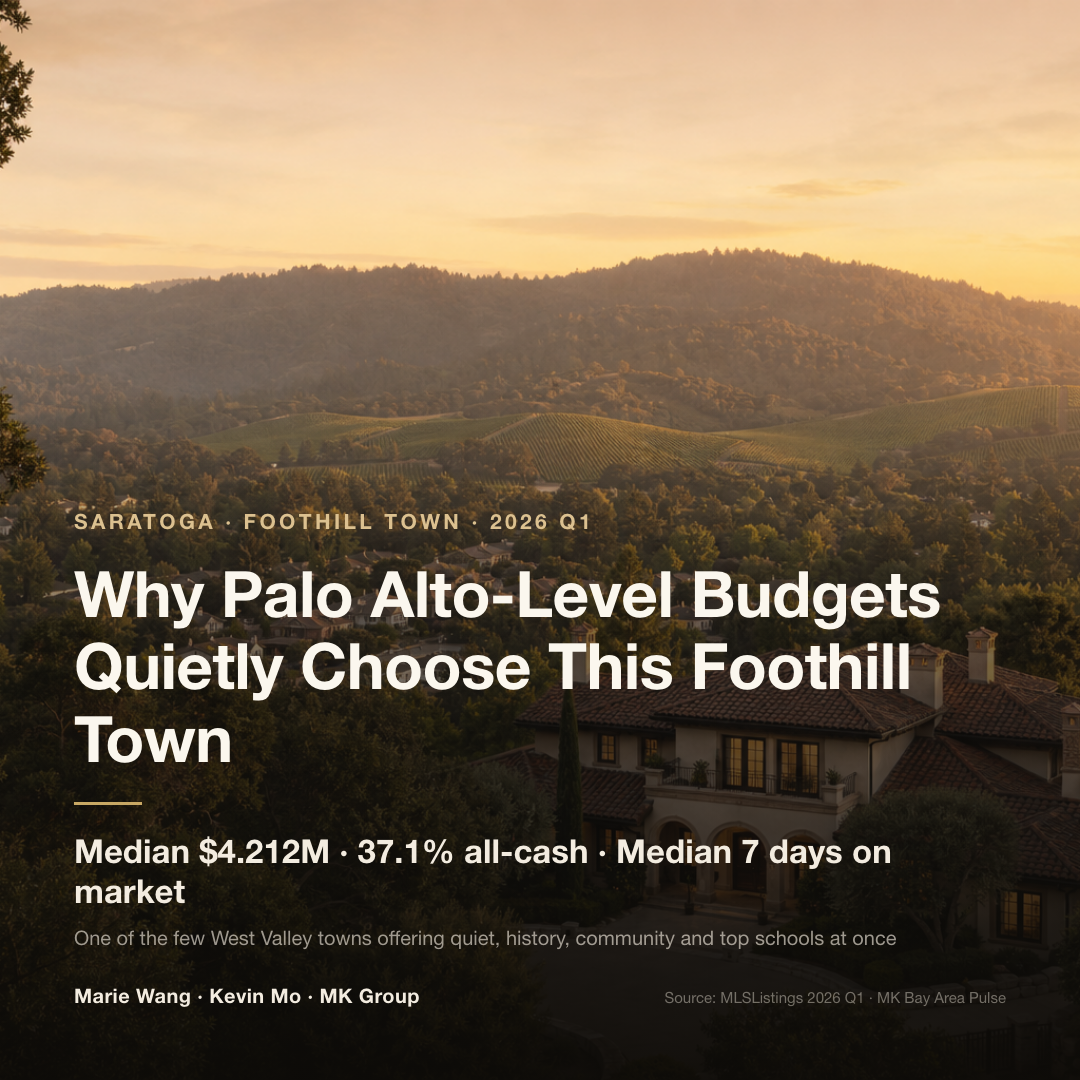
Saratoga is one of the few West Valley towns that delivers quiet, history, community, and strong schools at once. Q1 2026 closed at a $4.212M median, 37.1% all-cash, with a 7-day median time on market (source: MLSListings Q1 2026). The center of gravity is the $4M range, but the high end has cleared at the $12M scale — the close of this article is one such buy, represented by MK Group. Buyers who hold a Palo Alto–level budget and choose Saratoga anyway aren't looking for a discount. They want a foothill town they can live in for the long run, one that also holds its value.
Who this article is for
This is for the buyer who has already toured the Bay Area's luxury enclaves, holds a $4M–$12M budget, and keeps drifting toward somewhere quieter. Specifically:
- Families planning to settle for the long term — not a three-to-five-year turnover — who want one community to carry a child from elementary through high school;
- Buyers who prize privacy and quiet and don't want to live on a fast, high-exposure, traffic-heavy commute corridor;
- Long-hold owners who want both daily comfort and a home with real scarcity and value-retention logic;
- People who want town life with history, hillside views, and a genuine sense of community — not just a "good-school ZIP."
If you've been bouncing between Palo Alto, Los Altos, and Los Altos Hills and still feel one notch short on quiet, Saratoga is most likely the town you haven't looked at closely yet.
Three lenses for reading Saratoga
You can't read a town's character off a price ranking. To judge whether Saratoga fits you for the long run, start with these three things.
1. Its geography: a foothill town, not a grid of school-zone lots
Saratoga sits on the western edge of Silicon Valley, at the foot of the Santa Cruz Mountains. Unlike the flatland, grid-block neighborhoods of Palo Alto or Cupertino, much of Saratoga's luxury housing spreads across gentle slopes and wooded land — larger lots, denser tree canopy, and natural distance between neighbors. Head uphill and Saratoga-Sunnyvale Road runs into vineyards and the tree line; head into town and you reach an old main street that still carries its 19th-century building façades.
That foothill-town foundation sets two basic traits: quiet and distance-rich privacy. Saratoga isn't planted in the center of any major commute artery, so it never carries Palo Alto's round-the-clock traffic and exposure. Yet it sits within easy reach of 280 and 85, so the South Bay tech corridor stays close.
2. Its history and landmarks: a town with a sense of era
What makes Saratoga rare is that it has real historical layering, not just a recent cluster of new builds. A handful of landmarks all but define its character:
- Historic Saratoga Village — the old main street with preserved façades, where the restaurants, galleries, and weekend market sit; the physical center of the town's community feel;
- Hakone Gardens — one of the oldest Japanese gardens in North America, tucked into a hillside; the most literal expression of Saratoga's quiet;
- Villa Montalvo (Montalvo Arts Center) — an early-20th-century Mediterranean estate that doubles as an arts center, with hillside trails;
- Mountain Winery — a hilltop winery and open-air concert venue; the summer performances are a shared memory for many longtime residents.
What these landmarks have in common is that they make Saratoga feel like moving into a place with a story, rather than buying into a price figure. For long-term buyers, that sense of belonging is often the variable that surfaces last in the search — and ends up deciding whether they stay.
3. Its school footprint: continuity from elementary through high school
Saratoga's strong schools are one of its core draws for family buyers. The elementary years run primarily through the Saratoga Union School District, and the high-school years through the Los Gatos-Saratoga Joint Union High School District (which includes Saratoga High). Both have held high GreatSchools ratings over the long run (source: GreatSchools public ratings).
For families who want one community to carry a child from elementary through high school, that continuity means not having to move again mid-stream for the next school stage — which reinforces Saratoga's "stay a long time" character. A caution worth repeating: Silicon Valley school boundaries don't line up neatly with city lines, so confirm which school any specific home actually feeds, home by home. We walk through the method in how to verify which school district a Bay Area home actually belongs to.
Placing Saratoga on the Bay Area luxury map
It's hard to judge a town in isolation; to understand where Saratoga sits, set it beside its neighbors. The core numbers first: in Q1 2026, Saratoga closed at a $4.212M median, 37.1% all-cash, with a 7-day median time on market and a 105.4% sale-to-list ratio. That median already sits above Palo Alto's $4.120M, yet the all-cash share is well below Palo Alto's 50.8% — the quiet, slow-warming temperament reads straight off the data (source: MLSListings Q1 2026).
| City | Q1 2026 closings | Median sale price | All-cash share | Median days on market |
|---|---|---|---|---|
| Saratoga | 35 | $4.212M | 37.1% | 7 |
| Palo Alto | 61 | $4.120M | 50.8% | 8 |
| Los Altos | 50 | $5.082M | 28.0% | 8 |
| Los Altos Hills | 12 | $5.234M | 50.0% | 14 |
| Monte Sereno | 5 | $4.800M | 60.0% | 8 |
The difference to remember: Saratoga's 7-day median time on market is the fastest in this group — proof that "quiet" describes the lifestyle, not a cold market; the right home still gets picked up quickly once listed. Its character sits precisely between two poles. It isn't Palo Alto's high-exposure register — high visibility, fast pace, more than half the buyers paying cash; nor is it Los Altos Hills' near-total seclusion — outsized lots and a slower 14-day average on market. Saratoga is the small-town luxury enclave in between, offering the rare $4M+ pairing of hillside views and an authentic historic-village community. If you want a clear read on what those two poles are, see how to choose among the Bay Area's three top luxury enclaves.
Data source: MLSListings Q1 2026 (MK Bay Area Pulse); GreatSchools public ratings; Santa Clara County public records
Updated: 2026-06
Scope: Saratoga (ZIP 95070) single-family homes, primarily the $4M+ tier
What MK Group saw on the ground: a $12M buyer representation in Saratoga
Saratoga's center of gravity is the $4M range, and a sale at the $12M scale is an outlier at the high end. That outlier stops being abstract when it lands on a specific deal: the MK Group team led by Marie Wang and Kevin Mo recently completed full-service buyer representation on a $12M Saratoga purchase. The client's brief was clear from the start — a quiet, private, community-rich home built for the long term, in a property with genuine scarcity and value-retention logic.
The most telling thing about this deal was its counterintuitive distribution of difficulty. When a client's needs are sharply defined, "which community, which house" turns out to be the relatively easy part — Saratoga's quiet, history, and community feel are almost custom-built for this kind of long-term buyer. What actually decided the outcome was the step-by-step risk anticipation across the entire chain: area screening, property assessment, pricing strategy, negotiation pacing, inspection, and closing timeline. One small complication came up during the process, and it was resolved cleanly.
One line from the deal sums up MK Group's service thesis in Saratoga best: "The right home isn't necessarily the most expensive one on the market — but it is the one that best fits the client's stage, family needs, and future plans." Put differently, in a town like Saratoga where scarce inventory is king, the buyer agent's value anchor isn't "find the priciest house" — it's matching plus full-chain risk anticipation.
Common Misreads
Misreading 1: "Saratoga's median is even higher than Palo Alto's — so isn't it poor value?"
The comparison is mis-framed from the start. Saratoga's Q1 2026 median was $4.212M versus Palo Alto's $4.120M (source: MLSListings Q1 2026) — close figures, but you're not buying the same thing. Palo Alto buys flatland core location, the Stanford orbit, and high liquidity. Saratoga buys hillside lots, the distance the trees give you, a historic-village community, and the settled feel of living somewhere a long time. For a long-term, privacy-minded buyer, what makes Saratoga "expensive" is exactly the quiet you can't get elsewhere. That isn't a value question — it's a fit question.
Misreading 2: "Isn't a foothill town too far from the office, too inconvenient?"
Saratoga isn't in the dead center of any major commute artery — which is precisely the source of its quiet. But it's close to 85 and 280, and the South Bay tech corridor stays within reasonable reach. The real trade-off isn't absolute distance; it's whether you'll spend a few extra minutes a day commuting in exchange for a home that's quiet around the clock and within reach of the hills and the wineries on weekends. For buyers planning to settle and prioritizing quality of life, that math usually works. For someone heading into San Francisco daily and minimizing commute time, it may genuinely not be the first choice.
Misreading 3: "The schools are good anyway — so any house will do?"
It won't. First, Silicon Valley school boundaries don't match city lines, so different lots within Saratoga can feed different elementary and high schools — verify each one, don't assume. Second, Saratoga's good homes are scarce and sit just 7 days on market (source: MLSListings Q1 2026), which means "meets the school bar" is only the entry ticket. The real difficulty is securing — cleanly — that scarce property that satisfies both living and value-retention logic in the right community. That is precisely where the craft showed in the $12M buy MK Group represented in this article.
Misreading 4: "Saratoga is quiet — doesn't that mean homes are hard to sell, with poor liquidity?"
Quiet describes the lifestyle, not a cold market. Saratoga's Q1 2026 median time on market was just 7 days, with a 105.4% sale-to-list ratio (source: MLSListings Q1 2026) — among the fastest in its peer group; the right home still closes quickly once listed, and often above asking. Misreading a quiet community as an illiquid market is how you mistime your offer.
Next steps
- Confirm first whether you're a long-term buyer. If your hold horizon runs ten years or more and you value quiet and community belonging, Saratoga's town character will actually pay off; if you're turning over in three to five years, think it through before you start.
- Verify school assignment home by home. For any home you like in Saratoga, confirm its specific elementary and high-school feeders first — don't assume "it's all the same across town."
- Walk the town yourself. Spend an afternoon each at the old main street in Historic Saratoga Village, at Hakone Gardens, and at Mountain Winery, and judge whether this history-and-hills rhythm is the daily life you want.
- Drive the real commute. At the times you'll actually travel, drive from candidate homes to work, school, and the airport — decide on real minutes, not a map estimate.
- Set up the chain ahead of time for scarce listings. Saratoga's good homes sit just 7 days on market; rather than scrambling after one lists, get the risk anticipation — area screening, pricing strategy, inspection, and closing timeline — done in advance. That's what decides whether a scarce property can be secured.