Direct Answer
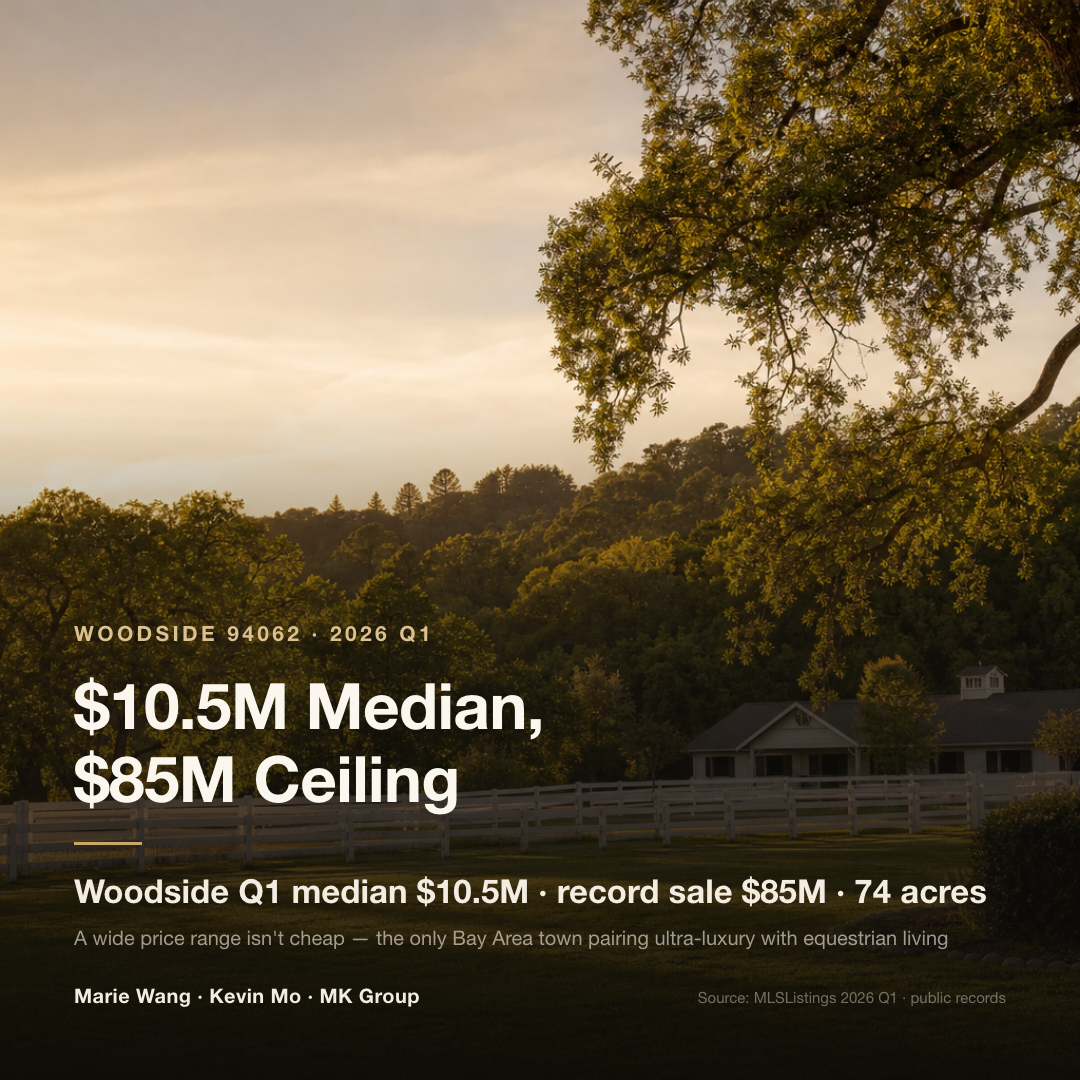
Woodside is the only Bay Area town that pairs ultra-luxury with stables, paddocks, and trail-riding land. Its 2026 Q1 median sale price was $10.5M — below Atherton's $15.71M — yet its ceiling runs to $85M on 74 acres. So when a horse-owning family insists on Woodside and turns down Atherton, that is not stubbornness. The two towns are not the same kind of place.
Who this article is for
- Ultra-high-net-worth families with budgets above $20M for whom riding, keeping horses, or owning large acreage is a core lifestyle requirement — not an amenity
- Buyers who want to understand how Woodside and Atherton actually differ in character, rather than asking only "which median is higher and more prestigious"
- Anyone who has been steered toward Atherton on the strength of its higher median, but keeps sensing that it isn't quite the right fit
- Readers drawn to the Peninsula's rural large-parcel belt — Woodside, Portola Valley, Los Altos Hills — who want to see how it differs from the classic ultra-prime towns
What kind of town Woodside is
To understand why some buyers will accept nowhere but Woodside, set the price rankings aside and look at the town itself. Woodside carries three qualities that the other ultra-prime communities simply cannot offer.
First, it is a rural town that has kept its equestrian heritage. Woodside's fabric is not modern mansions behind walls. It is bridle trails, pasture, woodland, and barns. The town still maintains a public trail system, and many properties come with their own stables and paddocks. When a family says, "We all ride, and we need room to do it," Woodside is very nearly the only place on the Peninsula that can answer that at the ultra-luxury tier. This is not the selling point of one house. It is the default setting of the whole town.
Second, the scale of the land is a different order entirely. Atherton's standard is a one-acre lot on an orderly residential grid. Woodside's large parcels routinely run past ten acres, some covering an entire oak-forested hillside. Woodside's record sale was a 34-bedroom, castle-class estate on 74 acres that closed at $85M (source: public sale records). That scale does not physically exist in Atherton. However expensive Atherton gets, its premium is the densest concentration of ultra-prime homes in the country paired with extreme privacy — not sweeping land and forest.
Third, its mood is concealment, not display. Woodside has no commercial-district bustle. The main street is a country café or two and a tack shop; the drive in is a winding two-lane road and oak-shaded private lanes. This is a different quiet from Atherton's fortress privacy. Atherton's silence shuts the world out at the gate. Woodside's is pastoral — it was never at the center of the world to begin with. Two kinds of quiet, drawing two kinds of people.
Three questions: do you belong in Woodside or Atherton?
One: are you buying a house, or land and a way of life? If your core need is a top-tier modern home, extreme privacy, and proximity to Palo Alto and Sand Hill Road, Atherton's logic is the cleaner fit. If your core need is usable acreage — an equestrian estate, an orchard, a vineyard, a family farm, private woodland — then Woodside offers what Atherton cannot.
Two: how much commute and how much "country" can you live with? Woodside sits at the foot of the hills and in the woods; getting in and out means winding roads, and it is a step farther from the nearest commercial core and freeway than Atherton. What you buy with that distance is genuine rural seclusion. Atherton is closer to I-280, to Stanford, to the Peninsula tech core — private, but not remote. That single mile decides the rhythm of your day.
Three: does the median ranking matter to you? This is the line that misleads buyers most often. Woodside's median sits below Atherton's, which can leave a buyer instinctively reading it as half a tier lower. But a low median only means Woodside's price band is wider — entry-tier properties at the bottom, running all the way up to that $85M, 74-acre castle-class estate at the top (source: public sale records). It does not mean its ceiling is any lower. If what you actually want lives at the top of the range, the median tells you nothing.
Where the data places Woodside among its peers
The core numbers first: Woodside's 2026 Q1 median sale price was $10.5M across 7 closings, 71.4% all-cash, with a median of just 10 days on market. Over the same quarter, Atherton's median was $15.71M across 10 closings, 80% all-cash, 9 days on market. Woodside's median runs roughly a third below Atherton's — yet its ceiling (the $85M record) and its top-tier closings (6 Cedar Ln at $23.5M all-cash and 211 Winding Way at $23.0M, both 2026) prove the town is in no way short of inventory at the ultra-luxury tier.
| City | 2026 Q1 Median Sale Price | Closings | All-Cash Share | Median DOM | Character |
|---|---|---|---|---|---|
| Woodside | $10.5M | 7 | 71.4% | 10 | Rural equestrian / large-parcel woodland |
| Atherton | $15.71M | 10 | 80.0% | 9 | Dense ultra-prime / fortress privacy |
| Los Altos Hills | $5.234M | 12 | 50.0% | 14 | Hilltop large parcels / more modern |
| Portola Valley | $5.10M | 9 | 66.7% | 40 | Woodland rural / slower pace |
What to remember: in this table Woodside and Portola Valley both sit in the Peninsula's rural large-parcel belt, yet Portola Valley's median DOM is 40 days — nearly four times Woodside's. Same "rural" label, very different market velocity and buyer pool. And Woodside's top-tier all-cash closings (211 Winding Way landed at $23.0M all-cash even after 248 days on market) show that its ultra-luxury buyers use cash and patience to match scarce parcels. They are not the crowd negotiating their way in off the median.
From MK Group's work: a family with $35M who would consider nowhere but Woodside
In a one-on-one buyer-positioning session, Marie Wang (DRE# 02110980) and Kevin Mo (DRE# 02127623) met a family like this: a $35M budget, and an opening line of "Woodside only." MK Group raised an alternative on purpose — would they consider Atherton, which ranks higher on both median and community reputation? The clients declined outright.
The reason was simple. The whole family rides, and they needed a property with stables, paddocks, and room to ride. That requirement is nearly impossible to satisfy in Atherton — a dense ultra-prime town of orderly one-acre lots, with no sweeping pasture or trail system to offer. Woodside is the only town in the Bay Area that can deliver both an equestrian way of life and ultra-luxury quality at this tier.
The lesson, as Marie and Kevin put it plainly in the debrief: above $30M, the decision logic is lifestyle-first, not investment return or median ranking. Woodside's median is lower than Atherton's, but its ceiling reaches $85M — a low median does not mean "cheaper," only that the price band is exceptionally wide. When an agent substitutes a price ranking for a needs match, this kind of client gets misrouted to Atherton — and what's mismatched isn't a house, it's the family's way of life for decades to come. As of that debrief, the family's Woodside search was still underway.
Common mistakes
Mistake 1: "Woodside's median is below Atherton's — isn't it half a tier down, and cheaper?"
No. The lower median only reflects how wide Woodside's price band is — entry-tier properties at the bottom, running up to the $85M, 74-acre castle-class estate at the top (source: public sale records). Atherton's median is high because the town is almost entirely ultra-prime, with virtually no entry tier dragging the median down. The two towns are not measuring the same thing: Atherton competes on ultra-prime density, Woodside on land scale and lifestyle. At the top of the range Woodside is not cheap at all — its 2026 Q1 top-tier closings included two at $23.5M and $23.0M all-cash (source: MLSListings 2026 Q1 $20M+ segment).
Mistake 2: "If I want privacy and quiet, aren't Atherton and Woodside the same?"
The two kinds of quiet are different. Atherton's quiet is fortress quiet — walls, gates, an orderly grid, no commercial district, the outside world shut out at the gate. Woodside's quiet is pastoral — winding roads, oak forest, bridle trails, pasture, a geographic seclusion. The first draws buyers who want extreme privacy while staying close to the tech core; the second draws buyers who want land, horses, and a slower rural pace. Same silence, two completely different visions of a life.
Mistake 3: "If I want horses or large acreage, can't I just buy a big lot in Atherton?"
It's very hard. Atherton's standard lot is one acre on a residential grid, with no public trail system and no physical room for sweeping pasture and woodland. An equestrian way of life needs stables, paddocks, riding ground, and contiguous usable land — and that is a question of how the whole town is set up, not something a single property can buy its way into. Woodside's 10+ acre parcels and town-level bridle heritage are the native match for this need.
Next steps
- First, write your requirements in priority order: is what you want a "top-tier modern home + extreme privacy + close to the tech core" (leans Atherton), or "large usable acreage + equestrian / farm / woodland lifestyle + rural pace" (leans Woodside)? Settle this and the rest of your search stays on track.
- If horses or large acreage are hard requirements, lock your search to Woodside 94062, and hold Portola Valley and Los Altos Hills as same-belt comparisons — so you understand how the three differ in market velocity and mood.
- Don't judge Woodside's large-parcel estates by Zillow or Redfin estimates. These properties are land-value driven with extremely scarce comparable sales, and automated valuations are almost always wrong. Anchor instead to real closings within the same community over the trailing 12–24 months.
- When you view top-tier properties, verify the "usability" of the land, not just the acreage: slope, woodland-protection setbacks, trail access, and the current state of barns and stables all decide whether the land can truly serve the life you want.
- To understand the character differences across the Peninsula's ultra-prime communities, read alongside these: Atherton and Hillsborough luxury transactions: the decision logic of high-net-worth buyers, How to choose among the Bay Area's three top ultra-prime communities — a four-dimension comparison of Atherton, Palo Alto, and Los Altos Hills, and The complete guide to off-market Bay Area luxury — how $5M+ pocket listings work.