The Direct Answer
When you buy a school-district home in the Bay Area, which district the house actually belongs to has to be verified by the exact street address, using the district's official attendance-area tool — the zip code, the neighborhood name, and the school tag on Zillow or the MLS do not settle it. The same zip, even the same street, can straddle a district boundary, and one house over can put you in a different elementary school. In a boundary town like Atherton, a comparable home bought on the wrong side of the line can carry a price gap of roughly $1.5 million when it comes time to resell. This is pre-offer due diligence, not a casual question at the showing — and the tool that settles it sits on each district's own site and takes about ten minutes.
Who this article is for
- Buyers about to write an offer on a school-district home. You have already found the house and you want to settle "which district does it actually belong to" beyond any doubt before you sign.
- Families buying in cross-district towns such as Atherton, Menlo Park, Palo Alto, Los Altos, and Cupertino. In these places a single city, a single zip, hides more than one district — exactly where boundaries get crossed by accident.
- Remote and out-of-state or cross-border buyers. You cannot walk every block in person, so you need a repeatable, street-level verification workflow rather than an agent's offhand "this area is a good district." In the $5M+ tier — Atherton, Old Palo Alto — a one-street school difference is itself a seven-figure swing in the asset, and cross-border principals in particular should confirm the side of the street in writing before the offer goes out.
- Anyone who wants "does the school zone check out" on their buyer due-diligence list. You want an executable set of steps to check, not one more review of which district ranks highest.
Three core decision dimensions
Dimension one: the zip code and the neighborhood name are not the district — the line is drawn street by street
A school district boundary — the attendance area — is an administrative line each district draws on its own, and it does not follow the zip code and it does not follow the neighborhood name. One zip can run across several district boundaries; a named neighborhood can be cut straight through the middle by one line, so a house on this side of the road goes to school A and a house on the far side goes to school B.
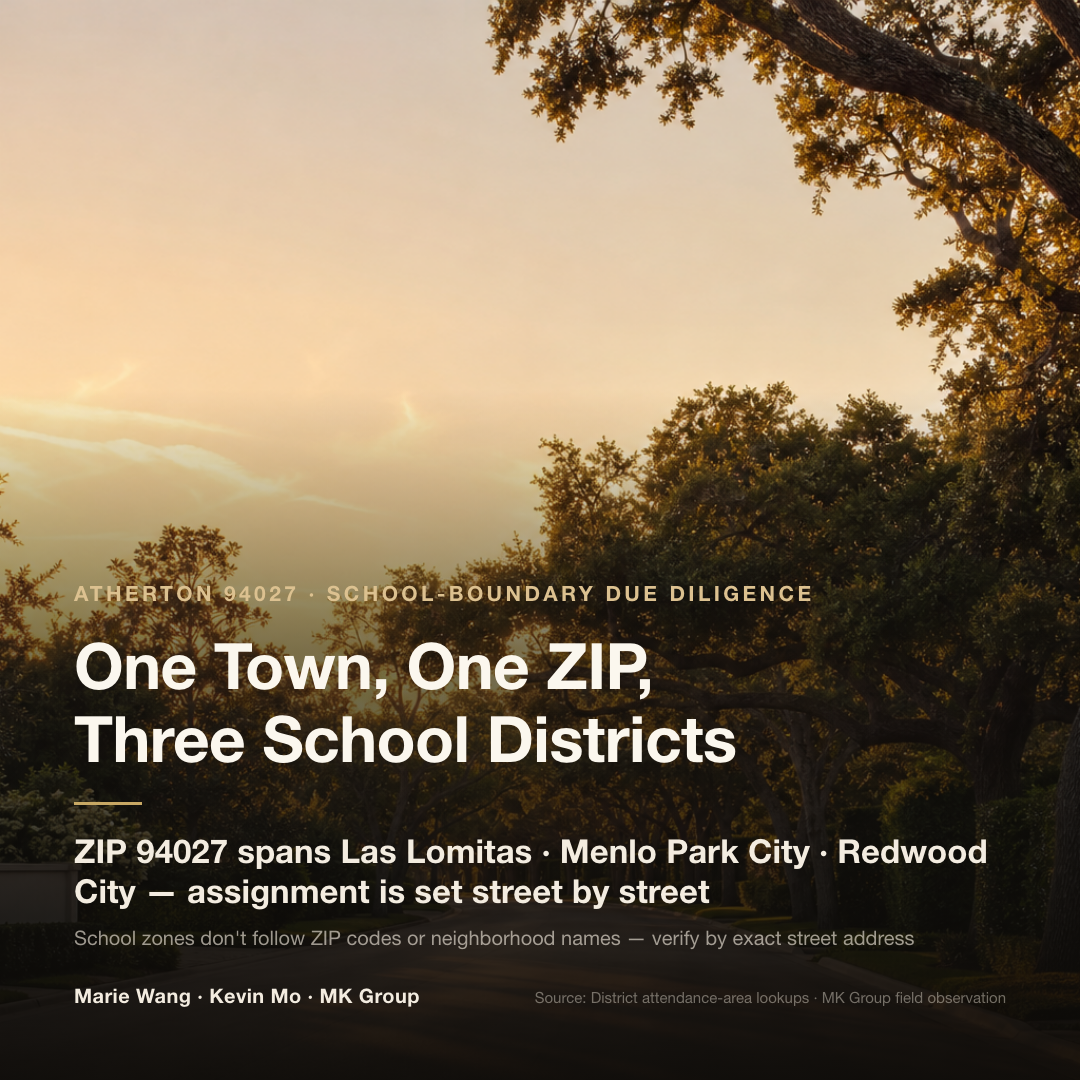
The clearest case is Atherton. The whole town shares zip 94027, but administratively it spans three elementary districts — Las Lomitas Elementary School District, Menlo Park City School District, and Redwood City School District — and which elementary a given house feeds is decided by the street it sits on, sometimes by which side of that street. So "94027 equals a top district" is wrong on its face: 94027 contains both elite elementary zones and a stretch that scores clearly lower. A zip is a postal sorting area, not an education zone.
Dimension two: use the district's official attendance-area or GIS tool, down to the side of the street
The only authoritative source for assignment is the website of the school district that governs the parcel. Most Bay Area districts publish one of two tools: an attendance-area or school locator — you enter the full street address and it returns the assigned school — or a zoomable boundary GIS map that shows exactly which street the line runs along.
Three things matter in practice:
- Enter the full street address, not just the city or the zip. Boundary precision goes to the side of a single street; a city-level query cannot return the answer.
- See which side of the street the line falls on. If the home you want sits right against the boundary, confirm it is on the side of the school you want, not the one across the road.
- Run the lookup separately for elementary, middle, and high school. For one address the elementary district and the high school district can be two different sets of boundaries — never assume a strong elementary means a strong high school.
A note: if a district locator returns "this address is full / transfer to another school" type results, that is enrollment-capacity information that changes year to year. For judging a property's assignment, what you trust is the static attendance-area / boundary map, not that year's seat availability. Treat the current version of each district's tool as of 2026-06 as the reference; boundary changes are usually announced with the school year, so watch for the effective-year label on the page when you check.
Dimension three: cross-check with CDE and GreatSchools so a single source can't lead you wrong
The district's official tool is the first source, but any single source can have a page that hasn't been updated or an address it reads imprecisely. So add two cross-checks:
- The California Department of Education (CDE) School Directory. Use the school name to confirm which district and which county it belongs to — verify that the school you found really sits in the district you think it does, not a same-named or similar-named school elsewhere.
- The GreatSchools attendance zone. Most listings and GreatSchools mark an "assigned school," which you can run against the district's official result. But remember: the school tag on GreatSchools, Zillow, and the MLS is a reference, not the referee — these often use approximation or lagging data, are most likely to be wrong near a boundary, and the district's official tool is the final word.
When all three sources agree, you have verified assignment to the point you can write it into an offer. If any one of them disagrees, stop, find out why before you go further, and only then talk about an offer.
School-verification tools and what each one is for
The bottom line first: when you verify a school assignment, the only source that can actually referee the boundary is the district's official attendance-area / GIS tool; the CDE confirms which district a school belongs to, GreatSchools is a second pass to cross-check, and Zillow / the MLS / the zip code are reference only — least reliable right at the boundary. The table below lays out each source's role, the precision it queries at, and what to use it for.
| Tool / source | Query precision | Role in the workflow | Source + scope | Update basis |
|---|---|---|---|---|
| District official attendance-area / boundary GIS | Street address / side of street | First source, final referee | District sites (Las Lomitas ESD / Menlo Park City SD / Redwood City SD / PAUSD / Cupertino USD, etc.); scope = that district's territory | Maintained by the district, updated when boundaries change |
| CDE School Directory | School to district / county | Confirms which district a school sits in, rules out same-named schools | California Department of Education; scope = all California public schools | Official directory, updated periodically |
| GreatSchools attendance zone | Address to assigned school (approximate) | Cross-check, supporting | GreatSchools; scope = nationwide, with ratings and zones | Third-party aggregate, zone is approximate |
| County district boundary map | Region / block | Read the overall direction of the lines | Santa Clara County / San Mateo County; scope = in-county district boundaries | County GIS, slower to update |
| Zillow / MLS school tag | Listing-page tag | Reference only, not authoritative | Listing platforms; scope = single listing | Entered by the lister, often wrong at boundaries |
| Zip code | Postal sorting area | Cannot be used to judge the district | USPS postal sort; scope = delivery area | No correspondence with district boundaries |
The one thing to remember: only the first row — the district's official tool — can deliver a final conclusion; everything else is there to corroborate it or catch an error. The real danger is not "not checking at all," it is "checking only the Zillow / MLS school tag and feeling safe" — because that row's reliability is lowest exactly at the boundary, and the boundary is exactly where the price gap is largest.
Data source: Official district attendance-area / boundary GIS lookups (Las Lomitas ESD / Menlo Park City SD / Redwood City SD / PAUSD / Cupertino USD), the California Department of Education (CDE) School Directory, GreatSchools attendance zones, Santa Clara County / San Mateo County district boundaries, and MK Group buyer-side field observation
Updated: 2026-06
Scope: Buyer due diligence for school-district homes on the Bay Area Peninsula / South Bay; boundaries and assignment are governed by a live query of the district's official tool
What MK Group sees on the ground
In MK Group's buyer due diligence, verifying the school boundary is a step that happens before the offer, not a casual confirmation at the showing. Marie Wang (DRE# 02110980) and Kevin Mo (DRE# 02127623) run it as a fixed sequence: take the home's exact street address, query the attendance area on the governing district's site, confirm the elementary assignment, then cross-check once more against the CDE and GreatSchools.
One real Atherton case makes the point. A client had set their heart on a home in a central-Atherton neighborhood — century-old oak canopy, an Atherton address, everything looked right on the surface. But Atherton as a whole spans Las Lomitas, Menlo Park City, and Redwood City, with assignment decided street by street. When the lookup got down to the side of the street, the house the client liked sat on the wrong side of the school boundary; buying it would have meant defaulting into the weaker stretch. MK Group compared comparable homes a few streets over, on the other side of the line, and pulled the target back to the correct side of the district. The transaction gap between comparable homes on the two sides was about $1.5 million — which is to say, if that wrong-side mistake had gone uncaught before the offer, the $1.5 million difference would surface directly in the list price at resale. Real money, real asset loss.
The zip code is not the district, and in a boundary town that cuts the other way too. MK Group worked with a homeowner in 94087 — the Sunnyvale / Cupertino edge — whose house sits in the Homestead zone. The 94087 zip straddles a district line: within the one zip, different streets can fall into different zones. That is exactly why a zip-based read like "I'm in 94087, so it should be a good district" cannot be trusted — you have to come down to the specific street and query the attendance area to know which school the house really feeds.
Common mistakes
Mistake one: "same zip code means same district"
Wrong. The zip code is a postal delivery zone and the district boundary is a separate system entirely — there is no correspondence between them. The most direct counterexample is Atherton's 94027: one zip across three elementary districts, holding both top zones and a stretch that scores clearly lower. 94087, on the Sunnyvale / Cupertino edge, sits on a district line too. So the assumption "same zip equals same district" is almost guaranteed to fail in a boundary town; to judge assignment, always come down to the specific street address.
Mistake two: "Zillow / the MLS tagged the assigned school, so just trust it"
You can't trust it outright. The school / assigned-school tag on Zillow, the MLS, and listing pages usually comes from an approximation or whatever the lister entered, it lags, and it is most likely to be wrong near a boundary — which is exactly where the price gap is largest. These tags are fine for first-pass filtering, but the final assignment has to be verified with the district's official attendance-area / GIS tool and then cross-checked against the CDE and GreatSchools. Treating a third-party tag as the referee is the single most common reason buyers step on a boundary.
Mistake three: "same neighborhood, same street — the district must be the same"
Not necessarily. A district boundary is an administrative line; it can run through the middle of a named neighborhood, or follow a street and split the two sides into different schools — this side goes to school A, the far side to school B. The central-Atherton neighborhoods feel this boundary effect: within one pocket, one street over can jump from one elementary district to another. So verification precision has to go down to "which side of the street," never stopping at "this neighborhood" or "this street."
Mistake four: "asking the agent at the showing is enough"
It isn't. School assignment is a hard fact that goes into the offer decision; a casual question at the showing and a casual answer in return cannot carry the risk of a whole-house boundary gap. The right move is to treat it as written, pre-offer due diligence: run the district's official tool by street address yourself, keep the screenshot or record, and write the offer only after all three sources line up. Verification is an action, not a conversation.
Next steps
- Get the home's full street address (house number + street name + city), not just the zip or the neighborhood name — every step that follows needs street-level precision.
- Go to the governing district's site and use the attendance-area / school locator or the boundary GIS map: enter the full address, see which side of the street the line falls on, and run it separately for elementary, middle, and high school.
- Cross-check that school in the CDE School Directory to confirm it really sits in the district and county you think it does, ruling out a same-named or similar-named school.
- Run it once more against the GreatSchools attendance zone — only when all three sources (district official / CDE / GreatSchools) agree is the assignment verified; if any one disagrees, find out why before you talk about an offer.
- Write the result into your buyer due-diligence list — keep the screenshot, the address, and the query date on file as the basis for the offer decision, not a verbal confirmation at the showing.
If you want to fold boundary verification into the larger decision of choosing an agent and picking a sub-market, read on: I'm a Silicon Valley engineer and I want to buy a school-district home in Palo Alto for my child — how should I find an agent?, What can $4 million buy in Palo Alto? Why Midtown 94303 is the best-value sub-market inside the Paly attendance zone, and Buying in Menlo Park: a complete buyer's guide to West Menlo Park, central Menlo Park, and Felton Gables.