The short answer
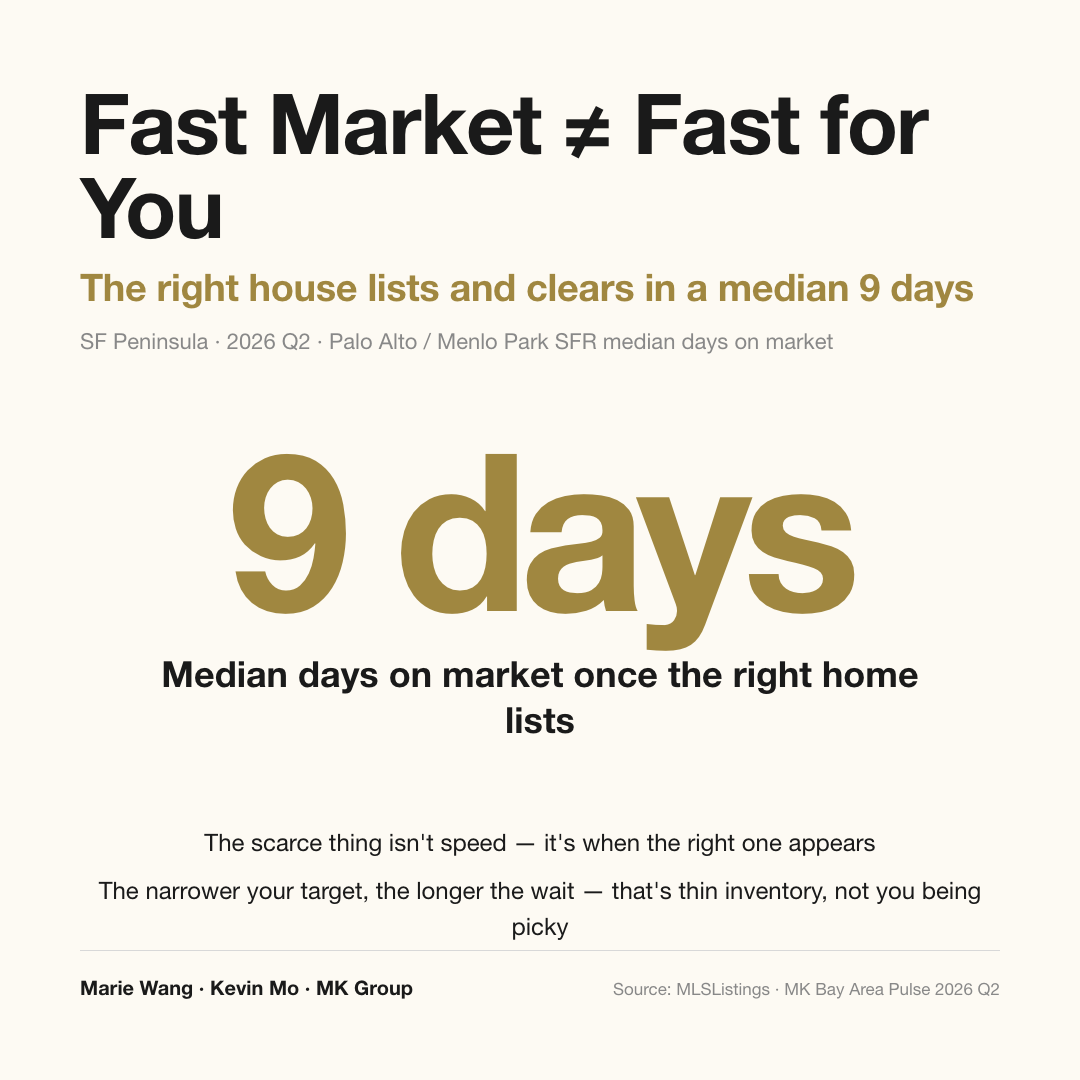
If the right home never seems to come, you're probably not too picky. For a $5M Peninsula school-district home, the scarce thing was never speed — the right listing closes in a median of 8–9 days (2026 Q2, Palo Alto and Menlo Park single-family). What's genuinely scarce is how often the right one appears — the right sub-market, the right block, the right attendance boundary. How long you wait depends on how narrowly you've locked your target, and whether your budget tier is mismatched to that district's inventory — not on how demanding you are.
Who this article is for
If any of these sounds like you, this article was written for you:
- You hold roughly a $5M budget, you have school-age children, you've locked onto one specific Peninsula school district, and after six months — sometimes a year or two — you still haven't closed, and you're starting to wonder "am I asking for too much?";
- You keep missing: the home you like goes pending before you can even schedule a showing, or every offer you make gets beaten by a faster buyer with cleaner terms;
- Your target district or sub-market is extremely narrow — one street, one attendance boundary, one specific floor plan — and you've discovered that only a handful of qualifying homes appear in a whole year;
- You want a quantifiable read on "how much longer," instead of anxiety by feel, and you want to know what to do while you wait so the waiting isn't wasted.
Three diagnostic dimensions: first figure out where you're actually stuck
"I just can't buy" is really several completely different bottlenecks, and blurring them together produces nothing but self-doubt. Run a self-check against each of the three dimensions below, and you'll find that "how long do I wait" isn't a mystical question — it's one you can take apart and quantify.
Dimension 1: Are you losing on speed, or has the right one simply not appeared yet?
These two have opposite fixes, so separating them first matters most. The first is a speed problem: the home did appear, but you couldn't get a showing, the offer window had passed, or a buyer with cleaner terms got there first. That kind of problem is fixable — pre-approve financing early, compress your decision loop, and make your offer clean. The second is a scarcity problem: you're already ready to move, yet months pass without a single home that meets your hard criteria. That isn't slowness — the "right one" (the right attendance boundary plus sub-market plus floor plan) is simply rare, and it can only be solved with time and wider channels; moving faster does nothing. Misread the bottleneck and you'll spend energy in the wrong place: it's scarcity, yet you keep pushing yourself to "go faster," and all you get is more anxiety.
Dimension 2: Quantify the wait — target narrowness × target-district inventory
"How much longer" feels anxious precisely because it stays a vague feeling. Convert it into a frequency, and the anxiety becomes a plannable time budget. Here's how: using public closing data from the last few quarters, estimate how many homes a year actually fall inside all of your hard criteria at once — target attendance boundary, sub-market, floor plan, price band. In 2026 Q2 the whole Bay Area's $3M–$5M band recorded 627 closings in a single quarter, which sounds like plenty. But once you narrow it to one specific district, a few particular streets, and one floor-plan type, a year might yield single digits. That isn't a flaw — it's the time cost you're paying for "right." The key is to see it and accept it: the narrower the lock, the longer the wait. That's arithmetic, not a personal failing.
Dimension 3: Is your budget tier mismatched to the target district's inventory?
The same $5M sits at wildly different scarcity levels depending on the price band it lands in. If your $5M corresponds to the upper half — or even the top tier — of your target district, inventory is naturally thinner: in 2026 Q2 the $5M–$10M band recorded only 223 closings region-wide in a quarter, with all-cash buyers making up 46.6%. In this tier you're not only waiting on scarcity, you're competing for those very few homes against cash buyers who close faster with cleaner terms. The signal of a mismatch is clear: your budget only reaches the most contested sliver of your target city. When that's true, there are three paths — move to a better-matched sub-market, extend your time budget, or raise your budget — any one works, but don't grind in place while blaming yourself. Calibrate, don't settle: narrow the definition of "right" to the 2–3 things you genuinely will not concede, and leave the rest flexible.
How fast the market really is, and how thin the inventory really is
The core numbers first: in 2026 Q2, the $3M–$5M band closed only 627 homes region-wide in a quarter, sold at a median of 8 days, at a median sale price of 105.3% of original list; step up to the $5M–$10M band and the quarter held just 223 closings region-wide, with the all-cash share rising to 46.6%. By city, Palo Alto and Menlo Park single-family homes both cleared at a 9-day median time on market, Los Altos at 8. In other words, the market itself is extremely fast — you "can't buy" not because the process is slow, but because so few homes land inside your target district and sub-market.
| Segment | Closings (2026 Q2) | Median DOM | All-cash share | Median sale / original list |
|---|---|---|---|---|
| $3M–$5M band (region-wide) | 627 | 8 days | 29.0% | 105.3% |
| $5M–$10M band (region-wide) | 223 | 8 days | 46.6% | 104.0% |
| Palo Alto (single-family) | 110 | 9 days | 40.0% | 105.5% |
| Menlo Park (single-family) | 72 | 9 days | 36.1% | 102.6% |
| Los Altos (single-family) | 80 | 8 days | 32.5% | 105.4% |
Data source: MLSListings / MK Bay Area Pulse 2026 Q2 (single-family SFR closings; price bands are regional aggregates); school-district assignments per GreatSchools and each district's official site
Updated: 2026-07
Scope: $5M-tier single-family school-district buyers on the Bay Area Peninsula
The counterintuitive point worth holding onto: every one of these numbers is saying "fast" — an 8-to-9-day median time on market, sale-to-list ratios above 100% — which means the moment the right home appears, it's bought almost immediately. So what you're waiting on was never "time to browse at leisure"; it's the time for the right one to appear. And when a $5M budget lands in the $5M–$10M tier, the quarter holds only 223 closings region-wide with cash buyers near half — you're not only waiting on scarcity, you're competing with cash for those very few homes. See both clearly and it's plain: if it never comes, it's usually scarcity plus competition, not you being too picky.
What MK Group sees on the ground
Among $5M-tier school-district buyers, "waited a long time and still hasn't bought" is close to the norm, not the exception. What ultimately carries these buyers to the right home is rarely one brilliant sprint — it's long-term companionship plus the execution to move the moment they're ready.
One real MK Group close is exactly this "slow is fast" sample: a school-district-driven family finally bought the school-district home they wanted in Menlo Park, at a close price recorded per source as $5.2M–$5.25M (two anonymized source posts differ slightly on the figure, and whether they describe the same transaction is still to be confirmed; the client's place of origin isn't covered in the source, so we don't infer it). The keyword for this relationship is "five years" — from the first showing to the final close, the team walked with the client for a full five years, and the client kept the decision with the same team the whole time, waiting until a genuinely right school-district home appeared before acting. High-end school-district homes don't arrive on demand; being able to wait for the right one is itself what that long-term trust made possible. Put differently, this family "waited five years" not because they were picky, but because the kind of home they'd locked onto is inherently scarce — they won by staying ready, able to take it the moment it appeared.
At the other end, MK Group has also served buyers who compressed the wait dramatically. A dual-income couple — both doing AI research at a large Seattle tech company, with an 8-year-old daughter — relocated across state lines to the Bay Area for education, and locked onto Palo Alto (PAUSD) within a few months. They could move fast because they'd defined "right" so precisely: still working, an 8-year-old daughter needing an education path, a public-school floor as insurance, and walkable or bikeable distance to Stanford — lay those four hard requirements down and the candidate cities collapse quickly to Palo Alto. Marie Wang (DRE# 02110980) and Kevin Mo (DRE# 02127623) ran remote walkthroughs and data screening before each of their trips out, concentrating in-person showings on the homes that were genuinely high-match. The contrast between the two closes gives one plain conclusion: how long you wait depends heavily on how precisely — and how narrowly — you define "right." Calibrate, don't settle. More of the founders' case reflections of this kind live on YouTube at @MarieWang (44K+) and @KevinMoRE (23K+).
Common mistakes
Mistake 1: "If it never comes, I must be asking for too much — I'm too picky."
Most of the time, no. The market data shows the right home closing in 8–9 days, often above original list — which means demand is intense and qualifying inventory is inherently scarce. The reason you keep waiting is usually that the "right one" (right attendance boundary plus sub-market plus floor plan) appears infrequently, compounded by cash-buyer competition — not that your standards are unreasonable. What actually needs checking isn't "am I too picky," it's "how many homes of this kind appear in a year at all." See the frequency clearly and the anxiety turns into a plannable time budget.
Mistake 2: "Homes close so fast (8–9 days) — I'm just too slow; speeding up will get me one."
Distinguish two kinds of "slow." If you're the buyer who "only finds out a home exists when you can't get a showing and the offer window has passed," that really is a speed and readiness problem, and it's fixable: get pre-approved early, compress showing-to-decision to 24–48 hours, keep your offer terms as clean as possible. But if you're already ready to move and still can't find a single home meeting your hard criteria over months, that isn't a speed problem — moving faster won't help. What you lack is the right one appearing, and that can only be solved with time and wider channels, including off-market.
Mistake 3: "As long as I'm willing to pay more, $5M can always buy in my target district."
Not necessarily. If your $5M sits in the upper half of your target district, it corresponds to thinner inventory — in 2026 Q2 the $5M–$10M band recorded only 223 closings region-wide in a quarter, with all-cash buyers at 46.6%. In this tier you're not just competing on price, you're competing with all-cash buyers who close faster with cleaner terms, and simply bidding higher may not win. What tends to work better is adjusting the dimensions you can concede (sub-market, floor plan, lot size), or extending your time budget and opening off-market channels — rather than pushing price alone.
Mistake 4: "Just buy something to get into the district now, and trade up later."
High risk. School-district homes are strongly owner-occupied and carry high transaction friction (commissions, taxes, moving, changing your child's school), so "settle now, trade up later" often loses on both ends: you live in a home you don't like, then years later sell and rebuy at the cost of another full round of friction, possibly breaking your child's continuity of schooling. The steadier move is to narrow "right" to the 2–3 things you genuinely can't concede (say, attendance boundary, commute, a floor-plan floor), leave the other dimensions flexible, and wait patiently for the home that satisfies those 2–3 at once. Calibrate, don't settle.
Next steps
- Split "right" into two columns: write down the 2–3 things you genuinely won't concede (attendance boundary / commute / floor-plan floor), and mark everything else negotiable — this step alone determines how long you'll wait.
- Run a "frequency check-up" on your locked target: using closing data from the last few quarters, estimate how many homes a year meet all of your hard criteria. Single digits means scarcity is the main driver, and what you need is a time budget plus wider channels, not self-doubt. (Start with Supply is up 67% — so why are Bay Area school-district homes still this hard to win? to learn how to quantify the "cost of waiting.")
- Check whether your budget tier is mismatched to your target district: if $5M only reaches the most contested sliver of your target city, weigh three paths — move to a better-matched sub-market, extend your time budget, or raise your budget — and choose one instead of grinding in place. (For what different budget tiers actually buy inside a district, see the Bay Area school-district budget-tier guide.)
- Keep yourself ready to move: complete financing pre-approval in advance (or have proof of funds ready), and compress showing-to-decision-to-offer to 24–48 hours, so the moment the right one appears you can take it. Slow is fast.
- Open off-market channels while first narrowing the sub-market: some of the strongest $5M-tier school-district homes never touch the open MLS, and widening your information reach materially raises the odds the right one lands in front of you; if you're still torn between two cities, start with Palo Alto or Menlo Park: which one for a $5M+ school-district buyer? to shrink the field first.