The short answer
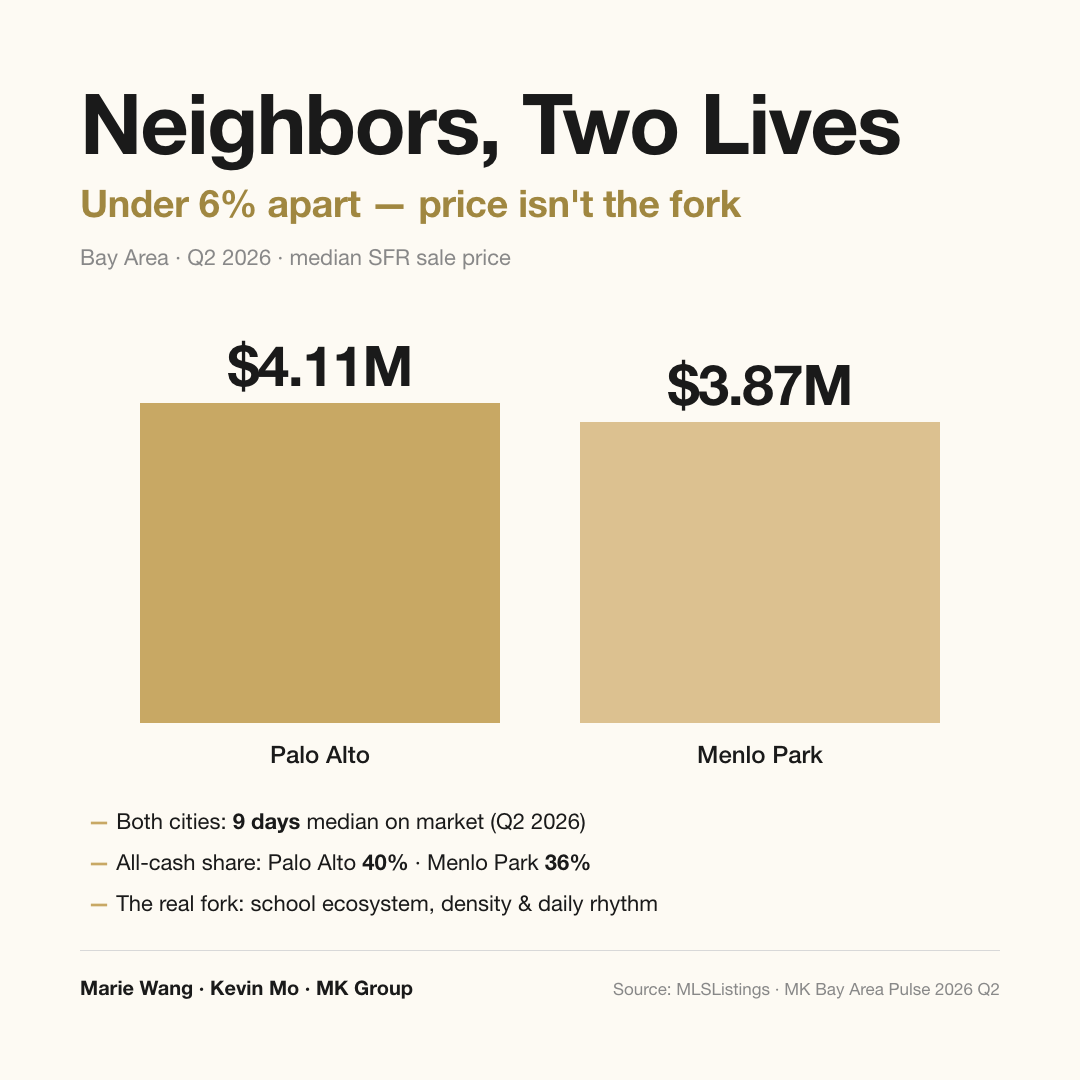
For a $5M+ school-district buyer: in 2026 Q2 the single-family median closing was $4.11M in Palo Alto and $3.87M in Menlo Park — about 6% apart, so the real fork was never price. Want a single unified PAUSD district as your floor, a walkable or bikeable line to Stanford, and a denser, more urban neighborhood? Choose Palo Alto. Want something quieter, more tree-shaded, and larger-lot — a lower-drain, sustainable life — and you're willing to verify a fragmented district map block by block? Choose Menlo Park.
Who this article is for
If any of these sounds like you, this article was written for you:
- You hold a $5M+ budget and you're buying a long-term family home for your children on the Peninsula, going back and forth between Palo Alto and Menlo Park;
- You're still working in tech (not fully financially independent) and you want a city that is close to Stanford with a strong public-school floor — but you're unsure how close to sit;
- You're already financially secure and starting to want a quieter, more tree-shaded, larger-lot "low-drain, sustainable" life, and you're curious why more families at your level are shifting from Palo Alto toward Menlo Park;
- You're moving to the Bay Area from overseas or another state, facing for the first time the reality that one city name can hide wildly different school districts, and you want to understand exactly where the two cities diverge.
Four Palo Alto vs Menlo Park decision axes
Palo Alto and Menlo Park are separated by a single waterway — San Francisquito Creek — both sit at Stanford's doorstep, and their single-family price tiers are nearly level. A generic "$5M+ buyer framework" won't help you here. The two cities differ not by price band but by four very concrete things. Check yourself against each axis; whichever city collects more of your checkmarks is the one to tour first.
Axis 1: How you want to be "close to Stanford"
Both cities are extremely close to Stanford, but "close" means different things. Palo Alto directly abuts the campus — El Camino Real is one street away — and many neighborhoods can bike to the campus, the library, a summer program, or tutoring in under 10 minutes. That is the embedded feeling of living against the campus. Menlo Park is just as close, especially West Menlo and central Menlo out to Sand Hill Road and Stanford's west side, where the VC and research ecosystem is right at the door — but for most neighborhoods it reads as a 5–10 minute drive to campus rather than a walk. The test is simple: if your children will use Stanford programs daily and you want the walk-or-bike embedded feeling, choose Palo Alto; if you want close enough but quieter, where a few minutes by car is fine, choose Menlo Park.
Axis 2: A single flagship district, or a fragmented-but-excellent patchwork
This is the axis most easily missed and most often underrated. Palo Alto is one K–12 unified district citywide — Palo Alto Unified (PAUSD) — one system end to end, with an exceptionally strong public-school floor (Palo Alto High and Gunn High). If the address falls inside the PAUSD boundary, the strong public schools and the continuous K–12 path are essentially locked — there is no risk of landing in a different district. Which specific elementary, middle, and high school an address actually feeds, however, is still assigned block by block and has to be verified by street address (see How do I know whether a Palo Alto address feeds Gunn or Paly?). Menlo Park is the opposite: its elementary schools are cut into several independent small districts — central Menlo Park sits in Menlo Park City School District, West Menlo Park and Ladera fall under Las Lomitas Elementary School District, and the east-side Belle Haven area (east of Highway 101) is in Ravenswood City School District; high schools are unified under Sequoia Union High School District (Menlo-Atherton High). In other words, the same "Menlo Park" address can land in wildly different elementary districts — you must verify block by block. Both cities' districts are strong; the difference is buy the right address once and you're set versus do the homework to lock it in. Want it easy, choose Palo Alto; willing to do the homework and precisely lock a top elementary district like Las Lomitas or Menlo Park City, choose Menlo Park. For how the boundaries actually fall around Atherton and Menlo Park, start with Which school district does an Atherton or Menlo Park estate actually feed into.
Axis 3: Density and privacy — walkable urbanism or shaded distance
Palo Alto is denser overall, with smaller lots and a more urban feel: many neighborhoods walk to the restaurants, coffee, and Caltrain of downtown University Avenue or California Avenue. Old Palo Alto and Crescent Park are the large-lot high-end exceptions, but the city's character is walkable, high-density, and elite. Menlo Park runs the other way — a denser tree canopy, quieter streets, and generally larger lots. In West Menlo Park, the Allied Arts, Vintage Oaks, and Felton Gables pockets commonly run a quarter to a half acre, with a stronger sense of closing the door and sealing off the outside world. Want to walk to a café and have urban convenience and energy, choose Palo Alto; want shade, quiet, lot size, and privacy, choose Menlo Park.
Axis 4: Pace of life — high-velocity tech core, or low-drain and sustainable
Palo Alto is one of the Peninsula's tech cores. The pace is fast, and the University Avenue corridor holds the densest concentration of startup, VC, and Stanford energy — a fit for families still working fast and enjoying life at the center. Menlo Park moves slower and leans toward recovery. One observation repeatedly cited through 2026: more and more $5M+ buyers are shifting from Palo Alto toward Menlo Park, wanting not a bigger house or louder finishes but life efficiency and emotional recovery — a low-drain, sustainable day. (Honest note: this is a market-level trend framing, not a claim that every family moving from Palo Alto to Menlo Park does so for the same reason.) If you enjoy the high energy of being at the center, choose Palo Alto; if you want to step half a pace back and live sustainably, choose Menlo Park.
The two-city price benchmark (an anchor, not a decision)
The core numbers first: in 2026 Q2, Palo Alto's single-family median closing was $4.11M (110 sales) and Menlo Park's was $3.87M (72 sales) — about 6% apart. Both cities had a 9-day median time on market; the all-cash share was 40.0% in Palo Alto and 36.1% in Menlo Park. The price tiers are nearly level. What actually decides your city is the four axes above, not this table.
| Metric | Palo Alto | Menlo Park |
|---|---|---|
| Single-family sales (2026 Q2) | 110 | 72 |
| Single-family median close (2026 Q2) | $4.11M | $3.87M |
| Median days on market (DOM) | 9 | 9 |
| All-cash share | 40.0% | 36.1% |
| Median sale / original list price | 105.5% | 102.6% |
| Single-family median close (2026 Q1 reference) | $4.12M | $3.40M |
Data source: MLSListings / MK Bay Area Pulse 2026 Q2 (single-family SFR closings); district assignments from GreatSchools and each district's official site (PAUSD, Menlo Park City ESD, Las Lomitas ESD, Ravenswood City ESD, Sequoia Union HSD)
Updated: 2026-07
Scope: $5M+ single-family school-district buyers in Palo Alto and Menlo Park
What to actually remember: the citywide single-family median (around $4M) is only a tier anchor. A $5M+ school-district buyer is really buying the upper half of each city — Old Palo Alto and Crescent Park in Palo Alto, West Menlo Park in Menlo Park — where prices run well above the citywide median. The genuinely counterintuitive point worth holding onto: Menlo Park's single-family median rose from $3.40M in 2026 Q1 to $3.87M in Q2 (about +14%), while Palo Alto held roughly flat ($4.12M → $4.11M). But hold this one loosely — a rising median only says Menlo Park's own high-end closing mix strengthened in the first half of 2026; it does not prove those buyers came from Palo Alto. Read "PA-to-MP shift" as a market narrative, not as causal proof of migration derived from this set of medians.
What MK Group sees on the ground
For the same $5M+ school-district buyer, whether they land in Palo Alto or Menlo Park comes down to which stage the family is in. Two real MK Group cases sit at opposite ends of exactly this fork.
One end is Palo Alto. A dual-income couple — both AI researchers at a large Seattle tech company, with an 8-year-old daughter — relocated across state lines to the Bay Area for their daughter's long-term education. They had also looked at quieter, more estate-oriented options like Atherton and Menlo Park, and they settled on Palo Alto for a clean reason: both were still working, so commute and daily rhythm still mattered; PAUSD's public schools give a floor — even if a private-school path never materializes, the public schools are among the strongest on the Peninsula; and walking or biking distance to Stanford was a hard requirement, a level above "close by car." Marie Wang and Kevin Mo read this need at the city-selection stage as an education-driven Silicon Valley landing rather than luxury asset allocation, and narrowed the shortlist to Palo Alto rather than Atherton or Los Altos Hills.
The other end is Menlo Park. A school-district-driven family closed on the home they wanted at $5.25M in Menlo Park, with the closing structure and family details anonymized. What made this relationship notable was its patience: from the first showing to the final close, Marie Wang (DRE# 02110980) and Kevin Mo (DRE# 02127623) walked with the client for a full five years, and the client kept the decision with the same team until the right house appeared. High-end school-district homes don't arrive on demand; being able to wait for the right one is itself what that long-term trust makes possible. This close also sits inside a larger market observation: through 2026, more $5M+ buyers are shifting from Palo Alto toward Menlo Park — not for a bigger house or louder finishes, but for a quieter, more tree-shaded, low-drain and sustainable way of living close to Stanford and the tech core. (Honest note: whether this particular client actually moved out of Palo Alto is not established in the source; read "PA-to-MP shift" as a market-trend framing, not confirmed individual behavior.) More of the founders' case reflections live on YouTube at @MarieWang (44K+) and @KevinMoRE (23K+).
Common mistakes
Mistake 1: "Menlo Park's schools aren't as good as Palo Alto's, so PA is the safer bet."
It doesn't hold. Las Lomitas and Menlo Park City are among California's top elementary districts, and Menlo-Atherton High is strong too. The real difference between the two cities' schools isn't who is stronger but structure: Palo Alto is one unified PAUSD district citywide, so the right address locks it in; Menlo Park is split into several independent small districts, so addresses under the same city name can fall into completely different districts — verify block by block. Don't mistake "you have to do homework" for "lower quality." Do the homework right, and Menlo Park's top districts don't trail Palo Alto's.
Mistake 2: "The two cities are right next to each other, so it doesn't matter which you buy."
Physical proximity isn't the same life. All four decision axes — how you're close to Stanford, district structure, density and privacy, pace of life — diverge between the two cities. And precisely because the price tiers are nearly level (about 6% apart on 2026 Q2 single-family medians), you're not paying a little more for the better one — you're choosing between two different ways of living. Price rules nothing out for you, which is exactly why matching yourself against these four axes matters even more.
Mistake 3: "With a $5M+ budget, just buy the highest-end Palo Alto neighborhood — it holds value best."
Value-retention logic depends on the need; there is no one-size-fits-all "best-holding neighborhood." For a family still working, wanting a public-school floor and walkable Stanford access, Palo Alto is indeed right. But more $5M+ buyers are counter-selecting Menlo Park's quiet and larger lots, because what they want is a low-drain, sustainable life rather than "most central, most expensive." What holds value best is always the home that best matches your family's current stage — not the nominally most expensive one.
Next steps
- Start by matching yourself: put one checkmark on each of the four axes (how you're close to Stanford / district-structure preference / density and privacy / pace of life). Whichever city collects more checkmarks is where you concentrate your touring first.
- If you lean Menlo Park, verify the school district block by block — the same MP address can belong to Menlo Park City, Las Lomitas, or Ravenswood, three completely different districts. Start with Buying in Menlo Park: a full buyer's guide to West Menlo, central Menlo, and Felton Gables to map sub-neighborhoods to their districts.
- If Palo Alto is also on your list, put Atherton alongside it to clarify whether you want urban texture hugging Stanford or larger-lot privacy and top-tier positioning — read Palo Alto or Atherton: which should you choose for a Silicon Valley luxury home.
- Anchor your budget to real closings: both citywide single-family medians run around $4M, but a $5M+ buyer is buying the upper half (Old Palo Alto and Crescent Park in Palo Alto, West Menlo Park in Menlo Park) — budget by sub-neighborhood, not the citywide median.
- Book a "both cities in one day" itinerary: walk a stretch of University Avenue or California Avenue in Palo Alto in the morning, then a quiet West Menlo block in Menlo Park in the afternoon — your body's read on pace and density often tells you the answer faster than the data.