The short answer
Palo Alto has exactly two comprehensive public high schools — Paly and Gunn — and which one an address feeds is decided by street-level attendance area, not by ZIP code and not by city name. With Palo Alto single-family homes at a 9-day median time on market in 2026 Q2, that verification belongs before the showing, not after the offer.
Who this article is for
This is written for a parent standing at the last mile. You have already settled on Palo Alto, your budget and neighborhood shortlist are roughly clear, and you are choosing among two or three houses — you may be writing an offer next week. What you need now is to know which high school each of those houses leads to, and what that difference will actually mean in your child's daily life over the next six years. You may be arriving from Seattle, New York, or overseas with only a few days on the ground and no time to learn PAUSD's internal structure slowly. Or you may have rented in Palo Alto for two years and noticed that every parent you meet describes the dividing line slightly differently. What you want is an institutional map: who decides placement, how the path runs, which statements are only approximate, and which steps have to be finished before an offer.
Three things that decide the answer
One — PAUSD is a single unified district, but the unit of assignment is still the street. Start with the most common confusion. Palo Alto really is served by one K–12 unified district, Palo Alto Unified, so you will not face what Menlo Park families face: one city name sitting on top of three independent elementary districts. The cross-district risk of buying your way into a different school system does not exist in Palo Alto (for how the two cities differ structurally, see Palo Alto or Menlo Park: which one for a $5M+ school-district buyer?). But one district does not mean one assignment. Elementary, middle, and high school placement inside PAUSD is still drawn street by street. The district's own School Placement & Transfers page puts it plainly: "Your school assignment is determined by your home address, known as your neighborhood school." What determines placement is the residence itself — not the city you register in, and not the neighborhood name in the listing copy. Two realities sit behind that sentence. First, ZIP codes and district lines are not the same map: the 94303 ZIP covers part of Palo Alto and all of East Palo Alto — the former in Palo Alto Unified, the latter in Ravenswood City Elementary and Sequoia Union High. One ZIP, two entirely separate public-education systems. Second, the PAUSD boundary does not follow the Palo Alto city line either: the northwestern portion of Los Altos Hills is also covered by PAUSD. So the chain "Palo Alto address, therefore PAUSD, therefore a specific high school" can break at every link. One action is reliable: run the exact street address through PAUSD's official School Finder. For the order in which budget, neighborhood, street-level district, and transaction channel should be handled in Palo Alto, see Buying in Palo Alto: schools, neighborhoods, prices, and the full decision guide.
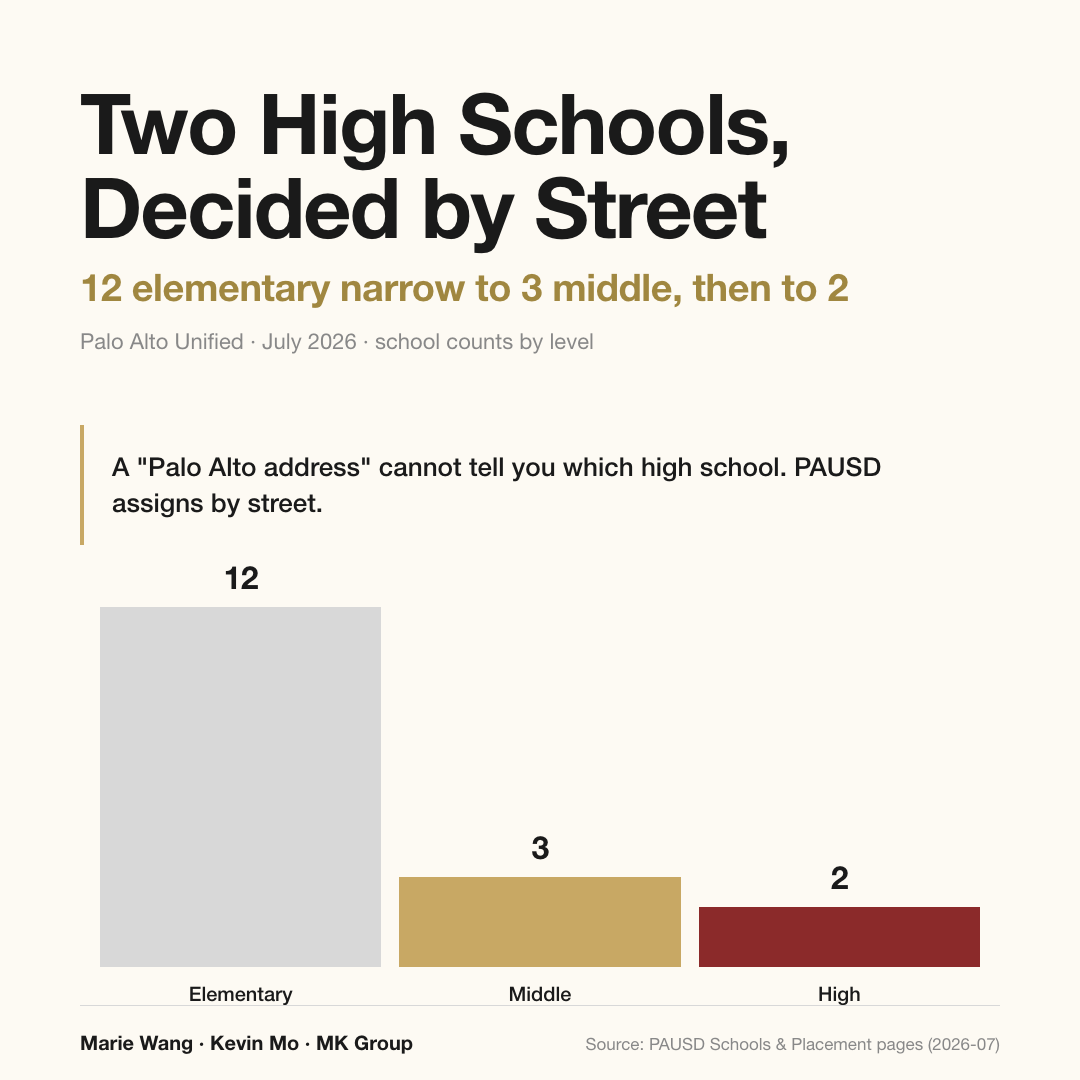
Two — the path runs in three stages, it consolidates on the way, and every level has to be confirmed on its own. PAUSD currently runs 12 elementary schools (Addison, Barron Park, Duveneck, El Carmelo, Escondido, Fairmeadow, Herbert Hoover, Juana Briones, Lucille M. Nixon, Ohlone, Palo Verde, Walter Hays), 3 middle schools (Ellen Fletcher, Frank S. Greene Jr., and Jane Lathrop Stanford — commonly Fletcher, Greene, and JLS), and 2 comprehensive high schools, Paly and Gunn, plus a Middle College alternative program that requires a separate application. The district describes its elementary schools as organized into clusters: schools in the same cluster feed the same middle school and the same high school. So the thing you are verifying is not one answer — "which high school does this house feed" — but three answers: elementary, middle, high. Twelve narrows to three, three narrows to two, and each consolidation is a regrouping, which is why inferring the next level from the last one is not safe. Two variables can also interrupt the chain. The first is capacity: the district states that when a neighborhood school is full, a student may be placed at another school in the same cluster and automatically added to the home school's waitlist — meaning the school you verified and the school your child attends in year one can, at the extreme, differ. The second is choice programs. Hoover and Ohlone are district-wide choice elementary schools (Ohlone also runs Mandarin immersion; Escondido runs Spanish immersion), and at the middle level there is Connections at JLS, Mandarin Bridge and Spanish Bridge at Greene, and Sustainability for All at Fletcher. Under district rules these admit by lottery when oversubscribed, guarantee no seat, and each student may apply to only one. They are an additional option, not a way around the attendance area.
Three — Oregon Expressway is only approximate, and a transfer is not a planning tool. The line that circulates most widely among Palo Alto parents is that north of Oregon Expressway goes to Paly and south goes to Gunn. As a rough sense of direction it is not wrong, but it carries two disqualifying limits. Local exceptions exist, so the general direction being right does not make your street right. And the boundary itself is not permanent — attendance areas are adjusted by resolution of the PAUSD Board of Education, and blocks have been moved from one set of schools to another in the past. A neighbor's experience from five years ago, or an undated map, is not evidence about your house. So can you buy outside the boundary and apply your way in? The district's own language closes that door. Intra-district: "All requests to transfer to a non-neighborhood school are subject to space availability," and the district site shows the 2026–27 application window already closed (checked 2026-07), with requests submitted after school starts considered case by case only in unusual circumstances. Inter-district: "Due to continued high volume of transfer requests, PAUSD does not anticipate approving any Interdistrict Transfers other than those that qualify per Board Policy 5117" — meaning approval is essentially confined to defined situations such as employee children, Project Search, and documented hardship. Staking a seven-figure housing decision on a channel the district openly describes as not guaranteed, space-dependent, and largely not approved is a risk-reward mismatch.
Paly and Gunn: not a ranking, a contrast in campus character and daily radius
To be clear before anything else: this section makes no quality judgment. Both schools sit in the top tier of California public high schools, and US News Best High Schools, California CDE DataQuest, and CAASPP results are public anchors any reader can check. Sorting them into a better one and a worse one is neither accurate nor useful — it pushes you into the wrong trade-off when you buy. Only two differences actually reach your family's daily life: the character of the campus, and the ride your child makes every day.
The short version first. Paly sits at 50 Embarcadero Road, on the downtown side of the city, with roughly 1,930 students enrolled (2023–24, California CDE DataQuest). Its most distinct signature is a journalism and media ecosystem — a Media Arts Center opened in 2014, plus a full slate of student publications including The Campanile, Verde, C Magazine, and The Paly Voice, which have taken national honors such as the Pacemaker and a Webby. On the athletic side it fields 25 teams, with CIF state titles in football (2010) and volleyball (2010 and 2011). Gunn sits at 780 Arastradero Road on the city's south side, with roughly 1,710 students (also 2023–24 CDE DataQuest). Its catalog leans further into technical depth: 29 AP courses, 16 Honors courses, a Project Lead the Way engineering sequence, and a dual-enrollment math path through Foothill College for advanced students. Its best-known club is the robotics team, which won Autodesk's national FRC Excellence in Design award in 2012. The two enrollments differ by about 200 students — the same order of magnitude, not a large school against a small one. One clarification worth stating: both schools offer a wide slate of AP and Honors courses, and exact counts and listings change by school year, so confirm against each school's course catalog for the year you enroll.
| Point of comparison | Palo Alto High (Paly) | Henry M. Gunn High |
|---|---|---|
| Address | 50 Embarcadero Road (north side, near downtown) | 780 Arastradero Road (south side, near Foothill Expwy) |
| Enrollment | About 1,930 (2023–24) | About 1,710 (2023–24) |
| Curricular emphasis | Broad academics with a strong humanities and media side | 29 AP and 16 Honors courses; engineering and math depth |
| Signature ecosystem | Student publication network plus the Media Arts Center | Project Lead the Way, robotics, Foothill dual enrollment |
| Daily radius | Downtown, Caltrain, the Stanford side | South Palo Alto, the Foothill and 280 side |
What to actually remember is not which row looks more impressive, but the last row: the daily radius decides the next six years of ordinary life, while the curricular difference only cashes in when your child actually picks courses. For a tenth-grader living in Midtown, biking to Embarcadero and biking to Arastradero are two different after-school rhythms — whether they can get themselves home, whether they can get themselves to practice or tutoring, whether a parent drives two round trips a day, is all decided on that stretch of road. So the right order is to ride the route once at a real school-hour time, and only then compare course catalogs. For the larger philosophical differences between districts, see Palo Alto vs. Cupertino schools.
Why "I'll look it up later" isn't an option: Palo Alto's clock
The core numbers first. In 2026 Q2, Palo Alto single-family homes recorded 110 closings at a $4,110,000 median close price, a median time on market of just 9 days, a median sale-to-original-list price of 105.5%, and 40.0% of closings all-cash. Over the same quarter, the Bay Area $3M–$5M band — where Palo Alto's $4,110,000 single-family median sits — recorded 627 closings at a median 8 days on market, 105.3%, and 29.0% cash.
The two sets side by side:
| Metric (2026 Q2) | Palo Alto, all single-family | Bay Area $3M–$5M band |
|---|---|---|
| Closings in quarter | 110 | 627 |
| Median close price | $4,110,000 | $3,600,000 |
| Median days on market | 9 | 8 |
| Sale / original list price (median) | 105.5% | 105.3% |
| All-cash share of closings | 40.0% | 29.0% |
What to actually remember: a 9-day median time on market means the sequence "tour first, fall for it, then go home and look up the schools" simply cannot finish in Palo Alto. The window from listing to accepted offer is usually about a weekend and a half, and 40.0% of your competition is paying cash — no loan approval to wait on, a faster clock than yours. The 105.5% median sale-to-original-list figure says something else too: bidding above list is normal here, and the decision you make on the night of maximum emotional pressure is rarely also your best-verified decision. Street-level district verification therefore has to move forward into the showing checklist — on the same page as parking, orientation, and lot size — instead of waiting for due diligence.
Data source: School counts, placement rules, cluster structure, capacity and waitlist rules, choice-program lottery mechanics, and the intra-/inter-district transfer language are taken from the PAUSD official site (pausd.org) — Schools, School Placement & Transfers, and Choice Programs pages (checked 2026-07); the note that boundaries have been adjusted by resolution comes from PAUSD Board of Education public meeting records (BoardDocs). Enrollment for both high schools is from California CDE DataQuest, 2023–24 school year (rounded). Addresses, course counts, athletic teams, student publications, and award history are from each school's public profile materials and its US News Best High Schools entry. Market data is from MK Bay Area Pulse 2026 Q2, built on MLSListings single-family (SFR) closings from 2026-04-01 through 2026-06-30, excluding condo and multi-family.
Updated: 2026-07
Scope: Single-family buyers inside the Palo Alto Unified School District service area. Attendance boundaries, cluster assignments, and transfer policy are subject to change by the district at any time; every institutional description here must be confirmed against the current-year PAUSD site. This article states no assignment conclusion for any specific street.
What MK Group sees on the ground: a relocating family needs a path map more than a ranking
In one anonymized real case (case-015), a dual-income couple — both AI researchers at a large Seattle tech company — moved across state lines to Palo Alto for their 8-year-old daughter and closed in early May 2026. What pushed them was not compensation; their employer ran offices in both metros, so the internal transfer cost them close to nothing. It was education: they wanted a city with a deeper school ecosystem, within walking and biking distance of Stanford.
The second piece of work in that file is exactly what this article describes: explaining the attendance boundaries of different PAUSD elementary schools, how the middle-school paths consolidate, and how Palo Alto High and Gunn High differ — so the couple could see what the real difference between Palo Alto ZIP codes actually consists of. Street sets the elementary school, the elementary cluster sets the middle school, the cluster sets the high school; three layers, each confirmed separately. The third piece was tempo. A remote buyer usually has only 3–5 days per Bay Area trip, so Marie Wang and Kevin Mo run a round of remote walkthrough video and data screening before the family lands, compressing the on-the-ground days down to the 5–10 houses that genuinely match. For any remote buyer, school placement belongs to the class of variables that has to be settled before boarding the plane — there is no room to negotiate it, and no way to repair it by feel on site. The house this couple finally chose sits 5–10 minutes from Stanford.
How large the asset consequence of a boundary check can be is best measured by a second real case — with one clarification: that was an Atherton transaction (case-014), not a Palo Alto number, and it is cited here only as an anchor for boundary risk. The whole town of Atherton shares the 94027 ZIP yet spans three elementary districts, with placement likewise set by street. The house the client originally wanted sat on the wrong side of the line. After MK Group completed street-level attendance verification before the offer, the team compared comparable homes a few streets away on the other side of the boundary. Comparable houses on the two sides closed roughly $1.5M apart — had the client written that offer without the step, the gap would have been paid back in cash years later at resale. Marie Wang (DRE# 02110980) and Kevin Mo (DRE# 02127623) treat that verification as a fixed pre-offer step for the same reason it holds in Palo Alto: a boundary is not an academic question, it is part of how the asset is priced.
Common mistakes
Mistake 1: "My address says Palo Alto, so of course my child goes to PAUSD."
Not necessarily. The PAUSD boundary and the Palo Alto city line do not coincide. On one side, the northwestern portion of Los Altos Hills is covered by PAUSD, and those homes are not inside the city of Palo Alto. On the other, a shared ZIP code does not mean a shared district — 94303 covers part of Palo Alto and all of East Palo Alto, and the latter belongs to Ravenswood City Elementary and Sequoia Union High. The district's own wording is that school assignment is determined by your home address, and "address" there means the exact street number — not the city name, not the ZIP code, and certainly not the neighborhood name written into the MLS description. The only action that counts is entering that street number into PAUSD's official School Finder.
Mistake 2: "PAUSD is unified, so the schools are all about the same — no need to check closely."
That statement folds two different questions together. Being a unified district answers whether you might land in a different district — in Palo Alto, you won't. It does not answer which school. Quality across the district genuinely sits on a high line, but the thing you have to establish is not whether a school is good; it is which one it is. That answer then carries into the middle school, into the high school, into which direction your child bikes every morning, and eventually into the listing description when you sell. More practically, one ZIP code can straddle different districts entirely — 94303 does — and what it straddles isn't two schools, it's two systems. So the reason to verify closely is not suspicion of any school; it's that this answer will be in force for six to twelve years.
Mistake 3: "North of Oregon Expressway is Paly, south is Gunn. That's all I need."
That is a rough directional pattern, not a rule you can write an offer on. It has two problems. Local exceptions exist, so the general direction being right does not make your street right. More importantly, the boundary itself is not permanent — attendance areas are adjusted by resolution of the PAUSD Board of Education, and there is precedent for blocks being reassigned. Which means a neighbor's experience and a map from a few years back both expire. Buying is a house-by-house, address-by-address decision; answering a street-level question with a city-level mnemonic is a scale mismatch from the start.
Mistake 4: "Buy outside the boundary, then apply to transfer into the school we want."
Under PAUSD's current published language, that cannot serve as a plan. The intra-district wording is: "All requests to transfer to a non-neighborhood school are subject to space availability" — entirely dependent on open seats; the district site shows the 2026–27 application window already closed, and requests submitted after school starts are considered case by case only in unusual circumstances. Inter-district is tighter still: "PAUSD does not anticipate approving any Interdistrict Transfers other than those that qualify per Board Policy 5117," meaning approvals are essentially confined to defined situations such as employee children, Project Search, and documented hardship. The same logic applies to choice programs (Hoover, Ohlone, the Escondido immersion track, and the middle-school Connections, Mandarin Bridge, Spanish Bridge, and Sustainability for All): they admit by lottery when oversubscribed and each student may apply to only one, so they are no fallback for getting around an attendance area. Staking a seven-figure purchase on a channel the district explicitly calls unguaranteed is not a strategy; it is deferred risk.
Mistake 5: "I'll verify the district calmly during due diligence after my offer is accepted."
In Palo Alto that timetable does not finish. In 2026 Q2 the median time on market for Palo Alto single-family homes was 9 days, the median sale-to-original-list price was 105.5%, and 40.0% of closings were all-cash — from listing to a seller choosing an offer, you usually get about a weekend and a half, and some of your competition isn't waiting on financing. Discover during due diligence that the school isn't the one you assumed and you are left with two bad options: proceed with an asset that doesn't match the reason you bought it, or cancel and re-enter a market that produces only a handful of new listings a week. The correct move is to make street-level verification a permanent column on the showing checklist, filled in at every house.
Next steps
- Search by street number, not by neighborhood name. Run every specific address on your shortlist through PAUSD's official School Finder, record all three levels — elementary, middle, high — separately, and screenshot the result with the date of the query. Two sides of the same street can genuinely return different answers.
- Make "elementary / middle / high" three fixed rows on your showing checklist. Put them on the same page as lot size, orientation, and parking, and fill them in at every house — not for the first time on the night you write the offer.
- Ride the commute at a real school-hour time. From the house in question, bike to Paly (Embarcadero Road) and to Gunn (Arastradero Road) during the morning school window, feel the daily radius your child will live inside for six years, and only then go back to the course catalogs. Straight-line distance on a map tells you nothing about the after-school driving load.
- If a choice program is in play, check that year's application window and lottery date first. The window typically opens in mid-to-late January of the prior year with a late-February lottery (for the 2026 cycle, registration ran January 20 to February 20 with a February 27 lottery — cited only as a sense of timing), and the exact dates for your year come from the PAUSD Choice Programs page. Write it into your plan as an additional option rather than a substitute path: oversubscribed programs admit by lottery, and each student may apply to only one.
- Put school assignment into the offer's written due-diligence items, not a verbal confirmation. The full verification toolkit and step-by-step method is in How to verify which school district a Bay Area home actually belongs to.