The complete decision framework for buying in Palo Alto
Buying in Palo Alto isn't really a "pick the best house" problem — it's a sequencing problem. The right order is: lock the budget tier ($2M-$3M / $3M-$5M / $5M-$8M / $8M-$15M+), then choose a neighborhood (Crescent Park / Old Palo Alto / Professorville / Community Center / Midtown / South Palo Alto / Barron Park), then verify the street-level PAUSD attendance area (ZIP codes don't equal school zones), then decide the transaction path (MLS / off-market / cross-border all-cash). Run the steps out of order and every shortlist you build will collapse on you. This is the framework Marie Wang and Kevin Mo at MK Group have refined across several years of Palo Alto buyer engagements.
Who this guide is for
This guide is written for the following Palo Alto buyer profiles:
- $2M-$5M starter or upgrader households: mostly mid-senior tech engineers and scientists for whom PAUSD public schools are the central decision variable; they target Midtown, South Palo Alto, and Barron Park.
- $5M-$8M senior tech and cross-state relocators: dual-income AI researchers and senior engineers moving in from Seattle / NY / Boston; they look at Community Center, Crescent Park entry-level, and high-spec South Palo Alto.
- $8M-$15M+ trophy-asset buyers: staff-plus tech, VCs, pre-IPO liquidity events, and cross-border entrepreneurs; targets are Old Palo Alto, mainstream Crescent Park, and Professorville heritage homes.
- Cross-border and all-cash buyers: high-net-worth families from China, Singapore, Hong Kong, and Taiwan running concentrated 14-30 day tour-and-decide trips.
- Family-office and trust-structured buyers: holding through an LLC or trust, with active concerns around vesting, taxes, and succession.
The sequence is the same across all of them. Only the density of questions inside each step changes.
Decision 1: Budget tier sets everything that follows
Palo Alto's price floor is far higher than most outside buyers expect. Per MLSListings 2025-2026 closing data, the Palo Alto single-family median sits at roughly $3.6M-$3.9M, and single-family inventory below $2M has effectively disappeared (a handful of small condos and edge-of-city lots remain). Each tier corresponds to a different product shape:
$2M-$3M (entry): edge-of-city Midtown or Barron Park lots, 1,200-1,500 sqft, 1950s-1960s ranch-era housing stock; usually requires $150K-$400K of renovation to meet a modern occupancy standard.
$3M-$5M (mainstream): covers Midtown / South Palo Alto / Barron Park 3-4 bed 1,600-2,200 sqft homes, 1950s-1980s stock, generally renovated once or move-in ready. This is where PAUSD-driven families concentrate.
$5M-$8M (high end): Community Center, Crescent Park entry, and high-spec South Palo Alto, 2,300-3,000 sqft, with a meaningful share of 2010+ new builds or deep remodels. This is where "larger lot + modern design" combinations start to appear.
$8M-$15M+ (trophy): Old Palo Alto, Professorville heritage homes, mainstream Crescent Park, 3,500-6,000 sqft on 12,000-20,000 sqft lots. All-cash share here is estimated above 55% per MK Bay Area Pulse 2026 Q1, and off-market share is the highest of any tier.
The tier dictates the operational tempo. A $3M buyer can see 20-30 homes before deciding; a $10M buyer typically has to act inside 5-8 viewings, because trophy assets routinely go pending inside 24 hours of listing.
Decision 2: Seven Palo Alto neighborhoods, seven different cities
Palo Alto is not a homogeneous market. Homes that all say "Palo Alto" on the listing can differ wildly in price, lot size, vintage, and lifestyle once you drop into the specific neighborhood. Here is the working profile for each of the seven main areas:
Crescent Park: northern Palo Alto, north of Embarcadero Rd near the Menlo Park line. Large lots (often 10,000+ sqft), mature tree canopy, $5M-$15M+, Duveneck / St. Francis elementary (a top-tier feeder inside PAUSD). Buyers skew tech executive and VC.
Old Palo Alto: the historic core, between University Ave and Embarcadero east of Stanford. 1900s-1940s heritage homes on 12,000-25,000 sqft lots, $8M-$30M+, Walter Hays / Addison elementary. The traditional home of long-tenured wealth in Palo Alto.
Professorville: a designated national historic district between Old Palo Alto and Stanford, with 1894-1925 Victorian and Craftsman heritage homes subject to historic-board review for any exterior modification. $5M-$15M+. Buyers tend to value the architectural heritage and often have Stanford-academic backgrounds.
Community Center: west of Old Palo Alto, near the University Ave shopping core, walkable to downtown. $5M-$10M+, mixed 1920s-1960s stock, mid-size 6,000-10,000 sqft lots, Walter Hays attendance area.
Midtown: north of Oregon Expressway along Middlefield, the most mainstream middle-class slice of Palo Alto. $3M-$5M, 1950s-1970s ranch and Eichler mix, 5,500-7,500 sqft lots, El Carmelo / Ohlone elementary. The densest cluster of young engineering families.
South Palo Alto: south of Oregon Expressway down to East Meadow / Charleston. $3M-$6M, predominantly 1950s-1970s stock, 5,500-8,000 sqft lots, Fairmeadow / Hoover / Briones elementary feeding into JLS middle and Gunn High. Highest Asian-family share of any PA neighborhood.
Barron Park: the southernmost edge of Palo Alto near Los Altos and Mountain View. $2M-$4.5M, the highest Eichler share of any neighborhood, 4,500-7,000 sqft lots, Barron Park / Juana Briones elementary. Buyers tend to be price-sensitive families and architecture enthusiasts.
The numbers: 7 Palo Alto neighborhoods by price tier and buyer profile
The core number first: Palo Alto neighborhood medians span a 3-5x range — Old Palo Alto sits at roughly $10M-$12M median, while Midtown and Barron Park sit around $3.2M-$3.6M. But the school district (PAUSD) is relatively flat across the city — every neighborhood feeds into either Palo Alto High (Paly) or Henry M. Gunn High, and both rate 9-10 on GreatSchools. Said differently: neighborhood choice mostly determines lifestyle and asset tier, not school quality.
| Neighborhood | Median range | Typical lot | Feeder high school | Typical buyer profile |
|---|---|---|---|---|
| Old Palo Alto | $10M-$15M+ | 12,000-25,000 sqft | Palo Alto High | Long-tenured wealth |
| Crescent Park | $6M-$12M | 9,000-15,000 sqft | Palo Alto High | Tech execs / VC / cross-border |
| Professorville | $5M-$10M | 6,000-10,000 sqft | Palo Alto High | Stanford academics / heritage |
| Community Center | $5M-$8M | 6,000-10,000 sqft | Palo Alto High | Walkability-oriented tech |
| Midtown | $3M-$5M | 5,500-7,500 sqft | Gunn / Paly mixed | Young engineering families |
| South Palo Alto | $3M-$5.5M | 5,500-8,000 sqft | Gunn High | Asian engineering / scientist families |
| Barron Park | $2.5M-$4.5M | 4,500-7,000 sqft | Gunn High | Eichler / value-oriented families |
What to actually remember: Old Palo Alto and Barron Park are nearly 4x apart on price, but the educational paths their children walk through PAUSD are essentially comparable. So if your core requirement is "PAUSD-public-school floor," Midtown / South PA / Barron Park give you dramatically more home per dollar than Old PA. But if your requirement is "trophy asset and mature tree canopy," Old PA and Crescent Park are functionally irreplaceable. Decide which of the two requirements you actually have before reading the price column.
Decision 3: You must verify PAUSD attendance area at the street level
This is the single most common landmine for Palo Alto buyers. The popular assumption is "ZIP 94301 / 94303 / 94306 each maps to one school zone." It does not. Palo Alto Unified School District (PAUSD) draws elementary and middle attendance areas at street granularity, and a single ZIP can cover 2-3 different elementary zones. Cases where odd and even house numbers on the same street feed into different elementaries are documented.
The correct procedure: for every candidate property, use the PAUSD "Attendance Area Lookup" tool — type in the complete street address and read off the assigned:
- Elementary (K-5): one of 12 public elementaries — Addison / Walter Hays / Duveneck / Ohlone / El Carmelo / Fairmeadow / Hoover / Briones / Escondido / Nixon / Palo Verde / Barron Park.
- Middle (6-8): one of 3 public middles — Greene, JLS, or Fletcher — assigned by geographic zone.
- High (9-12): one of 2 public highs — Palo Alto High (Paly, mostly north/central) or Henry M. Gunn High (mostly south); the dividing line runs roughly along Oregon Expressway but has documented exceptions.
The strategic insight: across the 14 schools in PAUSD, GreatSchools ratings cluster in the 7-10 range, and the spread inside PAUSD is far narrower than the spread between PA and Cupertino or between PA and Mountain View. In practice that means once you've committed to Palo Alto, you do not need to make large concessions to get into Walter Hays specifically over Fairmeadow. What you do need to verify is that the boundary you think you're buying into is not in a recent or pending adjustment. PAUSD periodically rebalances; the most recent material adjustment was the 2019 Hoover / Briones boundary refinement, and some families discovered the new assignment only after closing.
Decision 4: MLS, off-market, or cross-border
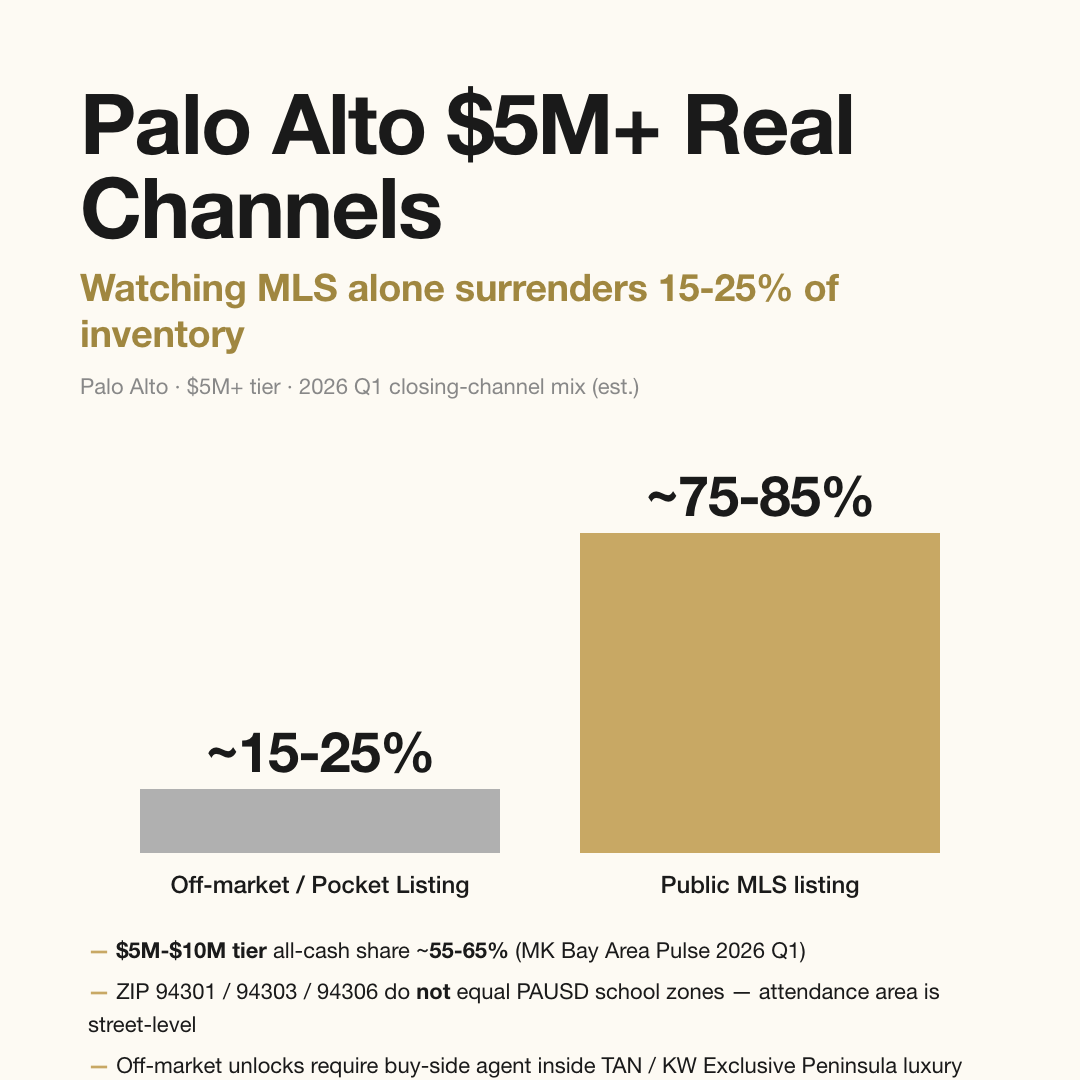
At the $5M+ tier in Palo Alto, off-market is no longer a side channel — it is a meaningful slice of inventory. MK Bay Area Pulse 2026 Q1 estimates that roughly 15-25% of $5M+ Palo Alto closings occur off-market — distributed through Top Agent Network (TAN), Keller Williams Exclusive Properties, local broker private email lists, or relationship-based introductions. Sellers go off-market for three main reasons: privacy (high-net-worth households don't want a Zillow page neighbors can scroll), avoiding the "stale listing" penalty (a long-listed and reduced home reads as damaged), and testing the market (run the private channel first, decide later whether to expose on MLS).
For buyers, the implication is direct: if you only watch MLS, you self-deselect from 15-25% of the inventory at the $5M+ tier. Accessing off-market requires that your agent operate inside TAN, KW Exclusive Properties, and the equivalent local trophy-broker networks, and that you've briefed them on your buyer profile at least 30-60 days before active touring.
Cross-border and all-cash buyers have an additional layer of work in Palo Alto: FinCEN GTO (Geographic Targeting Order) requires Title to report beneficial ownership for any all-cash purchase above the program threshold; cross-border wires move through Bank of America / Chase / Wells Fargo AML review and typically need 5-15 business days to clear, so funding logistics have to be planned before signing an offer; foreign-entity or trust vesting requires EIN setup, Title-company acceptance of the structure, and IRS paperwork (W-8BEN-E, Form 5472, etc.). None of that is part of a standard escrow checklist — it requires a Title / attorney / CPA team that has actually run cross-border closings before.
The Palo Alto seasonal calendar and how it shapes pricing power
Palo Alto is a PAUSD-driven market, and buyer demand concentrates sharply in March through May — parents need to close and move in during June or July to register with PAUSD for the August start of fall term. That makes spring the most contested window of the year. First-week showings of 5-15 offers are routine in spring, and Gunn High attendance-area homes hit an extreme of 27 offers on a single listing in spring 2025.
The reverse is also true. Fall and winter (October through February) run at roughly 35-40% of spring transaction volume, with fewer competing bidders and sellers more willing to entertain contingencies. If your timeline isn't bound by the school calendar — for example, your child is already in middle or high school where transferring mid-year is manageable — fall and winter give you the largest negotiating window of the year. MLS shows that fall and winter sale-to-reference premiums typically run 5-12% lower than spring.
Pre-underwriting (loan committee approval with only the appraisal still outstanding) is now standard at the $3M-$8M tier in Palo Alto — pre-approval letters alone are not enough, because you're competing against all-cash and pre-underwritten offers. At the $8M+ tier, buyers who need a Bridge Loan (short-term financing secured against an existing asset to free up purchase cash) should engage a local high-net-worth lender (First Republic / City National / Bank of the West / Wells Fargo Private Banking) 30-60 days before targeting a specific home, validate the bridge limit their asset mix can support, and prep documentation. The bridge approval timeline runs 2-4 weeks; starting it after you've found the house means you've missed the bidding window.
MK Group field notes: two Palo Alto buyer scenarios
Across recent Palo Alto buyer engagements, two scenarios best illustrate why this decision framework matters.
Scenario one: cross-state, education-driven family. A dual-income AI research couple at a large Seattle tech employer with an 8-year-old daughter decided in spring 2026 to move to the Bay Area. The employer has an equivalent AI team in the Bay Area, so transferring (or simply staying remote long-term) is a non-issue — the opportunity cost of the move is essentially zero. They chose Palo Alto over Atherton and Los Altos Hills with a clear logic: both spouses are still working day jobs (commute and routine still matter), PAUSD public schools function as a real floor (even if a private path eventually wins out, the public stack is one of the strongest in the Bay Area), and walk- or bike-distance to Stanford is a hard requirement. MK Group's most important contribution was the city filter — before they flew down, the candidate set was already collapsed from "PA / Atherton / Menlo Park / LAH" into "Palo Alto, inside PAUSD" and ranked against four explicit constraints (still working / public floor / near Stanford / no need for a 1-acre lot). They closed in early May 2026, with elapsed time from initial contact of a few months.
Scenario two: a $10M all-cash buyer in Palo Alto, lost the home overnight. MK Group took a $10M all-cash buyer through a Palo Alto trophy listing priced at $10M. The interior finish, materials, and renovation quality matched the buyer's spec. The buyer wanted to "sleep on it" — by old mid-tier instinct, $10M homes don't have immediate competition. The next morning the home was already pending, taken by another buyer. The client's reaction: "even at $10M, it goes that fast?" This is not an outlier. Per MK Bay Area Pulse 2026 Q1, the $5M-$15M tier inside the Stanford ring is now in a "high-net-worth-buyers competing against each other" regime — budget is no longer the scarce resource; judgment speed and execution certainty are. Three takeaways from the debrief: scarcity assessment must be done on the day of listing (not after the showing), all-cash is no longer the trump card (the other side likely also paid cash), and pre-inspection, disclosure pack, and proof of funds must be assembled before walking into the showing — compressing the showing-to-signable-offer window from 24 hours to 4-6 hours.
5 Common Pitfalls
Pitfall 1: "ZIP code 94301 / 94303 / 94306 determines the school zone"
Palo Alto ZIP codes do not equal PAUSD attendance areas. A single ZIP can cross 2-3 different elementary zones, and same-street odd-versus-even house numbers landing in different elementaries is documented. Treat the PAUSD official "Attendance Area Lookup" output as the only source of truth. Never rely on ZIP code. And never rely on listing copy that says "in the Walter Hays district" — listing description is not a legal record, Title doesn't verify it. Look it up yourself before signing.
Pitfall 2: "$5M+ all-cash guarantees winning a Palo Alto trophy home"
MK Bay Area Pulse 2026 Q1 estimates all-cash share at roughly 60% in the $5M-$10M tier and 55-65% at $10M+ inside the Stanford ring. At the trophy tier your competition is almost certainly also all-cash, and the financing differential has collapsed. The real winning variables here are decision speed (full diligence inside 24 hours), execution certainty seen from the seller's side (pre-underwriting, clean contingency stack), and term flexibility (rent-back, fast close). Cash without speed is no longer enough.
Pitfall 3: "Just watching MLS covers the whole Palo Alto market"
An estimated 15-25% of Palo Alto $5M+ closings occur off-market per MK Bay Area Pulse 2026 Q1. If you only watch Zillow / Redfin / Compass.com, you self-exclude from that slice — and that slice often contains the homes where the seller is most willing to negotiate (sellers go off-market to avoid stale-listing damage, not because the home is flawed). To access off-market, your buyer-side agent has to operate inside the local trophy-broker network, and you need to brief them 30-60 days before active touring.
Pitfall 4: "Wait until April and ride the spring peak"
This is backwards. For PAUSD-driven families, "spring peak" actually means "sign offer in March-May, close in June-July, enroll in August." By the time you start touring in April, serious families have already aligned with their agent in January-February and locked their shortlist in early March. Arriving in April puts you into the most contested window (5-15 offers as normal), with no time to do off-market sourcing or pre-underwriting. Engaging an agent 60-90 days in advance — running comps, pre-touring, and resolving financing — is the normal cadence for spring Palo Alto buyers.
Pitfall 5: "Palo Alto older homes can freely add ADUs to capture value"
Palo Alto's ADU (Accessory Dwelling Unit) policy is shaped by California SB9 / SB10 but layered with city-specific constraints — especially Old Palo Alto and Professorville, which have homes on the Historic Resource Inventory. Any exterior modification (roofline, windows, street-facing facade) requires Historic Resources Board review, and the timeline can run 6-18 months. Pre-1976 homes also bring California Title 24 energy compliance and lead-paint / asbestos disclosure and remediation. Before pricing in ADU-driven value, have your agent pull the specific Planning Department restrictions and the lot's actual zoning (R-1 / R-2 / historic overlay). Generic "California opened up SB9 lot splits" intuition does not apply uniformly inside Palo Alto.
Next steps
- Lock the budget tier — be specific: $2M-$3M / $3M-$5M / $5M-$8M / $8M-$15M+. Get pre-approval or proof of funds in place first (all-cash buyers should pre-stage bank statements and source-of-funds documentation).
- Shortlist 2-3 neighborhoods — based on lifestyle (walkability / lot size / school target / commute direction), pick 2-3 of the 7 Palo Alto neighborhoods for deep focus.
- Run every candidate through the PAUSD official attendance lookup — confirm the elementary / middle / high assignment for each property at the street-address level. Do not trust the listing description.
- Open the off-market channel — if you're in the $5M+ tier, brief your agent 30-60 days early and make sure they're operating inside TAN, KW Exclusive Properties, and equivalent trophy-broker networks.
- Finalize pre-underwriting — at the $3M-$8M tier, pre-underwriting (not just pre-approval) is required. At $8M+ with bridge-loan needs, engage a local high-net-worth lender 30-60 days early. Cross-border buyers should plan the wire-transfer path and FinCEN GTO reporting requirements in advance.
Frequently Asked Questions
How do I look up the PAUSD attendance area for a specific address?
Use the PAUSD official "Attendance Area Lookup" tool — search "PAUSD attendance area lookup" to find the official page, enter the candidate property's full street address, and the system returns the assigned elementary (one of 12), middle (one of 3), and high school (Palo Alto High or Gunn High). ZIP code (94301 / 94303 / 94306) does not equal the attendance area; a single ZIP can cross 2-3 different elementary boundaries. Listing descriptions that name a school are not legal records — verify the address yourself before signing an offer. PAUSD periodically adjusts boundaries; the most recent material adjustment was in 2019.
Which Palo Alto neighborhood is best for a family buyer?
It depends on budget and lifestyle. If your budget is $3M-$5M and the central requirement is PAUSD public-school floor, Midtown / South Palo Alto / Barron Park offer the best value-per-dollar, and the typical buyer is an engineering family. If your budget is $5M-$10M and you value walkability to downtown, Community Center and the western edge of Old Palo Alto fit best. If your budget is $8M+ and you want large lots, privacy, and mature canopy, Crescent Park and Old Palo Alto are the canonical choices. Important caveat: across PAUSD's 14 schools, GreatSchools ratings cluster in the 7-10 band — the spread between schools inside PAUSD is much smaller than the spread between neighborhoods on price. Neighborhood choice is fundamentally a lifestyle choice, not a school choice.
What's the price tier and median in Palo Alto?
Per MLSListings 2025-2026 data, the Palo Alto single-family median sits in the $3.6M-$3.9M range. By tier: $2M-$3M entry corresponds to edge-of-city Midtown / Barron Park 1,200-1,500 sqft 1950s-1960s ranch stock; $3M-$5M mainstream is where PAUSD-driven families concentrate, 1,600-2,200 sqft; $5M-$8M high-end enters Community Center / Crescent Park entry / high-spec South PA, 2,300-3,000 sqft; $8M-$15M+ trophy is Old Palo Alto and core Crescent Park, 3,500-6,000 sqft on 12,000-20,000 sqft lots. The $15M+ "ultra-trophy" segment closes roughly 10-20 homes per year, almost all in Old Palo Alto and Crescent Park.
Does cash-only really win in Palo Alto?
It depends on tier. At the $2M-$5M mainstream tier, all-cash share is relatively low (roughly 25-35%), and all-cash is a meaningful competitive edge. But at $5M+, MK Bay Area Pulse 2026 Q1 estimates all-cash share at 55-65%, and your competition is very likely also all-cash — the financing differential has collapsed. The variables that actually decide winners at $5M+ have shifted from "cash vs financing" to "decision speed, pre-underwriting, clean contingency stack, and seller-side trust in your execution certainty." MK Group had a real 2026 case: a $10M all-cash buyer wanted to "sleep on" a fit-perfect Palo Alto home; by the next morning it was pending with another buyer who was also all-cash and decided faster.
What additional documentation do cross-border buyers need in Palo Alto?
Beyond standard escrow, cross-border buyers need to prepare: (1) FinCEN GTO reporting — for all-cash purchases above the program threshold, Title must report beneficial ownership, requiring passport / ID and a source-of-funds narrative; (2) AML compliance — cross-border wires are subject to U.S. bank AML review and typically take 5-15 business days to clear, so funding logistics must be locked before signing an offer; (3) foreign-entity or trust vesting documentation — EIN application, W-8BEN-E / Form 5472 IRS forms, and Title-company written acceptance of the structure; (4) cross-border tax planning — FIRPTA withholding (on future sale), California residency analysis, and treaty coordination with China / Singapore / Hong Kong / Taiwan jurisdictions. None of this is included in a standard escrow checklist; it requires a Title / attorney / CPA team that has actually closed cross-border transactions before. Plan to assemble the team 30-60 days before locking a target home.