Direct Answer First
The Silicon Valley private vs public school decision isn't "which one is better" — it's how four interlocking axes resolve for your family: (1) Total K-12 cost — private K-12 runs $500K-$800K in tuition over 13 years vs public's "zero tuition but $1M-$3M PAUSD home premium"; (2) College outcomes — Harker, Castilleja, Menlo School and Crystal Springs post Ivy+ admit rates of 15-22%, PAUSD's Paly and Gunn around 8-12%, but the gap narrows to under 5% once you control for family SES and student drive; (3) Academic-environment fit — private average class size 12-16 vs PAUSD 24-30, Nueva and Mid-Peninsula serve learning differences, IB vs AP vs Honors curricula differ materially; (4) Operational fit — commute (Stanford Online K-8 fully remote vs Harker 30-minute drive), schedule, parent time investment. The most common optimal answer isn't picking a side — it's a hybrid path (K-5 public + 6-12 private, or K-8 private + 9-12 PAUSD). This article walks the four axes, provides side-by-side data on 15+ key Silicon Valley schools, and surfaces the five most common decision pitfalls Bay Area families fall into.
Who This Article Is For
- Silicon Valley tech families (household income $300K+) with kids in Pre-K through 5th grade: making the first major K-12 education path decision.
- Cross-border buyers (from China, Singapore, Hong Kong, Taiwan) deciding "buy a home first, or pick a school first": "education-driven landing in Silicon Valley".
- Dual-tech engineer households at Apple, Google, Meta, Nvidia, or major AI companies: RSU-heavy income but cash flow constrained by equity vesting.
- VC and founder families with abundant liquidity: weighing whether private's "small classes plus network" is worth $60K-$80K per year per child.
- Current PAUSD / FUHSD / CUSD / LASD school-zone homeowners: already paid the zone premium, but the child's learning style doesn't fit large classes.
Axis 1: Total K-12 Cost Over 13 Years
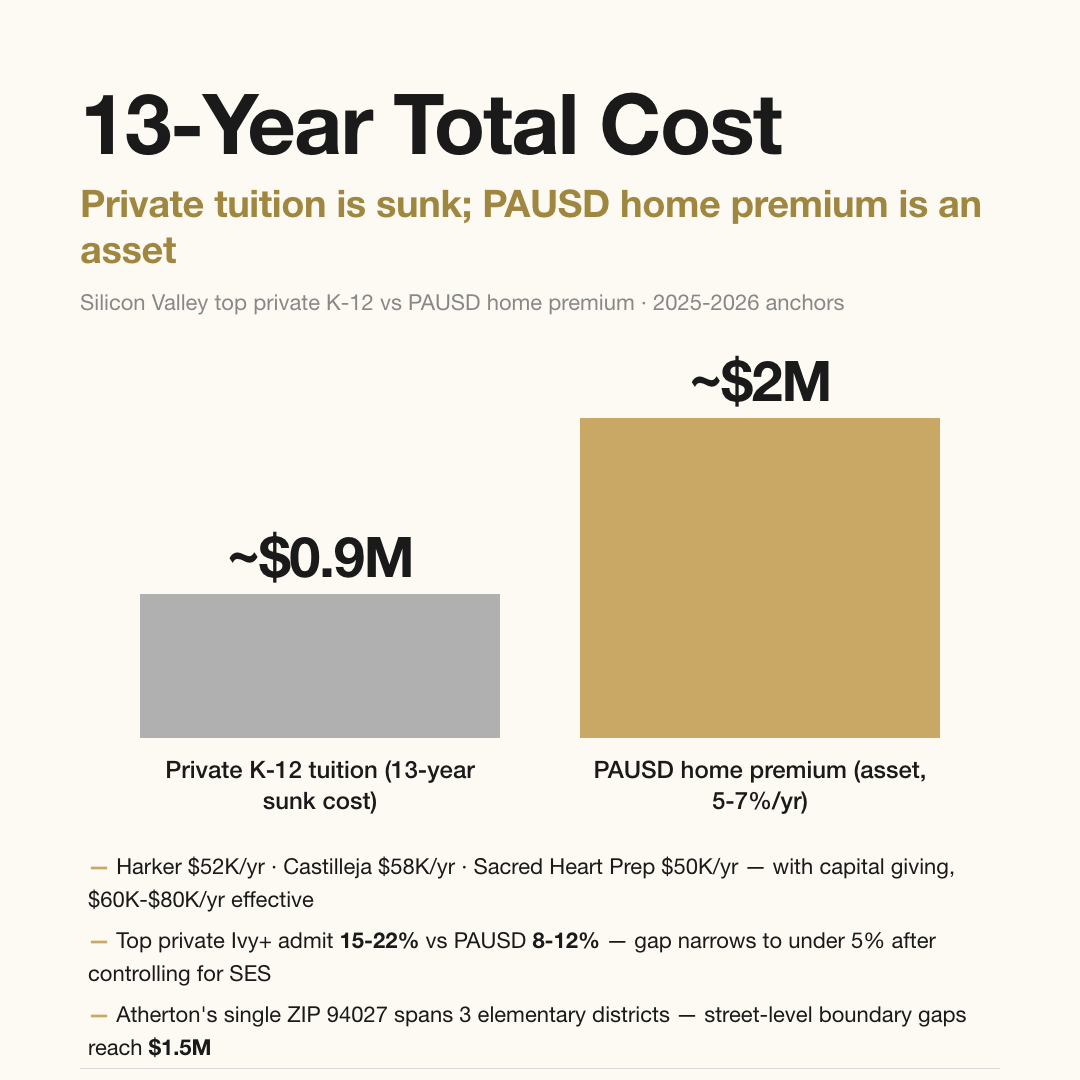
Key numbers first: Silicon Valley top private K-12 annual tuition runs $50K-$60K (Harker $52K, Castilleja $58K, Sacred Heart Prep $50K, Menlo School $56K, Nueva $52K are the current anchor prices). Add capital giving and extracurricular costs and effective annual spend reaches $60K-$80K. Over 13 years that accumulates to $780K-$1.04M. The public path has zero tuition but PAUSD school-zone homes carry a $1M-$3M premium versus comparable non-PAUSD homes.
The table below shows the Silicon Valley private schools most commonly compared by Peninsula families. Tuition figures are published 2025-2026 academic year; most schools also carry capital giving expectations ($5K-$20K/yr), senior-class fees, and overseas program costs. Verify the latest figures on each school's official website.
| School | Annual Tuition | Grades | Notes |
|---|---|---|---|
| Harker School (San Jose) | $52K-$56K | K-12 | Largest SV private, STEM-leaning |
| Castilleja (Palo Alto) | $56K-$60K | 6-12 all-girls | Bay Area's flagship all-girls school |
| Menlo School (Atherton) | $54K-$58K | 6-12 | Athletics and academics both strong |
| Sacred Heart Prep (Atherton) | $48K-$52K | 9-12 | Catholic tradition, strong community |
| Crystal Springs Uplands (Hillsborough) | $52K-$56K | 6-12 | Small-class depth, Peninsula top tier |
| Nueva School (Hillsborough) | $50K-$54K | PK-12 | Gifted education flagship |
| Stanford Online High School | $32K-$36K | 7-12 fully online | Remote flexibility, academically rigorous |
| Pinewood School (Los Altos Hills) | $45K-$50K | K-12 | Family atmosphere, South Bay mid-size |
| Mid-Peninsula High (Menlo Park) | $58K-$62K | 9-12 | Serves students with learning differences |
| BASIS Independent Silicon Valley (San Jose) | $36K-$40K | TK-12 | International curriculum, STEM-heavy |
| Archbishop Mitty High School (San Jose) | $24K-$28K | 9-12 Catholic | Catholic private, strong value |
What to remember: take Sacred Heart Prep at $50K/yr, multiply by 13 years, add capital giving — the full pathway lands at $780K-$1.04M and is non-recoverable. Once paid, it's sunk. Mitty at $24K-$28K is a meaningfully cheaper Catholic private option many Peninsula families pick as a "private but budget-rational" middle path.
A comparable detached home inside PAUSD carries roughly $1M-$3M in zone premium versus the same home in non-PAUSD areas. Cupertino FUHSD/CUSD homes carry $500K-$1.5M. Los Altos High zone homes run $800K-$1.5M over comparable nearby non-zone homes. But home-zone premium and private tuition differ fundamentally in nature: the zone home is an asset, and Bay Area top school-zone homes appreciate roughly 5-7% per year — a $1M premium held for 12 years can grow to $1.8M-$2.3M, leaving net appreciation of $800K-$1.2M after loan costs. Private tuition is consumption — once paid, it's gone.
Axis 2: College Outcomes (Real Data Ranges)
Key numbers first: top private and top public outcomes sit in the same league, with differences much smaller than the tuition spread suggests. Harker Ivy+ admit rate is roughly 15-20%, Castilleja 15-22%, Menlo School 12-18%, Crystal Springs 12-18%. PAUSD's Paly and Gunn run UC Berkeley/UCLA admit rates of 15-20% and combined Ivy+ around 8-12%. FUHSD's Monta Vista and Lynbrook post Ivy+ around 5-10%, with Monta Vista's STEM competition depth ranking in the national top 20. LASD's Los Altos High Ivy+ runs 6-10%.
The counterintuitive point to remember: the headline gap between top private and PAUSD Ivy+ admit rates (15-20% vs 8-12%) is surface data. Once you control for family socioeconomic status (SES) and individual student characteristics, the gap narrows to under 5%. Education research consistently shows that reading PAUSD vs Harker isn't the dominant driver of college outcomes — family culture, student drive, and application strategy are.
Axis 3: Academic-Environment Fit (Beyond Admit Rates)
Once admit-rate data is on the table, the real determinant of whether a child will thrive at a given school is academic-environment fit. Four specific dimensions matter:
3.1 Class Size and Student-Teacher Ratio
Harker averages 15-18 students per class with a 1:8 student-teacher ratio. Castilleja runs 12-16 students per class at 1:7. Nueva runs 12-15 at 1:6 to 1:8. PAUSD's Paly and Gunn run 24-30 students per class at roughly 1:20. FUHSD's Monta Vista hits 35+ in some AP courses. Class size changes feedback frequency (weekly 1-on-1 writing review vs monthly), discussion space (a 15-student class gives each student 5-8 daily speaking opportunities vs 1-2 in a 30-student class), and depth (Socratic seminars work in 12-student rooms, much harder at 30).
3.2 Curriculum Architecture (IB / AP / Honors)
PAUSD's Paly and Gunn offer 30+ AP courses with deep coverage. FUHSD's Monta Vista and Lynbrook offer 25-30 APs, and their STEM AP courses (Calc BC, Computer Science, Physics) match Harker in instructor quality and exam pass rates. Nueva's gifted education program offers dedicated acceleration paths for IQ 130+ students. Mid-Peninsula High serves students with learning differences. Conclusion: on curriculum breadth, PAUSD and top privates are roughly even.
3.3 Peer Composition
Gunn High enrolls 1,900+ students, Paly 2,000+. Harker enrolls 1,200+ across middle and high school, Menlo School 600+, Castilleja 450+. The scale difference matters: Gunn's "AI research group" might have 30+ members; Castilleja's comparable interest group might be 5-8 people. Cross-border families: STEM-leaning privates like Harker, Mitty, and BASIS have higher Asian-American student percentages (30-60%); Sacred Heart Prep, Menlo School, and Crystal Springs have lower percentages (10-20%) but offer deeper access to mainstream American elite networks.
3.4 Learning Style and Special Needs
Nueva: designed for IQ 130+ gifted students. Mid-Peninsula High: designed for high schoolers with learning differences. Stanford Online High School: fully online, suitable for students who don't fit traditional schools. This is the axis where "private vs public" really differs: PAUSD does excellent for mainstream students but lacks targeted support for edge populations.
Axis 4: Operational Feasibility
This is the most-ignored axis. Even when parents conclude "Harker is the best fit" on the first three axes, if the family lives in Los Altos Hills, the daily 30-40 minute one-way drive to San Jose accumulates to 1,500+ hours over 5 years.
4.1 Commute Distance
Harker's main campus is in San Jose Saratoga — 30-40 minutes one-way from Palo Alto / Atherton. Castilleja sits in downtown Palo Alto — walking or biking distance for PAUSD families. Menlo School and Sacred Heart Prep are in Atherton. Stanford Online High School: zero commute. Practical recommendation: families with one-way commutes over 25 minutes should build a "5-year time budget".
4.2 After-School and Extracurricular Load
Private extracurricular density typically exceeds public. Harker robotics, Castilleja debate, Menlo School varsity athletics all expect 2-4 hours of daily after-school commitment. Dual-career households need to weigh this carefully.
4.3 Peer-Family Culture
Private school parent communities are tight. Parents are expected to commit 50-100 volunteer hours per year plus capital giving. PAUSD parent communities exist but are loose.
Silicon Valley Top Public Districts at a Glance
- PAUSD (Palo Alto Unified): 13 elementaries + 3 middle schools + 2 high schools (Paly, Gunn). Home premium $1M-$3M.
- FUHSD + CUSD: Cupertino's main feeder. Monta Vista and Lynbrook are FUHSD flagships. Home premium $500K-$1.5M. STEM-competition strong. Asian-American family percentage 60-75%.
- LASD + MVLA: Los Altos main feeder. Los Altos High is MVLA's flagship. Home premium $800K-$1.5M.
- MPCSD + Sequoia Union: Menlo Park's main feeder. Menlo-Atherton High is Sequoia Union's strongest. Home premium $600K-$1.2M.
- HCSD: Hillsborough's primary K-8 (extremely low student-teacher ratio).
MK Group's Observation: School and Home Decisions Should Not Be Separated
Marie Wang, in serving Silicon Valley high-net-worth families over the past several years, has repeatedly observed: families treat "school district decision" and "home purchase decision" as two separate processes, ending up with suboptimal outcomes on both.
MK Group uses a "joint education and home planning" method. Kevin Mo ran the numbers: a family at a given budget choosing Menlo Park instead of Palo Alto saved $500K-$800K on the home, which over a 30-year loan reduces monthly payments by $35K-$55K per year — almost exactly the cost of one child's tuition at Sacred Heart Prep or Menlo School.
Real Case: The Street-Level Risk of School Boundaries
In 2025, MK Group helped a client doing due diligence on a home in Atherton Oaks uncover a typical trap: the town of Atherton spans three different elementary school districts (Las Lomitas, Menlo Park City, Redwood City), with assignment determined by street. The client's preferred home sat on the "wrong side" of the boundary. MK identified a comparable listing a few streets over on the "correct side". The price gap: $1.5M. Full case study → Atherton Oaks school boundary near-miss
Another case in 2026: a Seattle AI big-tech dual-income couple relocating with their 8-year-old daughter to Palo Alto. They chose PAUSD over private because (1) both still actively employed; (2) PAUSD provides a strong "fallback"; (3) Palo Alto is walking distance from Stanford. Full case study → Seattle AI couple's education-driven move to Palo Alto
5 Common Pitfalls
Pitfall 1: "Private tuition is $50K/yr, we can afford that"
Capital giving expectations at Harker, Castilleja, Nueva run $5K-$15K/yr; board-tier family implicit expectations can reach $20K-$50K/yr. Add extracurricular fees and overseas programs and the 13-year total runs 15-25% above "tuition × 13". If household income is $400K with Bay Area's high tax burden leaving about $250K after-tax, and K-12 dual-child private runs $130K-$160K/yr — the math doesn't work.
Pitfall 2: "Harker / Castilleja admit rates are double, so they must be better"
Once you control for family SES, child drive, and application strategy, the top-private vs PAUSD gap narrows to under 5%. In plain language — if your family is "high SES + push-the-child culture + sound application strategy", your child's odds of getting into Stanford from Gunn are essentially the same as from Harker.
Pitfall 3: "Buy a PAUSD zone home first, college outcomes will be safe"
If the family actually plans to go private (especially switching to Castilleja / Menlo School / Sacred Heart for middle or high school), the zone premium equals "paying for a service you won't use".
Pitfall 4: "Private can be a fallback, just try it for a year"
Exiting a top Bay Area private school is materially harder than families expect. Once a child leaves, the original seat is not held. Pressure-test the decision against a "minimum 4-year commitment" before signing.
Pitfall 5: "Look at the district rating, skip the boundary check"
Atherton's entire zip code 94027 spans three different elementary districts. Parts of Mountain View feed MVLA / Los Altos High; other parts feed MVWSD / Mountain View High. Buyers must do street-level attendance area verification.
Next Steps
- Build a four-axis scorecard for your family: rate your child on a 1-5 scale across total-cost capacity, college-path preference, academic-environment fit, and operational feasibility.
- Visit 2-3 candidate schools in person: Open House, Shadow Day, Parent Coffee.
- Run a 13-year cash flow model.
- If choosing public, do street-level attendance area verification.
- If choosing private, run a "4-year commitment test".
Frequently Asked Questions
What's the total 13-year tuition for top Silicon Valley K-12 private schools?
Silicon Valley top privates currently run $50K-$60K/yr. Add capital giving ($5K-$15K/yr), extracurricular projects, and senior-class fees and effective annual spend reaches $60K-$80K. Over K-12 (13 years), the cumulative total runs $780K-$1.04M. Stanford Online and Catholic private Mitty are materially lower, with 13-year cumulative around $400K-$600K.
How big is the PAUSD vs Harker outcome gap — is it really worth $800K in tuition?
Surface data: Harker Ivy+ admit rate around 15-20%, PAUSD Paly / Gunn around 8-12%. But once you control for family SES and individual student characteristics, the gap narrows to under 5%. The defensible reasons to choose private are small classes + individualized attention + specific educational philosophy + child's learning style — not "2x admit rate".
I already bought a PAUSD school-zone home — should I still switch to private?
Probably not. PAUSD zone premium of $1M-$3M is a real cost; switching to private means "paying for a zone you don't use". Unless your child has clear structural mismatches, sticking with PAUSD public is the capital-optimal answer.
Atherton / Menlo Park / Cupertino — which district offers the best value?
Pure college-outcome value: Cupertino FUHSD — zone premium $500K-$1.5M but UC admit rates higher (~25-30% vs PAUSD ~18-22%). Luxury + school combined: Atherton — zone home $5M+, school quality on par with PAUSD. Strong K-8 + private high school: Menlo Park / Hillsborough.
Cross-border families (from China / Singapore / Hong Kong) — how should we choose?
Cross-border families face additional constraints: (1) Cultural adaptation; (2) Private admission timing windows — most Silicon Valley top private admission cycles run October to January with February decisions, plan 12-18 months ahead; (3) Choosing private decouples "where you live" from "where the child studies". About 60% of MK Group's cross-border family clients ultimately choose a hybrid public-private path rather than picking a side.
Related Reading
School comparisons / budget tiers
School + home buying
Case references