The Direct Answer
Relocating to the Bay Area for your child's schooling, whether you make fall enrollment turns on one thing: the district's registration deadline. You have to be moved in — and holding two proofs of residency — before it passes; the closing date itself is secondary. California public schools enroll by residency, not by ownership of the school-district house, so renting or buying inside the attendance area both qualify. But most Peninsula districts open new-student registration back in the prior spring (roughly February to April), and fall term starts in mid-to-late August. Waiting until August to close is the most common — and most overlooked — way to miss it.
Who this article is for
- Families relocating to the Bay Area for their child's education with the target district already locked in: you've confirmed which district the house sits in; what's left to solve is "when do I close, and move in, to make this fall's start."
- Cross-state, cross-border, or remote buyers: you can't tour open houses on a weekend, your window on the ground is short, and your move-in and registration windows are compressed the same way — you most need a timeline you can back-plan.
- Families planning to rent inside the area as a bridge first: you want to know whether a child can enroll on a lease alone, without a purchase, and whether that lease counts as proof of residency.
- Parents who want the enrollment logistics laid out as a checklist: you want an executable action list — confirm the boundary → move in → assemble proofs → register — not another ranking of which district is best.
Three dimensions that decide the timeline
Dimension 1: Enrollment is by residency, not by ownership — renting or buying inside the area both work
The basis for enrollment in a California public school is residency, not title to the school-district house. Under California Education Code §48200, a school-age child is to attend school in the district where the parent or legal guardian resides; §48204 goes further, deeming a student a resident so long as the parent or guardian genuinely lives inside the district's boundaries. Two things follow. First, you don't have to buy to enroll — rent inside the target district's attendance area, and a signed lease is valid primary proof of residency. Second, holding title without living there doesn't create eligibility — an empty house inside the area while the family still lives out of state does not satisfy residency. Put plainly, what decides enrollment is whether you and your child actually live in this district; whose name is on the deed doesn't settle it directly.
Dimension 2: The registration window plus move-in timing — why closing in August misses it
Fall term starts in mid-to-late August, and many families default to "we'll move in over the summer, that's fine." What actually pins the timeline is the district's registration (enrollment) window, which usually opens far earlier than the first day of school. Most Peninsula districts open new-student fall registration back in the prior spring (roughly February to April), with a firm deadline; miss the window, and you're often left on a waitlist or in late enrollment, with no guarantee of a fall seat. So the time anchor to watch is the registration deadline — frequently months ahead of the first day of class. The move is to check the target district's registration calendar first, treat the deadline as a hard constraint, and back out your closing and move-in dates from there. Close only in August, and the registration window may well have already closed.
Dimension 3: The two proofs of residency — in your name, with dates that line up
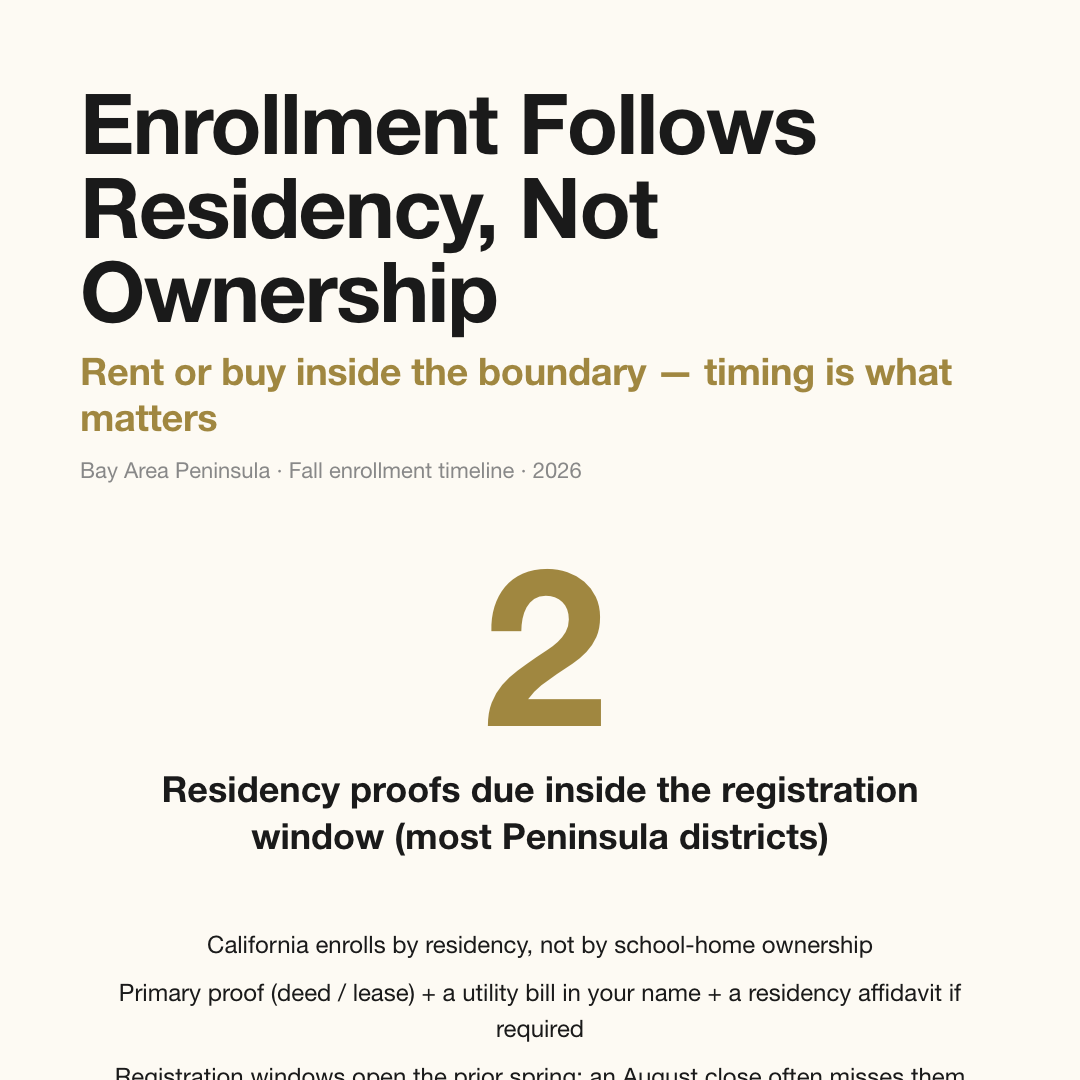
At registration, the district runs residency verification. Most Peninsula districts require two or more proofs of residency: typically one primary document (a grant deed, or a signed lease) plus a utility bill in your name (PG&E, water, and the like), and some districts also require a residency affidavit (a declaration of residency). Two details get missed. First, the bill must be in your own name at this exact address — not the seller's or a prior tenant's. Second, right after closing, your first utility bill in your name often takes another billing cycle to arrive. So assembling proofs isn't something you finish the day you move in; leave a buffer for the bill to issue.
The relocating family's enrollment timeline
The key dates first: fall term starts in mid-to-late August, but most Peninsula districts open new-student registration back in the prior spring (roughly February to April); you need to be moved in and have your proofs of residency filed before the district's registration deadline, rather than cutting it against the August start line. The whole chain is only four steps, and what actually catches people is the gap between step 1 (move in) and step 3 (register).
| Stage | Key action | Suggested timing (relative to a mid-to-late August start) |
|---|---|---|
| Step 0: Confirm the district boundary | Verify the house sits in the target attendance area by exact street address | Before the offer (spring or earlier) |
| Step 1: Establish residency | Close escrow or sign a lease, then physically move in | Ideally early summer, and before the registration deadline |
| Step 2: Assemble proofs of residency | Primary proof (deed / lease) + a utility bill in your name + (district-dependent) residency affidavit | As soon as possible after move-in; the bill must already carry your name |
| Step 3: Complete registration | Submit all documents within the district's registration window and pass residency verification | Window opens in spring, deadlines vary — clear it before the first day of school |
The one thing to remember: this chain most often breaks between step 1 and step 2 — plenty of families close only in August, move in fine, but the first utility bill in your name takes another billing cycle to arrive, and the district's registration deadline may already have passed. A signed lease or purchase contract can often let you begin registration, but final residency verification isn't complete until you've actually moved in and a bill is in your name. So the real margin of safety is to be both moved in and holding proof of residency in your name before the registration deadline; just moving in before the first day of school is often not enough.
Data source: California Education Code §48200 / §48204, the new-student registration and residency-verification pages of individual districts (PAUSD / Menlo Park City School District / Las Lomitas Elementary School District, among others), GreatSchools district profiles, and MK Group's front-line buyer-side observation
Updated: 2026-07
Scope: fall enrollment timelines and proof of residency for new students in Bay Area Peninsula districts; specific registration windows, deadlines, and document lists follow the current version on each district's official site
What MK saw on the ground
In MK Group's buyer work, enrollment logistics run as their own workstream alongside touring and offers — especially for remote and out-of-state families. Co-founders Marie Wang (DRE# 02110980) and Kevin Mo (DRE# 02127623) worked with a dual-career couple, both AI researchers at large Seattle tech firms, who relocated from Seattle to Palo Alto for the long game of their eight-year-old daughter's education. For cross-state buyers like these, every trip down to the Bay Area is only three to five days; the touring window is compressed, and the move-in and registration windows are compressed with it. If they hadn't put "which district is the house in, when does registration close, which proofs of residency are required" onto the calendar before flying down, it's easy to tour smoothly yet stall on the enrollment timeline. The right move for families like this is to reverse-engineer the enrollment chain off the touring schedule: fix the registration deadline first, then back out the latest date to move in and to close.
MK Group also spent years alongside a school-driven family that, for their child's district, ultimately bought a single-family home inside the attendance area in Menlo Park. Families who choose to buy rather than rent usually do so because they intend to stay for the long term. As a general path for school-driven buyers, buying only nails down the "residency" step — actually completing enrollment still means showing up within the district's registration window, primary proof (the deed) and a utility bill in your name in hand, to clear residency verification. Closing escrow is not the same as a completed registration.
But this whole chain rests on one precondition, and a single wrong step voids all of it: the house has to genuinely sit in the district you think it does. MK Group handled an Atherton case where the client had fallen for a home in the town center — an Atherton address, a century-old oak grove, everything right — except Atherton spans three separate elementary districts, assignment runs by street, and that house happened to land on the wrong side of a boundary. Miss that street-level check before the offer, and you can move in, assemble proofs, and register on schedule only to find the residency on that house buys a seat at the weaker school — the entire enrollment chain wasted. That's why the step-zero boundary check is the foundation this whole timeline stands on.
Common mistakes
Mistake 1: "Buy a house inside the area and my child is automatically assigned to the school"
Not automatically. Closing on a house is not the same as completing enrollment — you still have to register within the district's window, submit proof of residency, and pass residency verification. Buying only nails down the "residency" step; registration is a separate action you have to initiate. Every year, families assume "bought the school-district house, so my child has a seat," only to find in the summer that the registration window closed long ago and the child is left waiting on a list.
Mistake 2: "You must buy to enroll — renting won't work"
Not true. California public schools enroll by residency under Education Code §48200 / §48204, not by ownership. So long as you and your child genuinely live inside the target district's attendance area, renting satisfies the enrollment requirement just as well — a signed lease is valid primary proof of residency. Plenty of families relocating for a district rent inside the area first to lock in the seat, then take their time to find and buy — and that is entirely sound.
Mistake 3: "Once escrow closes, I can go register"
One step short. Getting the deed at closing is only one of the primary proofs; most Peninsula districts also require a second — usually a utility bill in your name — to corroborate that you actually live here. Right after closing, your first PG&E or water bill in your name often takes another billing cycle to arrive; some districts let you begin registration on a lease or purchase contract, but final residency verification waits until a bill is in your name. So build in buffer time for the bill to issue, and don't file your documents right up against the deadline.
Mistake 4: "School starts in August, so moving in over summer makes it"
Often too late. Most Peninsula districts open new-student fall registration back in the prior spring (roughly February to April), with a firm deadline; wait until summer to act and the window may already be closed, leaving only a waitlist or late enrollment. The right order is to check the target district's registration calendar first, treat the deadline as a hard constraint, and back out your closing and move-in dates from there — rather than defaulting to "moving in before school starts is fine."
Next steps
- Confirm the district boundary with no room left for doubt: verify by exact street address that the house sits in the target attendance area — this is step zero for the whole timeline. For how to do it, see How to verify which school district a Bay Area home actually belongs to.
- Check the registration calendar: open the target district's new-student enrollment / registration page, note the opening date and deadline for fall registration, and treat the deadline as a hard constraint.
- Match against the proof-of-residency list: on the same page, find the residency-verification / proof-of-residency requirements and check off item by item what you can provide — primary proof (deed or signed lease), a utility bill in your name, and (if required) a residency affidavit.
- Back out your move-in date: working backward from the registration deadline, set the latest date to close or sign the lease and physically move in, and leave one billing cycle of buffer for your first bill to issue in your name.
- If you're still choosing the city or district, settle assignment first: if you're still at the "buy in Atherton / Menlo Park — a city with several districts — and which one does my child actually attend" stage, work out the district assignment first: Buying in Atherton or Menlo Park — which school district do your kids actually land in?, and I'm an engineer in Silicon Valley looking to buy a school-district home in Palo Alto — how should I find an agent?.