The short answer
Find a bilingual agent who actually understands how a tech household buys — one who can translate your RSUs, ESPP and pre-IPO equity into buying power a lender will recognize, verify the PAUSD attendance area of every candidate home down to which side of the street it sits on, and explain why two homes both labeled “Palo Alto schools” can differ by $3M. Turn those three abilities into a single interview standard you apply to any agent, and hire whoever can answer all three.
Who this article is for
Engineers and their families working at Google, Meta, Apple, NVIDIA, Stripe, OpenAI or similar Bay Area companies, with a budget in the roughly $2.5M–$8M range, children aged 0–8, looking to settle into a long-term home inside the Palo Alto Unified School District (PAUSD). You may be buying for the first or second time, and you’re still figuring out how RSUs, ESPP and pre-IPO equity convert into buying power — and how to choose a buyer’s agent who genuinely understands that financial structure. What follows is an evaluation framework you can use on any agent, not a pitch for any one team.
Three dimensions that actually matter
Dimension 1: Can they turn RSUs, ESPP and pre-IPO stock into real buying power
A tech household’s balance sheet looks nothing like a W-2 buyer’s. The first thing a good buyer’s agent does is not show you more homes — it’s help translate your total compensation into a loan amount a lender will actually underwrite.
That starts with separating two things people constantly conflate: total comp is not cash, and paper equity is not a loan limit.
- Base salary is usually only part of the package. The rest is an RSU vesting schedule (four-year straight-line, or a back-loaded curve like 6-15-23-23), refresher grants, an ESPP discount, and performance bonus. Lenders treat each of these differently — the headline number on your offer letter is not what gets counted.
- Pre-IPO and private equity are assets, not income. Many engineers hold a large position in a still-private company (OpenAI, Anthropic, Stripe, Databricks and the like). A conventional lender generally won’t count it as income, but some private banks and portfolio lenders can pledge it as an asset for an asset-based loan — whether they will, and how much, depends on the company, the round, and the lender.
- The vesting cliff defines what counts right now. If you joined less than a year ago and haven’t cleared the one-year cliff, a lender may treat you as having no RSU income yet; once you clear it, your qualifying income can jump a full step overnight. Buying just before versus just after a cliff can move your pre-approval meaningfully.
How large is the real-world gap? The same household, taken to a lender who only looks at W-2 and base salary versus a private bank or portfolio lender who understands tech equity, can come back with materially different pre-approval ceilings — and that difference is often what decides whether you can buy in Palo Alto at all or have to step out to a cheaper city. So “can this agent connect me to the right lender” is itself part of your buying power.
How to test it: in your first meeting, ask directly — “Can you introduce me to two or three mortgage advisors who can model RSUs, ESPP and pre-IPO equity?” Ideally one conventional conforming lender, one private bank doing asset-based or portfolio loans, and one strong on jumbos. An agent who can’t answer, or names only one and can’t articulate how the three differ, is a pass. For the mechanics of turning private-company equity into a home, see turning pre-IPO stock into a Bay Area home: financing and holding structures.
Dimension 2: How precise are they on PAUSD attendance boundaries — down to one side of a street
The line between Palo Alto Unified (PAUSD) and its neighbors — Los Altos, Mountain View Whisman, Cupertino Union — runs down to one side of a street. On a single block, the homes on one side feed PAUSD (Gunn or Paly) while the homes across the street feed Mountain View Whisman or Los Altos. An address can read “Palo Alto, CA” with the right ZIP code and still not be in PAUSD at all. This is the single most common trap for buyers relocating from out of state or abroad.
It gets worse: the school matches on GreatSchools, Zillow and Redfin are algorithmic estimates, not authority. Along the southwest edge of Barron Park and in Charleston Meadows and Greenmeadow, those platforms are frequently wrong. The only authority is the PAUSD attendance-area lookup on the district’s own site, run address by address.
On this dimension, a competent agent does at least three things:
- Verifies the attendance area on the district’s own tool before you tour each candidate home, rather than copying the school label off the MLS sheet;
- Understands that PAUSD is not one undifferentiated zone — even within the district, elementary schools split between Walter Hays / Duveneck / Addison (the northern end) and Barron Park / Juana Briones / Hoover (the southern end), with very different cultures and parent communities, and the middle and high schools (Paly vs Gunn) each have their own attendance areas;
- Can explain PAUSD’s inter-district transfer policy honestly — getting a child into PAUSD from outside the district is extremely difficult, with only a handful of spots each year and a required hardship showing, so it is not something to plan around.
How to test it: when you schedule a showing, ask — “Exactly which elementary, middle and high school attendance area is this home in, and where did you confirm that?” If the answer is “Palo Alto schools” or a Zillow star rating, the precision isn’t there. To understand how districts map to price tiers, see Palo Alto vs Cupertino schools and Bay Area school districts by budget tier.
Dimension 3: Can they explain the price spread inside Palo Alto
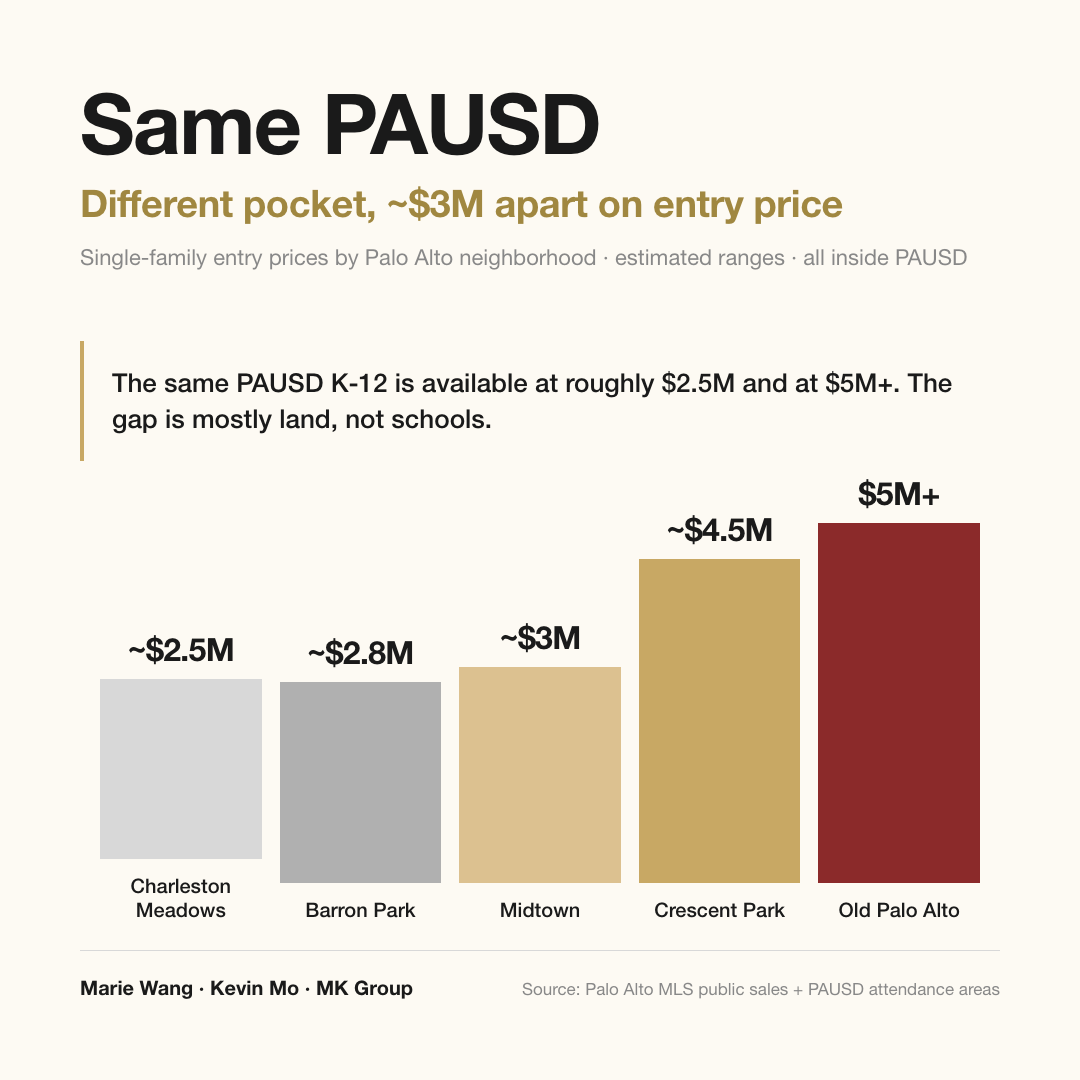
The other classic out-of-area mistake is assuming “Palo Alto schools” means one thing. In reality, two single-family homes both inside PAUSD can be $3M+ apart, and the reason is mostly land value and neighborhood character, not the schools. The identical PAUSD K–12 education is available to you at roughly $2.5M and at $5M+.
An agent who truly knows Palo Alto should be able to explain why Old Palo Alto’s entry price is roughly double Charleston Meadows’ as a land-value story — not wave at it as “that area’s just nicer.” Whether they can articulate that layer determines whether you end up stretching your budget for a legacy premium.
Entry prices by Palo Alto neighborhood
The key numbers first: inside the same PAUSD district, single-family entry prices in Old Palo Alto and Crescent Park start around $4.5M–$5M — and at that price you may be buying a roughly 1,700-sqft older ranch. The same money in Charleston Meadows, Greenmeadow or Midtown often buys a larger, renovated home, with entry as low as about $2.5M–$3M. The roughly $3M gap between the two ends is overwhelmingly land scarcity and a legacy premium for being near University Avenue and the Steve Jobs neighborhood — not a difference in schools. The table below covers Palo Alto’s main neighborhoods only, excludes East Palo Alto (not in PAUSD), and lists estimated ranges.
| Neighborhood | Main elementary (attendance area) | SFH entry price (estimated range) | Typical stock | Best fit for |
|---|---|---|---|---|
| Old Palo Alto | Walter Hays / Addison | ~$5M and up, no ceiling | Older ranch / Spanish / some renovated | Long-term holders who value the legacy address |
| Crescent Park | Duveneck | ~$4.5M and up | Older ranch / Eichler / a few new builds | Buyers wanting quiet, near University Ave |
| Professorville | Walter Hays | ~$4M and up | Historic cottages (often protected) | Buyers who love history and accept reno limits |
| Midtown | Hoover / Walter Hays | ~$3M and up | 1950s–60s ranch, often renovated | The value pick for dual-engineer families |
| Barron Park | Juana Briones | ~$2.8M and up | 1950s–80s ranch | Entry into PAUSD on value |
| Charleston Meadows | Hoover / El Carmelo | ~$2.5M and up | 1960s Eichler / ranch | First-time buyers stepping into PAUSD |
| Greenmeadow | Hoover | ~$2.5M and up | Mostly Eichler | Families who want the Eichler look |
The one thing to remember: Charleston Meadows, Greenmeadow and Barron Park are the realistic entry into PAUSD for an engineering family — roughly $2.5M–$3.5M buys a decent three-bedroom older home, your child still attends PAUSD K–12, and from the parent community to college support, you sit alongside the same families as Old Palo Alto. The only real difference is the luxury and lot size of the house itself. In other words, “Crescent Park sounds fancier” is rarely worth stretching for — the extra spend is mostly a land premium, not an education premium. Midtown is the middle ground: mid-priced, somewhat newer stock, moderate commute, and frequently the first choice for dual-income households. For a deeper look at that value tier, see what $4M buys in Palo Alto: why Midtown 94303 is the best-value pocket inside the Paly boundary.
Updated: 2026-06
Scope: Single-family homes in Palo Alto’s main neighborhoods; excludes condos / townhomes / East Palo Alto. Prices are estimated ranges; verify any specific home individually.
What MK Group sees in the field
When you run those three dimensions against real buyers, the story is remarkably consistent: a household starts fixated on Old Palo Alto or Crescent Park, and after actually doing the math and verifying schools home by home, more of them land in Charleston Meadows, Greenmeadow, Midtown or Barron Park instead. Not because they ran short on budget — because they concluded that a child attending PAUSD K–12 matters more than who the neighbors are, and that the money saved goes further in tutoring, summer programs and family life than in a land premium.
Talking a buyer through that “run the numbers, then change course” decision is exactly what a good buyer’s agent is for. Marie Wang and Kevin Mo of MK Group have seen versions of this path many times among relocating and education-driven families. One dual-income AI household moving cross-state from Seattle, with an eight-year-old, could transfer work to either coast — what pulled them here wasn’t pay but education: walking or biking distance to Stanford, plus PAUSD public schools as a floor, were their hard requirements. The work was to narrow the candidate cities back from the Atherton / Los Altos Hills luxury tier to Palo Alto, and — with only three to five days on each Bay Area trip — to run remote walkthroughs and data screening up front so on-site time went only to genuinely high-fit homes. Families like this — relocating for a child’s education, still working, wanting a public-school floor — tour different homes and ask different questions than a pure luxury-asset buyer.
The boundary issue isn’t theoretical, either. The team has helped buyers doing school due diligence near a town center discover that within one neighborhood, a few streets over, the elementary assignment jumps from one district to another — the home the buyer originally liked sat on the “wrong side” of the line, and comparable homes on the right side versus the wrong side traded about $1.5M apart. Verifying the attendance area street by street rather than trusting the ZIP code let the buyer change course in time and avoid a hidden loss that would otherwise have shown up dollar-for-dollar in the resale price.
For the founders’ perspective: Marie’s YouTube channel @MarieWang (44K+ subscribers) breaks down Palo Alto neighborhoods and Eichler decisions across several videos; Kevin’s @KevinMoRE (24K+ subscribers) runs series on equity allocation and the five-to-seven-year trade-up rule that speak more directly to a tech household’s financial planning. To get oriented on the buying process, start with buyer services and the Palo Alto buyer’s guide. What’s described here is MK Group’s method and process for serving these families, not a promise of any specific outcome — the framework in this article holds for any team that can do these three things.
Common misconceptions
Misconception 1: “A GreatSchools rating is enough to pick a school.”
A 10/10 on GreatSchools mainly reflects parent demographics and standardized test scores — not curriculum quality, college pathways, or your child’s actual experience. Inside PAUSD, Walter Hays, Hoover and Duveneck are mostly 9/10 or 10/10, yet differ widely in culture, parent pressure and intensity. Treat the rating as a starting point and tour two or three open houses before deciding.
Misconception 2: “A Palo Alto ZIP code equals PAUSD.”
ZIP codes 94301 / 94303 / 94304 / 94306 all contain addresses outside PAUSD. Before you buy, verify each address on the district’s own attendance-area lookup — don’t trust the MLS school label or Zillow’s match, especially in boundary neighborhoods where the platforms are frequently wrong.
Misconception 3: “It’s cheaper to wait for rates to drop.”
Tech households are prone to rate anxiety — waiting for the 30-year fixed to hit some target. But good Palo Alto inventory is chronically scarce; the moment rates ease, the best homes get bid back up. The monthly savings from a lower rate are often offset, or more than offset, by the higher total cost of a rising price. If you’ve decided to stay long term and your cash flow can carry it, “waiting for rates” is usually the more expensive strategy, not the cheaper one. For the underlying financial logic, see how a recent grad can afford a $5M Silicon Valley home.
Misconception 4: “Hire the agent who’s sold the most Palo Alto homes.”
High volume doesn’t mean “understands tech households.” Plenty of high-production Palo Alto agents specialize in cash buyers or 1031 investors and aren’t fluent in RSU / ESPP / pre-IPO structures, or in questions like “save for the down payment or max the 401(k) first.” A better question than total volume is: how many engineer-family buyers have you served in the last 12 months, and can you give me specific lender / CPA / contractor referrals?
Misconception 5: “Tour plenty of homes first, sort out the loan later.”
Good Palo Alto homes go under contract within 7–14 days of listing. A buyer without a pre-approval — ideally an underwritten pre-approval, not just a standard letter — has essentially no chance in a multiple-offer situation. Start “find an agent” and “find a lender” as the same step; don’t tour 30 homes and then circle back to financing, or by the time you know which home you want, you’re already a week late.
What to do next
- Inventory your real, usable capital. Base salary + the next four years of RSU vesting + ESPP + pre-IPO equity + 401(k) + any parental gift + existing home equity (if any) — then size it twice, once through a conventional lender’s lens and once through a private-bank / portfolio-lender lens, and look at the gap in borrowing capacity.
- Line up two or three mortgage advisors who understand tech households — one conventional conforming lender, one private bank doing asset-based loans, and one strong on jumbo / portfolio loans — and get a pre-approval from each to compare your real ceiling.
- Verify every address on the PAUSD attendance-area lookup. For each home you plan to tour, confirm the exact elementary, middle and high school yourself — don’t trust the MLS or Zillow label.
- Tour two or three candidate elementary open houses — Walter Hays, Duveneck, Hoover, Juana Briones, El Carmelo — to feel the difference in culture and parent community before you lock in a neighborhood.
- Interview two or three agents against the same standard. Ask each one: (a) which tech-savvy lenders can you recommend? (b) which exact attendance area is this candidate home in, and where did you confirm it? (c) how many engineer-family buyers have you served in the last 12 months, and what lender / CPA / contractor referrals can you give? Move forward only with the ones who can answer all three.