Quick Answer
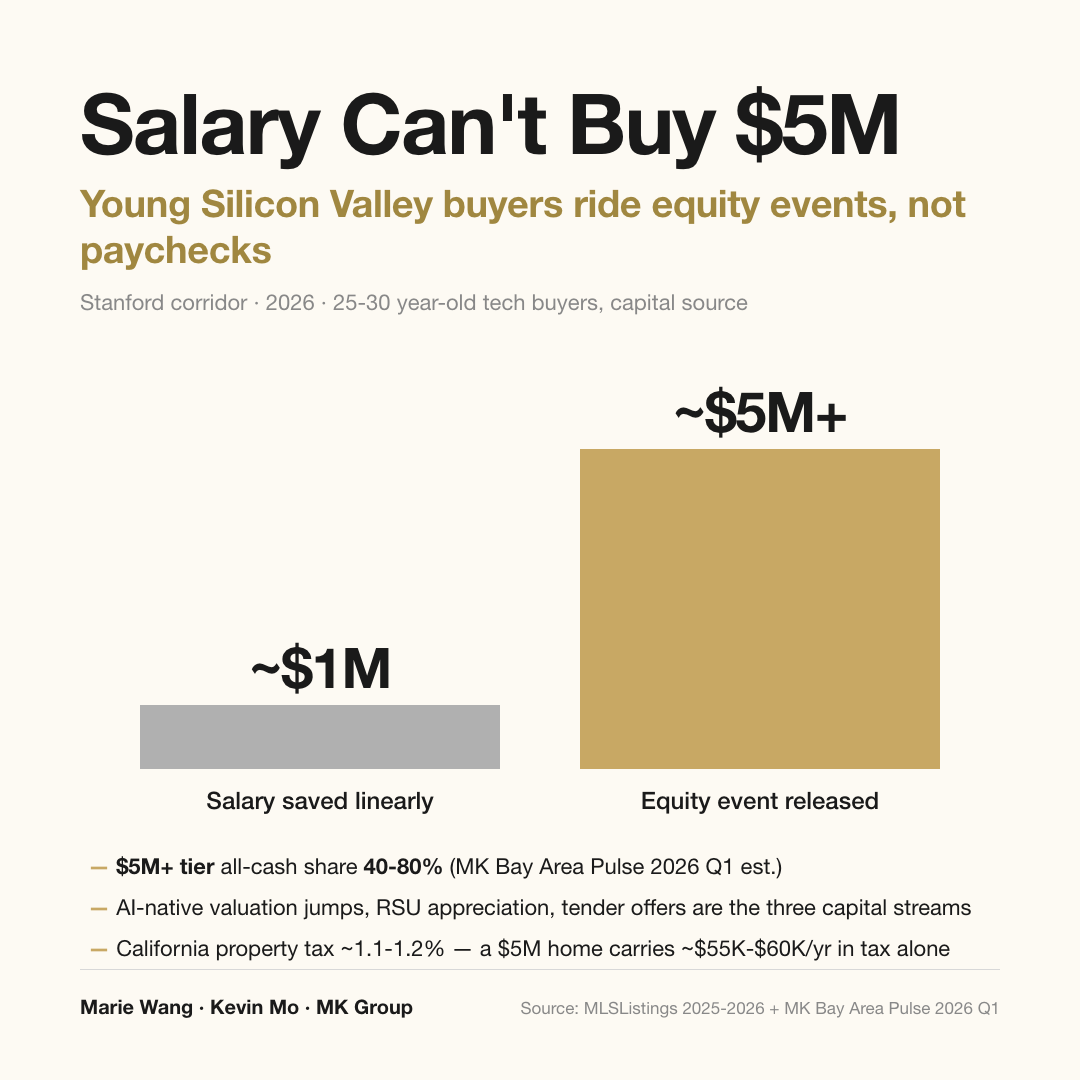
A Silicon Valley buyer one year out of school can afford a $5M home — not because the salary is absurdly high, but because of equity. Salary is income: it sets how much you can carry each month. Equity is an asset: it sets whether you can put a down payment together and clear the bar into the $5M+ market. Those are two completely different orders of magnitude. The people buying at $5M with only a year or two of work behind them are usually standing at a moment of fast asset appreciation — not riding linear salary growth.
Who this is for
- Tech buyers one to three years into an AI-native company or an established firm, trying to gauge whether their equity can carry a $5M budget.
- Anyone sitting on a large RSU or ISO position who can't yet separate the "total comp number" from the cash actually available for a purchase.
- First-time entrants to the Stanford corridor who want to know what $5M really buys, city by city, for a family.
- Anyone watching peers buy luxury homes young and wanting to understand the logic underneath it.
Three dimensions that define buying power
1. Did your wealth come from salary growth, or from asset appreciation?
This is the key to why Silicon Valley luxury buyers keep getting younger. Here, some people's wealth isn't stacked up through the steady, linear climb of a paycheck. It comes from a sudden expansion — a company's valuation leaps, a stock rises on an index-like curve, or a one-time event turns paper into cash. Salary is income; equity is an asset. The first sets how much you can carry each month; the second sets whether you can produce a down payment in one move. A person with one year of work, however high the salary, can rarely save a $5M down payment linearly. But if the stock in that person's hands completed an asset-scale expansion over that same year, the picture changes entirely. This is also why Silicon Valley prices and the local market can't be measured against a national yardstick.
2. Which kind of young buyer are you?
This cohort — 25 to 30, a year or two out of school, no family money, buying $5M entirely on their own — shares one trait: they got into the right industry at the right time. In practice they break into three groups. The first is people who joined an AI-native company (think OpenAI, Anthropic, xAI) one to three years ago at the right moment — they came in when the company was worth a few billion and it's now worth hundreds of billions, so even without converting to cash, the "income" inside the stock is substantial. The second is people already holding large RSU grants at an established firm (Google, Meta, Apple, NVIDIA) — NVIDIA and Meta shares have moved enormously over the past few years, and their real income runs far above base salary. The third is people who happened to hit a stock-liquidity window — the company raised, opened a secondary market, or ran a tender offer letting employees sell part of their position. This last group didn't save up bit by bit; at a single point in time they completed an asset conversion.
3. How far apart are the headline comp number and the cash you can actually deploy?
People often ask: these tech employees already earn so much — isn't a $5M purchase easy for them? Usually not. Public salary platforms show that engineers at Google, Meta, and OpenAI carry high total comp — a high-six-figure annual package is normal in the Bay Area, and AI firms pay more still. But total comp isn't cash. A large share of it is RSUs that vest over time, not money wired to your account on day one. A stock sale triggers tax, and the share price moves. So the headline comp number and the cash you can actually bring to a purchase are often far apart.
Assessing buying power: the four questions to ask in the first conversation
Because the income figure can mislead, Marie Wang and Kevin Mo don't open a first client conversation by asking "what's your income, how much can you bring." They ask four things — and these four are what truly define buying power.
- How much do you hold in liquid assets? — The part you can actually deploy, not the comp figure on paper.
- Has your stock vested? — Can it be sold at will, or is it sitting in a window where it can't (a blackout)? This directly sets when the down payment can be in place.
- What's your borrowing capacity? — Especially when base salary is a small slice of total comp, the loan that cash flow can support is limited.
- How much cash do you want to keep after closing? — Some want a renovation reserve, some want a safety cushion; that has to come off the top before you set a budget.
There's a carrying cost that's easy to overlook. California property tax runs roughly 1.1–1.2%, so a $5M home carries about $55,000–$60,000 a year in property tax alone — before insurance, maintenance, and landscaping. So keeping a cash cushion after closing isn't optional; it's required. That's exactly why the fourth question matters.
What $5M actually buys in each of the four cities
The headline first: in Menlo Park, $5M is a competitive budget with real optionality. In Palo Alto (median around $3.8M) it's solid but won't let you "walk in anywhere" — it fits entry-level family neighborhoods like Midtown or Palo Verde better. In Los Altos it's a grounded entry-level family budget. In Atherton it's simply a different league — real entry there usually starts at $8M+, and $5M buys only a very small lot or an old home needing major work.
| City | What $5M means | Right neighborhoods / buyers |
|---|---|---|
| Menlo Park | Highly competitive, real optionality | Buys roughly 2,800 sqft, 4–5BR, walking distance to Stanford / Sand Hill Road; West Menlo, Sharon Heights, and the circle near Stanford draw a high-quality buyer pool |
| Palo Alto | Solid, but don't expect to walk in anywhere | Old Palo Alto / Professorville / Crescent Park are likely out of reach; fits school-and-commute family neighborhoods like Midtown / Palo Verde / Green Meadow / Fairmeadow (the entry-ticket logic) |
| Los Altos | A classic family budget — entry-level but grounded | Mature community, strong schools, quiet, short commute; newer, larger, more central (such as 94022) runs $6–7M+ |
| Atherton | A different league entirely | $5M only covers a very small lot, an old home needing major work, or a non-core location — not a full acre; real entry usually starts at $8M+ |
What to remember: $5M is not a single "spending ladder" running from Menlo Park up to Atherton. The four cities correspond to four completely different products. The same check is a strong, optionality-rich budget in Menlo Park and a compromise-heavy entry ticket in Atherton. Take $5M to Atherton and you most likely can't buy a one-acre lot — and rather than settling in the most expensive market, you're better off putting the same money into Menlo Park or Los Altos and getting a complete home. For a finer breakdown of the $5M–$10M trade-offs across the three cities, see our companion piece, Palo Alto, Atherton, or Los Altos on a $5M–$10M Budget — Which Should You Choose?
What we see in the field
This cohort — buyers entering on equity rather than salary — is something we (MK Group) keep seeing firsthand along the Stanford corridor. Three recent observations.
The first is a recent Menlo Park closing. We recently helped a client buy a $5.25M home in Menlo Park: roughly 2,800 sqft, 4–5BR, on a lot over 10,000 sqft, within walking distance of Stanford and Sand Hill Road — well suited to a family raising children, with sound value-retention logic. It confirms the table above: just over $5M in Menlo Park genuinely buys a competitive, optionality-rich, complete home.
The second is a conversation at a buyer seminar last week. A client earning a $2M salary asked us: For someone on a $2M salary, what price home do people usually buy?
(Translated from Mandarin.) The honest answer varies by person. On a $2M package, the cash base salary might be only $500,000–$600,000, with the rest in stock. When base salary is modest, the loan it can support is limited. So the label "$2M salary" can't be converted directly into a home price — you have to go back to the four questions and look at the real structure of liquid assets and cash flow.
The third is a group that's genuinely growing. More and more 25-to-30-year-olds, a year or two out of school, with no family money, are buying $5M entirely on their own — and it's no longer the exception. What they share isn't a sky-high salary ceiling; it's standing at exactly the right moment of fast asset appreciation. Understanding that gets you closer to the truth of buying power than fixating on any single income figure.
Common misconceptions
"Tech total comp is so high that buying at $5M must be easy."
Total comp isn't cash. A Bay Area engineer's package in the high six figures is common, and AI firms pay more — but a large share is RSUs that vest over time, not money that lands at signing; a sale triggers tax, and the share price moves. So the headline comp number and the cash you can actually bring to a purchase are often far apart. Assess buying power on liquid assets and the already-vested portion, not the attractive total-comp figure.
"You can size a home purchase straight off the salary."
The salary label itself misleads. For two people each on a "$2M salary," one may hold most of it in cash base pay while another is 90% stock — and the loan capacity and down-payment ability differ completely. Buying power is set by four things: how much you hold in liquid assets, whether the stock has vested, your borrowing capacity, and how much cash you want to keep after closing. Skip those four and extrapolate a home price from salary alone, and you'll almost certainly get it wrong.
"$5M is roughly the same budget in any of these cities."
The buying power of $5M varies enormously across the four cities. In Menlo Park it carries optionality; in Palo Alto it's the entry ticket into family neighborhoods; in Los Altos it's a grounded family budget; in Atherton it covers only a very small lot or an old home needing major work — real entry there usually starts at $8M+. Treating $5M as a one-size-fits-all number is the most common misread for first-time entrants.
"As long as you can carry the monthly payment, you're fine."
Beyond the monthly payment there's carrying cost. California property tax runs roughly 1.1–1.2%, so a $5M home carries about $55,000–$60,000 a year in property tax alone, before insurance, maintenance, and landscaping. Add the renovation reserve or safety cushion many buyers want to keep, and the real budget has to set aside cash beyond the down payment and the monthly payment. Counting only the monthly payment — and ignoring carrying cost and the cash cushion — is the classic way to overstate your own buying power.
Next steps
- Map your own wealth structure first: separate cash flow (salary / base pay) from assets (already-vested stock / liquidity windows) — look at them separately rather than collapsing everything into one "total comp" number.
- Confirm your stock's liquidity status: can you sell at will now, or are you in a blackout window — and roughly how much tax a sale would trigger? This sets when, and how much of, the down payment can come together.
- Stress-test buying power with the four questions: liquid assets, vesting status, borrowing capacity, and the cash you want to keep after closing — rather than working backward from salary to home price.
- Fold property tax (about 1.1–1.2% of the price) plus insurance, maintenance, and landscaping into your annual carrying cost, and reserve a cash cushion.
- When you take $5M to a specific city, decide first what you actually want — urban feel, a large lot, or top-tier status — then weigh it against the real menu in each of the four cities. Don't assume $5M means the same thing everywhere.