The Direct Answer
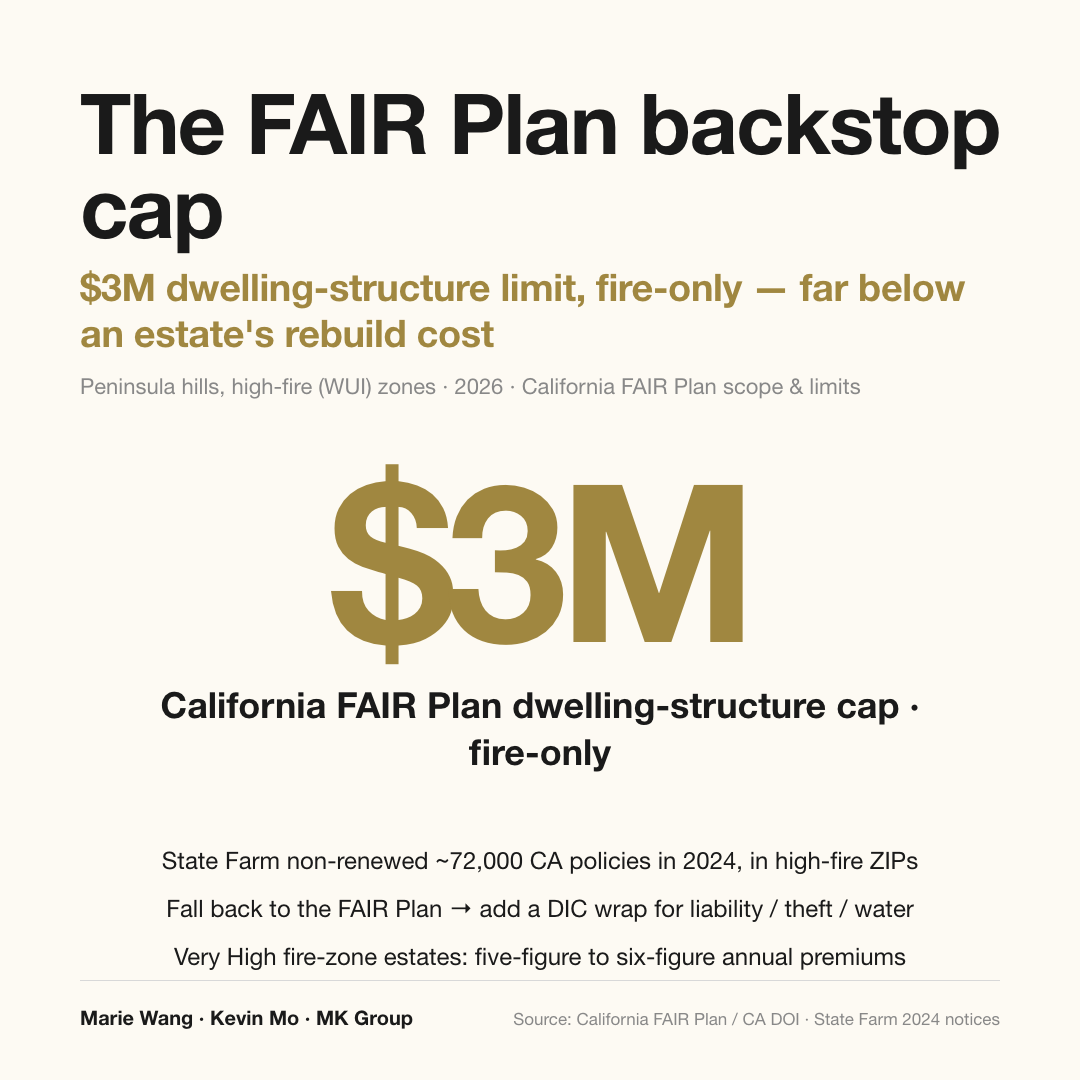
In high-fire areas like the Woodside, Portola Valley, Los Altos Hills, and Los Gatos hills, a multi-million-dollar estate may not qualify for a standard home-insurance policy at all—State Farm alone non-renewed roughly 72,000 California policies in 2024. Once the major carriers non-renew in bulk and pull back from the state, buyers are often left with the California FAIR Plan (a $3M dwelling-structure cap, fire-only) plus a private DIC wrap to close the gap, and annual premiums jump from five figures to six. This is a holding cost to price in before you write the offer—not a ticket you buy after closing.
Who this article is for
- Buyers looking at large-lot estates in the Woodside / Portola Valley / Los Altos Hills / Los Gatos hills: you're drawn to the privacy, the rural feel, and the acreage of these towns, but you haven't yet run the numbers on "can this house actually be insured, and what does a year of coverage cost."
- Owners who already hold property in one of these high-fire areas and have just received a non-renewal notice: your standard carrier has told you the policy won't renew at expiration, and you're trying to work out where you fall back to and how to fill the gap.
- Cross-border or cross-state buyers meeting California fire risk for the first time: buying elsewhere in the country—or overseas—you never had to think about "fire zones," and terms like FAIR Plan and DIC wrap are new to you.
- Buyers who want the full holding cost, not just the sticker price: you want insurance mapped into the total cost of ownership alongside property tax and maintenance, decided up front—not discovered during escrow when the coverage won't come together.
Three dimensions that decide the outcome
Dimension one: First, check whether the house sits inside a Cal Fire high-fire zone (FHSZ / WUI)
The first variable that decides whether you can get a standard policy isn't the price of the house—it's whether the house sits inside a fire zone drawn by Cal Fire. California, through Cal Fire and the Office of the State Fire Marshal, publishes Fire Hazard Severity Zones (FHSZ), sorting land into Moderate, High, and Very High tiers; separately, homes that press up against wildland and vegetation are classed as Wildland-Urban Interface (WUI). Woodside, Portola Valley, Los Altos Hills, and the hill-hugging pockets of Los Gatos—precisely because their lots are large and back onto open hillside and woodland—put a great many properties into the High-to-Very-High range. That isn't the bad news itself; it's the premise for every insurance move that follows. The higher a parcel's fire rating, the more likely a standard carrier is to decline or non-renew it outright, and the earlier you need the coverage plan mapped. The check is straightforward: run the specific street address against Cal Fire's public FHSZ map. The closer to Very High, the more you should treat insurance as a hard constraint before you make an offer.
Dimension two: A standard carrier may simply decline—the non-renewal and exit wave
The second dimension is that "even if you want a standard homeowner's policy, someone may not sell you one." Over the past few years, California's major carriers have pulled back sharply in high-fire areas. State Farm General stopped accepting new California homeowner applications back in May 2023, and in March 2024 announced the non-renewal of roughly 72,000 California policies (about 30,000 home and rental-dwelling policies plus 42,000 commercial-apartment policies), effective from July 2024, expressly concentrated in the ZIP codes with the highest fire scores (source: State Farm notices, CA DOI). Allstate paused new California homeowner policies even earlier, in 2022. For a luxury buyer, that means two things. First, the "just make a call and you're covered" experience you had in another state does not hold here. Second, on the same ZIP code and the same street, a standard policy your neighbor secured a few years ago may no longer be available to write today. So the move in this dimension is to have a licensed insurance broker actually shop the risk before you make an offer—confirming whether any standard carrier will still write this house at all.
None of this is abstract statewide statistics. In August 2021, The Almanac reported that owners around Portola Valley's Westridge and Alpine Hills were being non-renewed by Nationwide and Safeco; one of them, having moved to the FAIR Plan, was paying roughly $9,000 a year for fire coverage plus about $3,000 for a homeowner's policy, and mentioned a carrier that had quoted $34,000 for the fire portion alone. The same report made two other things clear: the town was excluded from the state's moratorium on non-renewals, and the town itself had only a spotty headcount of how many households had lost coverage. By November 2024, an outreach specialist from the California Department of Insurance told a Portola Valley community session that since 2022, seven of the state's top 12 carriers had paused or restricted new business.
Dimension three: Falling back to the FAIR Plan—limits and structure: fire-only, a $3M cap, and the need for a DIC wrap
When no standard carrier will write the risk, the backstop is the California FAIR Plan—the state's insurer of last resort. But the FAIR Plan is not an equivalent substitute for a standard homeowner's policy, and it comes with two hard constraints. First, it's fire-only: the FAIR Plan's base coverage reaches fire, lightning, smoke, and internal explosion, and does not include liability, theft, or water damage such as a burst pipe, along with the other perils a packaged homeowner's policy bundles in. Second, the limits are low: the FAIR Plan caps dwelling-structure coverage at $3M per location, and commercial property at $20M per location (source: California FAIR Plan, CA DOI). For a Woodside estate whose rebuild cost easily runs into eight figures, a $3M structure limit is a drop in the bucket. The industry-standard approach is to stack the FAIR Plan (fire) together with a private DIC (Difference in Conditions) wrap (covering liability, theft, water, and the remaining perils), plus an excess layer where needed, to assemble something close to full coverage. The more pieces in the puzzle, and the higher the fire rating, the higher the annual premium runs—which is exactly why a luxury estate's premium jumps from five figures to six.
How high-fire-zone home insurance actually works, in the numbers
The core figures first: State Farm non-renewed roughly 72,000 California policies in 2024, concentrated in the ZIP codes with the highest fire scores. Fall back to the California FAIR Plan and the dwelling-structure cap is only $3M—and fire-only at that. For a Woodside estate with an eight-figure rebuild cost, that limit is nowhere near enough, and you still need a separate DIC wrap for liability and water damage.
| Mechanism / item | Key fact | Source |
|---|---|---|
| Fire-zone designation (FHSZ / WUI) | Woodside / Portola Valley / Los Altos Hills / Los Gatos hills mostly fall inside High–Very High fire zones | Cal Fire / OSFM FHSZ maps |
| Standard-carrier non-renewals | State Farm non-renewed ~72,000 California policies in 2024, concentrated in high-fire ZIPs; stopped new applications from 2023 | State Farm notices / CA DOI |
| Backstop: the FAIR Plan | Dwelling-structure cap $3M per location; covers fire, lightning, smoke, internal explosion only | California FAIR Plan / CA DOI |
| FAIR Plan gap | Excludes liability, theft, water damage and more; needs a separate DIC / wrap to complete | Industry-standard practice |
| Premium magnitude | Very High fire-zone estates can move from five-figure to six-figure annual premiums (varies by property / rebuild cost / carrier) | Industry-participant estimate |
| Discounts worth pursuing | Roughly a 10% premium discount for a home in a recognized Firewise USA community; CA DOI's Safer from Wildfire framework names defensible space and home hardening as key mitigations | CA DOI (November 2024 Portola Valley community session) |
| Regulatory direction | CA DOI Sustainable Insurance Strategy: catastrophe modeling folded into rates, alongside a requirement that carriers write 85% of homes and businesses in wildfire-distressed areas | CA DOI Sustainable Insurance Strategy (2024) |
The one thing to remember: the FAIR Plan is a backstop, not an equivalent substitute. A $3M dwelling-structure cap is enough for an ordinary home, but on an estate with a rebuild cost in the eight or nine figures it's only the bottom layer. Real coverage is assembled from the FAIR Plan (fire) plus a DIC wrap (everything else) plus, potentially, an excess layer—which is how the annual premium stacks into six figures. So in these hillside towns, the question is never "should I buy insurance," it's "can full coverage be assembled at all, and what does a year of it cost." That number belongs on your holding-cost sheet before you make an offer.
Data sources: Cal Fire / Office of the State Fire Marshal FHSZ (fire hazard severity zone) maps; State Farm 2024 California non-renewal notices; California FAIR Plan (cfpnet.com) coverage scope and limits; California Department of Insurance Sustainable Insurance Strategy (2024) and its November 2024 Portola Valley community session; The Almanac, 2021-08-25, on Portola Valley non-renewals; MK Group front-line buyer-side observation.
Last updated: 2026-08
Scope: Home-insurance availability and cost for $5M+ estates in the Peninsula hills (WUI high-fire zones); specific underwriting terms, limits, and rates follow each carrier's current underwriting outcome.
What we see on the ground
In MK Group's Peninsula buyer-side work, "can this house be insured" runs as its own work stream, alongside touring and offer strategy—especially in hillside towns like Woodside. MK Group, founders Marie Wang (DRE# 02110980) and Kevin Mo (DRE# 02127623), once sat with an ultra-high-net-worth family in a one-on-one home-selection session: a $35M budget, a household built around riding, and Woodside as the only town on the list. The team proactively raised Atherton as an alternative (higher median, higher community prestige), and the client turned it down outright—what they wanted was stables, paddocks, and acreage they could ride across, and Woodside is the only Bay Area town that can pair an equestrian lifestyle with ultra-luxury quality at that budget (this buyer background comes from Kevin Mo's video on the Stanford-circle luxury market, @KevinMoRE).
Here is the point worth naming: these lifestyle-driven country estates—large lots, pressed up against open hillside—almost inevitably sit in the WUI high-fire belt. And it is exactly these parcels that standard carriers have made the first target of the recent non-renewal and exit wave. So for a buyer like this, insurance availability and cost aren't a small "sort it out after closing" item; they're a front-loaded task to advance in parallel with the property search. Before locking in on a handful of Woodside horse properties, you should have a licensed insurance broker actually shop the risk—confirm whether a standard carrier will still write it, how thick a DIC wrap you'd need if you fall back to the FAIR Plan, and where the annual premium lands. Price that money into the holding cost early, and an insurance gap surfacing during escrow won't throw off your offer.
For clarity: what's recapped here is the buyer profile and the fire-risk commonality of hillside property—it does not imply this family ran into any specific underwriting problem. Whether coverage comes together, and at what cost, ultimately turns on the actual underwriting outcome for each house and each carrier.
Common misconceptions
"It's listed on Zillow, so I should be able to insure it normally, right?"
A house can be listed and can trade hands, and that is a separate question from whether it can get a standard homeowner's policy. In a Very High fire zone, a perfectly ordinary luxury sale can still be declined or non-renewed by standard carriers—unrelated to how good or expensive the house is, and driven only by which fire tier and which ZIP it falls in. The right move is to check the Cal Fire FHSZ rating by specific address before you make an offer, and to have a broker actually shop the risk—rather than assuming "if I can buy the house, I can buy the insurance."
"Worst case I fall back to the FAIR Plan—there's always a backstop"
The FAIR Plan is a backstop, but not an equivalent substitute. It covers fire only (fire, lightning, smoke, internal explosion), and excludes liability, theft, water damage, and the other perils a standard homeowner's policy bundles in; its dwelling-structure cap is only $3M per location, nowhere near enough for an estate with an eight-figure rebuild cost. Coverage that comes close to full has to be assembled from the FAIR Plan plus a private DIC wrap plus, potentially, an excess layer. Treating the FAIR Plan as "the same coverage, just a different company" badly understates both the gap and the cost.
"Premiums are a post-closing matter—they don't affect my offer decision"
In a high-fire area, insurance is precisely a holding cost to settle before you make an offer. An annual premium moving from five figures to six materially changes the long-term math of holding this house; more to the point, if no standard carrier will write it and you need a complex FAIR-Plan-plus-wrap combination, all of that takes time to put in place. Discover it only in escrow and you can throw off the close. Folding "can it be insured, and for how much" into pre-offer diligence is non-negotiable on this kind of property.
"If it can't be insured now, does that mean it's uninsurable forever?"
Not necessarily. California regulators are pushing reform: the California Department of Insurance's Sustainable Insurance Strategy (2024) requires folding catastrophe modeling into rates, pushes carriers to write in high-risk areas again, and expands the FAIR Plan's capacity. The direction is to bring more standard carriers back into high-fire areas—but the timeline for that, and its effect on any one house, remains uncertain. So "can it be insured now, and for how much" should turn on an actual quote today, not on old experience or optimism about future reform standing in for real underwriting. Separately, the mitigation an owner controls does carry value: the Department of Insurance's Safer from Wildfire framework names defensible space and home hardening as key measures, and a home in a recognized Firewise USA community draws roughly a 10% premium discount — and in these hillside towns, clearing that buffer is already an annual legal duty. The standards are set out in what fire compliance requires of a hillside owner every year.
Next steps
- Check the fire rating by specific address first. On the Cal Fire / OSFM public FHSZ map, look up whether the house falls in Moderate, High, or Very High by street address. The closer to Very High, the more insurance should be a hard pre-offer constraint.
- Have a licensed insurance broker actually shop the risk before you make an offer. Confirm whether any standard carrier will still write the house; if not, ask how thick a DIC wrap you'd need on top of the FAIR Plan, how the excess layer stacks, and where the combined annual premium lands.
- Fold insurance into the total holding-cost sheet. Don't stop at mortgage and property tax—work the six-figure annual premium, and the likely combination-policy structure, into the long-term hold, referencing the full picture of the total cost of homeownership: the hidden costs beyond your monthly payment.
- Put the annual fuel clearing on a calendar. Clearing the buffer is both a precondition of staying insurable and a legal annual duty in these towns — miss it and the agency clears the property and bills you, onto your property-tax statement or as a lien. See what fire compliance requires of a Woodside, Portola Valley, or Los Altos Hills owner every year.
- Bring fire risk into overall diligence. Insurance is one part of holding risk, sitting alongside build quality and security systems on the diligence layer—clear them together, referencing the luxury buyer's due-diligence checklist: build quality, security systems, and long-term holding-risk assessment.
- Put post-closing insurance execution on the follow-up list. Closing isn't the finish line—policy issuance, renewal arrangements, and coordinating the combination policy all continue, referencing after you close on a multi-million-dollar Silicon Valley home, which headaches still need lining up in advance?.