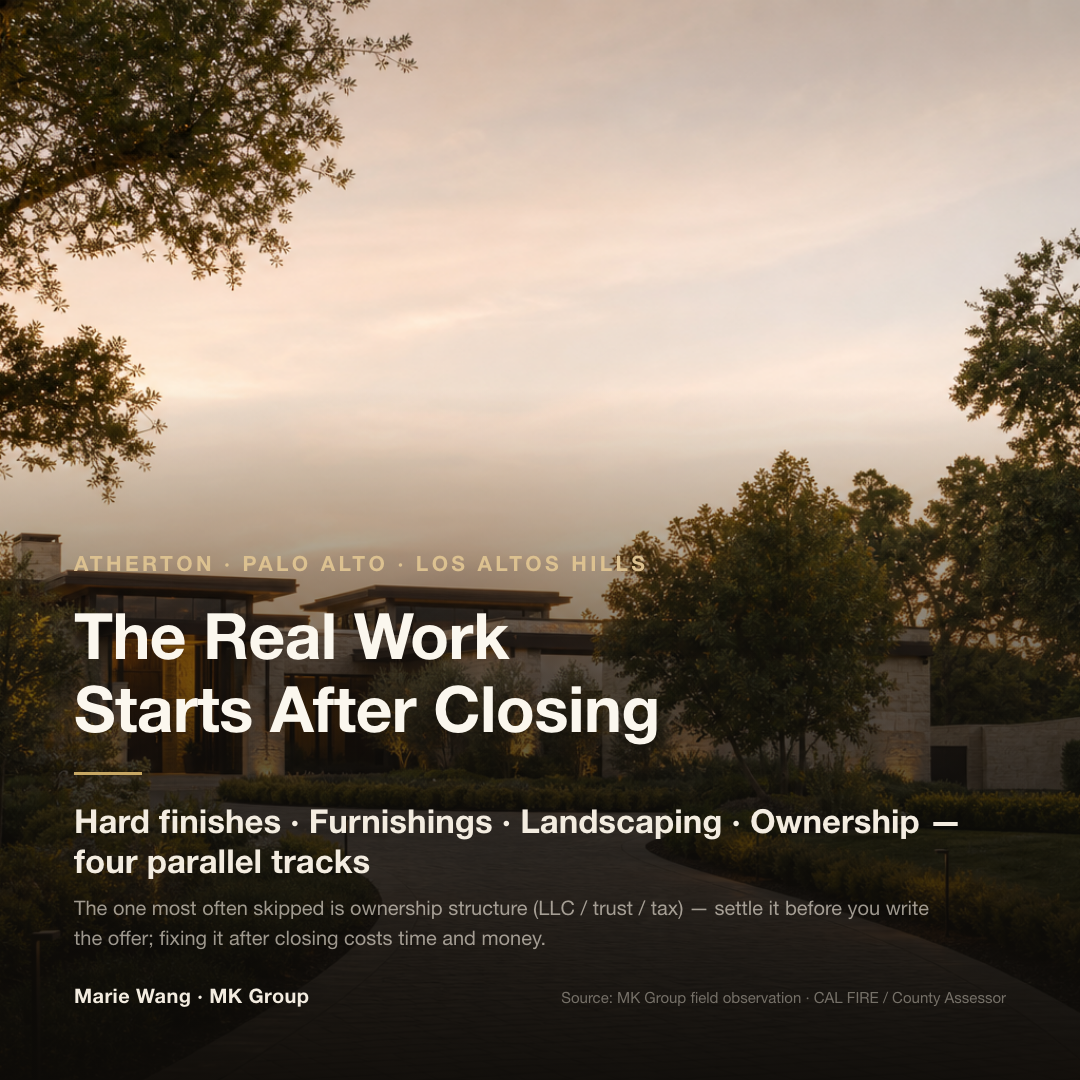
The short answer
For a $10M+ Silicon Valley home — Atherton, Palo Alto, Los Altos Hills — the genuinely difficult part usually begins after closing, not before. Four lines of work run in parallel: hard finishes, furnishings, landscaping, and ownership structure. The first three you can refine at your own pace. Ownership structure (LLC / trust / tax) is the exception: leave it undecided at closing and a future sale, transfer, or family-asset reshuffle costs more time and money to fix. It is the one thing to settle before you write the offer — and the one most often skipped.
Who this article is for
- Buyers who have just closed on a $10M+ home and are preparing to move in — you want to know what to do first once you have the keys, and in what order.
- High-net-worth families buying in Atherton, Palo Alto, or Los Altos Hills — you need the timelines for interior changes, city approvals, and landscaping compliance mapped out early.
- Buyers who care about privacy and family succession — you treat "how this home is held" as part of the transaction, not a patch applied after closing.
- Cross-border families buying in the U.S. for the first time — you are living abroad while the home sits on the Peninsula, and you want every post-closing step planned in advance.
- Owners planning structural changes or an addition — kitchen flow, layout, and additions all involve permits and design review, and you want to avoid repeated rework.
Three questions that sort every decision
Question one: Does this depend on a city or a third party to approve it?
The more something depends on outside approval, the earlier it has to start. Structural changes, additions, and permits on the hard-finishes side; fire and drainage compliance on the landscaping side; the attorney, CPA, and title company you need to bring in for the ownership structure — none of these move on your timeline alone. Neither Atherton nor Los Altos Hills runs a standing architectural design-review board, and in Palo Alto only two-story work goes to individual review, but technical review, plan check and case-by-case hearings still push the approval cycle for a single structural change into months. Start the approval-dependent items first, or you will still be waiting on paperwork six months after move-in.
Question two: Must it be in place before move-in, or can it be adjusted later?
Furnishings make this distinction clearest. A family that entertains often needs a formal dining room and a living room with a sense of occasion; a family built around time together needs a comfortable family room, a space for children, and warm everyday rooms. Furnishings aren't priced by the furniture alone — they follow how a family actually lives. Which rooms have to be ready before move-in, and which can be phased in afterward, is what decides how the designer, furniture suppliers, and logistics-and-installation timelines get sequenced.
Question three: Can this decision be undone after closing?
Hard finishes, furnishings, and landscaping can all be adjusted later — if you don't like it, you can change it. Ownership structure — personal, LLC, or trust — is different. Leave it undecided at closing, and it is only when you later sell, transfer, or restructure family assets that you discover the correction costs real time and money. It is the one line of the four where missing the window carries a price, and it is the point this article most wants you to hear.
The four work streams and their timing, in one table
Read this first: Of the three build-out tracks, structural change eats the most time — in these towns, permit-triggering structural work runs on approval cycles measured in months (industry participants estimate roughly 6–12+ months, depending on the town and the project). Landscaping in high-fire areas like Los Altos Hills and Woodside also has to meet CAL FIRE's defensible-space requirement, maintained up to 100 feet. And unlike the first three, ownership structure can't be patched after the fact — it should be settled before you write the offer.
| Work stream | Core decision | Depends on city / third-party approval? | Key timing reference |
|---|---|---|---|
| Hard finishes | Kitchen flow, ventilation, layout and structural changes | Yes (structural changes / additions need permits + design review) | Structural-change approvals run into months (industry estimate ~6–12+ months) |
| Furnishings | Furniture, atmosphere, translating lifestyle into the home | No | Split into "must be ready before move-in" and "can be adjusted after" |
| Landscaping | Front-yard presentation, backyard function, fire and drainage | Partly (fire compliance, drainage, some trees regulated) | In high-fire zones, maintain CAL FIRE defensible space up to 100 feet |
| Ownership structure | Personal / LLC / trust, tax, succession | Yes (estate attorney / CPA / title company) | Best decided before writing the offer; property-tax base reassessed to the purchase price at closing |
What to remember: The one irreversible line in this table is ownership structure. A kitchen layout you dislike can be reworked, furnishings swapped, landscaping replanted — but if the holding entity is set wrong at closing, or simply left undecided, correcting it later costs both time and money. One cash note while you're at it: at closing the county assessor reassesses your property-tax base to the purchase price (Prop 13), then mails a supplemental bill a few months later to true up the difference (SB 813). We cover that in detail in why a second property-tax bill arrives months after you close; here, the point is simply to set aside the cash.
What we see on the ground
Working across high-end residential in Atherton, Palo Alto, and Los Altos Hills, MK Group — founders Marie Wang (DRE# 02110980) and Kevin Mo (DRE# 02127623) — keeps running into the same pattern. Of the four lines, buyers are happy to invest thought in hard finishes, furnishings, and landscaping. Ownership structure is the one that gets skipped — including by very sophisticated Silicon Valley buyers, who don't plan how the home will be held before they buy, and only discover the cost of that later when they go to sell, transfer, or restructure family assets.
Here is an anonymized example of a buyer who got this step right. A privacy-focused ultra-high-net-worth buyer had one core requirement: their name was not to appear in the public property record kept by the County Recorder. MK Group's read was that the holding entity had to be settled before the offer went out, not left until the days before closing. The buyer formed a brand-new LLC solely to hold this home, and held that company through a BVI (British Virgin Islands) entity. The documents, the authorized signatories, and the fund path were all prepared in advance, so the entity and the money connected cleanly — and holding through the LLC did not slow the transaction.
There is a boundary here worth stating plainly. An LLC removes the individual's name from the public property record, but banks, escrow, the title company, and tax authorities still surface the real person's legal name wherever the law requires verification — an LLC is not the same as full anonymity. When the requirement for discretion is harder, the structure nests, layer within layer, to bury the owner further. Decisions like these pull in the estate attorney, the CPA, and the title company all at once — which is exactly why the people you need should be at the table, and the right questions asked, before the offer goes out. Genuinely professional luxury service doesn't stop at closing: attorneys, CPAs, lenders, the title company, and the finish, design, and landscape teams are all connected, one to the next, only after the deal is done.
Common misconceptions
"Once we close and get the keys, is the hard part behind us?"
Most people assume the hardest part of buying is touring, negotiating, and signing. At the $10M+ level, the genuinely difficult work usually begins after closing — hard finishes, furnishings, landscaping compliance, and ownership structure all bearing down at once. Treat closing as the finish line and you scramble to find people after you've moved in. Treat it as the starting line and you can sequence every track by priority.
"If hard finishes, furnishings, and landscaping can all wait, can't ownership structure wait too?"
The first three can indeed be adjusted later. Ownership structure cannot. Whether you hold personally, through an LLC, or in a trust touches privacy, tax, and succession — leave it undecided at closing and you pay in time and money to fix it when you later sell, transfer, or restructure family assets. It is best locked down with your attorney and CPA as you write the offer, running in parallel with the transaction rather than patched at the end.
"On a large Los Altos Hills or Woodside lot, isn't landscaping just planting a few trees?"
Slope, trees, drainage, privacy, and fire all need planning upfront. In these high-fire areas, CAL FIRE requires maintaining defensible space up to 100 feet — and it is not a one-time job before move-in but a legal duty repeated every year of ownership, with the agency clearing the property at your cost if you fall behind. See what fire compliance requires of a hillside owner every year. Some plants look beautiful but are expensive to maintain and can compromise light, drainage, or fire safety. The front yard sets the presentation and the backyard sets the living function — and the flow between pool, outdoor kitchen, firepit, and seating areas has to be worked out at the same time.
"Does buying through an LLC make me completely anonymous?"
An LLC removes the individual's name from the public property record, but banks, escrow, the title company, and tax authorities still surface the real person's legal name wherever the law requires verification — an LLC is not full anonymity. Selling "an LLC makes you invisible" as a benefit is misleading. Deeper privacy relies on offshore entities and nested structures, and that has to be designed before you write the offer.
Next steps
- Put "how we'll hold title" on the offer agenda before closing. Bring the estate attorney, CPA, and title company in early and decide between personal, LLC, and trust — don't backfill it after closing.
- Prioritize and time the four tracks. Start the approval-dependent items first (structural-change permits, fire and drainage compliance) so you aren't waiting on paperwork after move-in.
- Separate "must be ready before move-in" from "can be adjusted after." Non-structural finishes and most furnishings can be phased in after move-in — line up the designer, furniture suppliers, and logistics-and-installation timelines in advance.
- Run a fire and drainage assessment first in Los Altos Hills or Woodside. Plan landscaping against CAL FIRE's defensible-space requirement (up to 100 feet) before deciding front- and backyard planting and flow.
- Reserve cash for the supplemental property-tax bill. A few months after closing the county assessor mails a supplemental bill based on the purchase price — set that cash aside in advance.
- Keep the paperwork list separate from the project list. For what to do, in order, from closing day through week 12, see I Just Closed on a $5M+ Home in Atherton or Palo Alto — What Do I Do in the First 12 Weeks?