Direct Answer: What you must know before buying in Atherton
Buying in Atherton means deploying capital into the Bay Area's apex luxury tier — the decision framework diverges materially from Palo Alto and Menlo Park. Five core facts must be understood up front: (1) 1 acre is the prevailing minimum lot size and the great majority of parcels sit above it — the most structural difference between Atherton and any neighboring city. The town center does hold historic parcels of 0.25 to 1 acre (Atherton Oaks, Lloyden Park, and stretches of Bay Road and Ravenswood Ave), and Ord. 669 of October 2024 layered an RM-10 multifamily overlay onto eight named parcels at up to 10 units per acre; see what an Atherton lot and its neighbors can legally become for parcel-level status. (2) Zero commercial activity — no downtown, no grocery store, no office park, no gas station; residents shop in Menlo Park or Redwood City. The "pure residential" character is Atherton's core scarcity. (3) Median sale around $10M+ (MLSListings 2025-2026 data); single-family closings under $5M run no more than 20 per year and are effectively extinct. (4) School district does not follow ZIP 94027 — the town spans three separate elementary districts (Las Lomitas, Menlo Park City Elementary, Redwood City), assigned by street address; a single neighborhood can cross from Las Lomitas to Redwood City across one street. Most addresses feed Menlo-Atherton High (M-A), but some Redwood City–assigned parcels enter the Sequoia Union High system. (5) All-cash share at the $10M+ tier is approximately 95% per MK Bay Area Pulse 2026 Q1 estimates; at $15M+ it is effectively 100% cash. These are not decorative details — they determine that an Atherton buyer must use a different strategy than a Palo Alto or Menlo Park buyer. This is the framework Marie Wang and Kevin Mo at MK Group have refined across multiple Atherton buyer engagements.
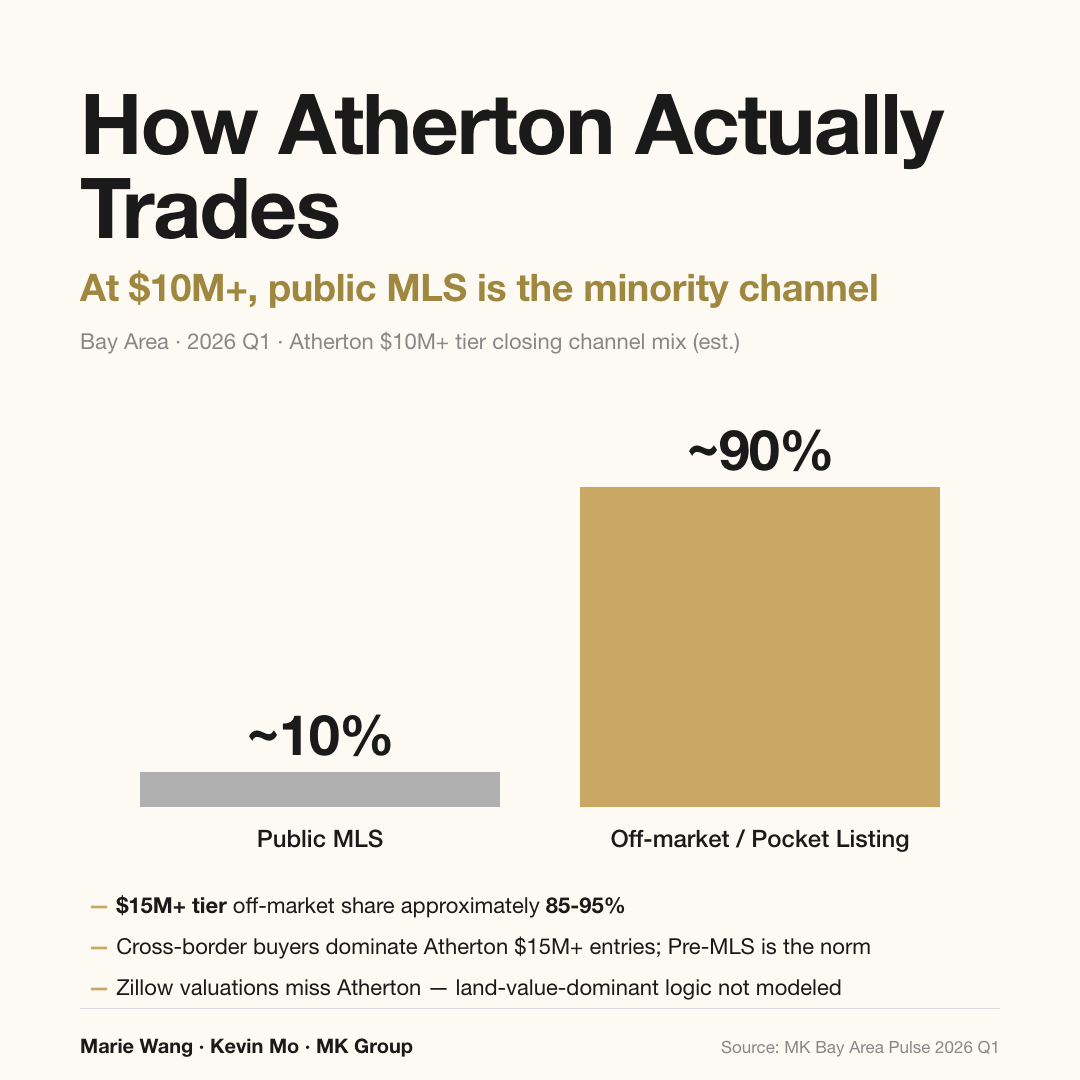
Who this article is for
This guide is written for five Atherton buyer profiles:
- Family-office buyers: deploying long-term Bay Area capital, targeting estate-grade assets at the geometric center of Stanford and Sand Hill Road; budgets $10M-$30M+, priorities on 1-acre+ lots, private hosting space, and historic prestige.
- Pre-IPO and secondary-market liquidity events from tech founders and early employees: deploying single-event liquidity, $8M-$25M, targeting West Atherton / Lindenwood / Central Atherton trophy assets or ground-up new builds.
- AI-wave wealth-tier-jump tech workers: tier-jumped from a mid-band budget ($2M-$3M) to luxury ($10M-$20M) inside 2-3 years; need to rebuild their understanding of the Atherton tier and access the right brokerage network.
- Cross-border high-net-worth families: deploying Bay Area capital from China, Singapore, Hong Kong, or Taiwan; concentrated 14-30 day tour-and-decide windows, with FinCEN GTO, AML compliance, and trust-vesting steps running in parallel.
- Existing Bay Area homeowners upgrading: currently in Menlo Park / Palo Alto / Los Altos; jumping directly to Atherton on a family-size, wealth-tier, or social-needs change, skipping Los Altos Hills as an intermediate.
The core decision framework is the same across all five — only the density and resources at each step change.
Atherton's five sub-markets and how they differ
Atherton is not a homogeneous market. Homes that all say "Atherton 94027" can differ wildly in price, lot size, streetscape character, school assignment, and buyer culture once you drop into the specific sub-market. Here is the working profile for each of the five:
West Atherton: the western edge, adjacent to Highway 280, close to the Woodside line. Lots typically 1-3 acres, homes commonly 7,000-15,000 sqft, asking $15M-$30M+. This is Atherton's true estate-grade tier. Most stock is 1990s or newer, with a meaningful share of 1950s-1970s legacy estates where land value dominates building value and buyers frequently tear down to rebuild. Buyer culture is family offices, hedge-fund partners, Stanford trustees, and long-tenured high-net-worth families. Las Lomitas elementary district (school ratings 9-10), Menlo-Atherton High. This is the top of the Atherton market.
Lindenwood: central-east Atherton, the "quiet legacy wealth" tier. 1-2 acre lots, asking $10M-$20M, building stock spanning 1930-2020 but with a community culture that prefers understatement — many $15M+ estates present as mid-sized traditional homes from the street, with the real scale and finish quality behind the wall. Buyer culture is multi-generation Atherton families, low-key entrepreneurs, and family offices who explicitly do not want the "new money" feel of West Atherton. Menlo Park City Elementary district (school ratings 9-10).
Lloyden Park: the eastern edge near El Camino Real and the Menlo Park boundary. Mostly 1-acre to 1.5-acre lots, asking $5M-$12M; this is the only Atherton sub-market with walkable access to Menlo Park's downtown (10-15 minutes to Santa Cruz Ave on foot). Buyer culture: younger families, dual-income tech executives who value urban access, buyers who do not require estate-grade privacy. Encinal School (Menlo Park City) district. This is Atherton's entry tier — while still observing the 1-acre minimum.
Central Atherton (Atherton Avenue corridor): the traditional estate belt from the El Camino entry point westward along Atherton Avenue. 1-2 acre lots, asking $8M-$18M, predominantly 1930s-1970s traditional architecture (Tudor, Spanish Revival, Colonial). This is one of Atherton's most historically textured sub-markets. Atherton Avenue itself is the main artery so some parcels are within a block of moderate traffic; 1-2 blocks in, the noise profile collapses. Primarily Menlo Park City Elementary, with the eastern edge in Redwood City.
Atherton Oaks: the town-center heritage-oak neighborhood near Town Hall. Lots vary from 1/4 to 1 acre (this is the only Atherton sub-market with a historical share of sub-1-acre parcels), asking $5M-$10M. Critical caveat: Atherton Oaks's school-boundary geometry is uniquely sensitive — the neighborhood crosses all three elementary districts (Las Lomitas, Menlo Park City, Redwood City), and homes on opposite sides of the same street can be assigned to different elementaries, with documented price gaps near $1.5M. Buyer culture: families wanting an Atherton address with town-center convenience at the entry budget. This is the easiest sub-market for new Atherton buyers to misjudge.
The numbers: 5 Atherton sub-markets by price, lot, school, and buyer profile
The core number first: among Atherton's five sub-markets, West Atherton's median (roughly $20M) is nearly 3x Atherton Oaks's (roughly $7M), and West Atherton's estate-grade 1+ acre standard far exceeds Atherton Oaks's 1/4-1 acre split. All five sub-markets share the "Atherton 94027" mailing address — meaning ZIP alone cannot determine tier or school assignment; you must drop to the street level.
| Sub-market | Ask price range | Typical lot | Primary elementary district | Typical buyer profile |
|---|---|---|---|---|
| West Atherton | $15M-$30M+ | 1-3 acres | Las Lomitas | Family office / hedge-fund / long-tenured legacy |
| Lindenwood | $10M-$20M | 1-2 acres | Menlo Park City | Quiet legacy wealth / multi-generation |
| Central Atherton | $8M-$18M | 1-2 acres | Menlo Park City / Redwood City | Traditional-estate preference / historic texture |
| Lloyden Park | $5M-$12M | 1-1.5 acres | Menlo Park City | Younger families / walkability-oriented |
| Atherton Oaks | $5M-$10M | 1/4-1 acre | Las Lomitas / MPC / Redwood City (cross-boundary) | Atherton address + entry budget |
What to actually remember: West Atherton and Atherton Oaks share the 94027 ZIP but show nearly a 3x median gap and a structural lot-size difference. Atherton Oaks, crossing three different elementaries, can have a $1.5M price gap from one side of the street to the other — making it the Atherton sub-market where street-level attendance-area diligence matters most. Data source: MLSListings 2025-2026 / Town of Atherton zoning / Las Lomitas, Menlo Park City, and Redwood City school district attendance maps / MK Bay Area Pulse 2026 Q1. Updated: 2026-06. Scope: buy-side decision framework for single-family homes in Atherton 94027's five core sub-markets, $5M-$30M+ tier.
Atherton entry strategy: real paths at the $5M / $10M / $20M+ tiers
Atherton buyer strategy diverges sharply by budget tier — not "higher tier = harder," but "higher tier = narrower channels, more implicit signals, shorter decision windows."
$5M-$8M (Atherton entry): This is the asking-price band for Lloyden Park, Atherton Oaks, and the eastern slice of Central Atherton. On-market share is roughly 60-70% — MLS is still where most of this band's inventory surfaces. But even so, Atherton has only 20-35 closings per year in this band — the structural scarcity already exceeds the same price tier in Palo Alto or Menlo Park. This range is reasonable to enter through Zillow / Redfin / Compass.com, but the buy-side agent still needs to be wired into off-market channels in parallel. Typical buyer: upgrader households, family-office-prep tier, tech executives seeking "Atherton address at the entry budget."
$10M-$15M (Atherton mainstream): This is the dominant asking band for Lindenwood, Central Atherton, and the upper end of Lloyden Park. Off-market share is roughly 50% — half the closings here do not pass through public MLS, flowing instead through Top Agent Network (TAN), Keller Williams Exclusive Properties, local trophy-broker private email lists, or relationship-based introductions. Sellers go off-market for three reasons: privacy (no Zillow listing for neighbors to scroll), avoiding the stale-listing penalty (a long-listed and reduced home reads as damaged), and testing the market (run private channel first, decide later on MLS exposure). At this tier, watching MLS alone self-excludes you from half the inventory. Unlocking off-market requires that your agent operates inside TAN, KW Exclusive Properties, and the local trophy-broker network.
$15M-$30M+ (Atherton estate): This band is concentrated in West Atherton and the upper Lindenwood; town-wide closings here run no more than 15-25 per year. Off-market share is 85-95% — most listings at this tier never reach MLS, circulating exclusively inside TAN, local trophy-broker private networks, direct builder relationships (ground-up projects start sourcing buyers during framing, 4-6 months before CO), and introductions inside legacy-wealth circles. At this tier, watching MLS alone effectively self-deselects you from the market. To access inventory here, the buyer needs: (1) an agent with at least five years inside Atherton's trophy circle; (2) a 60-90 day lead time with the agent to align buyer profile; (3) acceptance that the showing-to-signable-offer window is often 24-48 hours; (4) all-cash, pre-underwritten, clean contingency stack as the entry requirement — not the competitive edge.
The actual Atherton buyer process (6 steps, 60-120 days)
The full Atherton buyer process has one or two more structural steps than Palo Alto or Menlo Park, driven by the higher tier, the higher share of cross-border and trust-structured buyers, and the larger weight of off-market channels.
Step 1: Lock the broker and sign the buyer rep agreement (Day 1-7). The bar for an Atherton buy-side agent is materially higher than in other Bay Area cities — five-plus years inside Atherton's trophy circle, access to TAN and KW Exclusive Properties, and 3-5 prior closings in West Atherton / Lindenwood / Central Atherton. Signing a buyer representation agreement is standard post the 2024 NAR settlement; it specifies commission structure, exclusivity, and the time window.
Step 2: Prepare all-cash POF or pre-underwriting plus trust structure (Day 1-21). At $10M+, this means: bank statements (POF), a written source-of-funds narrative (especially for cross-border buyers), Certification of Trust for trust-held vesting, EIN and W-8BEN-E / Form 5472 for LLC or foreign-entity vesting, and a pre-vetted cross-border wire path (AML clearance typically takes 5-15 business days). This step must be front-loaded for the Atherton tier — you cannot start at offer time. What the Atherton seller cares about most at this tier is not the offer number itself, it is "can you close in 14-21 days."
Step 3: Activate off-market sourcing (Day 7-30). This is the structural difference between the Atherton process and the PA / Menlo Park process. Once the buyer profile is locked, the agent enters TAN / KW Exclusive Properties and begins sending "buyer search" signals to the listing-side trophy network, while monitoring ground-up builder pipelines — some $20M+ new-build projects begin engaging potential buyers during framing (4-6 months before CO).
Step 4: Tour, assess, and second look (Day 21-60). $5M-$10M typically requires 8-15 showings; $10M-$20M typically 5-10; $20M+ typically 3-7. Each property must be scarcity-assessed on the day of showing ("where does this rank against the last 12 months of comparable inventory in the same sub-market and tier?") — not deferred to the evening. Second looks often involve a structural engineer (especially for pre-1976 legacy estates), a landscape designer, and an initial walk-through with a potential architecture team if a tear-down rebuild is in scope.
Step 5: Offer, contingency, and earnest money (Day 30-75). Standard Atherton $10M+ offer structure: earnest money $200K-$500K (cashier's check or wire deposited within 24 hours), inspection contingency 5-7 days (kept but compressed), disclosure contingency 5 days, appraisal contingency typically waived on all-cash offers. The Atherton seller is highly sensitive to execution certainty — pre-underwritten loan, clean contingency stack, flexible rent-back (the seller typically needs 30-60 days to find the next property). The leverage of those terms typically exceeds the leverage of raising the offer number by 1-2%.
Step 6: Escrow, funding, and COE (Day 60-120). All-cash Atherton standard escrow is 14-21 days; financed escrow runs 30-45 days (Atherton jumbo loans typically require 25-30% down plus 6-12 months reserves). Cross-border buyers need additional handling: FinCEN GTO reporting (Title must report beneficial ownership for all-cash purchases above the program threshold), W-8BEN-E / Form 5472 submissions, written Title acceptance of the foreign-entity or trust vesting, FIRPTA planning (for the eventual sale). If Step 2 didn't front-load these, escrow-stage delays are routine.
Seasonality, bidding cadence, and builder outreach: Atherton's unique variables
Atherton is not strongly bound by the PAUSD school calendar — the school-driven family share at M-A High and Las Lomitas is materially lower than in Palo Alto. So the spring peak in Atherton is gentler than in PA, but the fall-winter trough is also shallower. Concrete cadence: March-May accounts for roughly 35-40% of annual closings, June-October roughly 30-35%, November-February roughly 25-30%. Fall and winter offer reduced competition and sellers more willing to entertain contingencies and longer rent-backs; the downside is that $15M+ estate-tier inventory can compress into a "hold until spring" pattern.
Pre-underwriting is essentially standard for financed buyers in the Atherton $10M-$20M tier — pre-approval letters are not enough. At $20M+, buyers who need a Bridge Loan (short-term financing collateralized against an existing asset to free purchase cash) should engage a local high-net-worth lender (First Republic / City National / Bank of the West / Wells Fargo Private Banking / JPMorgan Private Bank) 60-90 days before targeting a specific home, validate the bridge limit the asset mix supports, and stage documentation. This typically takes 2-6 weeks.
Builder outreach: A meaningful share of Atherton $15M+ closings are land-plus-tear-down rebuilds or land-plus-ground-up projects, meaning the buyer needs a builder shortlist locked before targeting a specific lot. The names most frequently recommended for Atherton $10M+ projects include Pacific Peninsula Group, Devcon Construction, Pacific Coast Land Design / Build, Conrad Construction Co., and Klopf Architecture. For builder profiles and city-by-city zoning experience differences see $10M+ Luxury Builders in Atherton, Hillsborough, and Woodside. If your target sits in the neighboring Menlo Park tier ($5M-$15M), see Menlo Park $5M+ Luxury Builders. This section involves cross-border capital compliance and trust vesting; consult an attorney or CPA before execution.
MK Group field notes: three Atherton buyer scenarios
Across recent Atherton buyer engagements, three scenarios best illustrate why this decision framework matters.
Scenario one: requirements clarity drives decision velocity ($10M+ tier). A $10M+ household completing an Atherton purchase moved decisively because the brief was clear from the start. Seven explicit requirements: a large living room for hosting, ability to receive VCs and investors at home, a private garden, capacity for 15-20 person events, walking-distance to Stanford, walking-distance to Sand Hill Road, and a 5-10 minute school commute for the children. These seven requirements naturally converged on Atherton — no commercial district, large lots, structural privacy, located at the geometric center of Stanford and Sand Hill Road. MK Group's contribution was the "daily movement map" — putting the family's social, business, and family activities onto a literal map and checking which sub-market made the flow smooth. The key insight: this family's social mode is "private hosting," not "walk to the café." So Atherton's "drawbacks" (no commercial district) were not drawbacks for this household. Full case → A $10M+ household choosing Atherton
Scenario two: the AI-wave tier jump ($20M+ tier). A Silicon Valley tech worker whose budget was $2.0M-$2.5M two years ago, profiled as a mid-tier Palo Alto / Los Altos school-driven buyer, was recruited into a leading AI company with a major equity package. Inside two years the wealth picture moved by an order of magnitude, and the 2026-early purchase landed at roughly $20M for an Atherton 1-acre new build. MK Group's contribution at three layers: long-term relationship (the two-year-old contact had been kept active), tier matching (recognizing the timing for the client to enter Atherton $10M+ buyer pool, anchoring on West Atherton), and off-market access (Atherton 2025 full-year saw only ~9 closings in the $10M-$20M band and 2 closings at $20M+ new construction; MK accessed off-market candidates through the trophy network). Full case → AI-wave 2-year jump from $2M to $20M Atherton
Scenario three: the $1.5M school-boundary near-miss ($5M-$10M tier). A buyer group anchored on a home in Atherton Oaks. Atherton Oaks sits at town center with the heritage-oak canopy, but the town crosses three different elementary districts (Las Lomitas, Menlo Park City, Redwood City), and the assignment is by street address — a single neighborhood can cross from Menlo Park City to Redwood City in one block. MK Group's mandatory pre-offer diligence: verify the exact street address, run the attendance-area lookup, confirm the elementary assignment. The buyer's preferred home sat on the "wrong side" of the Atherton Oaks boundary, which would have auto-assigned them into the weaker district; MK identified a comparable listing a few streets over on the "correct side." The price gap on the same caliber of home, attributable to school assignment alone, was approximately $1.5M. Full case → Atherton Oaks school boundary $1.5M near-miss
5 Common Pitfalls
Pitfall 1: "ZIP 94027 means Las Lomitas / M-A High"
Wrong. Atherton's mailing address spans three different elementary districts (Las Lomitas, Menlo Park City Elementary, Redwood City) with assignment by street address. High school assignment is also not uniform — most addresses feed Menlo-Atherton High (M-A), but parcels in the Redwood City elementary district feed the Sequoia Union High system. Within the same 94027 mailing area, the price gap attributable to school assignment alone can reach $1.5M. Always defer to the official Town of Atherton zoning map plus the attendance-area lookup tools published by the three school districts. Listing copy that says "in the Las Lomitas district" is not legal record — Title does not verify it. Verify yourself before offering.
Pitfall 2: "Just start with Lindenwood — that's the Atherton entry"
Wrong. Lindenwood is Atherton's "quiet legacy wealth" sub-market and its cultural fit with younger tech families, AI-wave-jump buyers, and cross-border entrepreneurs may be poor. The five Atherton sub-markets diverge sharply in culture, streetscape, and buyer profile — West Atherton is "explicit estate-grade," Lindenwood is "quiet multi-generation," Lloyden Park is "younger families plus walkable to Menlo Park," Central Atherton is "traditional-estate historic texture," Atherton Oaks is "entry budget with town-center convenience but school-sensitive." Defaulting to "the most famous Lindenwood" risks buying a culturally-mismatched asset — and that mismatch shows up in the resale price too. Decide on sub-market culture first (based on the family's social mode, hosting habits, streetscape preferences), then look at specific homes.
Pitfall 3: "Underestimating the 60-120 day closing complexity by anchoring on Palo Alto's 30 days"
Atherton's typical closing window runs noticeably longer than Palo Alto's. Reasons: (1) $10M+ sellers commonly need 30-60 days of rent-back to find their next home; (2) cross-border buyers' FinCEN GTO filings, trust vesting, and AML wire clearance can absorb 2-4 weeks of escrow; (3) Title-stage review of historic deed restrictions, heritage tree obligations, and private-road agreements in Atherton is more complex than in PA or Menlo Park; (4) $15M+ scenarios often involve multi-party coordination (estate attorney, family CPA, wealth manager). Anchoring Atherton closing on Palo Alto's 30-45 day muscle memory produces repeated misses.
Pitfall 4: "All-cash Atherton buyers don't need inspection contingency"
Wrong. All-cash Atherton buyers should still keep an inspection contingency — just compress the window (5-7 days versus the standard 17). Reason: a large share of Atherton $10M+ estates were built between 1950 and 1970 (land value dominates building value), and the latent-issue density is high — cast-iron drains, single-pane glass, knob-and-tube wiring, foundation settling, roof age, heritage-tree health risk, unclear private-road maintenance agreements. Waiving inspection looks like "showing decision speed" but actually transfers 100% of the latent-issue risk to the buyer. Correct approach: 5-7 day compressed window plus structural engineer plus parallel review of heritage tree / private road / historic deed documentation.
Pitfall 5: "Skip trust structure prep, deal with FIRPTA and vesting at escrow time"
Cross-border buyers, family offices, and multi-generation families typically vest Atherton property through an LLC, trust, or foreign entity rather than personal name. That decision must be locked at Step 2 (POF and capital path preparation), not deferred to escrow. Doing it at escrow time is the single most common cause of delay for cross-border Atherton buyers. FIRPTA withholding (15% withholding at the future sale for non-US-resident sellers), EIN application, W-8BEN-E / Form 5472, and written Title acceptance of the foreign structure — none of this is standard escrow, and it requires a Title / attorney / CPA team that has actually closed cross-border vestings. Title companies in the Atherton tier differ widely in cross-border vesting experience; picking the wrong one adds 2-4 weeks to escrow. This section involves tax, trust, and cross-border capital compliance; consult an attorney or CPA before execution.
Frequently Asked Questions
What should I know before buying a home in Atherton CA?
Five core facts before buying in Atherton: (1) Atherton is a 1-acre-minimum, zero-commercial-activity, purely residential town — a different tier from Palo Alto or Menlo Park. (2) Median single-family sale is roughly $10M+ (MLSListings 2025-2026); single-family closings under $5M run no more than 20 per year. (3) School assignment does not follow ZIP 94027 — the town spans three different elementary districts (Las Lomitas, Menlo Park City, Redwood City), assigned by street address; high school is mostly Menlo-Atherton High, with some addresses in the Sequoia Union High system. (4) All-cash share at $10M+ is approximately 95% per MK Bay Area Pulse 2026 Q1 estimates; at $15M+ it is effectively 100%. (5) Off-market accounts for roughly 50% of the $10M-$15M tier and 85-95% of the $15M-$30M+ tier — watching MLS alone at the upper tiers means missing half to most of the inventory.
Which Atherton sub-market is best for a family buyer?
It depends on budget, family profile, and cultural preference. $5M-$10M with "entry budget plus town-center convenience": Atherton Oaks and Lloyden Park — but Atherton Oaks requires street-level school-boundary diligence because it crosses three elementary districts. $10M-$20M with "quiet legacy wealth multi-generation culture": Lindenwood is the canonical choice; with "traditional-estate historic texture": Central Atherton along Atherton Avenue. $15M-$30M+ pursuing estate-grade 1+ acre with private hosting space at the geometric center of Stanford and Sand Hill Road: West Atherton is irreplaceable. Younger families wanting walkability to Menlo Park downtown: Lloyden Park is the unique Atherton-tier option.
What is the median price and tier distribution in Atherton?
Per MLSListings 2025-2026, Atherton single-family median sits at roughly $10M+ (the exact figure varies sharply by sub-market). By tier: $5M-$10M (Atherton Oaks / Lloyden Park / eastern Central Atherton) closes 20-35 homes per year; $10M-$20M (Lindenwood / Central Atherton / entry West Atherton) closes 30-45; $20M-$30M+ (upper West Atherton / select Lindenwood) closes 10-20; the $30M+ ultra-trophy band closes 2-5 per year, almost all in West Atherton. All-cash share at $10M+ is approximately 95% per MK Bay Area Pulse 2026 Q1 estimates.
Does all-cash really win in Atherton?
Depends on tier. At $5M-$10M, all-cash share is roughly 70-80% and the financing differential still buys some edge. At $10M+, all-cash share is approximately 95% — your competition is almost certainly also all-cash, and the financing differential has collapsed. At the Atherton upper tiers, the variables that actually decide winners have shifted from "cash vs financing" to "decision speed (full diligence inside 24-48 hours), execution certainty (pre-underwritten, clean contingency stack), seller-side trust in your close certainty, and term flexibility (30-60 day rent-back, fast COE)." MK Group's real Palo Alto case echoes this: a $10M all-cash buyer wanted to "sleep on it" and lost the home overnight to another all-cash buyer who decided faster.
What additional documentation do cross-border buyers need in Atherton?
Beyond standard escrow, cross-border buyers need: (1) FinCEN GTO reporting — for all-cash purchases above the program threshold, Title must report beneficial ownership; requires passport, ID, and source-of-funds narrative. (2) AML compliance — large cross-border wires are subject to US bank AML review and typically take 5-15 business days; the funding logistics must be locked before signing an offer. (3) LLC / trust / foreign-entity vesting documentation — EIN application, W-8BEN-E / Form 5472 IRS forms, and written Title acceptance of the structure. (4) Cross-border tax planning — FIRPTA withholding (15% on future sale), California residency determination, treaty coordination with China / Singapore / Hong Kong / Taiwan jurisdictions. (5) Atherton-specific: heritage-tree documentation, private-road maintenance agreements, historic deed restriction review (if applicable). None of this is standard escrow checklist; it requires a Title / attorney / CPA team that has closed cross-border vestings. Plan to assemble the team 60-90 days before locking a target home. This section involves cross-border capital compliance and tax planning; consult an attorney or CPA before execution.
Next steps
- Lock the budget tier — be specific: $5M-$10M, $10M-$15M, or $15M-$30M+. Get pre-approval or proof of funds in place first (all-cash buyers should pre-stage bank statements plus source-of-funds documentation). Financed buyers at $10M+ should go directly to pre-underwriting, not just pre-approval.
- Shortlist 2-3 sub-markets — based on family profile (hosting habits, streetscape preference, walkability needs, cultural fit), pick 2-3 of the five (West Atherton, Lindenwood, Lloyden Park, Central Atherton, Atherton Oaks) for deep focus. Do not default to "start with Lindenwood."
- Run every candidate through street-level attendance-area lookup — use the official attendance-area tools published by Las Lomitas, Menlo Park City Elementary, and Redwood City school districts; type in the full street address and confirm the elementary assignment. Do not trust listing description or ZIP. Atherton Oaks inventory in particular requires this step.
- Activate off-market sourcing — at $10M+, brief your agent 60-90 days before active touring and confirm access to TAN / KW Exclusive Properties / local trophy-broker network. At $20M+, simultaneously monitor ground-up builder pipelines (Pacific Peninsula Group, Devcon, Pacific Coast, Conrad, Klopf, etc.) — some projects begin engaging buyers at framing.
- Cross-border, trust, or family-office buyers: assemble the team 60-90 days in advance — Title company, cross-border attorney, CPA, bank wealth manager. At $10M+, prep the trust structure or foreign-entity vesting, EIN, W-8BEN-E / Form 5472, and FIRPTA planning. Leaving this for escrow stage routinely costs 2-4 weeks of delay.
- Tour cadence: scarcity-assess every property on the day of showing — Atherton $10M+ trophy homes routinely go pending inside 24-48 hours; "sleep on it" frequently means losing the property. Every showing should conclude with a scarcity assessment against the last 12 months of comparable inventory in the same sub-market and tier.
- Offer structure: prioritize execution certainty — earnest money $200K-$500K, inspection contingency 5-7 day compressed window, appraisal contingency waived on all-cash, flexible rent-back (the seller typically needs 30-60 days to find the next property). What the Atherton seller cares about most is whether you can close in 14-21 days, not whether you raised the offer by 1-2%.