Direct Answer: What you must know before buying in Menlo Park
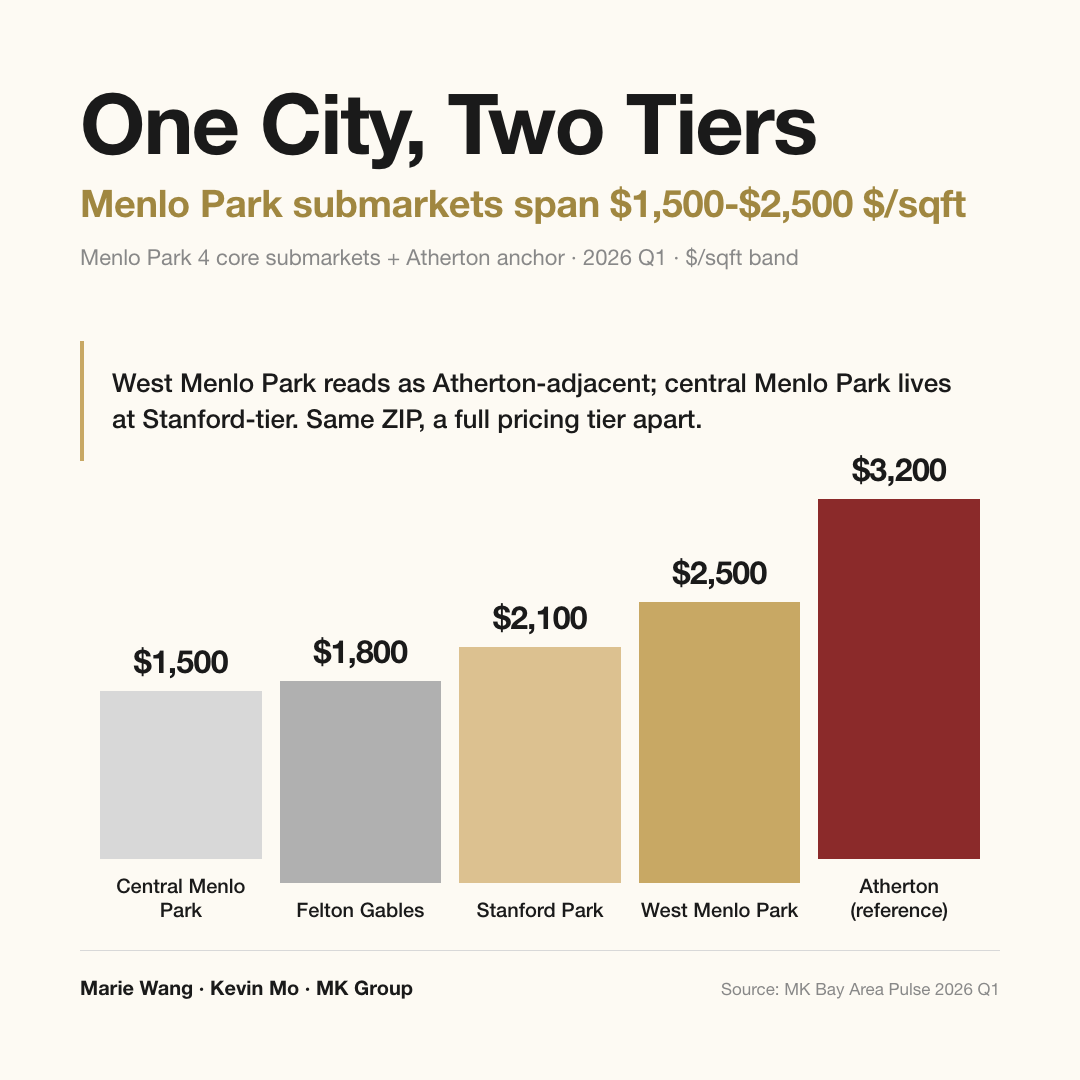
Buying in Menlo Park means treating it as the Peninsula's more livable adjacent luxury tier — not a "cheaper Atherton," but a different tier of market entirely. Five core facts must be understood up front: (1) Most Menlo Park parcels carry a 1/4-acre minimum (far below Atherton's 1-acre floor), with $5M-$15M ground-up as the dominant project size and typical permitting cycles of 6-9 months (roughly half of Atherton's). (2) Menlo Park spans three elementary districts — Las Lomitas (deep West Menlo Park), Menlo Park City Elementary (central Menlo Park and most Atherton-adjacent parcels), and Ravenswood (eastern Belle Haven) — with assignment by street address. The ZIPs (94025 / 94027) do not determine school assignment. (3) West Menlo Park sits adjacent to Atherton with $10M+ common — Allied Arts and Vintage Oaks run roughly $2,000-$2,500 $/sqft and are treated by owners and builders as "Atherton-adjacent" tier; central Menlo Park is downtown-walkable at $5M-$8M, with University Drive / Santa Cruz Avenue corridors stepping to restaurants, cafés, and Caltrain on foot at roughly $1,400-$1,800 $/sqft; Felton Gables / Stanford Park sits in between, concentrating Stanford academics and tech families in a culturally neutral submarket at roughly $1,800-$2,100 $/sqft. (4) Some Stanford-adjacent parcels sit on ground lease, not fee simple — Stanford Park and select Stanford-adjacent lots belong to Stanford University land, with owners holding the building only. Remaining ground-lease term directly determines loan availability, appraisal value, and resale liquidity; verify before offering. (5) Menlo Park's $5M+ off-market share is roughly 25-40% per MK Bay Area Pulse 2026 Q1 estimates, materially below Atherton $10M+'s 50%+ — meaning Menlo Park buyers combining public MLS with pre-MLS channels can cover most inventory, without the pure off-market dependency Atherton demands. This is the framework Marie Wang and Kevin Mo at MK Group have refined across multiple Menlo Park buyer engagements.
Who this article is for
This guide is written for five Menlo Park buyer profiles:
- West Menlo Park large-lot buyers: targeting Allied Arts / Vintage Oaks / west Felton Gables at the 1/3-acre to 1/2-acre tier, budgets $8M-$15M, considering ground-up or major remodel, seeking "Atherton-adjacent + Las Lomitas district + no 24+ month estate-grade timeline."
- Central Menlo Park downtown-adjacent buyers: University Drive / Santa Cruz Avenue / Linfield Oaks corridor, wanting to preserve a walkable lifestyle (Caltrain, cafés, bistros), budgets $5M-$8M, culturally preferring "everyday luxury" over "estate-grade."
- Stanford academics and faculty: households entering Stanford's academic system, targeting Stanford Park or Stanford-adjacent parcels. These buyers typically decide between Faculty Housing (restricted to Stanford employees) and ground-lease parcels (open to general buyers but with critical lease-term implications).
- Cross-border $5M-$10M buyers: deploying Bay Area capital from China, Singapore, Hong Kong, or Taiwan; budgets that sit below Atherton's $10M+ tier and parallel to Palo Alto's $5M-$10M tier — wanting Peninsula-tier schools, commute, and culture without the 24-36 month Atherton ground-up timeline or 60-120 day escrow complexity.
- Atherton tier-down buyers: originally screening Atherton $10M+ tier but, after evaluating the 24-36 month timeline and 1-acre maintenance load, electing to "shift tier, preserve budget, upgrade the build" — putting $8M-$12M into a 1/3-acre West Menlo Park ground-up rather than $15M into an Atherton tear-down, with faster delivery and lighter life impact.
The core decision framework is the same across all five — only the density, submarket matching, and attendance-area diligence depth differ.
Menlo Park's submarkets: which submarket determines what you actually buy
Menlo Park is not a homogeneous market. Homes that all say "Menlo Park 94025" can differ wildly in price, lot size, streetscape character, school assignment, and buyer culture — and Menlo Park's internal tier spread is wider than Palo Alto's. Here is the working profile for each of the four core submarkets:
West Menlo Park (Allied Arts / Vintage Oaks): the western edge bordering Atherton and near Sand Hill Road. Lots typically 1/3-acre to 1/2-acre (select Vintage Oaks parcels to 3/4-acre), $/sqft band $2,000-$2,500, asking $8M-$15M ground-up or $5M-$10M for existing inventory. Stock spans 1950s-2000s mid-century plus later Mediterranean, with modern farmhouse new builds increasing in recent years. Allied Arts is one of Menlo Park's oldest submarkets (strong community-preservation culture, active design review on streetscape consistency); Vintage Oaks runs newer and more modern-tolerant. Buyer culture: Stanford faculty plus tech executives plus Atherton tier-down families. Schools: primarily Las Lomitas (deep West Menlo Park) and Menlo Park City Elementary (most of Allied Arts).
Central Menlo Park (downtown corridor / Linfield Oaks): the walkable tier around University Drive and Santa Cruz Avenue. Lots 1/4-acre and up, some legacy parcels 0.18-0.22 acre, asking $5M-$8M dominant (select estates to $10M+), $/sqft band $1,400-$1,800. Stock is largely 1920s-1960s Craftsman, Ranch, and Spanish Revival, with selective tear-downs in recent years. Linfield Oaks holds central Menlo Park's "traditional-streetscape preservation" character; eastern Felton Gables also rolls up here. Core appeal: walking-distance Caltrain, restaurants, cafés, and bistros — the only Menlo Park submarket with true "daily walkable" character. Buyer culture: younger tech families, Stanford faculty, dual-income households seeking "Peninsula-tier plus urban convenience." Schools: Menlo Park City Elementary (Encinal, Oak Knoll).
Felton Gables / Stanford Park (Stanford-adjacent): between Menlo Park's southern edge and the Stanford campus boundary. Felton Gables runs 1/4-acre to 1/3-acre at roughly $1,800-$2,100 $/sqft, asking $6M-$12M; Stanford Park includes Stanford University ground-lease parcels (owners hold the building only), with fee simple versus ground lease driving sharp price segmentation. Stock is predominantly 1940s-1970s mid-century. Core appeal: Stanford-faculty community culture is neutral and understated, the typical mix of academic and tech families. Schools: Menlo Park City Elementary and Palo Alto Unified (PAUSD) split by street; some parcels do enter PAUSD (this is the only Menlo Park submarket bordering PAUSD). Verify remaining ground-lease term before offering on any Stanford-adjacent parcel.
Suburban Park / Sharon Heights: southwestern Menlo Park near Highway 280. Lots 1/4-acre to 1/3-acre, asking $4M-$8M, $/sqft band $1,300-$1,700. Stock is predominantly 1960s-1980s Ranch. Core appeal: more affordable than West Menlo Park, more school-stable than central Menlo Park, simpler fee-simple ownership than Felton Gables. Buyer culture: upgrader households, families seeking "Menlo Park address plus mid-band budget plus simple ownership." Schools: primarily Las Lomitas, with some Menlo Park City Elementary.
The numbers: 4 Menlo Park submarkets by price, lot, $/sqft, school, and buyer profile
The core number first: among Menlo Park's four core submarkets, West Menlo Park's $/sqft band ($2,000-$2,500) runs roughly 1.4-1.7x central Menlo Park's ($1,400-$1,800) — inside the same Menlo Park city limits, submarket difference matters more than budget difference for lifestyle outcomes. All four share "Menlo Park 94025" mailing — meaning ZIP alone cannot determine tier or school; you must drop to street level.
| Submarket | Asking range | Typical lot | $/sqft band | Primary elementary | Typical buyer profile |
|---|---|---|---|---|---|
| West Menlo Park (Allied Arts / Vintage Oaks) | $8M-$15M | 1/3-1/2 acre | $2,000-$2,500 | Las Lomitas / Menlo Park City | Atherton tier-down / Stanford faculty / tech exec |
| Felton Gables / Stanford Park | $6M-$12M | 1/4-1/3 acre | $1,800-$2,100 | Menlo Park City / PAUSD (partial) | Stanford academic / mixed tech family |
| Central Menlo Park (downtown / Linfield Oaks) | $5M-$8M | 0.18-1/4 acre | $1,400-$1,800 | Menlo Park City | Younger tech family / walkable preference |
| Suburban Park / Sharon Heights | $4M-$8M | 1/4-1/3 acre | $1,300-$1,700 | Las Lomitas / Menlo Park City | Upgrader / mid-band fee simple |
What to actually remember: West Menlo Park and central Menlo Park share the 94025 ZIP but show nearly a 1.7x $/sqft gap. Felton Gables / Stanford Park is the only Menlo Park submarket that may enter PAUSD — within the same neighborhood, crossing a few streets can move assignment from Menlo Park City to PAUSD, with material pricing implications. Data source: MLSListings 2025-2026 / City of Menlo Park zoning / Las Lomitas, Menlo Park City Elementary, Ravenswood, and PAUSD attendance maps / MK Bay Area Pulse 2026 Q1. Updated: 2026-06. Scope: buy-side decision framework for single-family homes across Menlo Park 94025 / 94027's four core submarkets, $4M-$15M tier.
Menlo Park entry strategy: real paths at the $5M / $8M / $15M+ tiers
Menlo Park buyer strategy diverges by budget tier — but less sharply than Atherton's. Across the $5M-$15M band, public MLS remains the base channel and pre-MLS is supplementary rather than substitutive.
$5M-$8M tier (central Menlo Park / Suburban Park dominant): This is the asking-price band for central Menlo Park downtown corridor, Linfield Oaks, and Suburban Park entry inventory. On-market share is roughly 70-80% — MLS still surfaces most inventory at this band. Buyers can reasonably begin via Zillow / Redfin / Compass.com, with the buy-side agent monitoring pre-MLS channels in parallel. Menlo Park closes roughly 80-120 homes per year in this band (versus Atherton's 20-35 at the same tier), so inventory depth is materially higher than Atherton at this dollar amount.
$8M-$12M tier (West Menlo Park dominant / central Menlo Park upper): This is the hybrid band — public MLS plus pre-MLS in parallel. Off-market share runs roughly 25-40% — about one-third of closings circulate first in private channels (TAN, KW Exclusive Properties, Pacific Union private email lists, local trophy-broker networks) for 1-3 weeks before deciding on MLS exposure, or close off-market entirely. Buyers limited to MLS at this tier miss 1/4 to 1/3 of inventory but still see most. The buy-side agent must be wired into the major brokerages' private listing networks.
$12M-$15M+ tier (West Menlo Park upper / select Stanford Park estate): This band approaches Atherton's $10M-$15M entry logic. Off-market share is roughly 40-60% — near Atherton tier but still below Atherton $15M+'s 85-95%. Homes here move through TAN, KW Exclusive Properties, local trophy-broker private email lists, legacy-wealth circle introductions, and direct builder outreach (ground-up projects start sourcing buyers during framing). At this tier the buyer needs: (1) a buy-side agent with 3-5+ years in Menlo Park's trophy circle; (2) a 30-60 day lead time to align profile; (3) acceptance that showing-to-offer windows can be 48-72 hours; (4) all-cash or pre-underwritten with a clean contingency stack as the entry baseline.
The actual Menlo Park buyer process (7 steps, 45-90 days)
The full Menlo Park buyer process is shorter than Atherton's (45-90 days versus Atherton's 60-120) but slightly longer than Palo Alto's (PA's standard 21-45 days) — primarily due to additional diligence in ground-lease and cross-border tiers.
Step 1: Lock the broker and sign the buyer rep agreement (Day 1-5). The Menlo Park buy-side agent bar is lower than Atherton's but still requires Peninsula-tier experience — 3-5+ years across Menlo Park / Atherton / PA, direct knowledge of the four core submarkets' $/sqft bands, and access to TAN or KW Exclusive Properties. Signing a buyer representation agreement is standard post the 2024 NAR settlement.
Step 2: Pre-approval, pre-underwriting, POF, and cross-border structure prep (Day 1-14). $5M-$8M financed buyers can operate on pre-approval; $8M+ should pre-underwrite; $12M+ aligns with Atherton — pre-underwriting plus all-cash POF readiness. Cross-border buyers in Menlo Park also need FinCEN GTO reporting (Title must report beneficial ownership on all-cash $300K+ purchases), AML pre-clearance (typically 5-15 business days), and trust / LLC / foreign-entity vesting documentation — but cross-border complexity at Menlo Park's $5M-$10M tier is materially lower than Atherton's.
Step 3: Submarket lock plus ground-lease diligence (Day 7-21). Based on family profile (walkable preference, streetscape culture, school targeting), shortlist 2-3 of the four core submarkets. Any Stanford Park candidate must complete ground-lease diligence — pull Stanford University's land records, verify remaining lease term (typical original 99 years, remaining term varies sharply), confirm ground rent adjustment mechanism and renewal options. Remaining term directly determines: jumbo loan availability (most lenders require remaining lease > loan term + 10 years), appraisal value (short-lease properties price below fee simple comps), and resale liquidity (short-lease buyer pool is narrower).
Step 4: Tour, assess, second look (Day 14-45). $5M-$8M typically requires 6-12 showings; $8M-$12M typically 5-10; $12M+ typically 4-8. Each property must be scarcity-assessed on the showing day — not deferred to the evening. Second looks routinely include a structural engineer (especially for 1950s-1970s legacy stock), street-level attendance-area verification, and initial walk-through with a potential architecture / contractor team if a tear-down rebuild is in scope.
Step 5: Offer, contingency, earnest money (Day 30-60). Standard Menlo Park $5M-$10M offer structure: earnest money $50K-$200K (cashier's check or wire deposited within 24 hours), inspection contingency 7-10 days (longer than Atherton's 5-7 because competition intensity is lower), disclosure contingency 5 days, appraisal contingency waived on all-cash or kept 17-21 days on financed offers. Menlo Park seller sensitivity: execution certainty still beats raising the offer by 1-2%, but the gap is narrower than Atherton's.
Step 6: Escrow, inspection, appraisal (Day 45-75). All-cash Menlo Park standard escrow is 17-21 days; financed runs 25-35 (Menlo Park jumbos typically require 20-25% down plus 6-12 months reserves). Inspection is critical at the Menlo Park tier — 1920s-1960s legacy stock concentration means foundation, roof, electrical, and plumbing latent-issue density is second only to Atherton's legacy estates. Appraisal is especially critical on ground-lease parcels — the appraiser must have ground-lease tier experience or risk using fee simple comps for an incorrect value.
Step 7: COE and post-closing transition (Day 60-90). Post-COE 30-60 day rent-back is common in Menlo Park but shorter than Atherton (sellers typically need 21-45 days to find the next home versus Atherton's 30-60). Cross-border buyers need post-COE follow-through on FinCEN GTO compliance, W-8BEN-E / Form 5472 filings, and Title insurance record confirmation. This section involves cross-border capital compliance and trust vesting; consult an attorney or CPA before execution.
MK Group field notes: Menlo Park's role in cross-border early-stage screening
Across recent Peninsula cross-border and Atherton tier-down engagements, Menlo Park has played a recurring role — "the third option on the first-round tour list."
A Shenzhen entrepreneur completing a first-round cross-border Bay Area tour in 2025 worked from a $7M-$9M+ budget. The first-round list included Los Altos, Los Altos Hills, Palo Alto, and Menlo Park — Menlo Park appearing on the list not as a fallback but as the "more livable adjacent tier." The client ultimately anchored on a $9M+ Los Altos home, but Menlo Park's walkable culture plus Stanford-adjacent tier had explicitly made the first-round shortlist — a typical Peninsula cross-border buyer pattern: Atherton's estate-grade culture and 24-36 month ground-up timeline can be a disqualifier for a meaningful share of cross-border buyers, and Menlo Park's $5M-$10M tier plus 20-30 month ground-up plus walkable culture is a genuinely comparable alternative. Full case → Shenzhen entrepreneur half-day luxury tour (Menlo Park in first round)
MK Group's multi-year observation in the Peninsula tier is that Menlo Park should not be casually reduced to "the cheaper Atherton" — it is a parallel tier of market with its own core buyer pool (Stanford faculty, younger tech families, walkable-preference dual-income households) whose cultural preferences are not, in fact, "Atherton tier-down." This observation directly drives MK Group's first-round matching guidance: for $5M-$10M families with high walkability preference, evaluate Menlo Park first; for $10M+ families with estate-grade preference, evaluate Atherton. The two markets are not substitutes — they are distinct tiers serving distinct buyer profiles.
5 Common Pitfalls
Pitfall 1: Treating Menlo Park as "the cheaper Atherton" — submarket difference matters more than budget difference for lifestyle outcomes
Menlo Park is not a homogeneous "tier-down Atherton." West Menlo Park ($/sqft $2,000-$2,500, Allied Arts traditional community culture, Atherton-adjacent streetscape) and central Menlo Park ($/sqft $1,400-$1,800, downtown-corridor walkable, younger tech-family character) are fundamentally different ways of life. An $8M household in West Menlo Park can land a 1/3-acre traditional estate; the same $8M in central Menlo Park can land a 0.18-acre walking-distance Caltrain Craftsman — both are "Menlo Park," but daily life diverges completely. Correct approach: decide on submarket culture first (based on family profile, walkability needs, streetscape preferences, school targeting), then look at specific homes. Submarket mismatch hurts a 5-10 year lifestyle horizon more than budget mismatch does.
Pitfall 2: Offering on a Stanford ground-lease parcel without verifying remaining term
Stanford Park and select Stanford-adjacent parcels sit on Stanford University ground lease — owners hold the building only, the original lease is typically 99 years, and remaining term varies sharply (some parcels with 60 years remaining, others with 20). Remaining term directly determines: (1) jumbo loan availability — most lenders require remaining lease > loan term + 10 years; a 20-year remaining lease may be entirely unfinanceable; (2) appraisal value — short-lease properties price below fee simple comps, and the appraiser must have ground-lease tier experience; (3) resale liquidity — short-lease properties have a narrower buyer pool and materially longer days on market than fee simple at the same tier; (4) property tax handling — ground-lease property tax computation differs from fee simple. Before offering, the buy-side agent plus Title officer should review Stanford's lease document, remaining term, renewal options, and ground rent adjustment mechanism together. This section involves ground-lease law and tax; consult an attorney or CPA before execution.
Pitfall 3: Assuming "PAUSD equals Menlo Park district" — Menlo Park spans 3 different elementary districts assigned street by street
Wrong. Menlo Park spans three elementary districts — Las Lomitas (deep West Menlo Park), Menlo Park City Elementary (central Menlo Park and most Atherton-adjacent parcels), and Ravenswood (eastern Belle Haven) — with assignment by street address. Felton Gables / Stanford Park submarkets contain select parcels that do enter PAUSD (Palo Alto Unified) — this is the only Menlo Park submarket bordering PAUSD, and within the same neighborhood, crossing a few streets can move assignment from Menlo Park City to PAUSD. Assuming "Menlo Park 94025 means Menlo Park City district" is the single most common buyer trap. Correct approach: use the official attendance-area lookups for all four districts (Las Lomitas, Menlo Park City Elementary, Ravenswood, PAUSD), enter the full street address, and confirm the elementary assignment — do not trust listing description or ZIP.
Pitfall 4: Watching public MLS only — missing 25-40% of pre-MLS inventory
Wrong. Menlo Park's $5M+ off-market share is roughly 25-40% per MK Bay Area Pulse 2026 Q1 estimates, climbing to 40-60% at $12M+. Sellers who skip pre-MLS and list straight to MLS at $8M+ frequently miss their pocket-buyer pool — pre-MLS buyers are active in private channels but withdraw once a property is "already seen by the market." The buyer-side mirror: watching MLS alone misses 1/4 to 1/3 of inventory at $8M+ Menlo Park, and nearly half at $12M+. Unlocking pre-MLS requires the buy-side agent operates inside TAN, KW Exclusive Properties, Compass Private Exclusives, and local trophy-broker private email lists. This is one of the key buyer-side variables in $8M+ Menlo Park decisions.
Pitfall 5: Skipping street-level attendance-area diligence — same neighborhood across the street can show a $1M+ gap
Felton Gables / Stanford Park and the deep western edge of West Menlo Park show high street-level attendance-area sensitivity. Felton Gables parcels split between Menlo Park City Elementary and PAUSD — crossing a few streets within the same neighborhood can move assignment from Menlo Park City to PAUSD, with $500K-$1M+ price implications. The deep western edge of West Menlo Park splits between Las Lomitas (school ratings 9-10) and Menlo Park City Elementary (ratings 8-9) — material but smaller than Atherton Oaks's $1.5M cross-boundary gap. Correct approach: every candidate property must pass street-level attendance-area verification using the three districts' official attendance-area lookups with the full street address before offering. This step cannot wait until escrow. This section involves school-boundary geometry and home valuation; defer to each district's most current official attendance map.
Frequently Asked Questions
What should I know before buying a home in Menlo Park CA?
Five core facts before buying in Menlo Park: (1) Most Menlo Park parcels carry a 1/4-acre minimum (far below Atherton's 1-acre), with $5M-$15M ground-up dominant and typical permitting cycles of 6-9 months. (2) Menlo Park spans three different elementary districts (Las Lomitas, Menlo Park City Elementary, Ravenswood) assigned by street address; ZIP does not determine school assignment; Felton Gables / Stanford Park additionally crosses into PAUSD. (3) Four core submarkets span sharply: West Menlo Park (Allied Arts / Vintage Oaks) at $/sqft $2,000-$2,500 is Atherton-adjacent; central Menlo Park (downtown corridor) at $/sqft $1,400-$1,800 is walkable Stanford-tier. (4) Some Stanford-adjacent parcels (Stanford Park and similar) sit on Stanford University ground lease — owners hold the building only; verify remaining lease term before offering. (5) Menlo Park $5M+ tier off-market share is roughly 25-40% per MK Bay Area Pulse 2026 Q1 (below Atherton $10M+'s 50%+) — combining public MLS with pre-MLS channels covers most inventory.
Which Menlo Park submarket is best for a family buyer?
It depends on budget, walkability preference, school targeting, and cultural fit. $5M-$8M with "downtown-corridor walkable lifestyle preference": central Menlo Park (University Drive / Santa Cruz Avenue corridor, Linfield Oaks) is the dominant choice. $6M-$12M with "Stanford-adjacent plus academic-community culture plus possible PAUSD exposure": Felton Gables / Stanford Park is canonical — but Stanford Park parcels require ground-lease diligence. $8M-$15M with "Atherton-adjacent plus traditional estate plus Las Lomitas district": West Menlo Park (Allied Arts / Vintage Oaks) is the top tier. $4M-$8M with "Menlo Park address plus mid-band budget plus simple fee-simple ownership": Suburban Park / Sharon Heights is the entry tier.
What is the median price and tier distribution in Menlo Park?
Per MLSListings 2025-2026, Menlo Park single-family median sits in the $3M-$4M range (including all submarkets and price bands). By tier: $4M-$8M (central Menlo Park / Suburban Park / select Felton Gables) closes roughly 80-120 homes per year; $8M-$15M (West Menlo Park / upper Stanford Park) closes roughly 30-50 per year; $15M+ closes no more than 10 per year, concentrated in West Menlo Park Vintage Oaks trophy lots. Menlo Park $5M+ off-market share runs roughly 25-40% per MK Bay Area Pulse 2026 Q1 estimates.
Does cash-only really win in Menlo Park?
No. Menlo Park $5M-$10M cash share runs roughly 50-65% (well below Atherton's 70-80% at the same tier and Atherton's 95% at $10M+) — strongly-credentialed financed offers (pre-underwritten + clean contingency + 20-25% down) remain competitive in Menlo Park. At $10M+ cash share climbs to roughly 75-85%, still below Atherton's 95% all-cash baseline — this is one of the largest structural entry differences between Menlo Park and Atherton. What decides Menlo Park offer wins: execution certainty (pre-underwritten / clean contingency stack) plus flexible rent-back (21-45 days) plus submarket fit.
What additional documentation do cross-border buyers need in Menlo Park?
Beyond standard escrow, cross-border buyers need: (1) FinCEN GTO reporting — Title must report beneficial ownership on all-cash $300K+ purchases; requires passport / ID / source-of-funds narrative. (2) AML compliance — large cross-border wires take 5-15 business days through US bank AML review. (3) LLC / trust / foreign-entity vesting documentation — EIN, W-8BEN-E / Form 5472, and written Title acceptance of the foreign structure. (4) Cross-border tax planning — FIRPTA withholding, California residency determination, treaty coordination with country of origin. (5) Menlo Park-specific: if the target property sits in Stanford Park, additionally complete ground-lease diligence covering remaining term, ground rent adjustment, and renewal options. Cross-border complexity at the Menlo Park tier is lower than Atherton $10M+ but higher than Palo Alto — assemble the Title / cross-border attorney / CPA team 30-60 days before locking a target home. This section involves cross-border capital compliance and tax planning; consult an attorney or CPA before execution.
下一步行动
- Lock the budget tier — specifically $5M-$8M, $8M-$12M, or $12M-$15M+. Get pre-approval ($5M-$8M), pre-underwriting ($8M+), or all-cash POF ($10M+) in place first.
- Shortlist 2-3 submarkets — based on family profile (walkability needs, streetscape preference, school targeting, cultural fit), pick 2-3 of West Menlo Park / Felton Gables / Stanford Park / central Menlo Park / Suburban Park. Do not default to "start with West Menlo Park."
- Run every candidate through street-level attendance-area lookup — use the official attendance-area tools for Las Lomitas, Menlo Park City Elementary, Ravenswood, and PAUSD; type in the full street address and confirm elementary assignment. Felton Gables / Stanford Park candidates especially require this step.
- Stanford-adjacent candidates require ground-lease diligence — pull Stanford University's lease records, verify remaining term, ground rent adjustment mechanism, renewal options, and Title's acceptance of ground-lease vesting. Remaining lease < 50 years materially reduces jumbo loan availability.
- Activate pre-MLS sourcing — at $8M+, brief your agent 30-60 days before active touring and confirm access to TAN / KW Exclusive Properties / Compass Private Exclusives / local trophy-broker private email lists. At $12M+, simultaneously monitor ground-up builder pipelines (see Menlo Park $5M+ Luxury Builders).
- Cross-border, trust, or family-office buyers: assemble the team 30-60 days in advance — Title company, cross-border attorney, CPA. At $8M+, prep trust structure or foreign-entity vesting, EIN, W-8BEN-E / Form 5472, and FIRPTA planning.
- Offer structure: prioritize execution certainty — earnest money $50K-$200K, inspection contingency 7-10 days, appraisal contingency waived (all-cash) or kept 17-21 days (financed), flexible rent-back (21-45 days). Seller sensitivity is below Atherton's but execution certainty still beats raising the offer by 1-2%.