Direct Answer: What you must know before selling in Menlo Park
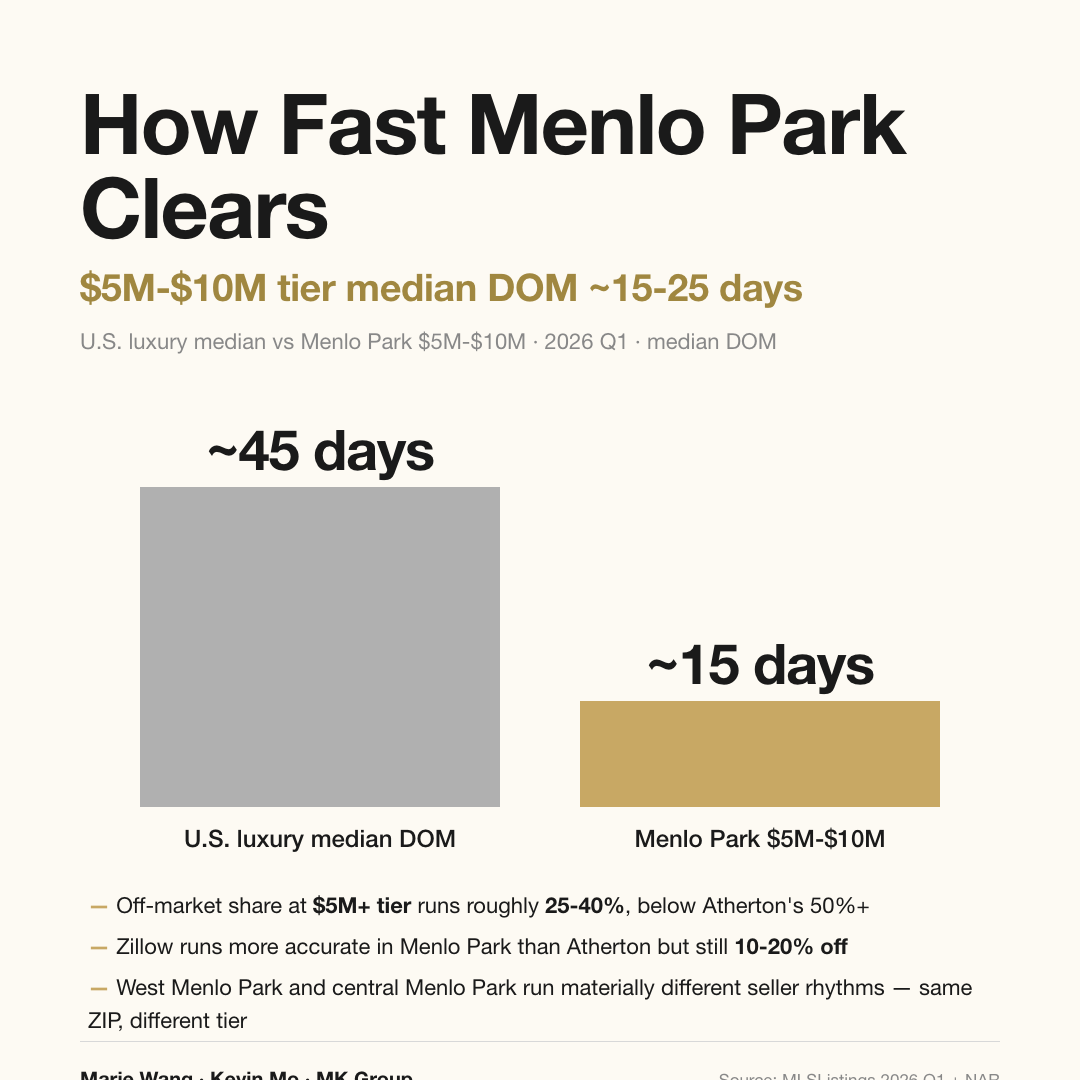
Selling in Menlo Park means deploying the Peninsula's more livable adjacent luxury tier exit — the decision framework diverges sharply from Atherton estate-grade, while being slightly more complex than Palo Alto. Five core facts must be understood up front: (1) Median DOM is 12-25 days — $5M-$10M tier typically 15-25 days, $10M+ tier typically 30-60 — materially faster than Atherton $20M+'s 90+ day rhythm. Menlo Park sellers should prepare for "short window, fast cadence" first weeks, not Atherton's "long window, slow cadence." (2) Menlo Park $5M+ off-market share runs roughly 25-40% per MK Bay Area Pulse 2026 Q1 estimates, materially below Atherton $10M+'s 50%+ — public MLS remains the dominant Menlo Park seller path, with pre-MLS as supplement rather than substitute. (3) Menlo Park pricing weights $/lot less heavily than Atherton — Atherton is land-value-dominated (West Atherton's valuation runs nearly 90% land), while Menlo Park weights build age, setback, streetscape fit, and design quality materially higher. The same 0.3-acre lot with a 5-year-new build versus a 50-year-old legacy home shows a wider price gap in Menlo Park than in Atherton. (4) Cross-border buyers are active in Menlo Park's $5M-$10M tier — playing the Peninsula's "livable alternative" role, especially for families disqualified by Atherton's 24-36 month estate-grade timeline. Sellers should prepare bilingual materials for the Stanford-academic and cross-border buyer pools. (5) Zillow runs more accurate in Menlo Park than Atherton but still typically 10-20% off — because Menlo Park's off-market share is lower than Atherton's, Zillow sees a more complete MLS sample. But submarket variation (West Menlo Park vs central Menlo Park 1.7x $/sqft spread), streetscape fit, and build quality remain undermodeled — Zestimate is never the listing anchor. This is the framework Marie Wang and Kevin Mo at MK Group have refined across multiple Menlo Park seller engagements.
Who this article is for
This guide is written for five Menlo Park seller profiles:
- Menlo Park owners upgrading to Atherton: holding the Menlo Park primary residence for 5-15 years, motivated by family expansion, wealth tier jump, or social-needs change to "sell Menlo Park, buy Atherton" — particularly common across the 2024-2026 tier.
- Retirement down-sizers: Menlo Park larger home held 10-20 years, children independent, exiting to Hillsborough / Burlingame mid-tier, Carmel, Lake Tahoe, or out-of-state smaller properties.
- Out-of-Bay-Area sellers: relocating for work (Austin / Seattle / Miami / cross-border), tax considerations (California versus other states), or family reasons.
- Stanford academic sabbatical / retirement sellers: households inside Stanford's academic system, exiting due to sabbatical, retirement, or relocation to an overseas university. If the property is on Stanford ground lease, the timeline differs from fee simple.
- Inherited-property sellers: Menlo Park property received through trust, estate, or inheritance — requiring handling of step-up basis, trust grant deed, multi-heir coordination, and family CPA plus estate attorney alignment.
The core decision framework is the same across all five — only the density, tax impact, privacy needs, and submarket-matching depth differ.
Menlo Park seller pricing: why Zillow isn't enough and where the real data comes from
Zillow runs more accurate in Menlo Park than in Atherton — primarily because Menlo Park's off-market share (25-40%) is below Atherton's (50%+), so Zillow sees a more complete MLS sample. But Zillow remains typically 10-20% off in Menlo Park, with three structural causes. First: Zillow's Zestimate model uses citywide $/sqft averaged regression, but Menlo Park's four core submarkets span a 1.7x $/sqft gap — West Menlo Park ($2,000-$2,500) versus central Menlo Park ($1,400-$1,800). Zillow interpolates linearly across street distance, materially understating West Menlo Park and slightly overstating central Menlo Park. Second: Menlo Park's pricing weights build age, setback, streetscape fit, and design quality more heavily than Atherton, but Zillow's model handles these variables thinly. The same 0.3-acre lot with a 5-year-new modern build versus a 50-year mid-century legacy home can show a $1.5-2.5M price gap in Menlo Park that Zillow typically cannot reflect. Third: Felton Gables / Stanford Park ground-lease properties are almost universally mispriced by Zillow — Zestimate uses fee simple comps for ground-lease assets, typically a material overstatement.
Where the real pricing data comes from: (1) MLS public closings — Menlo Park's 60-75% real-closing-in-MLS share (higher than Atherton's 30-50%) makes MLS comps more reliable in Menlo Park than in Atherton, though off-market still requires supplementing. (2) Off-market comp data — closings accessible only through TAN / KW Exclusive Properties / Compass Private Exclusives / Pacific Union private email lists, including $/sqft, $/lot, ask-vs-sale spread, and buyer source. (3) Menlo Park submarket $/sqft and $/lot dual-axis baselines — West Menlo Park $2,000-$2,500 / 1/3-acre $4-6M; Felton Gables / Stanford Park $1,800-$2,100 / 1/4-acre $3-4M; central Menlo Park $1,400-$1,800 / 0.2-acre $2-3M; Suburban Park $1,300-$1,700 / 1/4-acre $2-3M. (4) Build age, setback, and streetscape adjustments — 5-year-new build +20-30%, design review compliance plus streetscape fit +10-15%, ground lease versus fee simple -25-40%. (5) Builder ground-up project data — projects from Pacific Peninsula Group, Conrad, Toby Long, Pacific Coast at the $5M-$15M Menlo Park tier yield $/sqft completion cost plus land cost decomposition, enabling reverse calculation of land-value versus building-value weight. Data source: MLSListings 2025-2026 / City of Menlo Park public closing records / MK Bay Area Pulse 2026 Q1 / Top Agent Network off-market sharing / local luxury builder project data. Updated: 2026-06. Scope: seller pricing framework for single-family homes in Menlo Park 94025 / 94027 across four core submarkets, $4M-$15M tier.
Menlo Park seller listing path: on-MLS vs hybrid vs off-market
Menlo Park sellers have three basic listing paths, selected by tier, privacy needs, and timeline flexibility — but the diversification is less sharp than Atherton's.
Path A: Public MLS (on-market). Best fit for $4M-$8M central Menlo Park / Suburban Park / select Felton Gables entry inventory — this is the dominant Menlo Park path (80-90% of $5M-$8M closings run here). This tier still has substantial mainstream buyer attention on MLS (younger tech families, Stanford-faculty pre-entry, dual-income households seeking walkable Peninsula tier), and public MLS produces multi-offer competitive bidding. First-week cadence: Thursday afternoon MLS go-live, Friday Broker Preview, Saturday Public Open House, Sunday second tour, Tuesday 5 PM Offer Deadline. Strengths: maximum buyer pool, transparent pricing, dense first-week rhythm. Weaknesses: privacy exposure, stale-listing penalty risk.
Path B: Pure off-market / pocket listing. Best fit for $12M-$15M+ upper West Menlo Park estate, select Stanford Park upper tier, West Menlo Park Vintage Oaks large lots — roughly 30-50% of this tier runs pure off-market. Circulates through TAN / KW Exclusive Properties / Compass Private Exclusives / local trophy-broker private email lists / legacy-wealth circle introductions / direct builder outreach. Strengths: maximum privacy, no stale-listing penalty, seller controls timeline flexibly. Weaknesses: smaller buyer pool, pricing depends on the agent's off-market comp judgment.
Path C: Hybrid (off-market warm-up plus MLS conversion). Best fit for $8M-$12M West Menlo Park / Felton Gables / Stanford Park dominant inventory — increasingly the mainstream Menlo Park $8M+ choice. Flow: run 14-30 days of off-market warm-up (signal release into TAN / private network, selective broker previews), close off-market if a qualified offer materializes in the private channel; convert to public MLS with standard first-week cadence if not.
Decision matrix guidance: $4M-$8M defaults to Path A (public MLS); $8M-$12M defaults to Path C (hybrid); $12M-$15M+ defaults to Path B or C. Privacy-sensitive sellers (high-profile Stanford faculty, cross-border entrepreneurs, family offices) may consider Path C even at the $5M-$8M tier. This section involves pricing strategy, privacy management, and cross-border compliance variables; coordinate with the listing agent, Title officer, and family CPA before execution.
The actual Menlo Park seller process (8 steps, 2-5 months)
The full Menlo Park seller process is shorter than Atherton's (2-5 months vs Atherton's 4-9) but slightly longer than Palo Alto's (PA's standard 21-45 days) — primarily due to submarket matching, cross-border tier, and ground-lease tier additional diligence.
Step 1: Lock the listing agent (Day 1-10). The Menlo Park listing-agent bar is lower than Atherton's but still requires Peninsula-tier experience — 3-5+ years in Menlo Park / Atherton / PA, direct knowledge of the four core submarkets' $/sqft and $/lot bands, access to TAN or KW Exclusive Properties. Listing agreement specifies commission structure, exclusivity, 3-4 month window (versus Atherton's 6-9), and pre-MLS option.
Step 2: Pricing (Day 10-21). Pricing does not rely on Zillow but cross-validates three data sets: (1) MLS public closings (same submarket, same tier, last 60-90 days); (2) off-market comp (agent's private-network closings); (3) submarket $/sqft and $/lot dual-axis baseline plus build age / setback / streetscape adjustments. Stanford Park ground-lease properties additionally require independent ground-lease appraisal (the appraiser must have ground-lease tier experience).
Step 3: Prep — pre-listing inspection plus refurbishment decisions plus bilingual materials (Day 14-45). Pre-listing inspection is recommended but not required in Menlo Park ($800-$2,000), because 1920s-1960s legacy stock concentration drives high latent-issue density in foundation, roof, electrical, plumbing — second only to Atherton's legacy estates. $8M+ tier additionally requires bilingual materials (English plus Simplified Chinese) — cross-border buyers are active in Menlo Park's $5M-$10M tier, and Stanford-faculty and cross-border family members (potentially spouse or parents) face a materially lower reading bar with bilingual materials, raising conviction.
Step 4: Staging plus photography plus video (Day 21-45). Menlo Park staging investment tiers: $4M-$8M $15K-$30K; $8M-$12M $25K-$60K; $12M-$15M+ $50K-$120K. Menlo Park staging culture diverges from Atherton — not "estate-grade lifestyle production" but "livable elegance everyday luxury." West Menlo Park Vintage Oaks approaches Atherton tier but still skews livable; central Menlo Park staging should run "warm plus walkable lifestyle." Photography plus drone (where appropriate) plus virtual tour is standard at $8M+.
Step 5: Pre-marketing pocket (Day 30-60) — Path C / Path B only. If running Path C (hybrid) or Path B (pure off-market), execute 14-30 days of off-market warm-up before MLS — signal release into TAN / KW Exclusive Properties / Compass Private Exclusives, 1-2 selective broker previews. Warm-up qualified offers close off-market directly; even when ultimately converting to MLS, accumulated interest density makes the first-week cadence denser.
Step 6: MLS launch (Path A / Path C conversion) (Day 45-75). Standard first-week cadence (adjusted for Menlo Park tier): Thursday afternoon MLS go-live, Friday Broker Preview (11 AM-1 PM standard, $10M+ can extend to 12-3 PM), Saturday Public Open House (central Menlo Park walk-in, West Menlo Park by appointment), Sunday second tour plus private showing, Tuesday 5 PM Offer Deadline ($5M-$10M typically 5-7 day Deadline).
Step 7: Showing plus offer review plus negotiation (Day 60-90). $5M-$10M Menlo Park tier typically draws 4-10 offers (versus PA's 5-15 and Atherton's 3-8 at the same tier). Offer quality distribution: roughly 50-65% all-cash plus pre-underwritten financed plus some standard financed. Sellers should select on execution certainty (pre-underwritten, clean contingency, flexible rent-back) — 14-21 day close certainty plus clean contingency typically beats raising the offer by 1-2%, though seller sensitivity here is below Atherton's.
Step 8: Escrow plus funding plus COE (Day 75-150). All-cash Menlo Park escrow is 17-21 days; financed runs 25-35. Stanford Park ground-lease tier escrow may run longer (Stanford University lease transfer approval typically takes 2-4 weeks). Cross-border buyers' FinCEN GTO filings, trust vesting confirmation, and AML wire clearance run in parallel here. Post-COE 21-45 day rent-back is common in Menlo Park but shorter than Atherton.
Additional steps for cross-border, trust, family-office, and Stanford-faculty sellers
Cross-border identity, trust vesting, family-office holding, and Stanford-faculty ground-lease holding all run at materially higher Menlo Park share than Palo Alto. These scenarios require additional steps: (1) FIRPTA withholding — non-US-resident sellers face 15% federal withholding on $300K+ closings (Withholding Certificate may reduce in some cases); initiate filing 30-60 days before listing. Menlo Park tier FIRPTA withholding typically runs $500K-$1.5M, materially impacting seller cash flow. (2) Trust vesting grant deed prep — Revocable Living Trust holdings require trust documents, Certification of Trust, Successor Trustee authorization (where applicable) coordinated with title officer 21-45 days in advance. (3) Stanford ground-lease transfer — Stanford University ground-lease holdings require pre-coordinating lease transfer with Stanford: Stanford holds approval authority over buyer qualification (typical 2-4 weeks), ground rent adjustment mechanism may reset at transfer, remaining lease < 50 years narrows the jumbo loan buyer pool. (4) 1031 Exchange timeline — same-kind exchange plans require Qualified Intermediary designation before close, Identification within 45 days post-close, Acquisition within 180 days. (5) Family-office multi-party coordination — estate attorney, family CPA, wealth manager must align on pricing decisions and tax impact pre-listing. This section is for decision education and does not constitute legal or tax advice; consult an attorney or CPA before execution.
Menlo Park submarket seller matrix
The core number first: among Menlo Park's four core submarkets, West Menlo Park concentrates the $10M+ band (roughly 30-40% of closings there) with the highest off-market share; central Menlo Park is the $5M-$8M tier driver, public MLS dominant; Felton Gables / Stanford Park is the Stanford-tier tier (ground lease parcels require additional diligence); Suburban Park is the entry tier ($4M-$8M) with staging investment as low as $15K-$30K. The table below maps seller strategy by submarket; specific figures are experience-estimated from past Menlo Park closings.
| Submarket | Dominant tier | Typical DOM | Staging tier | Typical buyer profile | Strategy notes |
|---|---|---|---|---|---|
| West Menlo Park (Allied Arts / Vintage Oaks) | $8M-$15M | 30-60 days | $50K-$120K | Atherton tier-down / Stanford faculty / cross-border | Path C (hybrid) plus bilingual materials |
| Felton Gables / Stanford Park | $6M-$12M | 25-50 days | $25K-$70K | Stanford academic / mixed tech family | Hybrid plus Stanford-faculty buyer outreach plus ground-lease handling |
| Central Menlo Park (downtown / Linfield Oaks) | $5M-$8M | 15-25 days | $15K-$40K | Younger tech family / walkable preference | Public MLS plus dense first-week rhythm |
| Suburban Park / Sharon Heights | $4M-$8M | 20-40 days | $15K-$30K | Upgrader / mid-band budget | Public MLS plus attendance-area sensitivity callouts |
What to actually remember: West Menlo Park and central Menlo Park share 94025 but show 3-4x staging investment gap and 2x DOM gap. Stanford Park ground-lease properties versus fee simple properties show different DOM and different buyer pools — Menlo Park is the only Peninsula tier with this within-submarket complexity.
MK Group field notes: submarket matching beats pricing for Menlo Park sellers
Across recent Menlo Park seller engagements, one observation recurs: submarket mismatch hurts first-week rhythm more than pricing mismatch.
Two common Menlo Park seller mismatch scenarios: (1) Marketing a West Menlo Park Allied Arts $10M+ property as "mid-tier Menlo Park" — staging budget set at central Menlo Park standard ($25K-$40K), marketing copy emphasizes "downtown walkable" (but Allied Arts is actually Atherton-adjacent tier), open house scheduled walk-in (rather than by appointment). Result: cross-border buyers, Stanford faculty, and Atherton tier-down families — the Allied Arts real buyer pool — are not effectively reached, the first-week open house draws mismatched mid-tier buyers, offer count and quality both fall below tier-appropriate, final price runs 5-10% below comp. (2) Marketing a central Menlo Park downtown corridor $5M-$7M home as "Stanford-tier estate" — staging budget set at West Menlo Park standard ($60K-$80K), marketing copy over-emphasizes "estate quality" (but central Menlo Park's real selling point is walkable lifestyle), ignoring the walkable tier's most sensitive variable: walking time to Caltrain / Santa Cruz Avenue. Result: younger tech families and dual-income walkable buyers — the central Menlo Park real buyer pool — are not effectively activated, the first-week open house draws mismatched estate-preference buyers, final price runs 3-8% below comp.
MK Group's observation: Menlo Park sellers at Step 1 of listing-agent selection must confirm the agent has first-hand judgment on the four core submarkets' divergence — able to position your home in the correct submarket tier, identify the real buyer pool, and align staging culture. If this step is wrong, all the effort in Steps 2-7 is canceled by first-week submarket mismatch. Among the Peninsula sellers MK Group serves, Menlo Park has the highest submarket-matching complexity — higher than PA tier and more split than Atherton tier (because PA's seven sub-communities have cultural differences but a homogeneous buyer pool, Atherton has tighter and more specialized buyer pools per submarket; Menlo Park is the unique combination of "wide submarket spread plus wide buyer-pool spread").
5 Common Pitfalls
Pitfall 1: Importing PA / Atherton comps without adjusting to the Menlo Park tier
Wrong. Menlo Park pricing weights differ from PA / Atherton — PA tier is $/sqft dominant plus PAUSD school premium, Atherton tier is $/lot dominant plus 1-acre minimum zoning. Menlo Park tier runs "dual-axis weight" — $/sqft and $/lot in parallel, plus submarket culture (West / Felton Gables / central / Suburban Park), plus school district cross-boundary (Las Lomitas / MPC / Ravenswood / PAUSD), plus build quality. Importing a PA Crescent Park comp at -10% for a Felton Gables quote, or an Atherton Lloyden Park comp at -25% for a West Menlo Park Vintage Oaks quote, both produce wrong numbers. Correct approach: lead with Menlo Park within-submarket same-tier comps, supplement with PA / Atherton same-$/sqft-tier comps, then layer build age / setback / streetscape adjustments.
Pitfall 2: Missing the Stanford-academic buyer pool — not preparing for the Stanford ground-lease timeline difference
Felton Gables / Stanford Park's Stanford-academic buyer pool is unique to the Menlo Park tier — Stanford faculty, research staff, mixed tech-and-academic households newly entering Stanford. This pool has distinctive characteristics: long decision cycle (family meeting plus sabbatical timeline alignment), higher tolerance for ground lease than general buyers (Stanford faculty understand the mechanism), high sensitivity to design quality and streetscape fit, low tolerance for "ostentatious estate." Sellers who fail to prepare for this pool — (1) signaling 30-45 days early to Stanford-affiliated brokers and faculty community, (2) bilingual materials (some Stanford faculty are cross-border), (3) flexible closing timeline (adapted to sabbatical schedules) — miss the largest buyer pool for Felton Gables / Stanford Park tier. Stanford Park ground-lease sellers additionally must coordinate lease transfer with Stanford in advance, or escrow-stage 2-4 week delays are routine.
Pitfall 3: Treating all Menlo Park submarkets as the same — central versus West differs by a full tier
Wrong. Menlo Park's four core submarkets span very large culture, streetscape, and buyer-pool gaps — West Menlo Park ($2,000-$2,500 $/sqft / Atherton-adjacent / traditional estate culture / Las Lomitas + MPC districts), Felton Gables / Stanford Park ($1,800-$2,100 / Stanford-adjacent / academic culture / MPC + PAUSD cross-boundary), central Menlo Park ($1,400-$1,800 / downtown walkable / younger tech family / MPC district), Suburban Park ($1,300-$1,700 / 280-adjacent / upgrader / Las Lomitas + MPC). Staging culture, first-week rhythm, and buyer outreach channels diverge sharply across the four submarkets. Using the same staging template plus the same marketing copy across four submarkets is the most common Menlo Park seller trap — the first-week rhythm collapses on submarket mismatch. Correct approach: each submarket should have a dedicated staging template, marketing copy, open house cadence, and buyer outreach list.
Pitfall 4: Sending Zillow numbers to buyers
Zillow runs more accurate in Menlo Park than in Atherton but still typically 10-20% off. Pre-listing, if you send the Zillow Zestimate to the listing agent as the expected sale anchor, anchor your psychological list price to the Zillow number, or send the Zillow link to prospective buyers to "justify" pricing — all three put the seller in a disadvantaged position at pricing and negotiation. Core Zillow problems: (1) the 1.7x $/sqft spread across Menlo Park's four submarkets is undermodeled; (2) build age / setback / streetscape fit weights are undermodeled; (3) ground lease versus fee simple is almost entirely wrong. Correct approach: cross-validate three data sets — MLS comps (within 60-90 days, same submarket, same tier) plus submarket $/sqft + $/lot dual-axis baseline plus build age adjustment — to derive a range value (not a point estimate), then the listing agent prices inside the range based on current market momentum.
Pitfall 5: Staging over-spec — Menlo Park tier finish expectations diverge from Atherton
Menlo Park staging culture diverges from Atherton — Menlo Park buyers prefer "livable elegance" (everyday luxury), not Atherton "estate-grade lifestyle" (entertainment-grade luxury). Central Menlo Park tier successful staging is "warm plus walkable plus neighborhood-fit" — emphasizing "walking distance to Caltrain," cafés, neighborhood gardens; West Menlo Park, even at near-Atherton tier, should still stage "traditional plus livable" rather than "ostentatious estate." Sellers or agents producing over-spec'd "hotel-grade modern luxury" staging (emphasizing "modern luxury") clash with Menlo Park's buyer culture (Stanford faculty, younger tech families, cross-border families) — result: $80K-$120K staging investment but final price 3-7% below tier-appropriate. Correct approach: staging must align with submarket culture — West Menlo Park "traditional livable" $50K-$120K, Felton Gables "Stanford-academic neutral" $25K-$70K, central Menlo Park "walkable lifestyle" $15K-$40K, Suburban Park "warm fee simple" $15K-$30K.
Frequently Asked Questions
How do I sell a home in Menlo Park California?
Selling in Menlo Park, 8-step standard flow: (1) Lock the listing agent (3-5+ years Peninsula tier experience, first-hand judgment across the four core submarkets, access to TAN / KW Exclusive Properties); (2) Pricing (cross-validate MLS comps + submarket $/sqft + $/lot dual-axis baseline + build age adjustment; do not rely on Zillow); (3) Prep (pre-listing inspection + refurbishment decisions + $8M+ bilingual materials); (4) Staging + photography + video (set by submarket culture); (5) Pre-marketing pocket (Path C / Path B only); (6) MLS launch (Path A / Path C conversion); (7) Showing + offer review + negotiation; (8) Escrow + funding + COE. Full timeline 2-5 months. $5M-$10M typically Path A (public MLS), $8M+ typically Path C (hybrid), $12M-$15M+ typically Path B or C.
How long does it take to sell in Menlo Park?
Depends on tier and listing path. Median DOM 12-25 days (across $5M-$10M tier), $5M-$10M typical 15-25 days, $10M-$15M typical 30-60 days, $15M+ (rare) 60-120 days. Full process (from listing agreement to COE): $5M-$10M typically 2-3 months, $10M-$15M typically 3-4 months, $15M+ typically 4-5 months. Stanford Park ground-lease tier escrow typically adds 2-4 weeks (Stanford lease transfer approval).
How do I price a Menlo Park home?
Cross-validate three data sets: (1) MLS public closings (same submarket, same tier, last 60-90 days); (2) off-market comp (agent's private-network closings); (3) submarket $/sqft and $/lot dual-axis baseline plus build age / setback / streetscape adjustment. Menlo Park's four core submarkets' $/sqft bands: West Menlo Park $2,000-$2,500, Felton Gables / Stanford Park $1,800-$2,100, central Menlo Park $1,400-$1,800, Suburban Park $1,300-$1,700. Stanford Park ground-lease parcels additionally require independent ground-lease appraisal. Never use Zillow Zestimate as the list-price anchor — Zillow is more accurate in Menlo Park than Atherton but still typically 10-20% off.
Do I need bilingual materials to sell in Menlo Park?
$8M+ tier strongly recommended; $5M-$8M optional but additive. Menlo Park's $5M-$10M tier is active with cross-border buyers — playing the Peninsula's "livable alternative" role for families disqualified by Atherton's 24-36 month timeline, and for families with walkable plus Stanford-adjacent preferences. English-only one-pagers, Disclosure Package, and Property Highlight Sheet drive up the reading bar for cross-border family CPA, cross-border attorney, and remote-decision family members (spouse, parents) — conviction falls, decision cycle stretches, final offer price drops. Recommendation: $8M+ listings should carry bilingual materials — English plus Simplified Chinese (add Traditional Chinese if Hong Kong / Taiwan targeting), delivered by a professional real estate translator (not Google Translate).
What additional documentation do cross-border sellers need in Menlo Park?
Beyond standard escrow, cross-border Menlo Park sellers need: (1) FIRPTA withholding — non-US-resident sellers face 15% withholding on $300K+ closings; Menlo Park tier FIRPTA withholding typically runs $500K-$1.5M; initiate filing 30-60 days before listing. (2) AML compliance — outbound wires of sale proceeds run through US bank AML review. (3) Cross-border tax planning — FIRPTA Withholding Certificate (may reduce in some cases), California residency determination, treaty coordination with country of origin. (4) Stanford ground-lease holdings require pre-coordinating lease transfer with Stanford (Stanford holds approval over buyer qualification, typical 2-4 weeks). (5) Trust / LLC / foreign-entity holding additional documents — Certification of Trust, Successor Trustee authorization (where applicable), EIN, written Title acceptance of the foreign structure. Plan to assemble the Title / cross-border attorney / CPA team 30-60 days before listing. This section involves cross-border capital compliance and tax planning; consult an attorney or CPA before execution.
Next steps
- Lock the submarket tier — confirm whether your home sits in West Menlo Park (Allied Arts / Vintage Oaks), Felton Gables, Stanford Park, central Menlo Park (downtown / Linfield Oaks), or Suburban Park. This determines staging culture, first-week rhythm, and buyer outreach channels.
- When selecting the listing agent, confirm submarket matching capability — 3-5+ years Peninsula tier experience, last-12-month closing data in your specific submarket, access to TAN / KW Exclusive Properties.
- Price by cross-validating three data sets — MLS comps plus off-market comp (agent private network) plus submarket $/sqft + $/lot dual-axis baseline. Do not rely on Zillow. Stanford Park ground-lease parcels require independent ground-lease appraisal.
- Prepare bilingual materials at $8M+ — English plus Simplified Chinese (add Traditional Chinese where applicable), delivered by a professional real estate translator. Reading bar drops materially for cross-border and Stanford-faculty family members.
- Select the listing path — $4M-$8M defaults to Path A (public MLS); $8M-$12M to Path C (hybrid); $12M-$15M+ to Path B or C. Privacy-sensitive sellers may consider Path C even at $5M-$8M.
- Cross-border, trust, Stanford-faculty, family-office sellers: assemble the team 30-60 days in advance — Title company, cross-border attorney, CPA. FIRPTA withholding, trust grant deed, Stanford ground-lease transfer all require front-loading.
- Set first-week cadence by submarket culture — central Menlo Park walk-in open house plus dense first week; West Menlo Park by appointment plus slower first week plus bilingual broker preview. Stanford Park requires Stanford-academic buyer outreach channel.