Selling in Palo Alto, start here
Selling in Palo Alto, the final sale price is determined less by the home itself than by four interlocking decisions: (1) use street-level comps within the same attendance area, not Palo Alto city-wide median; (2) tier your pricing strategy by sub-neighborhood — the $3M-$5M tier benefits from "slightly under-market" pricing to trigger bidding wars, while the $8M+ tier rewards "near floor-price" listings that filter out non-serious buyers; (3) scale staging investment to the price tier — about $8K-$15K for a $3M home, $20K-$40K for $5M+; (4) execute the first week to the standard cadence — MLS Thursday, Broker Preview Friday, Open Houses Saturday and Sunday, Offer Deadline Tuesday. A misstep on any one of these four variables can cost 30 extra days on market or 5-10% off the final number. This article breaks down each decision in operational detail, along with the additional steps that cross-border, trust, and family-office sellers face in Palo Alto.
Who this is for
This article is written for: current Palo Alto homeowners preparing to list a single-family home in core sub-neighborhoods including Crescent Park, Old Palo Alto, Professorville, Community Center, Midtown, Barron Park, Green Gables, and Charleston Meadows; price tiers ranging $2M-$15M+; with sell motives spanning upsize, downsize, cross-border exit, trust dissolution, and family-office portfolio reallocation. If you are listing a condo or townhome under $1.5M, or a property in East Palo Alto, the sub-neighborhood tiering and staging investment dollar ranges below should be scaled down proportionally — but the comp-selection logic and first-week rhythm template still apply directly.
Dimension 1: Palo Alto comps must be street-level, not city-wide
The most common — and most expensive — pricing error in Palo Alto is using the wrong comps. Two specific failures account for most of it: referencing "Palo Alto city-wide median over the last six months" or "benchmarking against Cupertino sales in the same price range." Both methods produce severely distorted prices. Palo Alto's sub-neighborhood variation is enormous: a 2,000-2,500 sqft, four-bedroom, PAUSD-zoned single-family home in Crescent Park can sell for 1.6-1.8x the equivalent in Barron Park, with Midtown running 15-25% above Charleston Meadows. The reason is that Palo Alto's sub-neighborhood land-value gaps dwarf the building-quality gaps — two identical homes on different land sit at completely different price points. Correct comp selection: (1) same attendance area (different elementary boundaries within PAUSD matter significantly); (2) street-level — same street or within 2-3 adjacent blocks, sold in the last 60-90 days; (3) ±15% building square footage; (4) equivalent lot size tier; (5) similar age (pre-1976 vs post-1976 is the dividing line, because the former usually carries either historic-preservation review or a renovation reserve). If no comparable sale on the same street has closed in the last 60 days, extend to the same sub-neighborhood within the same elementary boundary over the last 90 days — never jump to the city-wide median.
Dimension 2: Strategy differences across Crescent Park, Old Palo Alto, Midtown, and Barron Park
The four core Palo Alto sub-neighborhoods have different buyer profiles, price bands, and pricing strategies. Crescent Park and Old Palo Alto / Professorville are the city's top tier: list prices typically $5M-$15M, buyers dominated by family offices, serial entrepreneurs, and large-fund VC partners, with $8M+ properties often transacting off-market. The selling strategy here is "near floor-price pricing plus active buyer-pool sourcing" — leave little upward headroom in the list price, use precise pricing to filter out non-serious buyers, and concentrate negotiation between one or two genuinely capable households. Community Center and Midtown are the mid-upper tier: $3M-$6M, with senior tech workers, dual-income families, and school-driven buyers. This range rewards "slightly under-market pricing plus high-density first-week exposure" — manufacture multiple-offer dynamics, with 8-15% over list as the common outcome. Barron Park, Green Gables, and Charleston Meadows are the mid tier: $2M-$4M, with first-time upgraders and dual-tech-worker households. The key here is that first-week discipline cannot slip — inventory is relatively healthier, buyers comparison-shop more aggressively, and if offer count falls short in week one, a price reduction recovers far less than getting pricing right on day one.
Dimension 3: Pre-1976 housing stock — repair ROI and renovation reserve
A large share of Palo Alto homes were built between 1940 and 1970 (parts of Old Palo Alto are earlier), making pre-1976 construction a distinct selling challenge. Common hard issues include: corroded cast-iron drain lines ($8K-$15K to replace), original single-pane windows ($15K-$30K), knob-and-tube wiring ($10K-$25K to upgrade), pre-1978 lead-based paint disclosure obligations, foundation settling (slab type $5K-$15K, crawlspace can run $20K-$50K), and aging roofs ($20K-$40K to replace). Repair ROI from a buyer's perspective, in priority order: (1) kitchen counters and appliances ($15K-$30K, ROI 70-85% — Palo Alto buyers respond especially strongly to white quartz and Wolf/Sub-Zero); (2) primary bath ($20K-$40K, ROI 60-75%); (3) whole-home paint and hardwood refinishing ($10K-$20K, ROI 70-80%); (4) exterior and garage door ($8K-$15K, ROI 60-70%); (5) front yard ($5K-$10K, ROI 50-65% — Palo Alto buyers are highly sensitive to the first impression at the entry). Historic preservation note: Professorville Historic District and parts of Old Palo Alto fall under PA Historic Resources Board review, requiring pre-approval for exterior, roof, and window changes — pre-listing renovations need a 6-8 week buffer for review. This is a variable unique to Palo Alto compared with other Bay Area sell markets. This section involves Historic District and lead paint disclosure; consult a property attorney before execution.
Dimension 4: Staging investment tiers and the Palo Alto standard
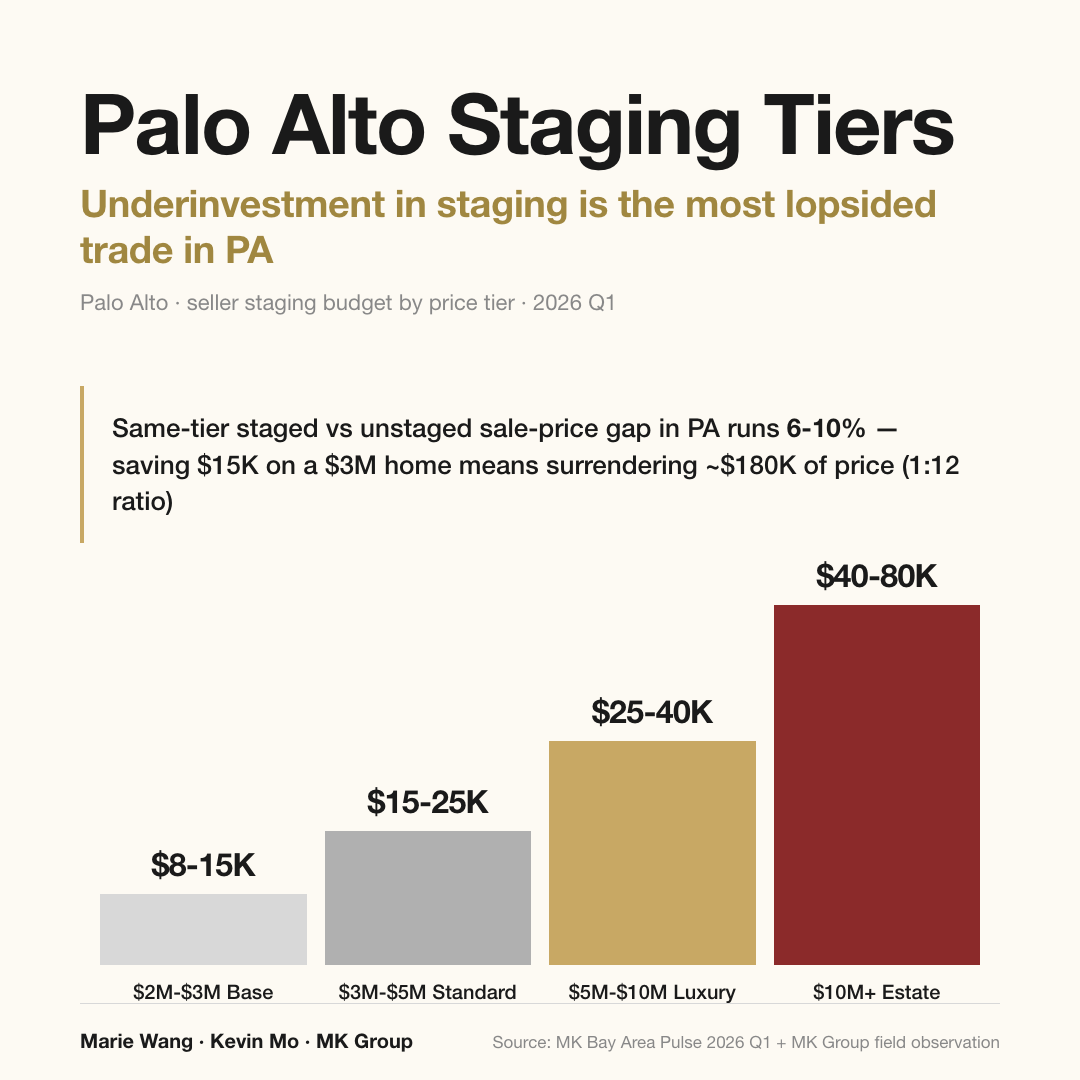
Palo Alto buyers — especially at $3M+ — expect a higher staging standard than other Bay Area cities. Standard tiers: (1) $8K-$15K base tier, suited to $2M-$3.5M Midtown / Barron Park homes, covering living room, dining, primary bedroom, and 1-2 secondary bedrooms in a neutral modern palette; (2) $15K-$25K standard tier, suited to $3.5M-$5M Community Center / Midtown homes, covering all major living spaces plus outdoor terraces and detailed soft furnishings; (3) $25K-$40K luxury tier, suited to $5M-$10M Crescent Park / Old Palo Alto homes, requiring custom soft furnishings, art rental, and a staging designer through the full cycle; (4) $40K-$80K estate tier, suited to $10M+ flagship properties requiring architectural-digest-level presentation. The guiding staging principle is subtraction — remove the seller's personal items and overly individualized décor, replace with neutral, current furniture and soft goods so the buyer can imagine living there. In a market as sophisticated as Palo Alto, listing empty or with the seller's own furniture is a serious pricing disadvantage — same tier, same conditions, the price gap between staged and unstaged in Palo Alto typically runs 6-10%.
Dimension 5: First-week traffic curve and the Palo Alto Open House standard
The standard Palo Alto first-week template: Thursday afternoon the listing goes live on MLS (so it lands prominently in Friday-morning Redfin / Zillow / Compass new-listing alerts); Friday morning Broker Preview (agents only, typically 11:00 AM-1:00 PM, with light coffee and an information sheet); Friday 4:30 PM-6:30 PM Twilight Tour (optional, well-suited to $5M+ properties, atmospheric evening setting); Saturday 1:30 PM-4:30 PM first public Open House; Sunday 1:30 PM-4:30 PM second public Open House; Monday-Tuesday private showings and second looks; Tuesday 5:00 PM Offer Deadline. Open House execution details matter significantly in Palo Alto: (1) fresh flowers in living room, dining table, and primary bedroom at minimum; (2) tasteful background music (piano or jazz, low volume); (3) climate set to 70-72°F; (4) a complete flyer covering PAUSD ratings, feeder pattern, attendance area map, comps, and disclosure package; (5) Open House directional signs placed 3-4 blocks out 2 hours ahead of showing time. Fewer than 25 showing groups in week one is a warning sign; fewer than 15 typically means pricing or marketing has a structural problem and adjustment is needed by day 10.
Dimension 6: Off-market vs MLS decision
A variable unique to the Palo Alto $5M+ tier is the choice between off-market and a public MLS listing. According to the MK Bay Area Pulse 2026 Q1 report, off-market transactions in the Palo Alto $5M+ tier account for an estimated 15-25% of public MLS volume (range varies by sub-neighborhood). Off-market is appropriate when: (1) the seller values privacy (high-profile families, well-known tech executives, cross-border family offices); (2) the property is in transition (trust restructuring, family coordination, mid-renovation); (3) the seller has timing flexibility and prefers to avoid the public-listing-failed-listing risk; (4) the property has special conditions (historic constraints, tenant occupation, complex permit history). The cost of off-market is forgoing public multi-bidder competition — final price is typically 3-7% below what a clean public listing achieves — but for high-privacy or time-sensitive sellers this trade is acceptable. Public MLS is appropriate when: (1) a standard single-family home with no special constraints; (2) the seller can absorb a 21-30 day market cadence; (3) the property has the ingredients to manufacture multi-offer dynamics (defensible pricing, polished staging, disciplined first-week rhythm). Decision guideline: prioritize public MLS for $3M-$5M (the competitive bidding premium is meaningful); evaluate case-by-case at $5M-$8M; prioritize off-market or a hybrid off-market-plus-selected-buyer-pool strategy at $8M+.
Dimension 7: Palo Alto all-cash buyer profile and seller-side adjustment
All-cash transactions account for a meaningfully higher share of mid-upper Palo Alto sales than in other Bay Area cities. Per the MK Bay Area Pulse 2026 Q1 report, all-cash share is roughly 61% in the $5M-$10M band and around 58% above $10M. The all-cash buyer profile is dominated by: (1) cross-border allocation households (Greater China, Singapore, India, Middle East high-net-worth); (2) Silicon Valley pre-IPO and secondary-market liquidity events from tech-company founders and early employees; (3) family-office portfolio reallocation; (4) local legacy-wealth second-generation purchases. Seller-side adjustments: (1) require proof of funds up front — before listing, set the expectation that all offers must include a Proof of Funds (bank statement or escrow funds verification) to filter out non-serious offers that waste decision time; (2) escrow timelines can compress — all-cash offers typically close in 14-21 days versus 30-45 days for loan-contingent offers, which is significant when the seller is time-sensitive (already buying in the next location, working a 1031 timeline, or coordinating cross-border capital flow); (3) do not assume all-cash equals automatic acceptance of all terms — all-cash buyers still negotiate inspection contingencies and disclosure review, and the negotiation cadence does not collapse just because financing is removed. This section involves cross-border capital compliance and 1031 timelines; consult an attorney or CPA before execution.
Dimension 8: Extra steps for cross-border, trust, and family-office sellers
The share of Palo Alto sellers who hold property cross-border, in trust structures, or through family offices is notably higher than in other Bay Area cities. Extra steps these scenarios require: (1) FIRPTA withholding — non-US-resident sellers on transactions over $300K are subject to a 15% federal withholding on the gross sale price (a Withholding Certificate can reduce this in some situations); the withholding process should be initiated 30-45 days before listing to avoid escrow-stage delays; (2) grant deed preparation for trust-held property — for Revocable Living Trust holdings, the trust documents, Certification of Trust, and Successor Trustee authorization (if applicable) need to be synchronized with the title officer well in advance to avoid getting stuck at escrow-stage title review; (3) 1031 Exchange timeline — if the seller plans to roll proceeds into a like-kind exchange, the Qualified Intermediary must be designated before close, Identification must be completed within 45 days post-close, and Acquisition within 180 days; the listing timing must be coordinated with that arc; (4) multi-party coordination for family-office portfolio reallocation — estate attorney, family CPA, and wealth manager need to be aligned on pricing and tax impact before listing, to avoid the discovery after close that the deal closed in the wrong tax year; (5) cross-border capital repatriation pathway — SAFE filings (for China-resident sellers), use of tax treaties, and FX settlement caps all need advance planning. This section is for decision-education purposes only and does not constitute legal or tax advice; consult an attorney or CPA before execution.
Palo Alto sub-neighborhood seller comparison
Core numbers first: across the four core sub-neighborhoods, Crescent Park and Old Palo Alto carry the highest concentration of $5M+ closings (over 60% of recent sales fall in that band) and the highest off-market share; Midtown and Barron Park drive the mid tier ($2.5M-$4.5M) and offer the largest first-week competitive-bidding premium; Charleston Meadows and Green Gables anchor the entry tier ($2M-$3M), where staging investment can scale down to the $8K-$12K range. The table below summarizes seller strategy by sub-neighborhood. Specific numbers are experience-based estimates drawn from prior PA closings; actual pricing should always reference the most recent 30-60 day comps.
| Sub-neighborhood | Core price tier | Typical DOM | Staging tier | Typical buyer profile | Strategy emphasis |
|---|---|---|---|---|---|
| Crescent Park | $5M-$15M+ | 14-28 days | $25K-$60K | Family office / serial founder / VC partner | Off-market priority + near floor price |
| Old Palo Alto / Professorville | $5M-$12M | 14-28 days | $25K-$50K | Tech executive / cross-border HNW | Historic review prep up front |
| Community Center | $3M-$6M | 10-21 days | $15K-$25K | Dual-tech household / upgrade buyer | Slightly under-market + high first-week density |
| Midtown | $2.5M-$5M | 10-18 days | $10K-$20K | School-driven family / senior tech | Target multi-offer bidding |
| Barron Park | $2.5M-$4M | 10-18 days | $8K-$15K | First-time upgrader / dual-tech household | Discipline on first-week cadence |
| Green Gables / Charleston Meadows | $2M-$3.5M | 10-18 days | $8K-$12K | Dual-income household / Stanford faculty | Defensible pricing + standard cadence |
The difference to remember: a four-bedroom, 2,500-sqft single-family home in Crescent Park can sell for 2-3x the equivalent in Charleston Meadows. That gap reflects land value, not the building — so list pricing must respect sub-neighborhood differentiation. This is the biggest divergence between selling in Palo Alto versus selling in Cupertino, Mountain View, or Sunnyvale.
MK Group field observation: two Palo Alto-relevant seller cases
Case A: A $10M all-cash buyer in Palo Alto wanted to "sleep on it" and lost the home the next morning. Although this is a buy-side case, it precisely illustrates what is happening at the top end of the Palo Alto seller market. MK Group walked a high-net-worth client through a $10M-listed flagship home in Palo Alto. The finishes, flow, and neighborhood positioning matched the client's brief. The client asked to "think it over one more night." By the next morning, the listing was in contract with another buyer group. The client's reaction: "Even $10M homes get snatched up that fast?" The lesson for Palo Alto sellers is clear: in the spring 2026 Palo Alto market, the buyer decision window on quality $5M-$15M inventory has compressed to 24-48 hours. Once a seller has defensible pricing, polished staging, and a disciplined first-week cadence in place, qualified offers tend to arrive in higher density than most sellers anticipate — meaning sellers should not, and need not, "leave room for a higher number." Qualified offers that meet the bar should be closed inside the first-week decision window. This case maps to Dimension 2 (sub-neighborhood pricing strategy — the $8M+ tier rewards near-floor-price listings that prompt immediate decisions). Marie Wang and Kevin Mo's debrief with the client made the same point: all-cash is no longer a knockout edge at the Palo Alto top end (the other buyer is also very likely all-cash); "speed and certainty" carry more weight than "another 1-2% on the offer" — a principle that holds on both sides of the table.
Case B (contrast reference): A 94087 Sunnyvale owner consulted three agents about upgrading to Los Altos. All three said list immediately. MK Group said do not sell. This is a cross-city seller-side decision case, and it illustrates a judgment Palo Alto sellers also need — not every "I want to upgrade" inquiry should turn into a listing. The owner held an 1,800 sqft, 3-bed/2-bath in 94087, in the Homestead school zone, with a 2020-2022 mortgage rate locked between 2.5%-3.5%. They wanted to upgrade to Los Altos but were short on funds and had no defined target city or timeline. Marie Wang and Kevin Mo recommended against selling — sell now and that low rate is gone forever (it cannot be replicated in a 6%+ rate environment); with no defined next move, the seller likely sits on cash "waiting for the market" for a long time; the alternative path is using a HELOC to extract equity from the low-rate home as the down payment for the next purchase, with the current home rented out. The owner's response: "You're the only ones who told him not to sell." The lesson for Palo Alto sellers: if you "just want to upgrade" but the next-step destination (city, school zone, timeline) is still undefined, listing may be premature — especially if you hold a pre-1976 Palo Alto home with a low-rate mortgage. The opportunity cost of selling (losing the rate plus mistiming the next purchase) can far exceed the patience cost of waiting another year. An agent who genuinely puts client interests first will run the motive and timeline diagnostic before discussing list strategy.
5 Common Pitfalls
Pitfall 1: Pricing Palo Alto homes against city-wide median or Cupertino comps
This is Palo Alto's most common and most expensive pricing error. Sub-neighborhood variation here is far wider than most sellers assume — a 4-bed, 2,500-sqft home in Crescent Park can sell for 2-3x the same in Charleston Meadows. Pricing a Crescent Park home off the city-wide median typically leaves 20-40% on the table; pricing a Charleston Meadows home off the same median can leave it on the market for 60+ days unsold. Using Cupertino comps for Palo Alto Midtown is the same class of error — the two cities have different school architectures, buyer profiles, and land scarcity, and a $3M Cupertino 4-bed is simply a different product than a $4M PA Midtown 4-bed in the buyer's eye. Correct approach: same attendance area, street-level, ±15% square footage, equivalent lot tier, similar build era, sold within 60-90 days.
Pitfall 2: Skipping pre-listing inspection on pre-1976 homes
A large share of Palo Alto stock was built between 1940 and 1970, with a high density of latent hard issues — cast-iron drains, single-pane glass, knob-and-tube wiring, foundation settling, roof age. Letting a buyer discover those issues during the inspection contingency is the worst possible negotiation point for a seller. By then the buyer holds the leverage, and any surprise becomes grounds for a $50K-$200K concession or a deal collapse. A pre-listing inspection at $800-$1,500 surfaces every hard issue, lets the seller price, disclose, and repair on their own terms before listing, and keeps the negotiation leverage where it belongs. Skipping the inspection in Palo Alto almost always expands the escrow-stage concession surface dramatically.
Pitfall 3: Underinvesting in staging, especially at $3M+
Palo Alto buyers — especially above $3M — are highly experienced and expect a leading-edge staging standard. Listing an empty home or showing with the seller's own furniture typically reduces the final sale price by 6-10% at the same tier. The "save money" logic ("$15K of staging is too much") does not match the economics — saving $15K on staging while losing 6% of a $3M price is $180K, a 1:12 trade-off. The gap is even wider at $5M+, where listing a flagship home without estate-tier staging is essentially walking away from the competitive premium at the top of the market.
Pitfall 4: Letting "weekend launch" disrupt the first-week curve
A surprising number of sellers and agents choose Saturday or Sunday to go live on MLS, on the theory that "weekend buyers are most active." This is a serious cadence misread. A Saturday MLS launch misses Friday-morning's Redfin / Zillow / Compass new-listing alert peak and only gets captured by the following Monday's emails — by which point the first-week momentum has already eroded. The Palo Alto standard cadence is Thursday afternoon MLS, so the listing rides Friday-morning alerts and arrives at the weekend's Open Houses with 48 hours of accumulated exposure. "Weekend launch" sounds intuitive but actually surrenders the highest-density traffic window.
Pitfall 5: Offer Deadline set too early or too late
A reasonable Offer Deadline lands on day 5-8 after listing, at 5 PM on a weekday (usually Tuesday or Wednesday). Setting it too early (day 3-4) leaves second looks and inspection contingency review without enough runway, and serious buyers are forced to pass. Setting it too late (beyond day 10) drains the first-week momentum, showing energy fades, and the seller loses the strongest pricing window. Guideline: $3M-$5M tier targets a day 5-6 deadline; $5M+ targets day 7-8 (to give cross-border and high-net-worth buyers extra diligence time); $8M+ in off-market scenarios can be handled case-by-case.
Frequently Asked Questions
What does staging investment typically run for selling a Palo Alto home?
By price tier: $2M-$3M, $8K-$15K base tier (living, dining, primary, 1-2 secondary bedrooms); $3M-$5M, $15K-$25K standard tier (all major living spaces plus outdoor and detailed soft goods); $5M-$10M, $25K-$40K luxury tier (custom soft goods, art rental, designer through full cycle); $10M+, $40K-$80K estate tier (architectural-digest-level presentation). At the same tier, the price gap between staged and unstaged in Palo Alto typically runs 6-10% — listing empty or with the seller's own furniture is a serious pricing disadvantage in this market.
When is the best season to sell in Palo Alto?
The peak windows are spring (late February through May) and early fall (September through mid-October). The spring peak offers maximum buyer activity (school-driven families want to settle before the new academic year) but also the highest competing inventory. Fall offers reduced competition and higher buyer intent but a shorter window. $3M-$5M homes do well in the spring first-week cadence; $5M+ homes can succeed in either window. Holiday season (late November through January) and mid-summer (July-August) see meaningful drops in showing density and should generally be avoided, unless off-market or under a time-constrained scenario.
Is a pre-listing inspection actually necessary in Palo Alto?
Highly recommended, and effectively required for pre-1976 stock. Many Palo Alto homes were built between 1940 and 1970 with high latent-issue density. A pre-listing inspection at $800-$1,500 surfaces problems early and lets the seller price, disclose, and repair on their own terms — keeping the negotiation leverage on the seller's side. The alternative — letting the buyer discover issues during inspection contingency — usually results in $50K-$200K of concessions or a deal collapse, a trade-off vastly worse than the inspection cost.
How do you decide off-market vs public MLS in Palo Alto?
$3M-$5M: prioritize public MLS (the competitive bidding premium is significant, and first-week multi-offer dynamics are common). $5M-$8M: case-by-case based on seller privacy preference, timing flexibility, and property specifics. $8M+: prioritize off-market or a hybrid off-market-plus-selected-buyer-pool approach. Per the MK Bay Area Pulse 2026 Q1 report, off-market transactions account for an estimated 15-25% of public MLS volume in the Palo Alto $5M+ tier. Off-market trades 3-7% in final price for privacy protection and timing flexibility — for high-profile families, family offices, and cross-border sellers, this is usually a reasonable exchange.
How far in advance should I plan taxes / 1031 / FIRPTA when selling in Palo Alto?
Start tax planning 60-90 days before listing. Specific timelines: (1) 1031 Exchange requires the Qualified Intermediary to be designated before close, then 45 days post-close for Identification and 180 days for Acquisition — listing timing must be coordinated with that arc; (2) FIRPTA for non-US-resident sellers withholds 15%, with a Withholding Certificate available to reduce in some situations — start the filing 30-45 days before listing; (3) Trust-held property requires advance synchronization of grant deed and title review — coordinate 2-3 weeks before listing with the title officer; (4) Family-office capital-gains-tax-year selection involves trade-offs between current and next tax year that must be modeled. This section is for decision-education purposes only and does not constitute legal or tax advice; consult an attorney or CPA before execution.
Next Steps
- Confirm your home's sub-neighborhood and attendance area — Crescent Park, Old Palo Alto, Community Center, Midtown, Barron Park, Green Gables, or Charleston Meadows — and confirm the elementary attendance area within PAUSD. This decides the universe for comp selection.
- Pull the last 60-90 days of comps within the same attendance area, street-level, ±15% square footage — not city-wide median. If no comp has closed on the same street in the last 60 days, extend to the same sub-neighborhood within the same elementary boundary over 90 days.
- Complete a Pre-listing Inspection 4-6 weeks before listing ($800-$1,500), identify pre-1976 hard issues, and sequence repairs by ROI — kitchen and appliances first, then primary bath, then whole-home paint and hardwood, then exterior and garage, then front yard.
- Lock staging investment to the price tier — $8K-$15K for $3M, $15K-$25K for $3M-$5M, $25K-$40K for $5M-$10M, $40K-$80K for $10M+ — and book staging, photography, and video teams 5-7 days in advance.
- Lock the first-week cadence to the sub-neighborhood strategy — MLS Thursday, Broker Preview Friday, Open Houses Saturday and Sunday, Offer Deadline Tuesday — and start tax planning (1031, FIRPTA, Trust grant deed) 60-90 days before listing to avoid escrow-stage delays.