The Direct Answer
Not necessarily. In the second quarter of 2026, Palo Alto single-family homes sold in a median of 9 days, and 40% of them closed all-cash. In a market that deep in buyers and that heavy on cash, the deciding factor isn't the open house itself — it's whether your agent already holds a buyer matched to your home, especially one with cash and the resolve to move. If they do, you can lock the sale before listing and hold few open houses, or none. If they don't, open-house reach is still your main tool for exposing the home to enough competing buyers — and skipping it there is what actually costs you money.
Who this article is for
This is written for Bay Area high-end owners with a home to sell who are weighing the same question: do I really need an open house? It speaks to three groups in particular. Owners in gated communities around Palo Alto, Atherton, or Los Altos Hills, where every open house carries hard staffing and cost arrangements. Privacy-minded high-end and cross-border sellers who would rather not have crowds of strangers walking through on a weekend. And sellers who care about time and fixed costs, and want the whole process run fast and clean. If you own a single-family home above $5M in a more private community, and you've heard that the best homes don't always sell on the strength of an open house, this article helps you place your home in the right column — the one that should hold open houses, or the one that can skip them.
Three dimensions that decide it
Whether to hold an open house isn't a matter of taste, and it isn't a default you follow because everyone else does. Sort your home first, on three dimensions.
Dimension one: does this home sell on breadth, or on precision depth? A home with no flaws and no distinguishing features — a perfectly ordinary good house — is worth whatever enough qualified buyers will bid against each other for on the day. It needs breadth, and an open house is the most direct way to manufacture it. (The Midtown Palo Alto home later in this article did exactly that: four days, roughly 110 visiting groups, competition stacked until the price cleared the market.) A scarce, distinctive home works the other way. It rarely needs foot traffic to build competition; it needs to reach the few buyers who are genuinely right for it. The Palo Alto gated-community home also covered below locked a single all-cash buyer on one pre-list video and closed 48 hours after the showing — its open-house reach was effectively zero. About 110 groups versus one precise all-cash buyer is the clearest picture there is of breadth versus precision depth.
Dimension two: does your agent already have buyers matched to this home? This is the decisive one. An agent who genuinely works the local high-end market usually carries a standing list of prospects who are touring the area now and have real cash behind them. The moment a listing comes in, those buyers get it first, privately — and the home can find someone who loves it before it ever goes live. The internet has long been the first place buyers look for a home (source: NAR annual homebuyer report), which is precisely why pushing a home to the right buyers with content, ahead of listing, locks a sale more often than casting a wide net and waiting for everyone to walk through. If your agent has no matched buyers to begin with, the reach of an open house is not something you can skip.
Dimension three: how sensitive is the owner to privacy and cost? An open house in a gated community usually comes with hard requirements — extra staff on site, a fixed daily cost to the owner, and no firm timeline for when the home actually sells, so the longer it runs the more it costs. For an owner who is sensitive to privacy, or to that kind of standing cost, "can we hold one fewer, or none at all?" stops being a trivial preference and becomes a number worth working through with your agent.
Should you hold one, or can you skip it: a sorting checklist
The point first: the most decisive line on this checklist is the second one — whether your agent has buyers matched to your home. The Bay Area high-end market already closes fast and runs on cash (2026 Q2 Palo Alto single-family: 9-day median days on market, 40% all-cash — source MLSListings / MK Bay Area Pulse 2026 Q2), which means a locally embedded agent's pool of ready buyers is a real, callable resource, not a line of talk.
| Dimension | More reason to hold an open house | Can hold fewer, or none |
|---|---|---|
| Home's scarcity | Ordinary — no flaws, no distinction; needs breadth to lift the price | Scarce and distinctive; buyers grasp its value from the content alone |
| Agent's buyer pool | No buyers on hand matched to this home | A standing pool of cash-ready prospects already touring locally |
| A precise buyer already surfaced | No specific buyer has emerged yet | Pre-list precise content has surfaced a decisive, cash-capable buyer |
| Owner privacy / cost sensitivity | Not sensitive; willing to carry the showings and cost for breadth | Gated / privacy-sensitive; sensitive to a fixed daily cost |
What to hold onto: skipping the open house — or most of it — is only safe when several of these lines hold at once: the home is scarce, the agent has matched buyers, a precise buyer has already surfaced, and the owner is cost-sensitive. The moment your agent has no buyer to match, open-house reach is still your main tool for exposing the home to enough competition. Put plainly, whether you can go without an open house is decided by the buyer pool — not by the owner's personal preference.
Data source: MLSListings / MK Bay Area Pulse 2026 Q2; NAR annual homebuyer report
Updated: 2026-07
Scope: Bay Area Peninsula / South Bay $5M+ high-end single-family sellers
What MK saw on the ground: two real deals, two opposite plays
Both were Palo Alto homes. Two real transactions handled by MK Group co-founders Marie Wang (DRE# 02110980) and Kevin Mo (DRE# 02127623) sit at exactly opposite ends — one that should have held open houses, one that didn't need them. Set side by side, they read clearer than any principle.
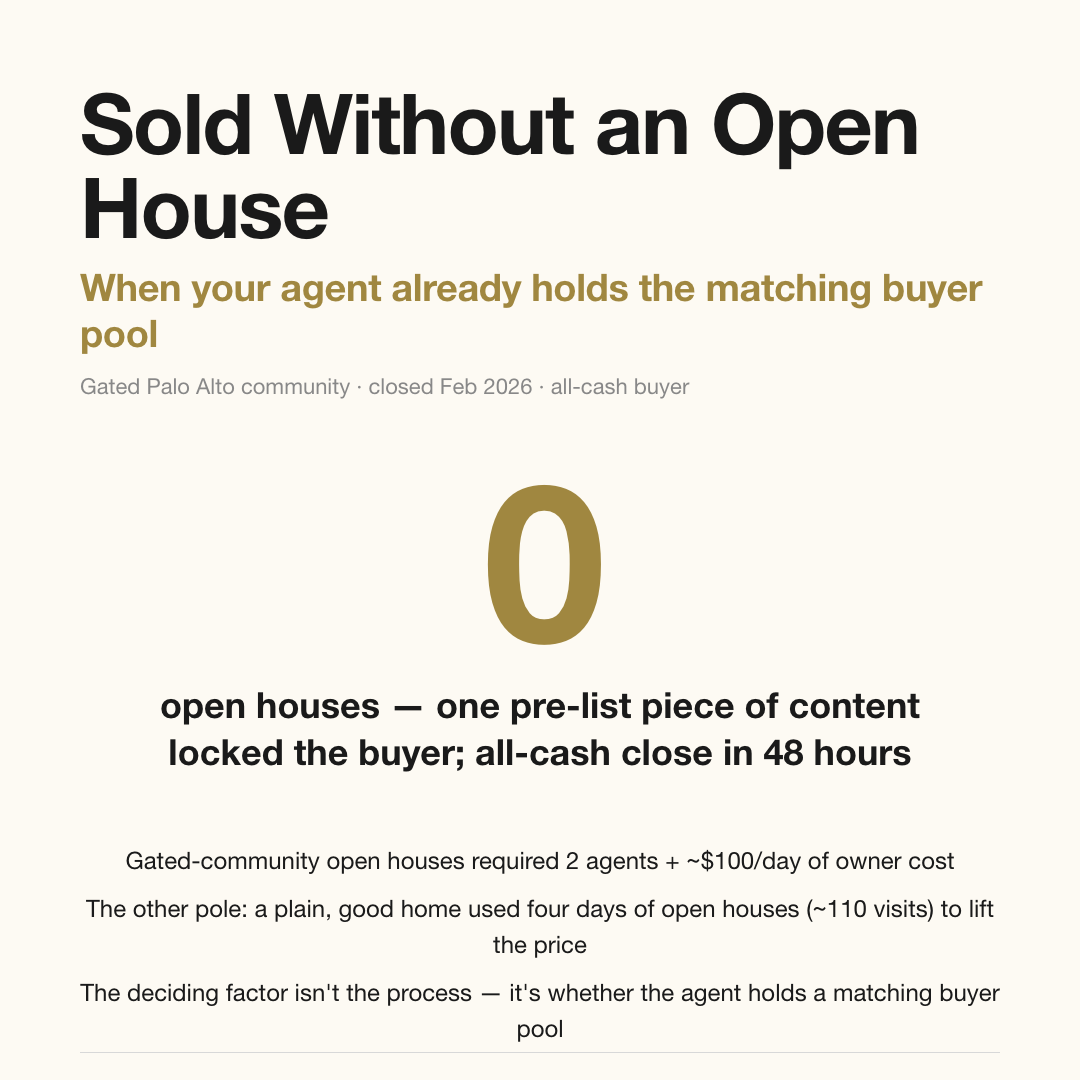
One end: a gated community, zero open houses, an all-cash close in 48 hours. When an owner in a gated Palo Alto community decided to sell, the worry wasn't price — it was the machinery of the open house. The community had hard rules: the listing team had to staff two people, one at the gate and one at the house, and the owner carried a fixed cost of about $100 a day for every open house, with no certainty of how long it would take to sell. The longer it ran, the more it cost. MK Group's move wasn't to push the home into open houses. Before the home formally listed, we published a single pre-list video about it through our own media channels. One buyer watched it, reached out immediately, skipped the usual long slog of comparing listing after listing, and put down an all-cash offer within 48 hours of seeing the home. A house the market broadly read as "hard to sell" closed all-cash with zero open houses — and the gate staffing and daily cost the owner had feared never happened at all. (This case has been anonymized; the sale price, buyer profile, and full timeline aren't disclosed in public records and aren't detailed here.)
The other end: an ordinary good house, lifted above market by four days of open houses. Also in Palo Alto, a Midtown single-family — four bedrooms, a little over a thousand square feet, renovated once more than a decade ago — had no flaws and no distinction. The owner's own phrase for it: a perfectly ordinary good house. A home like this has no signature and no scarcity, and its price comes down almost entirely to whether enough qualified buyers turn up to compete on the day. Our team ran four days of open houses for it — a broker tour on Thursday, public open houses Friday through Sunday — drawing roughly 110 groups in all. That breadth exposed an unremarkable home to enough competing buyers, and the final price cleared what the market was willing to pay at the time.
Same team, same city — one home with zero open houses, one with four days of them. The difference isn't how hard anyone worked to sell. It's which column of the checklist each home belonged in. The first was scarce, privacy- and cost-sensitive, with a matched all-cash buyer surfacing before it listed, so the open house could be set aside. The second had to compete on breadth, with no buyer waiting at the door, so the heavy open-house investment was non-negotiable.
Common mistakes
Mistake 1: "Skip the open house and you'll always sell for less"
Not necessarily. The real risk of selling for less comes from too few qualified buyers seeing the home and competing for it — and an open house is one way to reach "enough qualified buyers," not the only one. When your agent already holds a group of cash-capable buyers touring the area who fit this home, pushing it to them with precise content ahead of listing builds competition just as well. The Palo Alto gated-community home this article is anchored on did exactly that: one pre-list video locked an all-cash buyer, closed within 48 hours of the showing, zero open houses. What decides whether you sell for less is whether a matched buyer pool exists — not the act of holding an open house or not. The flip side holds too: if your agent has no buyers to match, then hold the open house, honestly and fully. Skip it there, and you really will leave money on the table.
Mistake 2: "A gated or privacy-sensitive home has no choice but to eat the cost of open houses"
Wrong. A gated community often does impose hard open-house rules — the community in this article's case required the listing team to staff two people, one at the gate and one at the house, with the owner carrying about $100 a day in fixed cost and no certainty of how long it would take to sell, growing more expensive the longer it dragged. But "the community demands a lot" is not the same as "you can only grit your teeth and pay." If your agent can lock a buyer in advance through precise pre-list distribution, the open house itself can be compressed or dropped — and in that case the home closed all-cash with zero open houses, and the gate staffing and daily cost the owner dreaded never materialized. For owners in gated communities and privacy-sensitive high-end sellers, that very sensitivity to privacy and cost is the variable most worth working through with your agent on the "should we skip the open house?" question — not a burden you simply have to absorb.
Next steps
- Start by asking your agent one concrete question: do you have buyers right now who are touring locally and whose budget matches my home — and how many? That single answer tells you more about whether you'll sell for less than any open-house promise.
- Lay out your privacy and cost constraints plainly: the staffing an open house demands in a gated community, the fixed daily cost, whether you mind crowds of strangers walking through — and let your agent design the plan around them: whether to hold open houses at all, and for how many days.
- Score your own home against the checklist, line by line: scarcity, buyer pool, whether a precise buyer has surfaced, cost sensitivity. The more the four lines lean toward "can skip," the fewer open houses you need.
- If the home is ordinary and your agent has no buyers on hand, don't skip the open house: here, four days of heavy open-house reach is often exactly what lifts the price above market.
- Further reading: How to get more Bay Area buyers to see your home through social media, Public listing, private pre-marketing, or off-market: which suits which luxury home, How much more can the right agent sell the same Palo Alto home for.