The short answer
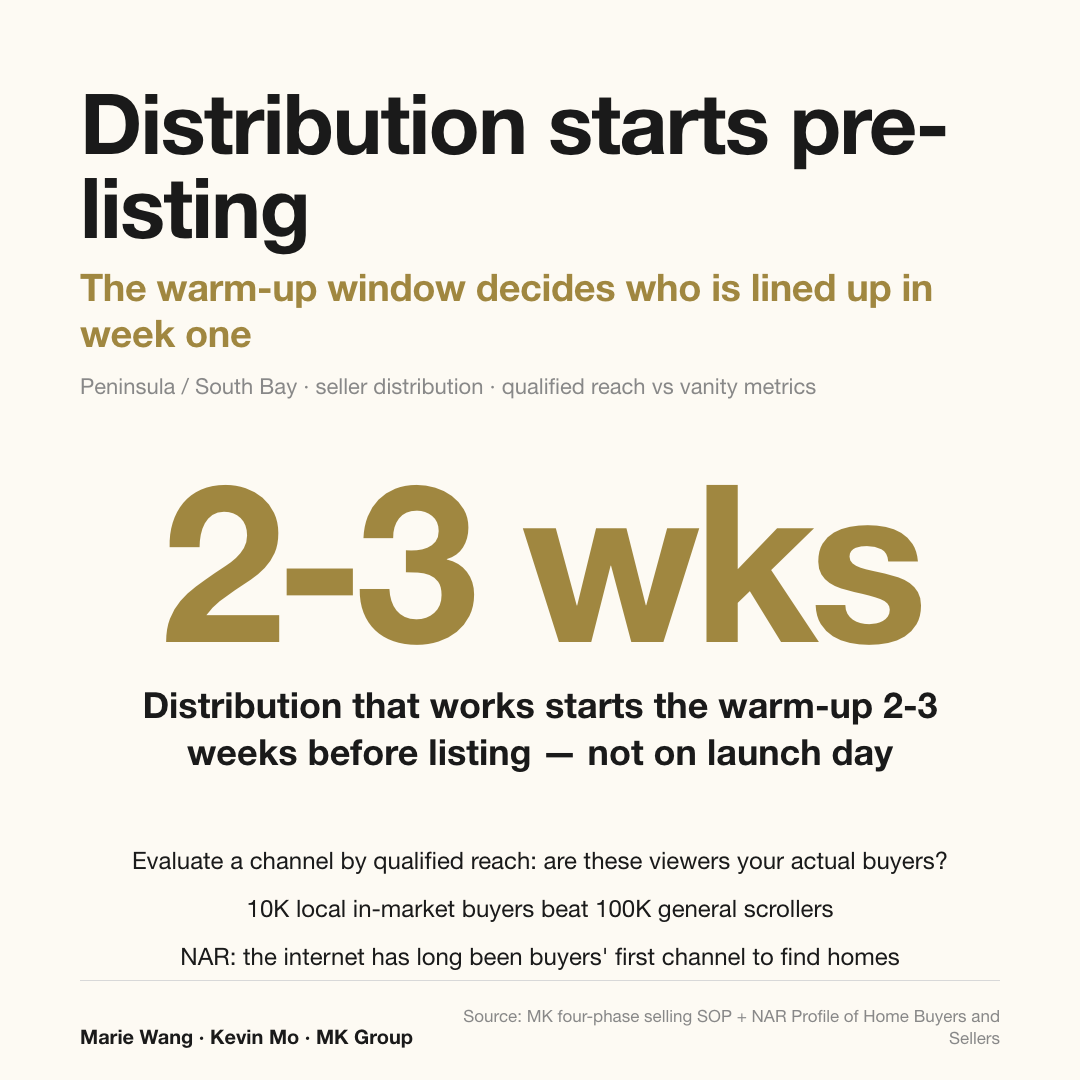
Yes, an agent’s social-media audience can meaningfully help sell your home — but not for the reason most sellers assume. The lever is not follower count or view count. It is whether that audience is made of buyers who could plausibly write an offer on your property, and whether the agent reaches them on a deliberate timeline that starts two to three weeks before the listing goes live, not on launch day. Judge a listing agent’s distribution by how many of their viewers are actually your buyers — not by how many viewers they have.
Who this is for
Sellers preparing to list on the San Francisco Peninsula or in the South Bay — Palo Alto, Atherton, Hillsborough, Los Altos, Menlo Park, Cupertino — over the next three to six months, who want to maximize qualified buyer exposure and reach the active Chinese-speaking buyer pool in particular. It is written for sellers in the listing-interview stage who are trying to evaluate whether an agent’s “social media presence” is a real marketing asset or a line on a brochure.
It is not reach. It is qualified reach.
When sellers weigh listing agents, they usually compare track record, pricing strategy, and local knowledge. Increasingly a fourth factor enters the room: the agent’s social-media presence. The right question to ask about it is narrow and unforgiving. A listing video that pulls 100,000 views on a general real-estate channel is worth less — often far less — than one that pulls 10,000 views among families actively searching in your specific submarket. The first audience is mostly people watching renovations and scenery. The second is, potentially, the people standing in your living room next Sunday.
This is the difference between qualified reach and vanity metrics. Likes, view counts, and total follower numbers are vanity metrics. They describe the size of an audience, not its relevance. Qualified reach describes the slice of that audience that is geographically local, financially capable, and actively in-market. In Silicon Valley luxury, where Chinese and other Asian buyers represent a significant share of transactions, an agent who can put your listing in front of that segment in its own language is not running a marginal advantage. They are reaching a buyer pool that an English-only campaign simply does not touch.
To pressure-test any distribution channel, ask three things. Is the audience concentrated in the Bay Area? Do they already understand local pricing, school districts, and neighborhood character? Are they in a “searching” state, or just scrolling? A private list of 1,000-plus active high-net-worth buyers can be worth more than a hundred thousand general followers, because everyone on that list has already been filtered once — they know what tier of home they are looking at, and they raised their hand to be on it.
The distribution clock starts before you list
The most expensive misconception about social media in a home sale is that it means “post something on launch day.” Distribution that actually moves the outcome runs as a week-by-week timeline, and the job is different in each phase:
- Two to three weeks before listing (warm-up). While the property is still off MLS, the agent seeds an off-market teaser — “a home coming soon in a Peninsula neighborhood” — paired with neighborhood story and exterior mood, without the full address. The purpose is to build intent and assemble a waiting list. When the listing goes live, these are the first buyers through the door.
- Launch week (the surge). The 4K listing film, bilingual photo sets, and deep neighborhood content all push to every channel at once. This is the traffic peak, and every asset has to be finished before launch day — you cannot produce it in real time.
- Open-house window (the showcase). Footage from the open house, the energy of a full room, and early buyer reactions create a visible social signal — “a lot of people are looking at this” — that pushes fence-sitters to act.
Miss the warm-up and you waste the single highest-demand window a Bay Area home gets, which on a well-priced property often lasts only seven to fourteen days. By the time everyone on MLS sees the listing simultaneously, the warm-up audience is already arriving with a different posture — they have been waiting for this house. That is why the distribution timeline matters more than the number of platforms. For the full first-week cadence, read the Bay Area 1-week selling plan.
Production quality is part of the reach
“Posting to social media” covers two completely different things. A handful of phone snapshots and a 4K cinematic listing film with a researched neighborhood story and bilingual delivery are not in the same league of persuasion, and buyers register the difference in the first second of a scroll.
The quality bar shows up in three places. Image — 4K cinematic capture, professional lighting, a clear read of spatial flow, rather than backlit, wide-angle, distorted phone shots. Story — beyond the house itself, the character and lifestyle of the neighborhood, because the emotional premium usually comes from the moment a buyer imagines themselves living there. Language — in a luxury market where Chinese-speaking buyers are a meaningful share, bilingual delivery directly decides whether an entire segment of the buyer pool can even follow what you are saying. Content quality is not a finishing touch; it decides whether your home is remembered or swiped past. It sits alongside staging and pricing strategy as a core, not a cosmetic, decision.
Four selling phases, four distribution jobs
The core idea first: distribution is not a single action but four phases — warm-up, surge, showcase, close — each with a different social job and a different purpose. Warm-up builds a waiting list with an off-market teaser; the surge concentrates a 4K film and bilingual sets to maximize first-week reach; the showcase uses open-house footage to manufacture a social signal. The one non-negotiable: the warm-up has to start two to three weeks before listing, not on launch day.
| Phase | Timing | Primary social action | Channels | Purpose of this step |
|---|---|---|---|---|
| Warm-up | 2–3 weeks before listing | Off-market teaser, neighborhood story pre-release | YouTube pre-release + Xiaohongshu + private buyer list | Build intent, assemble a waiting list, test demand |
| Surge | Launch week | 4K listing film, bilingual photo/text, deep neighborhood content | MLS + YouTube + Xiaohongshu network + WeChat groups | Concentrate the launch, maximize first-week reach |
| Showcase | Open-house window | Open-house footage, room energy, buyer reactions | All channels reused + WeChat groups | Create a social signal, move fence-sitters to act |
| Close | After accepting an offer | Sale recap, neighborhood reputation build | YouTube + Xiaohongshu | Bank trust capital for the next listing |
The line to remember: the row sellers most often overlook is the warm-up. Once a home is officially on MLS, every public buyer sees it at the same moment. The buyers reached during warm-up arrive already convinced they have been waiting for this exact house. That posture — not the raw size of any single audience — is what an agent’s distribution is actually buying you.
What a real distribution system looks like
Whether social distribution works comes down to whether a team has a genuine multi-channel system already running, rather than someone hired to post a few times around launch.
At MK Group, co-founders Marie Wang and Kevin Mo run distribution across a standing matrix: beyond MLS, there is YouTube pre-release, a network of Xiaohongshu accounts, WeChat communities, and a private buyer list of more than 1,000 active high-net-worth contacts. Each founder operates an independent channel — YouTube @MarieWang (44K+ subscribers) and @KevinMoRE (24K+ subscribers) — publishing Bay Area market analysis and neighborhood breakdowns over a long period. What accumulates is an audience that already understands the market, not one-time traffic. So when a property enters warm-up, the first buyers it can reach are people already fluent in local pricing, school districts, and neighborhood character.
On the production side, the standard playbook includes 4K cinematic listing films, neighborhood-story research, and a multi-sensory open-house experience designed touchpoint by touchpoint — sight, sound, even scent — so the home registers in the few seconds a buyer spends scrolling past it or stepping through the door. The full process is laid out in the selling process, and past listing films live in the selling video library.
What is described here is the process and mechanism of MK Group’s distribution, not a promise of any specific outcome. Every home’s performance depends on pricing, location, timing, and many other factors. The job of a distribution system is to put the right home in front of the right buyers; the market decides the rest.
Common mistakes
Mistake 1: Believing viral traffic equals buyers
High view counts and high likes do not mean anyone will buy your home. A beautifully shot video that pulls several hundred thousand views may reach an audience that is overwhelmingly out of market and not buying at all. Selling needs qualified reach — precise contact with local, in-market, financially capable buyers, even if that audience is only a few thousand people. When you evaluate a distribution channel, do not read the traffic number; ask how many of those people could become your buyer.
Mistake 2: Assuming you can market after listing and still be on time
This is the costliest mistake. A well-priced Bay Area home hits peak demand in its first week and often goes under contract within seven to fourteen days. If you wait until launch day to start posting, you forfeit the entire warm-up window where demand is assembled. Distribution that works starts the off-market teaser two to three weeks before listing, so launch week opens with a waiting list of buyers already lined up to tour. Miss the warm-up and there is no way to recover it.
Mistake 3: Treating social media as a gimmick for junior agents
Ten years ago that view may have held. The information architecture of the Chinese-speaking buyer pool has since changed. Today a large share of Bay Area Chinese buyers begin their search, market reading, and decision-making on YouTube, Xiaohongshu, and WeChat groups — not only MLS or Zillow. NAR’s annual research has long shown the internet is the first channel buyers use to find homes. A selling strategy that does not distribute on these channels voluntarily surrenders a large slice of the local buyer pool. That is not a gimmick; it is table stakes.
Next steps
- Plan the timeline backward. Once you fix your target close window, count back — set “start distribution” at three to four weeks before your intended listing date, not on listing day. Warm-up demand is assembled, not improvised.
- Ask three questions in the listing interview. (a) Where is your social-media audience concentrated — are they local Bay Area buyers? (b) From pre-listing to close, exactly how is your distribution timeline sequenced for my home? (c) Can you show me a sample distribution plan from a past listing?
- Demand a sample distribution plan. Ask the agent to produce a complete distribution record from a real listing — what went out in warm-up, which channels carried launch week, how the open-house window was followed up. An agent who can show the record is more credible than one who only says “we’ll post it everywhere.”
- Evaluate the channel, not the follower count. Do not be moved by “I have hundreds of thousands of followers.” Ask whether that audience is your home’s buyer pool, and which languages and platforms it covers. Ten thousand local, in-market buyers beat a hundred thousand general viewers.
- Prepare high-quality assets in advance. Confirm the production schedule for 4K film, bilingual photo/text, and neighborhood story with your agent, so everything is ready before launch week — surge-week content cannot be produced on the fly.