The direct answer
After the 2024 NAR settlement (the practice changes took effect nationwide on August 17, 2024), buyer-agent commission is no longer paid by the seller as a matter of course, and it can no longer be advertised on the MLS. Whether the seller compensates the buyer's agent — the "offer of compensation" — is now a negotiable choice. You can offer the full amount, a portion, or nothing. But that money buys showing traffic, speed to close, and your net-to-seller — not a discount.
Who this article is for
This is for a very specific reader: you have a Bay Area home about to go on the market, you're interviewing listing agents, and you're stuck on one question — after the NAR settlement, do you still cover the buyer's agent? You might be a move-up family in the $3M–$8M range around Palo Alto, Menlo Park, or Los Altos, or a $10M+ seller in Atherton, Hillsborough, or Los Altos Hills. You might be selling for the first time since the rules changed because of a job relocation, or inside a cross-border or trust structure, unsure what actually changed. What you really care about is three practical things: who pays this commission now, how much, and whether it's negotiable; how offering — or not offering — moves your showing traffic and speed to close; and, at the end, whether your net-to-seller went up or down. These are the questions Marie Wang and Kevin Mo field most often in the pricing-and-strategy meeting before a home is listed.
Three core dimensions for the decision
The settlement pulled apart something that used to be bundled and automatic, and put each piece back on the table. To get this decision right, see three things clearly.
First, separate three questions: who pays, how much, and is it negotiable. The 2024 NAR settlement changed two concrete things. One: a seller's offer of compensation to the buyer's agent can no longer be posted on the MLS. Two: before a buyer is shown homes, they must sign a written buyer-representation agreement with their own agent (in California this is typically the C.A.R. Buyer Representation Agreement), spelling out what the buyer's agent is paid and by whom. That ends the old default in which the seller paid both sides in one bundle. The real picture now: the seller negotiates one number with their own listing agent; whether to additionally compensate the buyer's agent, and how much, is a separate, negotiable decision; and the buyer negotiates their own number with their agent. So the answers to who pays, how much, and is it negotiable are — it can be the seller, or it can fold into the buyer's side; there is no set amount; and yes, it's fully negotiable.
Second, whether you compensate the buyer's agent moves your showing traffic and your buyer pool. In theory a seller can offer no compensation at all. In practice, if you don't, the buyer either pays it out of pocket — and at the Bay Area's higher tiers, where they are already producing a large down payment and cash, that pressures the price they'll offer or waves them off entirely — or they turn around and ask the seller for a credit in the offer to cover their agent, and the money is back on the table under a new name. So "not offering" is not the same as "money saved." Compensating the buyer's agent is, at its core, what makes more buyer's agents willing to bring their qualified buyers to your home. The work a buyer's agent does — off-market sourcing, hidden-systems due diligence, loan structuring and negotiation execution — has real value (we take the buyer's-eye view of this in Buying a $10M+ Bay Area estate: do you still need your own buyer's agent?); what you're paying for is that system's willingness to run for your listing.
Third, work backward from net-to-seller, not forward from a commission percentage. The most common mistake is to reduce the sale to "pick whichever team quotes the lowest commission." But commission is a cost and the sale price is the revenue; what you actually care about is the gap between them — your net-to-seller. Put the same home with a stronger execution team and the difference in sale price can easily swallow the difference in commission (we unpack that mechanism with a real closing in How much more can the right listing agent sell the same Palo Alto home for?). So the right question isn't "what's your rate," it's "what distribution, what buyer pool, and what net-to-seller does this spend buy me?"
Which price band your home sits in decides how much leverage you have
The core numbers first: in 2026 Q2 the Bay Area $3M–$5M band recorded 627 closings in the quarter, with a median of just 8 days on market and sale prices around 105.3% of the original list — abundant buyers, intense competition. Move up to the $10M–$20M band and the quarter held only 33 closings, the median time on market stretched to 24 days, and sale prices ran around 95.9% of the original list — a thin buyer pool, a slower rhythm. Which band your home falls in directly decides how much leverage you hold on the question of compensating the buyer's agent.
The table below lays out closings, all-cash share, median days on market, and sale-to-original-list ratio by price band for the Bay Area in 2026 Q2 — a read on your buyer-competition intensity:
| Price band | Closings in quarter | All-cash share | Median days on market | Sale / original list |
|---|---|---|---|---|
| $1.5M–$3M | 1,927 | 17.4% | 12 | 103.6% |
| $3M–$5M | 627 | 29.0% | 8 | 105.3% |
| $5M–$10M | 223 | 46.6% | 8 | 104.0% |
| $10M–$20M | 33 | 72.7% | 24 | 95.9% |
| $20M+ | 6 | 83.3% | 44 | 90.2% |
The counterintuitive point to hold onto: the higher the price, the fewer the buyers and the slower the decision — the $10M–$20M band's median time on market (24 days) is three times the $3M–$5M band's (8 days), and more than seven in ten of those buyers pay all cash. In a market that thin, a buyer's agent who will actually bring a qualified buyer and write clean terms is the scarce resource; here, compensating the buyer's agent is often not a giveaway but a way to widen an already-limited buyer pool by one more turn. Conversely, in a hot band like $3M–$5M — hundreds of closings a quarter, gone in 8 days — your leverage is plainly greater, and whether and how much to compensate has far more room to move. In either band, the test is always this decision's effect on your final net-to-seller, not the absolute figure in the commission column.
This article is for decision education and is not legal or tax advice. Commission and buyer-agent compensation are fully negotiable and there is no "standard rate"; any claim that a given percentage is "the industry rule" or "required" is inaccurate. Confirm specific terms, credit structures, and compliance with your listing agent and a cooperating attorney / CPA. For transactions involving relocation, cross-border funds, a trust, or a foreign seller (FIRPTA withholding), build the third-party review and tax steps into the timeline early.
Data sources: NAR 2024 settlement (public filings; practice changes effective August 17, 2024 — buyer-agent compensation removed from the MLS, buyers must first sign a written buyer-representation agreement); C.A.R. Buyer Representation Agreement form guidance (public); closings by price band, all-cash share, median days on market, and sale-to-original-list ratio from MK Bay Area Pulse 2026 Q2 (based on MLSListings closing data).
Updated: 2026-07
Scope: Bay Area Peninsula / South Bay $3M+ single-family sellers; commission rates and compensation structures are all negotiable — this article states no fixed rate.
What MK Group sees in practice: commission buys net proceeds, not a discount
MK Group — Marie Wang (DRE# 02110980) and Kevin Mo (DRE# 02127623) — works deep in Palo Alto and the surrounding high-end market, and sees the same pattern again and again: the moment a seller shifts attention from "commission percentage" to "net-to-seller," the quality of the decision changes.
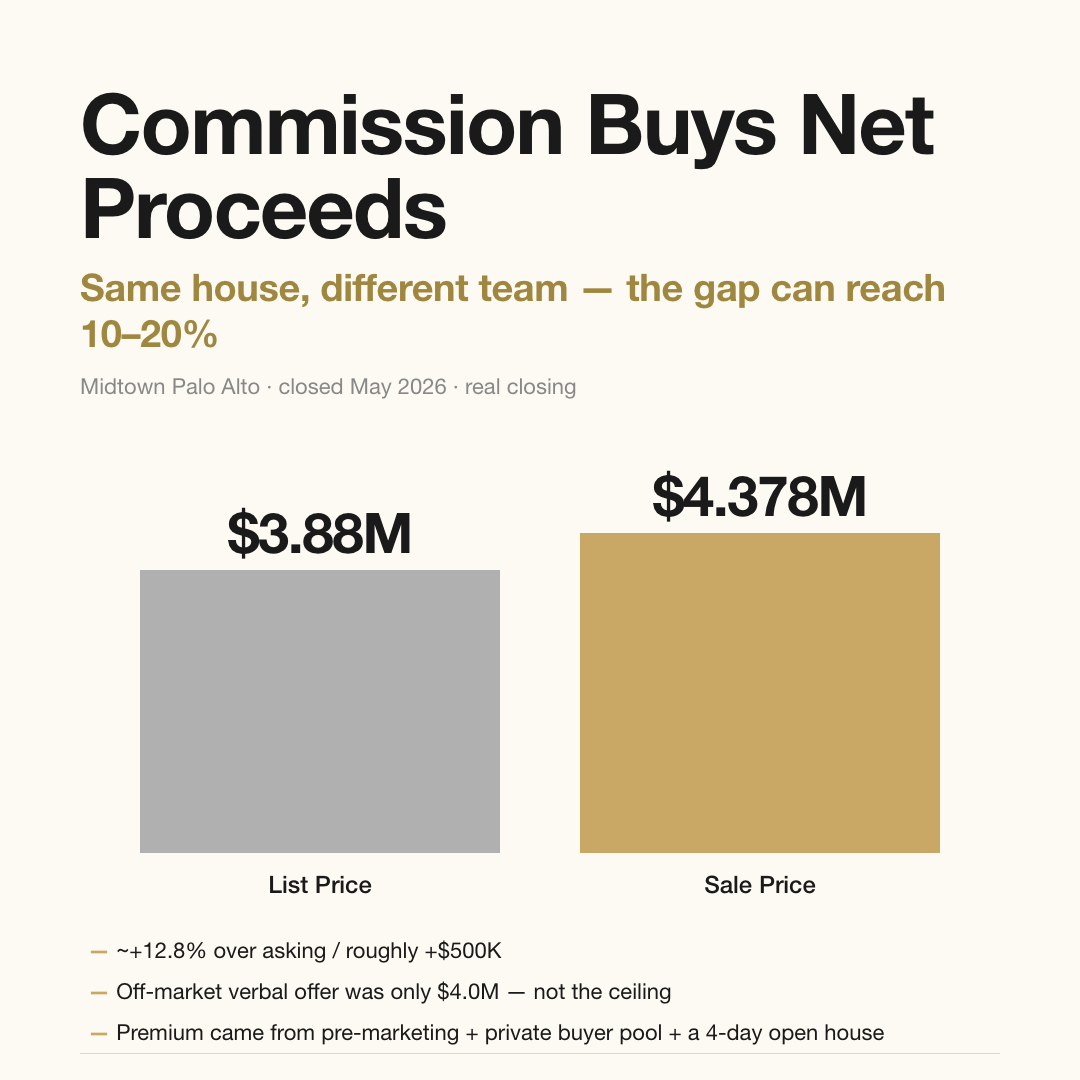
One frequently cited example is a Midtown Palo Alto single-family home — the owner called it "an unremarkable good house": four bedrooms, a bit over a thousand square feet, no flaws and no standout features. The owner held a real-estate license and his wife had worked as an agent, yet they openly interviewed several very large, well-respected local teams and gave the listing to MK — for the team's social-media distribution and, they said, its sincerity and drive. There were a little over two months between signing and going live, and the team didn't wait them out: before listing, it quietly circulated the home to roughly 25 buyers already touring locally with cash in hand, warming up demand offline, and produced two or three pieces of content on the neighborhood, the home, and the market. Then it ran a four-day open house (a Thursday broker tour plus a Friday-to-Sunday public open) to bring attention to a peak. The off-market phase had already produced a verbal offer of $4.0M (against a $3.88M list — not a lowball). But after the full public process plus the warm-up, the home closed at $4,378,000 — about $380K above the verbal offer, roughly $500K over asking, about +12.8%. That is the sentence made concrete: net-to-seller is decided by whether the agent can lift the sale price above "what the market will give today," not by the fraction shaved off a commission quote. The full breakdown of that mechanism is in How much more can the right listing agent sell the same Palo Alto home for?
Execution shows up even more clearly in a cold market. In an anonymized Palo Alto relocation sale, the owner was moving out of state on short notice for work; the home sat for three weeks and drew only one low offer, and the seller was close to accepting a near-fire-sale price. The turn came when the signing had to clear a third-party relocation company's review — a 10-day hold. What looked like a drag on the deal became an opening: instead of coasting, the team kept marketing and kept actively hunting buyers through those 10 days, and matched a higher-quality buyer who lifted the sale price by roughly another $100K. Whether you keep pushing a listing after an offer is already in hand translates directly into what the seller takes home.
And in a Palo Alto gated-community sale, the owner's biggest worry wasn't even price — it was the process cost of open houses: the community required the listing team to post two people, one at the gate and one at the home, and the owner faced about $100 a day for each open house with no clear end date. Rather than push straight to open houses, MK released a single warm-up video for the home before it formally listed. An all-cash buyer watched it, reached out directly, skipped the long multi-home comparison, and delivered an all-cash offer within 48 hours of seeing the home — with zero open houses. What these three sell-side stories share is that the money went toward one thing: who can bring the right buyer to the door. Whether you're compensating a buyer's agent or choosing a listing team, you're paying for distribution and buyer pool — not for a lower percentage.
Common mistakes
Mistake 1: "After the NAR settlement, sellers don't pay the buyer's agent at all anymore"
Inaccurate. What the settlement removed is "paid by the seller as a bundled default and posted on the MLS" — not the seller's ability to compensate the buyer's agent. A seller can still choose to offer compensation — full, partial, or none — it has simply become a negotiable term out in the open, and one that must be communicated off the MLS. Reading "no longer the default" as "can't pay / don't need to pay" makes you miss the lever that compensation gives you to widen the buyer pool.
Mistake 2: "If I don't pay the buyer's agent, I pocket that money"
Not necessarily. Buyers now sign a written representation agreement with their own agent and set that commission in advance. If the seller offers nothing, the money usually either comes back as a credit the buyer requests from the seller in the offer (the same cost under a different name, back on your ledger) or is paid by the buyer out of pocket, which lowers the price they are willing to offer. Whether you actually save depends on how many buyers are competing for your home right now — in a thin market, offering little or nothing can cut showings and offers, and cost you more than it saves.
Mistake 3: "Commission is a standard rate; the industry charges a fixed X%"
There is no "standard rate." Commission in the U.S. has always been fully negotiable, and the NAR settlement reinforced it. Any claim that a given percentage is "the industry rule" or "required" is inaccurate and may cross a compliance line. What you are negotiating isn't alignment to some number — it's whether the distribution, buyer pool, and execution that spend buys are worth it.
Mistake 4: "Pick the listing agent who quotes the lowest commission"
That treats commission as a discount instead of an investment. A Midtown Palo Alto home already had a $4.0M verbal offer off-market (against a $3.88M list — not a lowball) and, after pre-list warm-up, a private buyer pool, and a four-day open house, closed at $4.378M — about $500K over asking. What actually decides your net-to-seller is whether the agent can lift the sale price above "what the market will give today," not the fraction shaved off a commission quote. Compare teams by net-to-seller, not by commission percentage.
Next steps
- First, pin down which price band and sub-market your home is in, and use 2026 Q2 closings / median days on market / all-cash share to gauge buyer-competition intensity before you set your buyer-agent compensation strategy — a hot band gives you more leverage; in a thin market, compensation is usually about widening the buyer pool.
- When you interview listing agents, swap the question from "what commission do you charge" to "what distribution, what buyer pool, and what net-to-seller does this spend buy me?" — and ask for a net-to-seller estimate, not a commission percentage.
- Have the agent spell out three scenarios — offer full / offer partial / offer no buyer-agent compensation — and their expected effect on showings, offer count, and time to close, ideally as a written comparison, and decide from there.
- If you're relocating, cross-border, or selling through a trust or as a foreign seller, build the third-party review, FIRPTA withholding, and funds path into the timeline early, so process rhythm doesn't eat your negotiating room. For the related tax and re-purchase-capital math, see The Bay Area home-sale financial map: from tax math to re-purchase capital planning.
- Anchor the final decision to one number — net-to-seller. Every negotiation over commission, credits, and buyer-agent compensation comes back to that single line.