The short answer
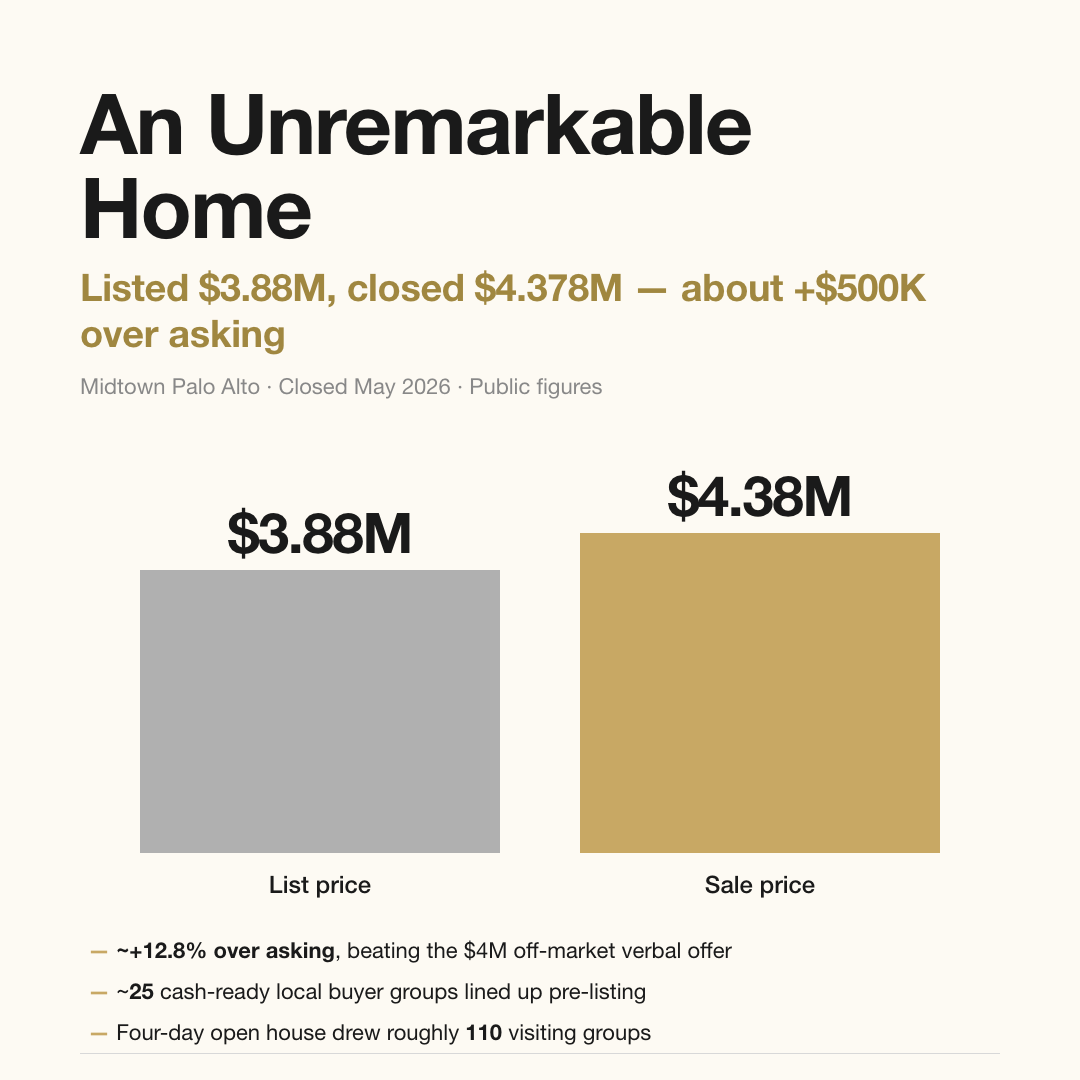
The gap can run 10%–20%, and it widens the higher you go — one point on a $4M home is $40,000. What separates the prices isn't the house; it's whether the agent does three things right before the home ever lists: match buyers offline pre-listing, pre-market it on social, and over-invest in the open house. An unremarkable Midtown Palo Alto home listed at $3.88M and closed at $4.378M, about $500K over asking — that's the three working together.
Who this is for
- Owners preparing to sell a single-family home in Palo Alto, Los Altos, Los Altos Hills, or the Stanford area, currently interviewing and choosing a listing agent.
- Sellers whose house has "no flaws but no real standout features," worried it won't fetch a premium, and trying to understand where the difference between agents actually lives.
- Owners who've already received a verbal off-market offer and are deciding between taking it now or running a full marketed process.
- High-end sellers who want to know what a good listing team should actually be doing during the quiet stretch between signing and going live.
Three things that decide the sale price
1. The pre-listing buyer pool: match the home to the right person before it ever hits MLS
Most sellers picture the process as list, wait for showings, collect offers. The teams that actually drive a premium start working buyers in reverse the moment you sign. A team that works Palo Alto–area high-end homes year-round keeps a running roster of buyers who are actively touring locally and have the cash to move — here, MK Group had about 25 such groups in hand at the time. The instant a listing comes in, it goes out privately to that audience, so the home is matched to a buyer who loves it before it ever lists publicly. That gives the seller a head start: opening day isn't building interest from zero, it's a pool of real buyers already waiting. In this case, that pre-listing motion is what produced a $4,000,000 verbal offer off-market.
2. Social distribution: build the attention before listing day
How many real buyers a listing reaches directly decides how many groups compete once it's live. A team with genuine distribution plans content ahead of the listing — separate pieces on the community, the home, and the market, with the listing woven in — to build attention early. Here, MK's media team produced two or three such pieces. This isn't running ads to chase view counts; it's putting the home in front of the people who actually care about this community and this price band before anyone else sees it. Social is only one of the three things, but when the house itself isn't scarce, it's often the nudge that turns a passerby into someone who shows up on purpose.
3. Open-house execution: four days, about 110 groups, a barista on site
Plenty of open houses are two hours, doors open, sign the sheet. Real execution is a different thing. This home ran four days — a Thursday broker tour, then public open house Friday through Sunday — with a barista on site pulling hand-poured coffee and serving hot chocolate, so the showing felt considered and intentional. Across the four days, about 110 groups came through, and the feedback ran strongly positive. When several buyers see a home over the same weekend, in the same well-staged setting, and feel each other's interest in the room, the competitive energy builds on its own — and that's the on-the-ground foundation for the multiple bidders who ultimately pushed the price past asking.
The numbers: an unremarkable house, about $500K over asking
The core figures first. This four-bed, three-bath Midtown Palo Alto home is modest in size and was last renovated 10 to 20 years ago; the owner himself called it "a good but unremarkable house" — no flaws, no real standout features. It listed at $3,880,000 and closed at $4,378,000 (about $4.38M): roughly $500K over asking, about +12.8%. More telling: that final number cleared the $4,000,000 a buyer had been willing to offer verbally off-market — after the full marketed process and pre-listing buildup, the home sold for about $380K more than the off-market figure. The table below lays out the key numbers.
| Metric | Figure | Note |
|---|---|---|
| List price | $3,880,000 | Not conservative for a good-but-unremarkable house |
| Off-market verbal offer | $4,000,000 | Not a lowball — the list was only $3.88M; this is what the market would pay today |
| Final sale price | $4,378,000 | Public listing + pre-listing offline buildup + four-day open house |
| Premium | ~+$500K / ~+12.8% | About $380K above the off-market verbal offer |
| Pre-listing buyer groups | ~25 | Touring locally, cash-capable |
| Open-house visitors | ~110 groups (4 days) | Thursday broker tour + Friday–Sunday public |
The one thing to remember. This premium did not come from the house — it was unremarkable, with no scarcity to trade on. The roughly $500K over asking came almost entirely from distribution and execution: the ~25 buyers matched before listing, the social attention built up early, and the competitive energy stacked across four days and ~110 visiting groups. Put differently, on a property with no flaws and no standout features, the ceiling on the sale price is set by the listing team, not by the house. That's exactly why the same home with a different agent can land 10%–20% apart.
Why this matters more at higher price bands
Lifting a sale price one percentage point translates into wildly different dollars depending on the band: 1% of a $1M home is $10,000, but 1% of a $4M home is $40,000. The same "doing a little more, a little better" is worth tens or hundreds of thousands at the $4M level. So the higher you go, the more it matters to pick a team that can actually manufacture the premium — this isn't a few thousand dollars in fees, it's hundreds of thousands in sale price.
Sources
- Data source: MK Group front-line listing execution; list price / sale price are the figures disclosed on video.
- Updated: 2026-06
- Scope: Palo Alto / Peninsula high-end single-family sellers
What we saw on the ground
The two-plus months from signing to listing — we didn't sit and wait
This one (detailed in our anonymized case file, case-017) carried particular weight for us at MK Group. The owner holds a real estate license himself, and his wife had worked as an agent — so they understood completely that selling your own home should go to a full-time, professional team, and they openly interviewed several large, well-respected local teams. They chose us for two reasons: we had social distribution the other teams didn't, and he could feel the effort and sincerity in our work. We treated this listing as our opening statement in Palo Alto and went all in.
The pace was the test. The owner signed the listing agreement in February 2026 but couldn't move out until late April, leaving only about three weeks from vacancy to listing — with painting and refresh work in between. Tight. But we never treated those two-plus months as waiting: we matched buyers offline before listing, had our media team build community-and-home content ahead of going live, and planned every detail of the four-day open house, down to the on-site barista. Those three things stacked together are what produced the multi-bidder competition and the $4,378,000 close. Marie Wang and Kevin Mo's team is working Palo Alto–area high-end homes intensively this year, and the @MarieWang (44K+) and @KevinMoRE (24K+) YouTube channels keep producing this kind of community and market content — which is precisely the underlying capability that lets attention get built before a home lists.
Off-market isn't only a Palo Alto play: a $7M–$9M Atherton sale, fully private
A pre-listing buyer pool and private distribution work at higher tiers too. We recently closed a home in the $7M–$9M range in Atherton fully off-market — it never went on MLS publicly; the buyer was matched privately, start to finish. Same logic underneath: work one area for years, keep a real roster of cash-capable buyers, and a home can sell at the right price without ever being publicly exposed. For high-end single-family sellers, a public listing isn't the only path — what matters is whether the team holds buyers who match.
Common misconceptions
"Whether a house sells well is mostly about the house itself — the agent doesn't change much."
The opposite is true: the more unremarkable the house, the bigger the difference the agent makes. A home with real flaws or extreme scarcity has its price range largely fixed by the market. But a "no flaws, no standout features" good house has its ceiling set by the agent's buyer pool, distribution, and execution. This case is the proof: an unremarkable home, lifted about $500K over asking through pre-listing buildup and a four-day open house. The same home with a different agent can land 10%–20% apart.
"If I get a verbal off-market offer, taking it is the easiest path."
A verbal off-market offer isn't the ceiling. Here, the off-market stage already produced a $4,000,000 verbal offer — and not a lowball, since the list was only $3.88M — but after the full marketed process and pre-listing buildup, the home closed at $4,378,000, roughly $380K more. An off-market offer reflects what the market will pay today; a team that runs the process well earns its value precisely by taking the sale above that number. Before accepting a private offer, work out how much more a full process might capture.
"There's nothing to do between signing and listing — you're just waiting on the reno and the move."
That window is a pre-marketing window, not a waiting room. Here, the owner signed in February and didn't move out until late April — but those two-plus months were exactly the window to work: match buyers offline, plan two or three pieces of community-and-home content, and lock down the four-day open house. Wait until listing day to start building interest and you've missed the chance to grow the buyer pool and the attention ahead of time — and the competition that erupts after listing comes precisely from the homework done before it.
"Choosing a listing agent is mostly about who charges the lowest commission."
Commission differences are usually a fraction of a percentage point, while an agent's ability to drive the sale price higher can differ by 10%–20%. On a $4M home, 1% is $40,000 — a team that can lift the price a few points returns far more than the small commission gap. What you should actually weigh when choosing an agent is how deep the buyer pool is, how strong the distribution is, and how well the open house is executed — not the fraction of a point you'd save on fees.
"A big social following means strong home sales."
Follower count doesn't translate directly into sale price. What works isn't broad reach but whether a team can bring the people who genuinely care about this community and this price band to the home ahead of time. Social distribution is only one of the three things; it works only when stacked with a real pre-listing buyer pool and on-the-ground open-house execution. Judge a team's social capability by whether it converts content into real buyers who show up on purpose — not by the view counts on the back end.
Next steps
- When interviewing teams, ask directly: "Between the day I sign and the day the home lists, what specifically will you do?" A team that can answer "find buyers first, pre-market on social, plan the open house" is one that actually does the pre-marketing.
- Ask how many cash-capable buyer groups they currently have touring locally — the depth of the pre-listing buyer pool is what gives you a head start.
- Ask to see samples of their past social distribution (community / home / market content) and judge whether it's precise — bringing buyers to the home on purpose — or just chasing views.
- When a verbal off-market offer arrives, work out with your agent how much more a full marketed process plus buildup might capture before deciding whether to accept the private offer.
- Treat the sign-to-list window as a pre-marketing window: even with reno and a move in progress, push the buyer search and the social buildup in parallel — don't wait until listing day to start building interest.