The short answer
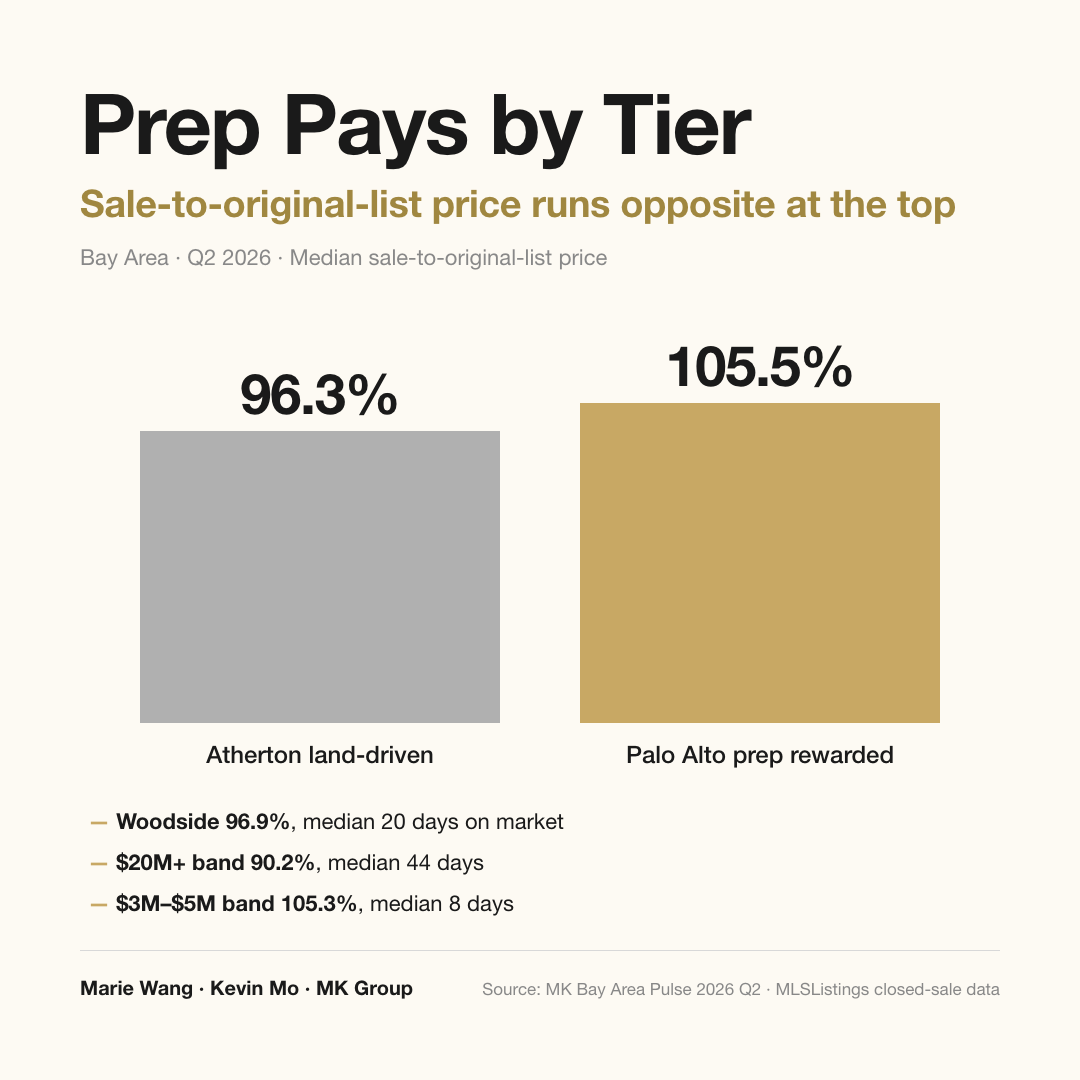
Settle one question first: will buyers price this house as land? If they will, renovation is a sunk cost. If they won't, what you need is clearing out, paint, better lighting, and the inspection punch list — nothing more. In 2026 Q2, Bay Area closings in the $3M–$5M band ran a median 105.3% of original list price. Atherton ran 96.3%. The same budget meets two different fates in those two markets.
Who this article is for
This is written for a Bay Area owner who has already decided to sell and is stuck on one step: whether to spend six figures preparing the house before it goes live. You may hold an older home in a land-driven community — Atherton, Woodside, Los Altos Hills, where a lot starts at an acre — and be weighing a full rebuild before sale. You may hold a $10M+ Peninsula property long-term through a trust or a cross-border structure and want to know how much belongs in it before listing. You may be an upgrading family in the $3M–$10M band in Palo Alto, Menlo Park, or Los Altos on the Peninsula, or in Cupertino on the Silicon Valley side, holding a house with no real defects and no real signature, last renovated fifteen or twenty years ago. Or you may have inherited or long held an older house and want to know whether to fix first or list as-is. You almost certainly have a contractor bid or two in hand already, and what you actually want is three answers: which items are mandatory, which items never come back, and how much more the market will pay right now for money spent. All three answers hang on the same prior judgment — and once that judgment is made, most of the line items on the bid sort themselves.
Three questions that decide the answer
The most common way this decision goes wrong is treating it as a question of taste. It is closer to a question of asset structure — you have to know why a buyer is paying the price before you know whether to spend money on it.
One — decide whether this house gets bought as a lot. In the Bay Area's top communities, the price anchor is land and locational scarcity; the structure is one component, and it is the component that depreciates. One real transaction shows the structure plainly: three years ago MK Group helped a buyer acquire a roughly 7,000-square-foot older home on a 1-acre parcel in West Atherton for $12M+, while a comparable new build of about 8,000 square feet in the same location was listed at $20M. The buyer took the older-home-plus-later-renovation path. Only one conclusion follows, and it is the important one: at this tier, land is the asset anchor and the building's value is discounted separately. Turn that around to the seller's side and it reads: the six figures you put into the structure are very hard to price back out at closing. Testing your own house is not complicated. If recent sales on your street include buyers who tore down and rebuilt after closing, or if your lot is clearly large relative to what the house itself contributes to value, then your house will most likely be appraised as a lot — and a full renovation is a gift to the next owner.
Two — separate a house with hard defects from a house that simply lacks character. These two conditions take opposite prescriptions, and confusing them is the expensive mistake. Hard defects — a leaking roof, foundation or drainage problems, out-of-code wiring, an unpermitted addition — get used against you at inspection, and the repricing is usually far larger than the repair itself, because the buyer is deducting an unknown-risk premium rather than a contractor's quote. Lacking character is a different situation entirely: the kitchen is dated, the bathrooms are old-fashioned, the palette has aged, but the structure is sound and there is no deal-breaker. What that house needs is doubt-removal prep — clear it out, paint throughout, replace fixtures for brightness, clean up the yard, and work down the small items on the pre-inspection report line by line, until a buyer has no psychological reason to discount. Whether to add staging on top of that is a marginal call, and it belongs in the pricing conversation rather than the construction one; for how to frame it, see Bay Area Sell-Side Pricing Strategy: The Three-Tier Method and First-Week Data-Driven Adjustments.
Three — check whether your build schedule and your listing window actually line up. The hard part of a large project is never the design; it is the calendar. A $20M-tier new-construction estate in Atherton looked close to flawless on paper — floor plan and community both strong — and a cross-border family office walked away from it anyway. MK Group's read was that the workmanship was rushed, closer to a builder's spec home turned quickly for sale than a house built to be held. For a seller the lesson is direct: spending more is not automatically additive, and a large project that was hurried gets deducted at the price line — most sharply at the top, where buyers have almost no tolerance for flaws. So if your renovation plan needs three to six months plus a city permit cycle and you want to hit a particular listing window, the safer move is to shrink the scope and leave the schedule intact.
What the market currently pays for "prepared and problem-free"
Start with the core numbers. In 2026 Q2, the Bay Area's $1.5M–$3M band recorded 1,927 closings, a median 12 days on market, and a median 103.6% of original list price — that is the mid-market baseline. One step up, the $3M–$5M band recorded 627 closings, a median of just 8 days, and 105.3%. In the same quarter the $10M–$20M band recorded only 33 closings, with the median time on market stretching to 24 days and the ratio falling to 95.9%; the $20M+ band recorded 6 closings at a median 44 days and 90.2%. In other words, closing above original list price is a mid-market phenomenon. The higher you go, the more the price returns to land and scarcity themselves.
The table below puts closings, all-cash share, median days on market, and median sale-to-original-list price side by side for each 2026 Q2 price band, with a prep-intensity read derived from those four columns in the last position:
| Price band | Closings in quarter | All-cash share | Median days on market | Sale / original list price | Prep intensity |
|---|---|---|---|---|---|
| $1.5M–$3M | 1,927 | 17.4% | 12 days | 103.6% | Doubt-removal only: clear out, paint, work the inspection report |
| $3M–$5M | 627 | 29.0% | 8 days | 105.3% | Doubt-removal plus light visual prep; weight goes to launch timing |
| $5M–$10M | 223 | 46.6% | 8 days | 104.0% | Doubt-removal plus quality-detail correction; be cautious with structural work |
| $10M–$20M | 33 | 72.7% | 24 days | 95.9% | Present as-is and on land terms; large renovations rarely come back |
| $20M+ | 6 | 83.3% | 44 days | 90.2% | Present as-is and on land terms; rushed work can subtract |
What to actually remember is the counterintuitive part, and it shows up more clearly at the city level. In the same quarter, Palo Alto recorded 110 closings at a $4,110,000 median close price, a median 9 days on market, and a median 105.5% of original list price. Atherton recorded 23 closings at a $10,500,000 median, 73.9% all-cash, a median 13 days on market — and 96.3%. Woodside recorded 23 closings at a $5,080,000 median, 78.3% all-cash, 96.9%, and a median 20 days. Hillsborough sits between the two poles: 42 closings, a $6,500,000 median, 7 days, 103.0%.
The methodology has to be stated plainly here. Sale-to-original-list price measures list-pricing strategy first, not renovation return. Mid-market listings are routinely priced slightly under the seller's expectation to invite competing bids, which pushes the ratio up mechanically. Top-tier listings are priced at the seller's expectation from day one, and the closing price settles back toward land value, which pulls the ratio down mechanically. So the number tells you whether your band is a bidding market or a land market. It does not convert into "prep will add X points." In fast-moving mid-market cities like Palo Alto and Cupertino, preparing a house so buyers can find nothing to object to influences the intensity of the bidding. In a structure like Atherton's or Woodside's, the extra renovation dollars are very hard to price out separately at closing. One caveat on sample size: the $10M–$20M band had 33 closings this quarter and the $20M+ band only 6, so neither should be read as a rule — and among those 6 top-tier closings, 2 still closed above original list price. The top of the market is itself divided.
The other data set worth reading alongside it is public cost-recoup research. Zonda's Cost vs. Value Report, 2025 edition (38th edition, published September 2025, covering 28 projects across 119 metro markets, costvsvalue.com), states the gap between replacement and upgrade about as bluntly as it can be stated. On national figures, the top recoup is garage door replacement at 267.7%, followed by a midrange minor kitchen remodel at 112.9% — both above their own cost. A midrange major kitchen remodel returns 50.9%, an upscale major kitchen 35.7%, and an upscale primary suite addition 18.0%. Zonda's own summary notes that eight of this edition's ten highest-recoup projects are exterior replacements, and that the strongest overall returns come from the Pacific division (which includes California) and West South-Central. That the Bay Area sits in a division outperforming the national average means these national figures read as a conservative floor here rather than an overstatement. The NAR x NARI Remodeling Impact Report, 2025 edition (published April 2025) reaches the same directional conclusion by an entirely different method — NARI reports project cost, REALTORS® estimate added value — with a steel entry door at 100%, a closet renovation at 83%, a fiberglass entry door at 80%, a complete kitchen renovation at 60%, a kitchen upgrade at 60%, a new primary suite at 54%, and a bathroom renovation at 50%. Both reports carry one premise that has to be surfaced: they assume the improvement itself gets counted in the sale price. In a land-driven market that premise does not hold, and the reference value of any recoup rate falls further.
This article is decision education, not legal, tax, or engineering advice. Renovation and pre-sale prep touch three kinds of professional judgment. First, permits and compliance: unpermitted additions and structural or electrical changes need to be confirmed with your city building department and your contractor. Second, disclosure: California sellers must disclose known defects and completed alterations on the statutory forms, whether or not the item is repaired. Third, tax treatment: ordinary repairs and painting generally do not add to your cost basis, and only qualifying capital improvements may — confirm the specifics with your CPA. If the transaction involves trust ownership, cross-border funds, or a foreign seller subject to FIRPTA withholding, build the tax and third-party review steps into the timeline early.
Data source: Closings by price band and by city, all-cash share, median days on market, median sale-to-original-list price, and the individual $20M+ closings are from MK Bay Area Pulse 2026 Q2, built on MLSListings closed-sale data. Cost-recoup figures are from Zonda's Cost vs. Value Report, 2025 edition (38th edition, published September 2025, 28 projects across 119 metro markets) and the NAR x NARI Remodeling Impact Report, 2025 edition (published April 2025; NARI reports project cost, REALTORS® estimate added value). This article cites the national project figures from both reports plus Zonda's published directional conclusion on regional performance (the Pacific division returns the most). Both reports also publish a Pacific division breakdown and separate San Francisco / San Jose metro figures, which are not reproduced here — readers can look up their own metro at costvsvalue.com. Neither report is adjusted for high-land-value, land-driven markets like the Bay Area. The final column of the table, prep intensity, is a judgment framework derived from the first four columns, not survey data.
Updated: 2026-07
Scope: Sellers of $3M+ single-family homes on the Peninsula and in the South Bay (the $1.5M–$3M row is included only as a gradient baseline). Any specific home's prep plan still depends on physical condition, permit history, and comparable sales inside its own submarket.
What MK Group sees on the ground: the premium came from distribution and timing, not the renovation budget
A single-family house in Midtown Palo Alto, described by its own owner as "a perfectly ordinary good house" — four bedrooms, three baths, a little over a thousand square feet, renovated once fifteen or twenty years ago, no defects and no signature. The owner held a real estate license himself and his wife had worked as an agent, and they still ran an open interview process across several very large, well-respected local teams before giving the listing to MK Group. Their stated reasons were narrow and worth noting: owned-channel distribution the other teams did not have, and visible effort. Neither reason had anything to do with a construction budget.
What matters here is how little prep the file actually contained. The listing agreement was signed in February 2026, but the owner could not move out until late April, which left roughly three weeks from vacancy to launch — and that window included painting. Three weeks does not hold a kitchen remodel, a bathroom rebuild, or an addition. What did get invested was the two-plus months between signing and launch. MK Group circulated the property immediately through its own channels to about 25 active, cash-capable buyers already touring locally, warming the house up offline before it went live. In parallel the team produced two or three pieces of owned-channel content — one on the neighborhood, one on the house, one on the market — building attention ahead of launch. The close was a four-day open house: broker tour Thursday, public Friday through Sunday, drawing roughly 110 groups over the four days.
The result: listed at $3,880,000, closed at $4,378,000 — about $500,000 over, roughly +12.8%. Worth noting is that a buyer had already made a verbal $4,000,000 offer during the off-market stage, which against a $3,880,000 list price was not a lowball. The full public process plus pre-marketing still added about $378,000 on top of that verbal number. The complete debrief is in The Same Palo Alto House, a Different Listing Agent — How Much More Can It Sell For?
One more situation deserves its own paragraph, because for some houses the right answer at this step is "don't sell yet." An owner of a 94087 single-family home — 1,800 square feet, three bedrooms and two baths, a 7,500-square-foot lot, Homestead schools — wanted to upgrade to Los Altos, and the three agents consulted before MK Group all recommended listing as soon as possible. Marie Wang (DRE# 02110980) and Kevin Mo (DRE# 02127623) walked the property and gave the opposite advice: the house had no defects, the location and schools were solid, the mortgage rate was extremely low, and neither the funding gap nor the next-step target had been resolved. Selling would permanently surrender that rate and would likely land the family in the familiar trap of still not having bought two years later. The more rational path was to keep the low-rate property and raise the next down payment through a HELOC. The full framework sits in Should You Sell Your Bay Area Home in 2026?. In this article's context, it flags something easy to skip: before deciding how much to spend preparing a house for sale, confirm that this house should be sold now at all.
Common mistakes
Mistake 1: "Spend $300K on a new kitchen and I'll get $500K more at closing."
Almost never true. Public cost-recoup data draws the line between upgrade and replacement clearly. In Zonda's 2025 national figures, a midrange major kitchen remodel recoups 50.9%, an upscale major kitchen 35.7%, and an upscale primary suite addition 18.0% — the larger and more upscale the project, the lower the return. Meanwhile a minor kitchen remodel recoups 112.9% and a garage door replacement 267.7%, both above cost. The NAR x NARI Remodeling Impact Report, 2025 edition, puts a complete kitchen renovation at 60% and a bathroom renovation at 50%, with its highest entry a steel entry door at 100%. In plain terms: a $300K major kitchen project returns somewhere around three to five dollars on ten by public benchmarks. The more realistic mechanism is that buyers never pay a separate premium for your renovation — they simply bid one increment higher because they can't find anything to object to. Which makes the correct target of a prep budget the removal of deductions, not the manufacture of bonuses.
Mistake 2: "An old house has to be renovated or it won't sell."
Age and unsellability are not causally linked. What actually decides whether to start work is whether the house gets bought as a lot. In 2026 Q2 Atherton closed at a median 96.3% of original list price and Woodside at 96.9% — houses in those two land-driven markets are still selling, with the price anchored to the land (source: MK Bay Area Pulse 2026 Q2, built on MLSListings data; that ratio is also shaped by list-pricing strategy, methodology explained above). In those communities, listing an older home as-is is standard practice, and renovating it thoroughly often just means paying in advance for work the next owner intended to tear out. In fast-moving mid-market cities the reverse holds: an old house doesn't require a major remodel, but dark, dirty, and cluttered genuinely does cost money at the price line — and the fix for that is cleaning and paint, not construction.
Mistake 3: "We can compress the schedule — once it's done, it looks good."
At the top of the market, rushed work is a liability. A cross-border family office toured a $20M-tier new-construction estate in Atherton and walked away; MK Group's read was that the workmanship had been rushed, closer to a builder's spec home turned for quick sale. Buyers at that price have almost no tolerance for defects, and one visible flaw in the finish work is enough to disqualify an entire house. The seller-side conclusion: if the schedule can't hold the work to standard, shrinking the scope is far safer than compressing the calendar. A clean, honest, well-presented existing house beats a visibly hurried half-new one.
Mistake 4: "Skip the pre-inspection — why expose my own problems?"
That logic barely survives in California, because sellers carry a statutory duty to disclose known defects, and the legal exposure of concealment far exceeds the negotiating exposure of disclosure. In practice, running a pre-inspection, repairing the small items line by line, and publishing the report with the listing works better than letting every buyer bring their own inspector to hunt for problems. In the first version you control the narrative and the repair cost; in the second the buyer prices unknown risk, and the deduction routinely runs several times the actual repair. This is the single highest-value item inside doubt-removal prep.
Mistake 5: "Prep spending will offset capital gains later anyway."
Two categories have to be kept apart. Ordinary repairs, painting, cleaning, and staging done to sell a house generally do not add to cost basis. Only qualifying capital improvements — an addition, a new roof, rewiring, work that extends useful life or adds value — may be added, and only then do they affect the capital gains calculation. Treating every prep dollar as future tax relief in order to justify a large renovation is a common assumption with a real price attached. Confirm the specific treatment and documentation requirements with your CPA.
Next steps
- Run the land test first. Pull the closings on your street from the past 24 months and check whether any buyer tore down and rebuilt after closing. If some did, and your lot is not small by neighborhood standards, plan as though your house will be bought as a lot — and hold the prep budget to the floor.
- Order a pre-inspection and sort the report into three piles. Hard defects that must be fixed (structure, roof, drainage, wiring, permit issues); small items whose repair removes doubt (doors and windows, water stains, aging hardware); and pure upgrades (kitchen, baths, additions). Do the first two piles. Default to skipping the third unless a specific comparable sale supports it.
- Use your band's ratio to identify which market you are in. A band closing near 104%–105% of original list price is usually a price-to-invite-bids, multiple-offer market, where the point of prep is to maximize bidding intensity. A band closing around 96% is a land-priced market, where the prep budget should shrink substantially. Ask your agent to run that ratio for your specific submarket — and read it as a market-type test, not as a renovation return rate to back a budget out of.
- Schedule the work and the listing window together. Fix the date you want to be live, then count backward to see how many weeks remain. If the remaining time can't hold your plan, cut scope before you cut schedule. Clearing out, paint, lighting, and yard cleanup usually finish within a few weeks and are the most reliably returned combination available.
- Confirm that this house should be sold now. If you hold an unusually low mortgage rate, your next move isn't defined yet, or the appreciation already carries a meaningful tax consequence, settle whether and when to sell before you settle the prep budget. Reverse that order and everything spent in front of it can be written off.