Direct answer
Possibly, within limits. Since July 16, 2026, Palo Alto has applied SB 79 at 50% of state-law capacity. A single-family lot next door, within half a mile of the station, can still become a small building of 5 or more apartments. None of the public proposals of 6 stories or more sits on a single-family lot.
So far, only one filing gives a reading on a single-family lot: 340 Palo Alto Ave in Downtown North. As reported by San José Spotlight, the plan is 4 stories, with parking at grade and 6 condominiums on the three floors above. SB 79 took effect on July 1, 2026. Under state law, Caltrain stations are Tier 1 stops. Within a quarter mile of a station's pedestrian access point, a project can reach 75 feet and a residential FAR of 3.5; from a quarter to a half mile, 65 feet and 3.0. Palo Alto's interim ordinance halves those FARs to 1.75 and 1.5. Where the project next door abuts a low-density residential zone, it must also stay under a 45-degree daylight plane that begins at a height of 16 feet. Locally designated historic resources are exempt as well, until one year after the city adopts its 7th-cycle Housing Element. The city's announcement puts that date at January 31, 2032.
The exception is the July 1–15 window. In those two weeks the city received 9 pre-applications totaling 341 units, and the filings made public so far, 555 College Ave among them, argue for review under the full state standards. If you are buying near the California Ave or University Ave station, check three things address by address: the straight-line distance from the lot to the station's pedestrian access point, which projects nearby are in review, and whether your parcel or the one next door is on the historic inventory.
Who this article is for
- Buyers doing parcel-level due diligence on a Palo Alto single-family home at $5M and up that sits less than half a mile from the California Ave or University Ave station
- Buyers drawn to a home in Old Palo Alto, Professorville, Downtown North or College Terrace, or in the Eichler neighborhoods near the San Antonio station, who want to know first what the lot next door could become
- Buyers already in escrow who have just found the neighboring parcel on an SB 79 application list and need to judge how much it matters
- Buyers also weighing homes near the Menlo Park or Burlingame stations who want to understand why the rules differ from city to city
- Long-term owner-occupants who want to price both sides into the offer: the chance of added density next door, and the new development option on their own lot
Three things that decide the answer
One: which station the address is near, and how far in a straight line
Three stations affect Palo Alto: University Ave and California Ave inside the city, and San Antonio, which sits in Mountain View but whose half-mile ring reaches into south Palo Alto (City of Palo Alto, August 4, 2026). State law classifies heavy rail, and commuter rail running at least 72 trains a day across both directions, as Tier 1 (§65912.156(n), (r)). The Association of Bay Area Governments (ABAG) states in its SB 79 summary that Caltrain stations are Tier 1, and a Menlo Park staff report likewise lists Palo Alto Caltrain Station as Tier 1.
Distance is where readings most often go wrong. State law measures in a straight line from the nearest edge of the project parcel to the station's pedestrian access point (§65912.157(b)). It is not a walking route, and it does not start at your front door. The statute does not define "pedestrian access point" itself. The standards fall into three bands: within 200 feet of a pedestrian access point, within a quarter mile, and from a quarter to a half mile. In a city of fewer than 35,000 residents, only the quarter-mile ring applies, and Menlo Park's staff report follows that rule: at the Menlo Park station, only the quarter-mile ring counts, and the R-1-S and R-1-U single-family zones inside it are included (Staff Report 26-078-CC, May 12, 2026).
Neighboring cities also come with a different price backdrop. In Q3 2026, Menlo Park recorded 74 single-family sales at a median of $3,718,000, with 43.2% bought all-cash; Burlingame recorded 57 at a median of $3,450,000, and Mountain View 63 at a median of $2,925,000 (MK Bay Area Pulse, MLSListings data). Population thresholds and local ordinances differ by city, so for Burlingame and others, go by that city's own documents. Atherton's station closed permanently in December 2020 (Caltrain announcement); with no trains stopping there, it sits outside this framework. For any address, the final word is the SB 79 map published by the Metropolitan Transportation Commission (MTC), read together with the city's zoning map; state law gives that map a rebuttable presumption of validity (§65912.160(f)). Homes right on the tracks also face noise and horns, covered in Caltrain Went Electric — Are Homes Along the Tracks in Palo Alto Still Loud?.
Two: which rulebook the lot next door is reviewed under, and how much it can hold
SB 79 reaches well beyond commercial districts. The statute covers sites zoned for residential, mixed or commercial development (§65912.157(a)), single-family zones included. A project has to clear four thresholds: at least 5 units; a density of at least 30 units per acre; an average unit size of no more than 1,750 net habitable square feet; and, from 11 units up, an affordable set-aside of 7% extremely low income, 10% very low income or 13% lower income, whichever the developer chooses.
Within the same half-mile ring, three rulebooks now run side by side. The first governs the 9 pre-applications filed July 1–15. Under SB 330, a project is generally subject only to the rules in effect on the day its preliminary application was submitted (§65589.5(o)), provided a full application follows within 180 days (§65941.1(e)). Counted from the filing dates, those deadlines fall between late December 2026 and around January 11, 2027. Filings made public so far, such as the letter from the 555 College Ave applicant's attorney, argue for review under the full state standards (Palo Alto Online, July 8, 2026). The city says hearings will be held only after formal applications are filed.
The second rulebook covers projects filed from July 16 onward, which are reviewed under Palo Alto's interim ordinance. Take 2151–2211 Park Blvd, within a quarter mile of the California Ave station. The plan would demolish three office buildings and build a 7-story, 98-unit residential project. Its application asks for review under the full state standards and is signed July 16. The city says that because it was submitted after the local ordinance took effect, it will be processed under the city's rules (Palo Alto Online, July 29, 2026).
The third rulebook applies once the interim period ends: either the full state standards, or a local TOD alternative plan that clears review by the state Department of Housing and Community Development (HCD).
The interim ordinance sets no explicit height limit (Palo Alto Online, July 29, 2026). Its constraints come from three places: the halved FAR; setbacks of 10 feet front and rear and 4 feet on the sides, unless the base zone provides otherwise; and, where a project abuts a low-density residential zone, a 45-degree daylight plane that begins at a height of 16 feet (City of Palo Alto, August 4, 2026). For a single-family buyer, the last one matters most in practice. The closer the neighboring building comes to your side, the further it has to step back.
Three: which protections are real, and which expire
The historic-resource exemption is real, but it has an end date. Palo Alto's interim ordinance exempts locally designated historic resources until one year after the city adopts its 7th-cycle Housing Element, which the city's announcement puts at January 31, 2032 (City of Palo Alto, August 4, 2026). State law limits this kind of interim exclusion to historic resources listed on a local register before January 1, 2025 (§65912.161(b)(1)(F)). Over the long term, if the city moves to a TOD alternative plan, parcels excluded from the density floor on historic grounds may not exceed 10% of the eligible area in any station's TOD zone, cumulatively (§65912.161(a)(2)(C)). City staff concluded from this that not every historic property can stay exempt in the long run (Palo Alto Online, April 27, 2026). The rules for altering or tearing down an older home itself are covered in I Want to Buy a Century-Old House in Old Palo Alto or Professorville and Rebuild — How Do I Find Out Whether It Can Be Torn Down?.
The interim ordinance also has to clear the state. Local SB 79 ordinances go to HCD for review (§65912.160(d)). A June 2026 analysis by Holland & Knight notes that HCD has not yet taken a position on rezoning station-area parcels to 50% of state standards first and then claiming an exclusion on that basis, and it names Palo Alto as relying on that path to defer SB 79 citywide. Nor is 50% necessarily the end point for the California Ave area. On June 15, the City Council also directed planning staff to study accelerating housing along California Ave and the adjacent stretch of El Camino Real (Palo Alto Online, June 16, 2026), and the city's August announcement lists that study among its next steps.
The room for neighbors to block a project together is narrowing as well. Starting January 1, 2027, denying an SB 79-compliant project in a high-resource area is presumed to violate the Housing Accountability Act, unless the city can cite health, life or safety grounds (§65912.157(m)).
Three bands within half a mile: the full state standard vs. Palo Alto's interim standard
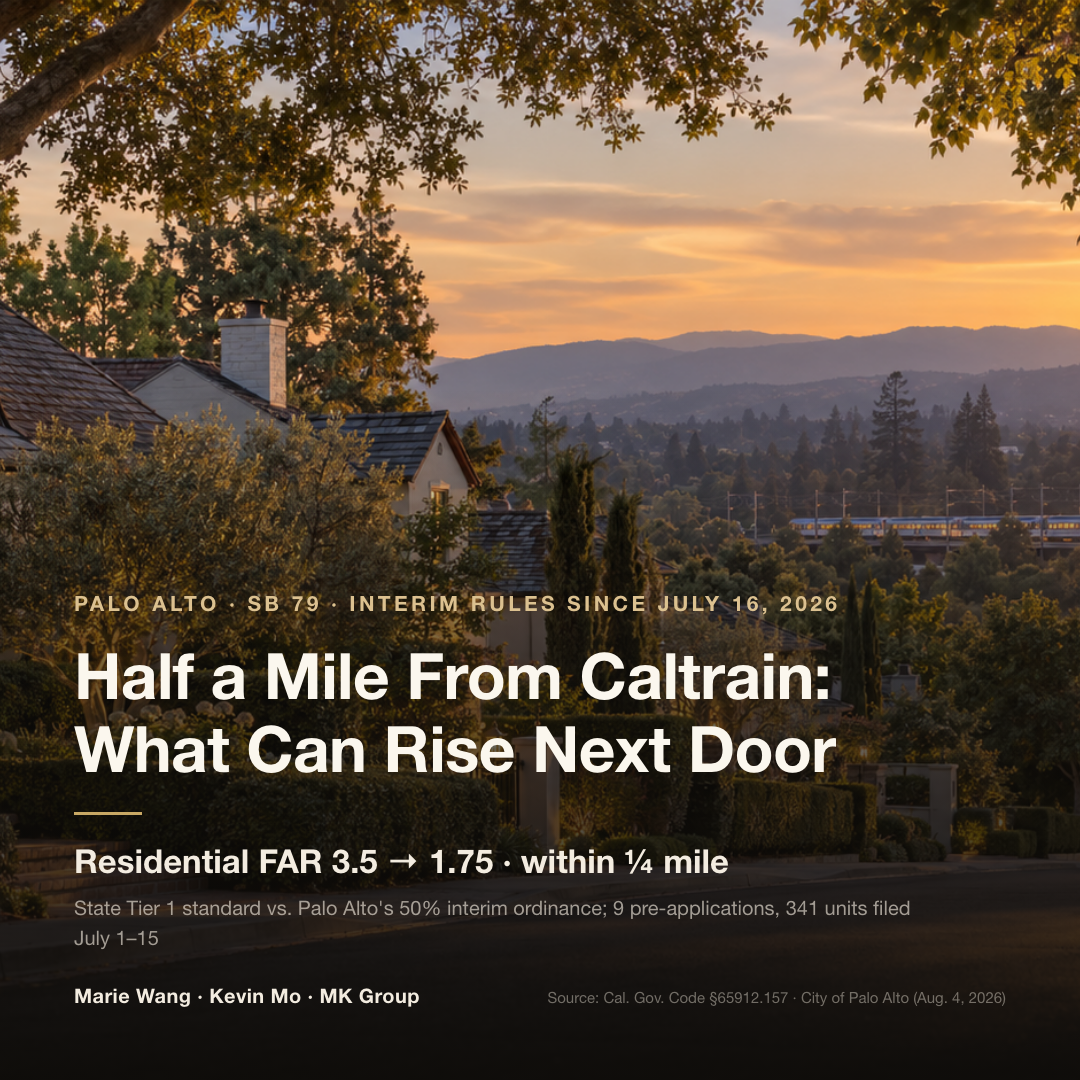
The key numbers first: within a quarter mile of a Caltrain station's pedestrian access point, SB 79's state standard is 75 feet, 120 units per acre and a residential FAR of 3.5, and Palo Alto's interim standard cuts that FAR to 1.75. From a quarter to a half mile, the FAR drops from 3.0 to 1.5. On a 7,200-square-foot lot, the median lot size among Palo Alto's 103 single-family sales in Q3 2026, the residential floor-area cap in the quarter-to-half-mile band falls from 21,600 square feet to 10,800.
| Distance to station pedestrian access point | SB 79 state standard (Tier 1) | Palo Alto interim standard (from July 16, 2026) | Residential floor-area cap on a 7,200 sq ft lot (state / interim) |
|---|---|---|---|
| Within 200 ft | 95 ft; 160 units per acre; FAR 4.5 | FAR 2.25 | 32,400 / 16,200 sq ft |
| Within 1/4 mile | 75 ft; 120 units per acre; FAR 3.5 | FAR 1.75 | 25,200 / 12,600 sq ft |
| 1/4 to 1/2 mile | 65 ft; 100 units per acre; FAR 3.0 | FAR 1.5 | 21,600 / 10,800 sq ft |
| Applies in every band | At least 5 units; at least 30 units per acre; average unit no more than 1,750 net habitable sq ft | Setbacks of 10 ft front and rear, 4 ft side; 45° daylight plane from a height of 16 ft where abutting a low-density residential zone; no explicit height limit | FAR multiplied by lot area |
What to remember: even halved, an ordinary single-family lot still fits a small apartment building, and the arithmetic is easy to check. At the interim FAR of 1.5 for the quarter-to-half-mile band, a 7,200-square-foot lot tops out at 10,800 square feet. The state minimum of 5 units at the 1,750-square-foot average ceiling comes to 8,750 square feet, still inside 10,800. The interim ordinance limits bulk; it does not keep SB 79 off single-family lots. How close and how tall the building next door can get is decided by the setbacks and the daylight plane.
The one named filing deserves a separate look. 340 Palo Alto Ave in Downtown North also sits on a 7,200-square-foot lot (MLSListings), and the city's parcel table lists 17,545 square feet of floor area (City of Palo Alto, August 4, 2026), an FAR of about 2.44. That is above what the interim standard allows on this lot, 12,600 square feet within a quarter mile or 10,800 from a quarter to a half mile, and inside the 21,600 square feet that the full state FAR of 3.0 permits. It does not fit the interim standard; it does fit state law. That gap is what filing in the July window was worth. One caveat: the city's figure may include at-grade parking and common areas, so it may not match the statute's definition of residential FAR.
The 9 pre-applications filed in the July window
The key numbers first: between July 1 and 15, Palo Alto received 9 pre-applications under SB 79, totaling 341 units and 395,310 square feet. Four of them, with 204 units between them, are within half a mile of the California Ave station; five are around the University Ave station; none is near San Antonio. Only one of the 9 is on a single-family (R-1) lot: 340 Palo Alto Ave, with 6 units and 17,545 square feet in the city's table.
| Address | Nearest station | Current zoning | Units | Floor area (sq ft) |
|---|---|---|---|---|
| 2455 El Camino Real | California Ave | CC(2) | 76 | 90,000 |
| 414 California Ave | California Ave | CC(2)(R)(P) | 39 | 66,080 |
| 555 College Ave | California Ave | CN | 70 | 70,475 |
| 2497 High St | California Ave | RM-30 | 19 | 19,250 |
| 525 Hamilton Ave | University Ave | CD-C(P) | 21 | 27,430 |
| 127 Lytton Ave | University Ave | CD-C(P) | 24 | 20,925 |
| 135 University Ave | University Ave | CD-C(GF)(P) | 17 | 14,491 |
| 332 Forest Ave | University Ave | RM-40 SOFA 1 | 69 | 69,114 |
| 340 Palo Alto Ave | University Ave | R-1 | 6 | 17,545 |
| Total | — | — | 341 | 395,310 |
Sources: address, zoning, units and floor area from the City of Palo Alto (August 4, 2026). Nearest station compiled from the four-and-five split reported by Palo Alto Online (July 22, 2026); the city's parcel table does not list stations.
What to remember: the known proposals of 6 stories or more, such as 555 College Ave at the edge of College Terrace (6 stories, 64 feet, 70 units) and 2497 High St (6 stories, 71 feet, 19 units), are all on commercial or multifamily lots (Palo Alto Online, July 8 and July 22, 2026). By unit count, the California Ave area's 204 units make up about 60% of the 341. In an April report, city staff judged that the California Ave area would feel the greatest effect, because it has many parcels over 10,000 square feet that can take an apartment building without assembling lots (Palo Alto Online, April 27, 2026). All 9 are still pre-applications. Whether any gets built depends on whether a full application follows within 180 days, and on the review after that.
What MK Group sees in practice: price land near a station with the residual method
SB 79 cuts both ways on value, and both edges land on the same person. On the day you sign, you are a buyer worried about density next door; after closing, you own land inside a station ring. To judge which side weighs more, Marie Wang (DRE# 02110980) and Kevin Mo (DRE# 02127623) use the residual method developers rely on to value land: start with what the finished project can sell for, subtract construction, holding and financing costs and the developer's profit, and what remains is what the land is worth.
In July 2026, MK Group ran exactly this math for a buyer client (case-027). The property was a 1926 home in Old Palo Alto listed above $8M, in a condition that left only one path: tear down and rebuild. Building about 5,000 square feet without a basement meant roughly $4M in construction and about $12M all in. Adding a basement and finishing to the standard of a $10M-class home meant about $6M in construction and about $14M all in, before holding costs. The best-case resale three years out was $21M to $22M. The conclusion: as an investment, the purchase price had to come down to about $7M. That was a single-home rebuild with no connection to SB 79. What carries over is the method.
Inside a station ring, a single-family lot gains one more possible use: 5 or more apartments. Land value rises only when the residual value of an apartment project exceeds what a single-family buyer will pay, and in Palo Alto that bar is high. In Q3 2026, Palo Alto recorded 103 single-family sales at a median of $4,200,000, 27 of them at $5M or above; 36.9% were all-cash, the median time on market was 9 days, and the median sale price was 107.6% of original list price (MK Bay Area Pulse, MLSListings data). The apartment side has to absorb the cost of multistory construction, the affordable set-aside from 11 units up, the 1,750-square-foot average unit cap, and the time spent in approvals and litigation. Only 1 of the 9 July filings chose a single-family lot; the other 8 are on commercial or multifamily zoning. That points the same way as the math above.
That one filing also offers a reading from the owner's side. 340 Palo Alto Ave is a 1910 two-bedroom home of 1,120 square feet on a 7,200-square-foot lot. After filing an SB 79 pre-application, the owner listed it at $6,300,000. The listing remarks describe the accompanying application for 6 condominiums of roughly 1,500 to 1,550 square feet each, and mention a possible added top-floor unit of about 1,800 square feet (MLSListings). As of October 21, 2026, the home is still for sale, and MLSListings shows 92 days on site. That is a running count for an active listing, measured differently from the median days on market for closed sales cited above, so the two should not be compared directly. Whether development potential turns into a land premium is something the market is still pricing. For how to judge a developer's unsolicited offer, see A Developer Knocked and Offered to Buy My Old Bay Area House to Tear Down — Is the Number He Gave Me High or Low?.
A listing like this has one more effect on buyers: it becomes an anchor for nearby sellers. An Old Palo Alto off-market purchase in MK Group's case library (case-026) ran into exactly that. Before signing, the seller saw another older home on the same street listed above $8M and called to ask about it; handled poorly, a moment like that can erase the room to negotiate. That deal had nothing to do with SB 79, but the lesson travels. When you bid inside a station ring, split the seller's number in two: the price of the single-family home itself, and a development option that has not been realized yet. Single-family supply in Palo Alto's core neighborhoods is thin to begin with. In another purchase, in Crescent Park (case-028), the team reached out to fellow agents one by one before finding a home that had not yet come to market. When inventory is that scarce, separating the two parts of the price matters even more.
Common mistakes
Mistake 1: "Palo Alto has a 50% interim ordinance, so the single-family lot next door can't become apartments"
The interim ordinance cuts FAR; it does not carve out single-family zones. State law applies to sites zoned residential, mixed or commercial, and single-family zoning is part of that. At the interim FAR of 1.5 in the quarter-to-half-mile band, a 7,200-square-foot lot still allows about 10,800 square feet of residential floor area, enough to meet the state minimum of 5 units. At the 1,750-square-foot average cap that works out to about 6 units, more if the units are smaller, and from 11 units up an affordable set-aside applies. What decides how close and how tall the building next door can get are the 10-foot front and rear setbacks, the 4-foot side setbacks, and the 45-degree daylight plane that begins at a height of 16 feet.
Mistake 2: "The interim ordinance took effect July 16, so the 9 earlier filings have to start over at 50%"
Once a pre-application is filed, the project is subject only to the rules in effect on the filing date (§65589.5(o)), provided a full application follows within 180 days (§65941.1(e)). If the unit count or square footage changes by 20% or more, the applicant has to file again (§65941.1(d)). Filings made public so far, such as 555 College Ave, argue for review under the full state standards, and the city says hearings will come only after formal applications are filed. Which rulebook the approvals will follow is not yet settled. If the parcel next door is on the list, watch the formal-application deadlines, which fall between late December 2026 and around January 11, 2027.
Mistake 3: "My house is historic, so SB 79 doesn't touch this street"
The historic exemption attaches only to the designated parcel, and it expires. Palo Alto's interim exemption runs until one year after the 7th-cycle Housing Element is adopted. Under a long-term alternative plan, historic-resource exclusions in each station ring cannot exceed 10% of the eligible area, cumulatively. A neighboring parcel that is not on the register was never inside the exemption to begin with.
Mistake 4: "Half a mile from the station means half a mile of walking on Google Maps"
State law measures in a straight line from the nearest edge of the project parcel to the station's pedestrian access point (§65912.157(b)). It ignores walking routes, and it does not start at your front door. A lot cut off by the tracks, an expressway or a creek may be well over half a mile away on foot and still sit inside the ring as the crow flies. A city can exclude an area on the evidence only where there is no walking path to the station of one mile or less (§65912.160(e)(1)), and doing so takes a separate ordinance submitted to HCD for review.
Next steps
- The day you have an address, check which band it falls in on the MTC SB 79 map and Palo Alto's zoning map: within 200 feet, within a quarter mile, a quarter to a half mile, or outside the ring. If it sits near a boundary, ask the city's Planner on Duty to confirm the measurement method and the result in writing.
- Pull the city's Parcel Reports for your lot and the adjacent lots. Note the zoning, and whether each parcel is on the Historic Inventory or in a historic district. The state's interim exclusion recognizes only historic resources listed before January 1, 2025.
- Search the city's online permit system by address for projects in review nearby, and check them against the 9 pre-applications from the July window. If a neighboring parcel is on the list, write the 180-day formal-application milestone into your due-diligence timeline.
- Build the interim standard's open questions into your holding plan: the January 31, 2032 date in the city's announcement, HCD's review of the interim ordinance, and the Council's study on accelerating housing along California Ave and El Camino Real.
- Before you write an offer, run the residual math both ways: what redevelopment next door would do to your light and privacy, and what the added development option on your own lot inside the ring is worth. For a specific parcel, get a written opinion from a land-use attorney.
This article is decision education, not legal, planning or tax advice. What can be built on a specific parcel, and under which rules it will be reviewed, should be confirmed with written answers from Palo Alto's planning department and with the attorney you work with. The statutes cited, including California Government Code §§65912.155–65912.162, reflect the text in effect as reviewed at the time of writing (October 2026). Palo Alto's interim ordinance, HCD's review and the status of pending projects may all change.