Along the Caltrain corridor in Palo Alto, the trains got quieter and the horns did not. Caltrain switched the full line to electric multiple units on September 21, 2024, and buyers here consistently get the consequence backwards. The new trainsets are markedly quieter than the diesel fleet, but horn soundings at grade crossings are mandated by federal rule and have nothing to do with what powers the train — the horn must sound between 96 and 110 decibels. A third variable moved the wrong way too: service got more frequent, which means crossing gates stay down longer and horns sound more often.
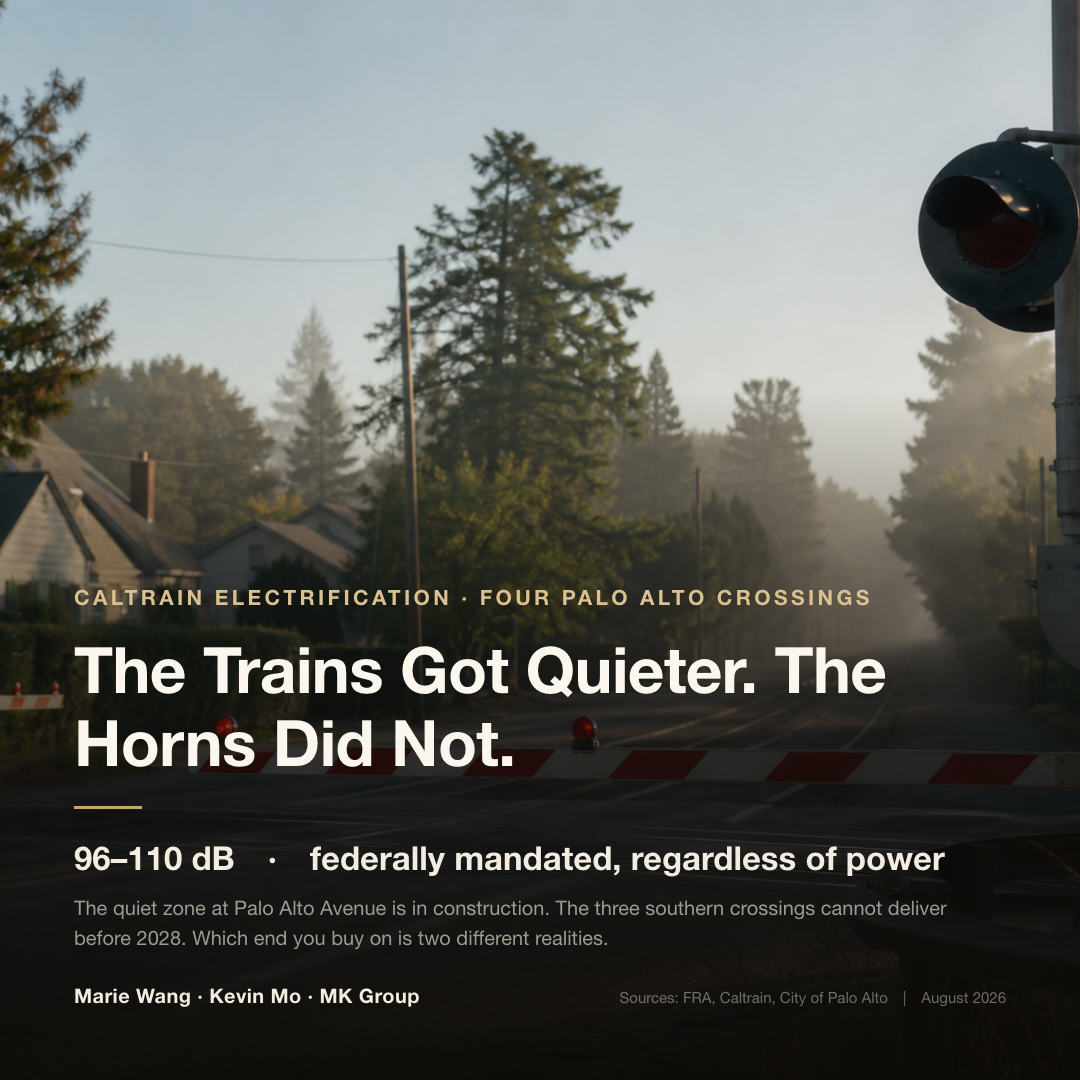
So the intuition that electrification quieted the tracks is inverted. What actually determines whether a home near the line is livable is which crossing it sits near, and what year that crossing's quiet zone is scheduled for. Both of those have concrete answers today.
Who this is for
- Buyers looking along Alma Street or Park Boulevard. The tracks hug Alma for nearly its entire length, and this is the corridor the horns actually reach.
- Anyone weighing an offer on a specific near-track home. The four crossings are on very different timelines, which shapes the next two to four years of living there.
- Families buying here primarily for the Caltrain commute. Service genuinely improved — count the cost that came with it.
- Current owners near the tracks weighing when to sell. Quiet zone and grade separation progress is the key local variable for the next several years.
Three things that decide the answer
One: electrification moved three variables, and only two moved your way
The trains are quieter. That part is real. The first Stadler electric multiple units entered passenger service on August 11, 2024, with the fully electric timetable taking over on September 21. The modernization program cost $2.44 billion and delivered a fleet of 19 seven-car double-deck EMUs. Officials and press agree the new sets are significantly quieter than the diesel fleet — quiet enough that Caltrain now warns the public to take extra care at crossings, because an approaching train is harder to hear.
The air quality improvement was measured. A UC Berkeley team publishing in Environmental Science & Technology Letters found that passengers' in-carriage black carbon exposure fell by an average of 89% after electrification. The researchers' comparison: the diesel-to-electric transition took only a few weeks, yet the drop in black carbon at the station matched what California cities achieved through thirty years of clean air regulation.
The horns did not change, and they sound more often. Under Federal Railroad Administration rules, trains must sound the horn approaching a public crossing, at between 96 and 110 decibels; eleven pedestrian-only crossings along the Palo Alto corridor carry the same requirement. The only lawful way to stop routine horn soundings is to establish a quiet zone — an FRA-recognized segment at least half a mile long, within which trains stop sounding the horn as a matter of routine (emergencies still warrant it). One modest improvement is worth knowing: since December 2024, Caltrain has turned the EMU horns down to 96–97 decibels, at the bottom of the federal range.
One more thing that gets missed: Union Pacific freight still runs diesel through here at night. Not many trains, but concentrated in the overnight hours.
Two: four crossings, four different timelines
Palo Alto has four remaining at-grade crossings, all cutting across the Alma Street corridor — from north to south, Palo Alto Avenue, Churchill Avenue, E. Meadow Drive and Charleston Road. Their situations differ sharply, and this is the section to take away.
Palo Alto Avenue, the northernmost, is furthest along. Its quiet zone design is complete and construction has begun — raising and lengthening the crossing's median, adding curbing and signage (this crossing does not require new gates). The city council approved a $3.8M construction contract covering the work on June 2, 2025. Once built, the city still has to complete a formal notification process with Caltrain and the FRA before it takes effect. Reporting in November 2025 anticipated summer 2026; as of mid-July 2026 no report had confirmed it formally in effect. Verify the current status before you close.
The three southern crossings are much further out. On November 12, 2025, the council voted 5–0 to install quad gates (full-closure type) at Churchill, E. Meadow and Charleston to meet quiet zone standards, rejecting the faster and cheaper wayside horn alternative because it still generates noise. Budget is $4.1M to $5.6M, construction is estimated at 32 to 50 months, and CPUC and FRA approvals are still required. That puts horn relief beyond 2028 in the best case.
Grade separation is a slower track still. On December 15, 2025 the council selected approaches for three crossings: a partial underpass at Churchill (lowered west of Alma, existing grade to the east, converting the intersection to a T), a hybrid at E. Meadow (raised track plus lowered roadway), and an underpass at Charleston (roadway under both the tracks and Alma). Only 15% concept design is complete. Next comes 35% design and the start of environmental review, which must finish before October 2027 to meet a funding deadline. Current funding stands at $20M — far below the construction cost. The council was due to give feedback on the refined design in summer 2026; no outcome had surfaced as of this research.
Churchill carries one unresolved variable. The crossing sits directly beside Palo Alto High School, and after a death near the crossing in February 2026 (per city council and school district public records) the school district's superintendent publicly called for closing it permanently. The city subsequently added high-visibility signage and a Rail Sentry AI camera system at those three crossings, and approved roughly $1.7M for 24-hour staffed monitoring at all crossings, cost-shared with the district. As of mid-March 2026 the council was still weighing the safety case against traffic displacement. The analysis was expected to conclude within 60 days; no public final decision had surfaced by the time of this research, so confirm the council's latest action before closing. For a buyer that means this crossing may close, and local traffic patterns would redistribute if it does.
Three: more frequent service cuts both ways
For commuting it is a clear gain. Under the weekday timetable effective January 31, 2026 (the official figure is 104 weekday trains), Palo Alto (University Avenue) is a stop for the line's regular service classes, with four trains per hour in each direction at the morning and evening peaks. Weekend service now runs every 30 minutes at all stations, against hourly before electrification.
For living there, the same fact runs the other way: more trains means gates down longer and horns sounding more often. The city's Connecting Palo Alto project material puts gate down time at roughly 9 minutes per peak hour, or 15% of it, and states that under Caltrain's selected moderate-growth service scenario that figure would rise 137% above current levels. Those numbers come from city material; the PDF could not be opened directly during this research and the figures were taken from a search summary, so treat the city's original document as the authority.
The numbers: service frequency and the four crossing timelines
Start with the headline. About 104 trains stop at the main Palo Alto station each weekday, four per hour in each direction at peak. Of the four at-grade crossings, only the northernmost — Palo Alto Avenue — has a quiet zone in construction; the quad gates at the three southern crossings are estimated at 32 to 50 months, which puts horn relief no earlier than 2029. That gap is the difference between buying on the north end of Alma Street and the south end — a difference in municipal project scheduling, not a judgment about either end of the corridor. One price anchor for context: near-track single-family homes in Palo Alto still transact above $3M; this corridor's noise variable does not move the price band, it moves the experience of living there.
| Crossing (north to south) | Quiet zone status | Grade separation approach | What a buyer should expect |
|---|---|---|---|
| Palo Alto Avenue | Design complete, in construction; $3.8M contract approved June 2025 | — | May already be horn-free or close to it; confirm formal effect before closing |
| Churchill Avenue | Quad gates, approved 5–0 in November 2025 | Partial underpass (lowered west of Alma, T intersection) | Horns beyond 2028 in the best case; the crossing itself may be closed permanently |
| E. Meadow Drive | Quad gates, same decision | Hybrid (raised track plus lowered roadway) | Same; construction itself will also be disruptive |
| Charleston Road | Quad gates, same decision | Underpass (roadway under tracks and Alma) | Same |
Read the southern budget and schedule together. The quad gates carry a $4.1M–$5.6M budget over 32 to 50 months and still need CPUC and FRA approval, while grade separation is only at 15% concept design with $20M in hand ($14M from VTA Measure B plus a $6M FRA grant) against a far larger construction cost. Neither is imminent. If you are buying near the tracks in south Palo Alto, the working assumption should be that horns continue for the next two to four years — and the safer move is to price that into how you will live there, not to assume the seller has already priced it into the ask.
What MK Group looks for on site: a midday visit tells you nothing
Homes near the tracks are one of the few categories that have to be verified at specific hours — and most showings happen midweek afternoon or on a weekend, which is exactly when this line is at its quietest.
The timetable explains why. Off-peak, roughly 9:30am to 3pm, each direction runs 2 trains an hour — one every half hour. At the morning peak it is 4 per hour per direction, close to 8 movements an hour across both directions, including express trains that do not stop. The quiet you hear standing in the yard at 2pm on a Wednesday is not the same house at 8am.
Marie Wang and Kevin Mo tell Peninsula buyers to see a near-track listing twice, at named hours: once on a weekday between 7 and 9am, and once after 10pm or between 5 and 6am. The overnight visit matters because diesel freight still runs then, and residents have told local press that horns continue into the early hours. One resident figure is worth citing with care: while campaigning for a quiet zone in 2025, south Palo Alto residents described horns sounding 832 times a day between 5am and 1am — a resident estimate derived from train counts multiplied by soundings per crossing, not an official measurement, and it should be presented that way.
If the Caltrain commute is your main reason for buying here, the commuting side of the math is worked through in our piece on where dual-workplace couples should land on the Peninsula.
Common Misconceptions
"It went electric, so the tracks are quiet now"
The trains themselves did get much quieter, but the dominant noise inside a nearby home is the horn, not the train. Horn soundings are federally mandated at 96 to 110 decibels regardless of motive power. The only lawful exemption is a quiet zone, which requires the crossing's safety infrastructure to meet the federal standard, and the city to apply for the zone and accept the liability. The question to ask about a near-track home is not whether the trains are electric — it is whether that crossing's quiet zone has been approved.
"The quiet zone is coming soon, so it will sort itself out"
That depends entirely on which crossing. Palo Alto Avenue at the north end is in construction and is the only one close to done. The quad gate approach adopted for Churchill, E. Meadow and Charleston runs 32 to 50 months and still needs CPUC and FRA sign-off, putting relief beyond 2028 even on the optimistic path. Confirm which crossing you are actually near before treating "soon" as a reason to buy.
"More frequent service is purely good news for me"
It is a gain for commuting and a cost for living. More trains means gates down longer and horns more often — the city's figure is about 9 minutes of gate down time per peak hour, 15% of it, rising 137% under the moderate-growth service scenario. These are two consequences of one cause, and they belong in the same decision.
"I visited on the weekend and it was fine"
Weekends and midday are precisely this line's quietest periods. Off-peak runs 2 trains per hour per direction against 4 at the morning peak, close to 8 movements an hour across both directions, plus overnight diesel freight. A quiet Wednesday afternoon supports no conclusion at all — a near-track listing has to be visited once at the morning peak and once overnight.
"The grade separation designs are settled, so construction must be close"
The council did select approaches for three crossings in December 2025 — partial underpass at Churchill, hybrid at E. Meadow, underpass at Charleston — but that is 15% concept design. Next comes 35% design and environmental review, which has to conclude before October 2027 to meet a funding deadline, against $20M in hand versus a far larger build cost. There is a long distance between a selected approach and a groundbreaking.
What to do next
- Measure the straight-line distance from the house to the nearest crossing. A quarter mile is the audibility radius commonly used in FRA quiet-zone literature; actual reach varies with terrain, orientation and intervening buildings, so trust what you hear on site. Alma Street, which the tracks hug, and Park Boulevard to the south are the most exposed.
- Establish exactly where that crossing's quiet zone stands. The north end and the three southern crossings are years apart. The city transportation department's quiet zone project pages carry current status — confirm formal effect before closing.
- Visit twice, at fixed hours. Once on a weekday between 7 and 9am, once after 10pm or between 5 and 6am. Off-peak and weekend impressions do not count.
- Read what the seller's disclosure says about rail noise. It appears in the disclosure packet, and it is worth reading before you price your offer rather than during the review period — the same packet carries the natural hazard page, whose logic is worked through in our Palo Alto flood zone guide.
- If the home is near Churchill, price in the possibility that the crossing closes. No final decision has been made, but if it happens local traffic redistributes — whether that helps or hurts you depends on which side you live on.
- If you already own near the tracks: routine horn relief at the three southern crossings is beyond 2028 in the best case, so horns will still be there when you list in the next two to four years. The pricing and timing framework is in our complete guide to selling in Palo Alto.
This article organizes public information for decision-making purposes and is not investment or engineering advice. Service levels, crossing schedules, quiet zone effective dates and grade separation approaches can all change; before closing, rely on Caltrain's current timetable, the City of Palo Alto transportation project pages, and the seller's disclosure as they stand at that time. The gate down time figures (9 minutes, 15%, a 137% increase) come from the city's Connecting Palo Alto project material; at the time of writing that PDF could not be opened directly and the numbers were taken from a search summary. The "832 times a day" figure is a resident estimate submitted in a municipal proceeding, not an official measurement.