Direct answer
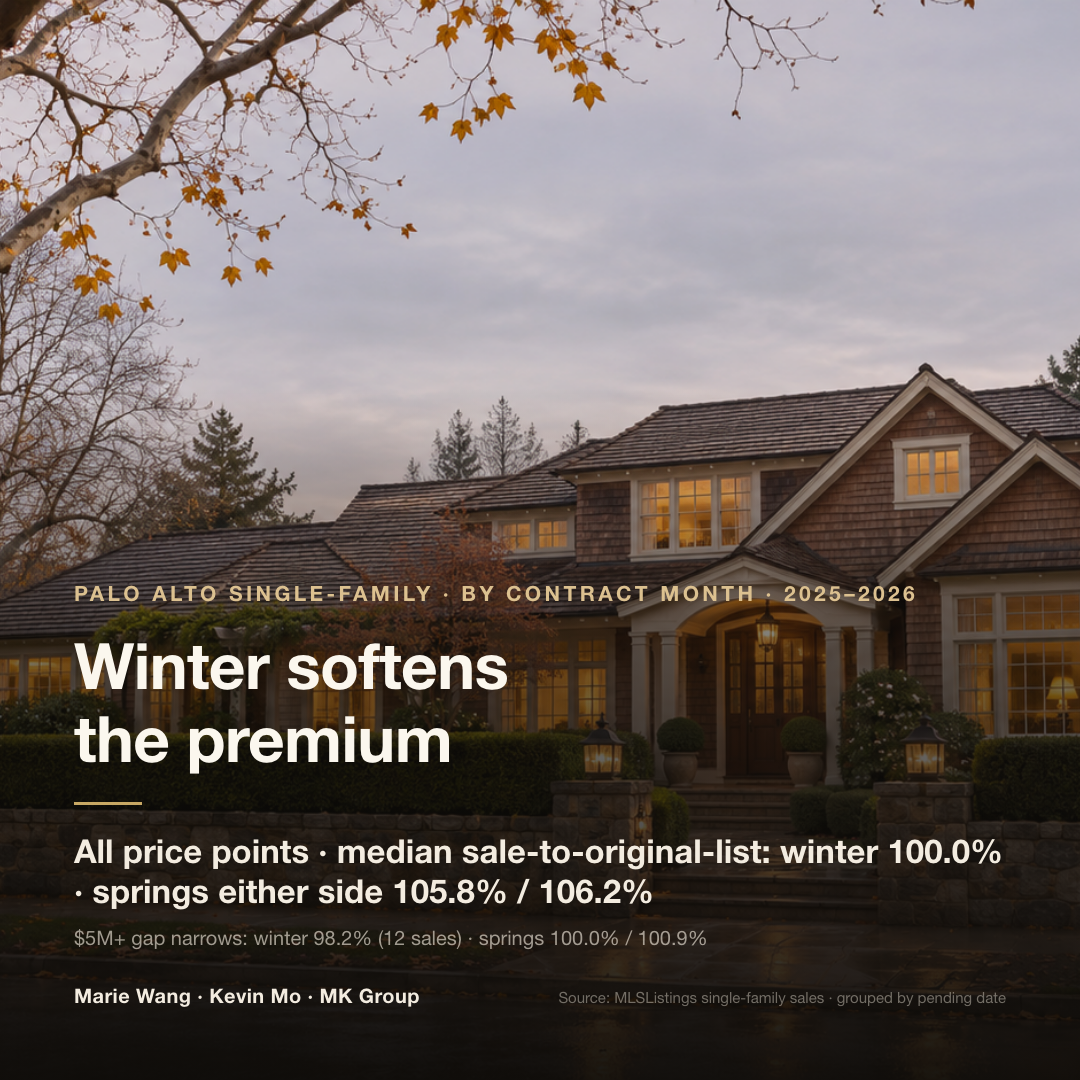
Yes, but what you save is the premium, not the price. Palo Alto single-family homes at all price points that went under contract in November–December 2025 sold at a median 100.0% of original list price, against 105.8% and 106.2% in the springs on either side (MLSListings).
Above $5M, winter still trims the premium, but by much less. Palo Alto single-family homes that sold for $5M or more and went under contract in November–December 2025 closed at a median 98.2% of original list (12 sales, a small sample), against 100.0% and 100.9% in the two springs (23 sales each). That seasonal gap of about 2–3 points is clearly smaller than the roughly 6-point gap across all price points. The $5M+ tier across 11 Peninsula and South Bay cities moved the same way: contracts signed in November 2025 had a median of 98.3%, and those signed in February and March 2026 had 101.9% and 101.6%. In Atherton and Los Altos Hills, winter contracts had medians of 97.9% and 95.6%.
Good homes still come to market in winter, and they still draw competition. In the same winter, single-family homes across the 11 cities that went under contract within two weeks of listing sold at a median 106.4% of original list, almost exactly where spring sits. What pulls the winter median back to 100% is the homes that sat for more than a month, cut their price, or carried over from the fall. The cost is choice. In all of December 2025, the 11 cities logged only 77 contracts, about a third of March 2026's 220.
Who this article is for
- Families with a budget of around $5M or more, touring single-family homes in Palo Alto, Menlo Park, Los Altos, Cupertino or Saratoga, who were outbid once or twice in spring and are thinking about buying at year-end instead
- Buyers looking at homes from $5M into eight figures in Atherton or Los Altos Hills who want to know how much extra negotiating room winter actually gives them
- Cross-border and out-of-state buyers who can only fly into the Bay Area for a concentrated round of tours over Thanksgiving or the Christmas holidays
- Families with a flexible move-in date who can place their contract anywhere between November and the following January
Three dimensions that decide the answer
"Will buying in winter save me the premium?" breaks into three questions. Is winter's lower premium caused by the season, or by a market that is weakening? Which homes does the lower premium actually land on? And how large is the seasonal effect in your price tier and your city?
Dimension one: count by contract month, and set one winter between two springs
Price gets negotiated at the moment a home goes under contract (pending). Closing comes later. Across the 11 Peninsula and South Bay cities covered here (Palo Alto, Menlo Park, Atherton, Los Altos, Los Altos Hills, Cupertino, Saratoga, Hillsborough, Woodside, Portola Valley and Burlingame), the median time from contract to close in the three periods compared was 21 days. Counting by closing quarter blends two seasons together. The 98 Palo Alto single-family homes that closed in Q4 2025 sold at a median 102.8% of original list price (MK Bay Area Pulse), but about seven in ten of them went under contract between August and October. So every comparison in this article groups sales by the pending date recorded in the MLS (PendingDate), and counts only single-family homes that ultimately closed.
The second step is ruling out a market that is simply getting weaker. Compare winter 2025 only with spring 2026, and you can't tell whether the gap comes from season or from a market that strengthened. Put the winter between the springs on either side, and the answer is clear. Palo Alto contracts signed in February–March 2025 had a median of 105.8%, with 68% selling above original list. In November–December 2025 that fell to 100.0% and 50%. In February–March 2026 it was back at 106.2% and 74%. The two springs are nearly level, so the dip between them is seasonal.
One more point: winter is not the only low. Across the 11 cities, contracts signed in July and August 2025 had medians of 100.0% and 99.5%, and June 2026 was also 100.0%. The more precise statement is that February–March is the year's highest-premium contract season, and midsummer and year-end are the two lows. For how sellers can use this rhythm to time a listing, see When to Sell in the Bay Area: A Three-Dimensional Framework Across Season, School Cycle, and the Rate Window. This article covers only the buyer's side.
Dimension two: which homes the winter "discount" actually lands on
A winter median of 100.0% doesn't mean every home can be bought at list. Of the 206 single-family homes that went under contract across the 11 cities in November–December 2025, 112 (54%) did so within two weeks of listing. Those sold at a median 106.4% of original list, 80% of them above it, almost identical to the 106.8% for the same kind of home in spring 2026. Another 73 (35%) sat for more than 30 days before going under contract. Their median was only 92.4%, and just 7% sold above original list. By February–March 2026, homes on the market more than 30 days made up only 12% of contracts (47 of 379).
In other words, the winter median falls mainly because stale listings rise from just over a tenth of contracts to more than a third. The homes that go under contract within two weeks carry no smaller a premium than in spring. Price-reduced homes tell the same story: 43 winter contracts (21%) had been reduced, and they closed at a median 89.9% of original list; in spring 2026 there were only 18 reduced homes (5%). Palo Alto on its own has the same structure. Its 26 winter contracts signed within two weeks of listing had a median of 106.4%, and the 12 that had been on the market more than 30 days had a median of 90.6%. How to read days on market and price-cut history to decide whether to bid up or negotiate down on a given home is covered in I'm Buying a $3M–$6M Single-Family Home in Palo Alto, and Everyone Else Is Bidding Over Asking — Should I Join In or Negotiate Down?, so it isn't repeated here.
Dimension three: the winter effect varies sharply by price tier and city
Above $5M, the seasonal gap in the median is smaller than the market overall, but the share of homes closing below list climbs noticeably. Start with Palo Alto. Of the single-family homes that sold for $5M or more, 12 went under contract in November–December 2025, at a median 98.2% of original list, and 7 of them closed below original list. In each of the two springs, 23 went under contract, at medians of 100.0% and 100.9%, with 9 below original list each time. Palo Alto's winter-to-spring gap of about 6 points across all price points narrows to 2–3 points in this tier. Widen the lens to the 11 cities, with the tier defined as a sale price of $5M or more. Contracts signed in November 2025 had a median of 98.3% (37 sales), December 100.0% (19), and February and March 2026 101.9% (59) and 101.6% (77). Taken together, 48% of the 56 winter contracts closed below original list, against about a third in each spring (34% and 33%).
Atherton and Los Altos Hills are markets where plenty of homes sell below list in every season. Of the single-family homes that went under contract in 2025, 40 of 79 in Atherton (51%) and 51 of 103 in Los Altos Hills (50%) closed below original list. Winter simply deepens the pattern. Atherton had 11 winter contracts at a median 97.9%, 6 of them below original list; Los Altos Hills had 13 at 95.6%, 8 below original list. Even among the two cities' 31 contracts in February–March 2026, 13 closed below original list. Los Altos went the opposite direction: its 15 winter contracts had a median of 110.1%, higher than the 106.8% and 104.5% of the springs on either side. Fifteen sales is a small sample, and a few underpriced new listings are enough to push the median up, but it does show that winter is not easier everywhere. Cupertino's winter median was 102.3%, with 67% still selling above original list. For how premium levels differ by city over a full quarter, compare How Much Over Asking Do You Need to Win in the Bay Area? 2026 Q1 Premium Rates by City.
The data: winter contracts against the springs on either side
The key numbers first: the 42 Palo Alto single-family homes at all price points that went under contract in November–December 2025 sold at a median 100.0% of original list, with 50% above it. The springs on either side came in at 105.8% (68%) and 106.2% (74%). For Palo Alto homes that sold for $5M or more, winter was 98.2% (12 sales) and the two springs 100.0% and 100.9%, a much smaller gap. The 11 cities combined ran 100.0% in winter and 104.6% in both springs, and winter's 206 contracts were just over half of spring's 360 and 379. Each cell below reads: median sale price to original list price, share sold above original list, number of contracts.
| City / tier | Contracts Feb–Mar 2025 | Contracts Nov–Dec 2025 | Contracts Feb–Mar 2026 |
|---|---|---|---|
| Palo Alto (all price points) | 105.8% · 68% · 76 sales | 100.0% · 50% · 42 sales | 106.2% · 74% · 72 sales |
| Palo Alto, sale price $5M+ | 100.0% · 39% · 23 sales | 98.2% · 25% · 12 sales | 100.9% · 52% · 23 sales |
| 11 cities, sale price $5M+ | 101.0% · 56% · 131 sales | 100.0% · 39% · 56 sales | 101.7% · 60% · 136 sales |
| Atherton | 100.0% · 47% · 17 sales | 97.9% · 36% · 11 sales | 100.0% · 62% · 16 sales |
| Los Altos Hills | 102.0% · 69% · 16 sales | 95.6% · 23% · 13 sales | 98.8% · 47% · 15 sales |
| Menlo Park | 105.9% · 66% · 47 sales | 100.1% · 52% · 27 sales | 105.0% · 73% · 55 sales |
| Saratoga | 104.0% · 72% · 39 sales | 100.0% · 46% · 28 sales | 104.8% · 71% · 49 sales |
| Cupertino | 112.8% · 93% · 43 sales | 102.3% · 67% · 24 sales | 107.1% · 91% · 46 sales |
| Los Altos (counterexample) | 106.8% · 73% · 52 sales | 110.1% · 73% · 15 sales | 104.5% · 63% · 49 sales |
| 11 cities combined | 104.6% · 68% · 360 sales | 100.0% · 49% · 206 sales | 104.6% · 69% · 379 sales |
What to remember: for buyers at all price points in Palo Alto, Menlo Park and Saratoga (where median sale prices across these three contract periods ranged from $3.05M to $4.28M), winter turns a median premium of 4–6 points into roughly list price. Above $5M the gap narrows to about 2–3 points. Palo Alto's winter median in this tier was 98.2%, 1.8 and 2.7 points below the springs on either side, and the more visible winter change at this level is the larger share of homes closing below original list (7 of 12 in winter, 9 of 23 in each spring). Atherton and Los Altos Hills, with higher prices and larger lots, are different again: about half of their 2025 sales closed below original list anyway, and winter only adds to that. The 11-city $5M+ tier behaves the same way, with the below-list share rising from about a third in spring to nearly half (48%) in winter. Palo Alto's $5M+ tier and the winter samples for Atherton, Los Altos Hills and Los Altos are all 15 sales or fewer, so read them for direction. Pricing an offer on a specific home still depends on recent sales of comparable homes in the same neighborhood.
How long the window lasts: late October to mid-January
The key numbers first: split contracts into half-month periods, and every period across the 11 cities from the second half of October 2025 through January 15, 2026 had a median sale price of 100.0%–100.1% of original list. Contracts signed in the second half of January returned to 104.0%, and the first half of February reached 106.5%.
| Contract date (11 cities) | Contracts | Median sale / original list | Share sold above original list | Median days on market |
|---|---|---|---|---|
| Oct 16–31, 2025 | 106 | 100.0% | 49% | 14 |
| Nov 1–15, 2025 | 70 | 100.1% | 53% | 13.5 |
| Nov 16–30, 2025 | 59 | 100.0% | 47% | 12 |
| Dec 1–15, 2025 | 49 | 100.0% | 47% | 11 |
| Dec 16–31, 2025 | 28 | 100.0% | 46% | 31 |
| Jan 1–15, 2026 | 27 | 100.0% | 48% | 9 |
| Jan 16–31, 2026 | 63 | 104.0% | 70% | 9 |
| Feb 1–15, 2026 | 91 | 106.5% | 71% | 9 |
What to remember: in 2025–26 the winter window lasted about three months, and it closed earlier than many buyers assume. The reason is on the supply side. Counting by listing date, among 11-city single-family homes that later sold, only 51 were listed in December 2025, against 152 in January 2026, 177 in February and 242 in March. Once new listings return, buyers return with them, and the premium on contracts signed in the second half of January was back at 104.0%. The second half of December is the period most easily misread. It had only 28 contracts, at a median 31 days on market, which means most of the homes going under contract then were stale listings, and the premium was no lower than in the first half of November. Only the 2025–26 winter can be split by half-month here (contracts from November–December 2024 are excluded because the data is truncated), and each season's window will run a different length, so don't map this one directly onto the current year.
Sources: MLSListings single-family sales records (Santa Clara, San Mateo and Alameda counties), compiled by MK Bay Area Pulse from Q1 2025 through Q3 2026; 34,200 records merged and de-duplicated by MLSNumber, with 1 additional cross-MLS duplicate entry removed; Res. Single Family only; grouped by contract date (PendingDate). Metrics are the median of sale price to original list price (OriginalListPrice), the share sold above original list, and median MLS days on market (DOM); the $5M+ tier is defined by sale price. Updated: November 2026. Scope: 11 cities = Palo Alto, Menlo Park, Atherton, Los Altos, Los Altos Hills, Cupertino, Saratoga, Hillsborough, Woodside, Portola Valley and Burlingame; only single-family homes that ultimately closed are counted, and contracts cancelled after signing are not included; Palo Alto's $5M+ tier has only 23, 12 and 23 sales in the three periods, and Atherton, Los Altos Hills and Los Altos have 11–15 winter sales each, so these show direction only; the full-year baseline for Atherton and Los Altos Hills uses contracts signed January–December 2025; contract months November–December 2024 and September 2026 are excluded because the data is truncated.
What MK Group has seen in practice
MK Group, co-founded by Marie Wang (DRE# 02110980) and Kevin Mo (DRE# 02127623), keeps an anonymized library of real client cases. Three records in it are worth reading against the data: the first two bear on winter touring and on negotiating at the top of the market, and the third shows what happens after the window closes. The first dates from November 2025 (case-006). The family of a China-based business owner, flying in to look at Silicon Valley homes for the first time, had a budget of $7M to $9M-plus. They called in the morning and asked to tour that same day. Within half an hour, Marie Wang had pulled 4 homes from MLS and off-market inventory, in Menlo Park, Palo Alto, Los Altos Hills and Los Altos, and scheduled them from least to most expensive. The clients ended up comparing a $7M-range home in Palo Alto with a $9M-range home in Los Altos. The Los Altos home was built in 2016, with more than 5,000 square feet on a lot of more than 15,000 square feet, and the clients concluded on their own that the $9M home was worth far more. They made no offer on that trip and said they would come back once they were ready (case details). In a month with few listings, half a day spent seeing representative homes across several cities is a good way to learn what a given budget buys in each one, so that decisions come quickly once new listings return.
The second shows that negotiating room at the top of the market is real (case-007, recorded November 2025). An employee of a leading AI company sold pre-IPO shares on the secondary market and bought a Los Altos Hills estate with all cash. Once the team took over the negotiation, it brought the price down by more than $1M from the original ask (case details). Marie Wang discussed the transaction in a video on her YouTube channel, @MarieWang (44K+ subscribers). The case record does not attribute the price difference to the season, and we don't read it that way either. The case review credits three things lining up: a seller who had reached the point of being ready to deal, a buyer whose funds were certain, and the right market window. That points the same way as the data above. Half of the Los Altos Hills single-family homes that went under contract in 2025 (51 of 103) closed below original list, and the share was higher in winter (8 of 13). How much any one deal can take off depends on whether the offer gives the seller confidence.
The third shows what happens once the window has closed (case-010, recorded April 2026). An all-cash buyer with a $10M budget found a benchmark Palo Alto home listed at $10M and wanted to go home and sleep on it for one night. By the next morning, the home was already in contract (case details). The debrief's recommendation: before the next showing, have the inspection, the disclosure review and proof of funds ready, so the time from first seeing a home to being able to sign an offer drops from 24 hours to 4–6 hours. With fewer listings in winter, it's the right season to get that preparation done in advance.
Common mistakes
Mistake 1: "Homes are cheap in winter, so waiting until December gets you 10% off"
Only a minority of homes go for 10% under. Among winter contracts across the 11 cities, price-reduced homes and homes on the market more than 30 days closed at medians of 89.9% and 92.4% of original list. But homes that sit usually sit for a reason, whether pricing, condition or the lot. Good homes that went under contract within two weeks of listing still had a winter median of 106.4%. Price levels themselves barely moved. The median sale price per square foot for Palo Alto single-family homes that went under contract in winter was about $2,005, against about $2,056 and $2,085 in the springs on either side, a difference of only 2.5%–3.8%, and the winter sample contains more stale listings. What winter saves you is mostly the premium; the price of the house itself doesn't come down much. In Palo Alto's $5M+ tier, even the premium saving is only 2–3 points.
Mistake 2: "Anything listed in winter is a home that couldn't sell"
Winter does carry more listings left over from the fall. Of the 206 homes that went under contract across the 11 cities in November–December 2025, 47 had been listed before the end of September, with a median of 89 days on market and a median sale price of only 91.3% of original list. But in the same period, 112 went under contract within two weeks of listing. Good homes listed in winter move just as fast. They usually don't stay on the open market long, and some already have a buyer lined up before they formally list. A Palo Alto seller-side case in the MK Group library (case-025) shows how fast that can be. A home in a gated community, widely considered hard to sell, got a preview video from the team before it formally listed. One buyer reached out right after watching and made an all-cash offer within 48 hours of the showing. There were no open houses, and the sale price was not disclosed (case details). That sale happened in February 2026, when premiums had already recovered, so it isn't a winter contract. It's here to show how quickly a good home can go from preview to contract. If you wait for a good home to stop moving before you act, it has most likely already been signed.
Mistake 3: "Nationally, winter is a buyer's market, so the Bay Area's core cities must be too"
National figures and the Bay Area's core cities sit on different scales. According to NAR's Realtors Confidence Index, only 16% of homes nationwide sold above list price in December 2025, and 14% and 18% in February and March 2026. In the same winter, half of the Palo Alto single-family homes that went under contract sold above original list, as did 67% in Cupertino and 73% in Los Altos. The two sets of figures are measured differently (NAR's is a member survey, based on each responding agent's most recent sale), so compare them only for order of magnitude. But the order of magnitude says enough. "Winter is a buyer's market" holds for the national average. In cities like Palo Alto, Cupertino and Los Altos, winter just means somewhat less competition.
Mistake 4: "Hold off until around Christmas and you'll negotiate the lowest price"
The data doesn't support this. Across the 11 cities, the second half of December 2025 saw only 28 contracts, at a median 100.0% of original list, no different from 100.1% in the first half of November. The homes that went under contract in those two weeks had a median of 31 days on market, so most were stale listings. Waiting until year-end doesn't buy more room to negotiate, only fewer homes to choose from. The real cutoff comes after mid-January: contracts signed in the second half of January 2026 were already back at a median 104.0%.
Next steps
- From the first week of November, pull the active listings in your target cities every week and flag three kinds of home separately: listed before the end of September and still not in contract; price-reduced; on the market more than 30 days. In winter 2025–26, these three groups went under contract at medians of 91.3%, 89.9% and 92.4% of original list. Before you offer, find out why the home has sat (pricing, condition, lot, school boundary), then price from recent sales of comparable homes nearby rather than simply discounting from list.
- For new listings in their first two weeks, prepare by spring rules: in winter these homes still sold at a median 106.4% of original list, with eight in ten going above it. Have proof of funds ready before you tour, read the disclosures the day you receive them, and book any inspections you'll need in advance.
- Schedule your offer before mid-January: in 2025–26, contracts signed before January 15 still had a median of 100.0%; the second half of January returned to 104.0%. If what you're waiting for is the new listings after New Year (three times as many homes were listed in January 2026 as in December), budget for a bidding environment.
- Use Thanksgiving and the Christmas holidays for homework: a month with few listings is a good time to spend half a day touring representative homes across several cities and settle what your budget buys where, so that when spring listings arrive, you can decide the same day.
- In Atherton, Los Altos Hills and the $5M+ tier, look at the full year before you look at winter: about half of the single-family homes that went under contract in these two cities in 2025 closed below original list, and Palo Alto's $5M+ tier showed a winter-to-spring gap of only 2–3 points. Check how many comparable homes in your target neighborhood closed below original list over the past year, then judge how much of winter's negotiating room comes from the season and how much the market already had.