Quick Answer
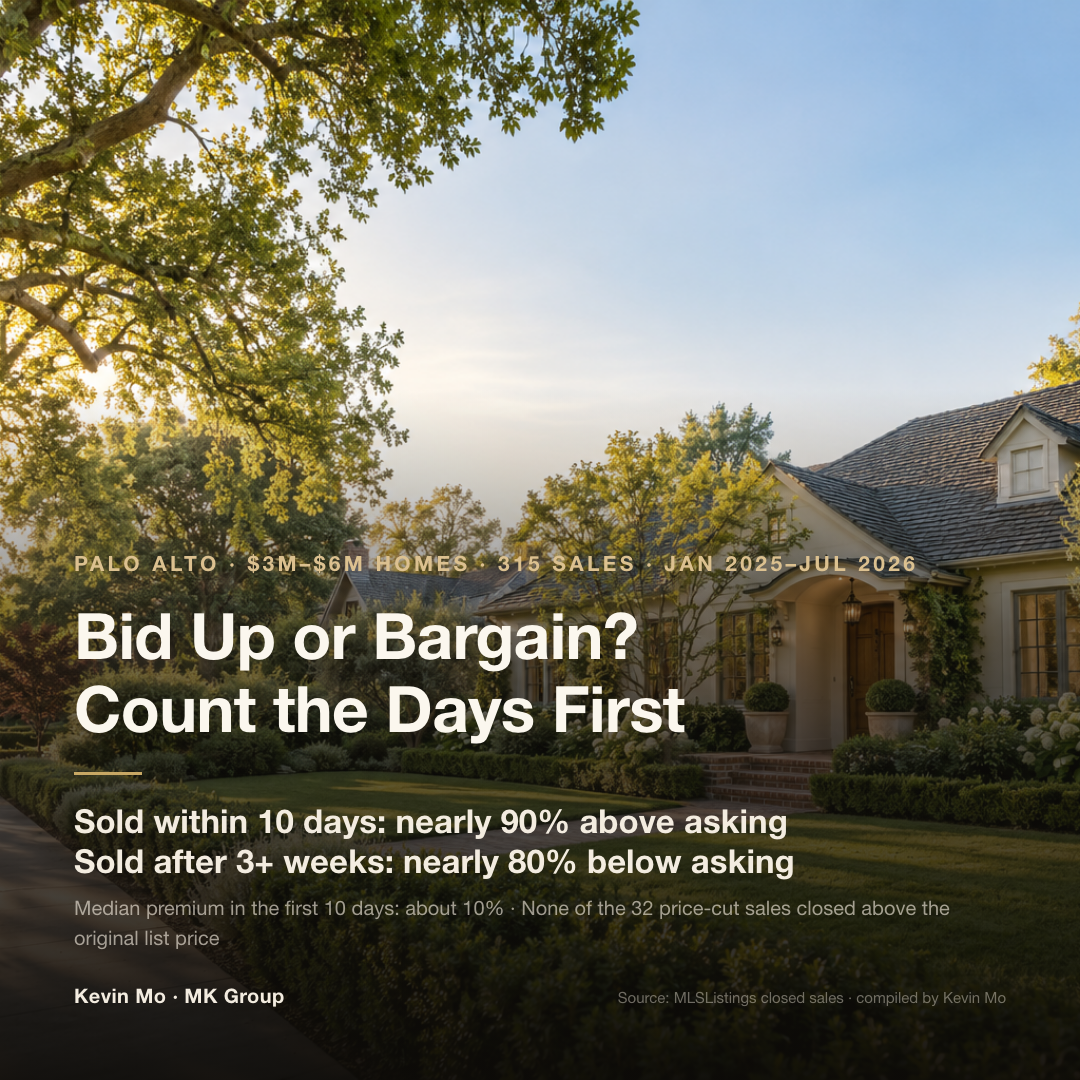
Check how long the home has been on the market before you decide. Among Palo Alto single-family homes between $3M and $6M, nearly 90% of those that sold within 10 days of listing closed above asking, while nearly 80% of those that sat past three weeks closed below it. The list price reflects the seller's strategy. Anchor your offer on what comparable homes nearby have actually sold for.
That is the core of an October 2026 video by Kevin Mo (DRE# 02127623), co-founder of MK Group, on his YouTube channel (@KevinMoRE, 24K+ subscribers). When you bid in the Bay Area, the list price is the number to take least seriously. What decides whether to compete or negotiate is how long the home has been on the market, and whether the market has already turned that price down.
Who this article is for
- Buyers looking at $3M–$6M single-family homes in Palo Alto or Los Altos who can't tell whether to bid over asking or push the price down
- Buyers whose target home has passed its offer date, had a price cut, or been withdrawn and relisted, and who want to know how far they can negotiate
- Buyers shopping for a townhome or condo in Cupertino or San Jose
- Buyers bidding in Atherton and other estate communities who need to tell a home worth negotiating hard on from one worth securing decisively
Three core dimensions
Dimension one: days on market says more about a home's position than its list price
When a home has just come on the market and several buyer groups are writing offers within the first week, a low offer won't even earn a counteroffer. The seller has better options on the table, and no reason to engage.
The reverse is just as true. A Palo Alto home still unsold after three weeks has already been marked down once by the market, whether or not the list price admits it. Offer at asking, or above it, and you may well be the buyer who overpays.
In the 315 sales Kevin pulled, the dividing lines fall at roughly day 10 and the three-week mark. Before day 10, the competition is real. After three weeks, leverage has moved to the buyer. In between, most homes still sell above asking, but by a thin margin, which means there is room to talk.
Dimension two: the list price is a pricing strategy, so anchor on comparable sales
A median premium of about 10% is not a formula. Among Palo Alto homes that sold within 10 days, 30-plus sold essentially at asking, while another 30-plus went for 20% or more over. The difference is listing strategy.
In Palo Alto, the South Bay and Berkeley, pricing a home low to draw a bidding war is common practice. More than half of the single-family homes that closed in Berkeley in July 2026 sold for 30% or more over asking. Other sellers simply list at market value, and their price is already transparent.
So the first question is what comparable homes nearby have sold for recently. Say similar homes in the neighborhood have been closing around $4.5M. A home listed at $3.99M that you bid up to $4.5M is fairly priced. If the same home were listed at $4.5M and you added 10% out of habit, you would be overpaying by more than $400,000.
Dimension three: has the market already turned this price down?
Days on market alone isn't enough. Three further signals tell you whether the asking price has already been rejected.
The first is an offer date that has come and gone with the home still available. The offer date is the day the listing side sets for reviewing offers. If the home is still on the market afterward, the seller didn't receive an offer they were willing to take.
The second is a price cut, a withdrawal and relist, or a previous escrow that fell through. Of the 315 Palo Alto sales at this price, 32 had a price cut. Not one of them sold above its original list price, and their median sale price came in more than 8% below it.
The third is a hard drawback in the home itself: road noise from a busy street, a lot that's awkward to use, an odd floor plan, or a house that needs a major renovation after purchase. The more of these signals stack up, the more room you have to negotiate.
The numbers: Palo Alto $3M–$6M single-family sales by days on market
The short version: Palo Alto single-family homes between $3M and $6M recorded 315 sales from January 2025 through July 2026. Nearly 90% of those that sold within 10 days of listing closed above the original list price, at a median premium of about 10%. Nearly 80% of those that sold after more than three weeks closed below it. And of the 32 that had a price cut, none sold above the original list price.
| Days on market | Sale price vs. original list price | What it means for your offer |
|---|---|---|
| Sold within 10 days | Nearly 90% above asking; median premium about 10% | Competition is real; a low offer usually won't even draw a counteroffer |
| Sold in weeks 2–3 | Most still above asking, but by a thin margin | Room to negotiate begins to open |
| Sold after 3+ weeks | Nearly 80% below the original list price | The market has already marked the price down once for you |
| The 32 of 315 with a price cut | None above the original list price; median more than 8% below | The original price has already been rejected |
Basis: MLSListings single-family closed sales, compiled by Kevin Mo. Medians and shares are grouped by days on market within this price band and are directional only; for any individual home, recent comparable sales nearby govern. Los Altos follows the same pattern at this price, on a smaller sample.
What matters most: in the same city and the same price band, days on market can point your offer in opposite directions. The 10% median premium in the first group blends homes that sold right at asking with homes that went 20% or more over. It tells you competition exists, not how much you should add. The 32 price-cut sales are more direct still. The market has already turned down the original price once; offering it again means handing back the 8-plus points the market has already taken off. The same pattern holds for $3M+ single-family homes across three Bay Area counties (see My $3M+ Bay Area Home Has Had No Offers After Two Weeks — If I Cut the Price, How Much of the Original List Price Will I Get?).
Townhomes and condos: the same logic, a different pace
The short version: two years ago, townhomes in Cupertino and San Jose sold in a median of 8 days. This year they take 19, and sale prices have gone from clearly above asking to only slightly above. In Cupertino, the median condo price this year is still about 6% below where it stood in 2022.
| Metric | Two years ago | This year (2026) |
|---|---|---|
| Median days to sell, Cupertino and San Jose townhomes | 8 days | 19 days |
| Townhome sale price vs. list price | Clearly above asking | Only slightly above |
| Cupertino median condo price | — | About 6% below 2022 |
What matters most: with townhomes and condos, days on market matters even more. Condos are the easiest homes to price-check, because you can see what similar units in the same building, with similar square footage and layouts, have sold for recently. If the open houses are done, the offer date has passed and there still isn't a single real offer, there is no reason to bid against yourself.
Two extremes at the top: one Atherton home sold $6.75M under its original ask, another $3.2M over
Kevin Mo cites two Atherton sales in the video. Both are public market closings, not MK Group transactions, and together they carry the same logic into eight figures.
The first was originally listed at a little over $34 million. The price was cut once, the home sat for 70 days in all, and it finally sold for $6.75 million less than the original ask. A price cut and a long stay on the market: every signal described above was present, and the buyer had every reason to negotiate hard.
The second was listed at $18 million, went pending in four days, and closed $3.2 million over asking. The house itself was built in 1922 and has only about 1,600 square feet of living space. What buyers were competing for was the land beneath it: nearly 80,000 square feet, close to 2 acres, a parcel that would be very hard to find a second time in Atherton. A multimillion-dollar premium at this level can look reckless. In practice, it is buyers competing for an opportunity with almost no substitute.
Four questions, three situations: when to compete and when to negotiate
Everything above comes down to four questions. How long has the home been on the market? Was there a real offer after the offer date? Are there comparable alternatives nearby? Has the seller cut the price, or withdrawn and relisted? The first two tell you whether the market has already turned this price down. The last two decide how far you can push.
- Just listed, no real alternatives, several groups competing: Kevin doesn't advise opening with a low offer. The competition is real.
- Listed three weeks, price already cut, similar homes still for sale nearby: he doesn't advise offering at the list price. The market has already negotiated a round for you.
- Listed two weeks, buyers touring but no offers: find out first whether any other offers are in play, then decide how much to offer.
What MK Group sees on the ground: worth buying doesn't mean worth any price
The team led by Marie Wang (DRE# 02110980) and Kevin Mo has done both: competed hard for homes, and negotiated hard on them. The deal Kevin mentions in the video is a Saratoga estate the team recently bought on behalf of a client. After 12 days of price negotiation, it closed at a little over $12 million, more than $1 million below the seller's original price.
The client never came to the Bay Area to see the home and bought through a family office. What they were really buying was the team's judgment on the ground. So the team did the opposite of selling the house: it laid out the drawbacks in full. The lot, the natural light, the distance to the neighbors, backyard privacy, surrounding noise, how the floor plan works day to day, and how readily the market would accept the home at resale were all weighed together. The conclusion was that the home was worth buying, but worth buying doesn't mean worth any price. That is where the 12 days of negotiation came from.
The case record doesn't say how long that home had been listed or whether its price had been cut, so we won't force it into the signal framework above. What carries over is the order of operations: decide first whether a home is worth buying, then decide, separately, what it is worth.
Common Misconceptions
Misconception 1: "Everyone is bidding over asking, so if I don't, I'll never get a house"
Over-asking bids are concentrated among homes that sell within 10 days. At the same price, nearly 80% of the homes that sat past three weeks sold below the original list price. Look at how long this particular home has been on the market before deciding whether to follow the crowd.
Misconception 2: "The median premium is about 10%, so adding 10% to the list price is safe"
Behind every list price is a pricing strategy. For a home priced low on purpose, 10% may not be enough; for a home listed at market value, another 10% is simply overpaying. The anchor is recent comparable sales nearby, not the list price.
Misconception 3: "That townhome sold $200,000–$300,000 over asking, so the buyers overpaid"
This year, Cupertino and San Jose townhomes have generally sold only slightly above asking. One that still went $200,000–$300,000 over was most likely just listed low. Pull recent sales of the same floor plan nearby and compare before you draw a conclusion.
Misconception 4: "A multimillion-dollar premium on a luxury home means the buyers lost their heads"
The Atherton home that sold $3.2 million over asking was a 1,600-square-foot house built in 1922. The buyers were paying for a lot of nearly 80,000 square feet with almost no substitute. How far over asking a luxury home goes depends on how many alternatives exist.
Next steps
- Check the listing date and price history first. How long the home has been listed, whether it has had a price cut or been withdrawn and relisted, and whether a previous escrow fell through are all in the listing record.
- Pull recent comparable sales nearby to set your anchor. Same floor plan, similar square footage and lot. Look at what those homes actually sold for, rather than multiplying the list price by a percentage.
- Confirm the competition both before and after the offer date. Have your buyer's agent ask the listing side whether other offers are in, and how many groups are writing.
- List the drawbacks and put a cost on each. Road noise, lot shape, floor plan and the renovation the house will need: each one is a basis for negotiation.
- Run the four questions, then make your offer. Whichever situation the home falls into, use the approach that fits it.