Direct answer
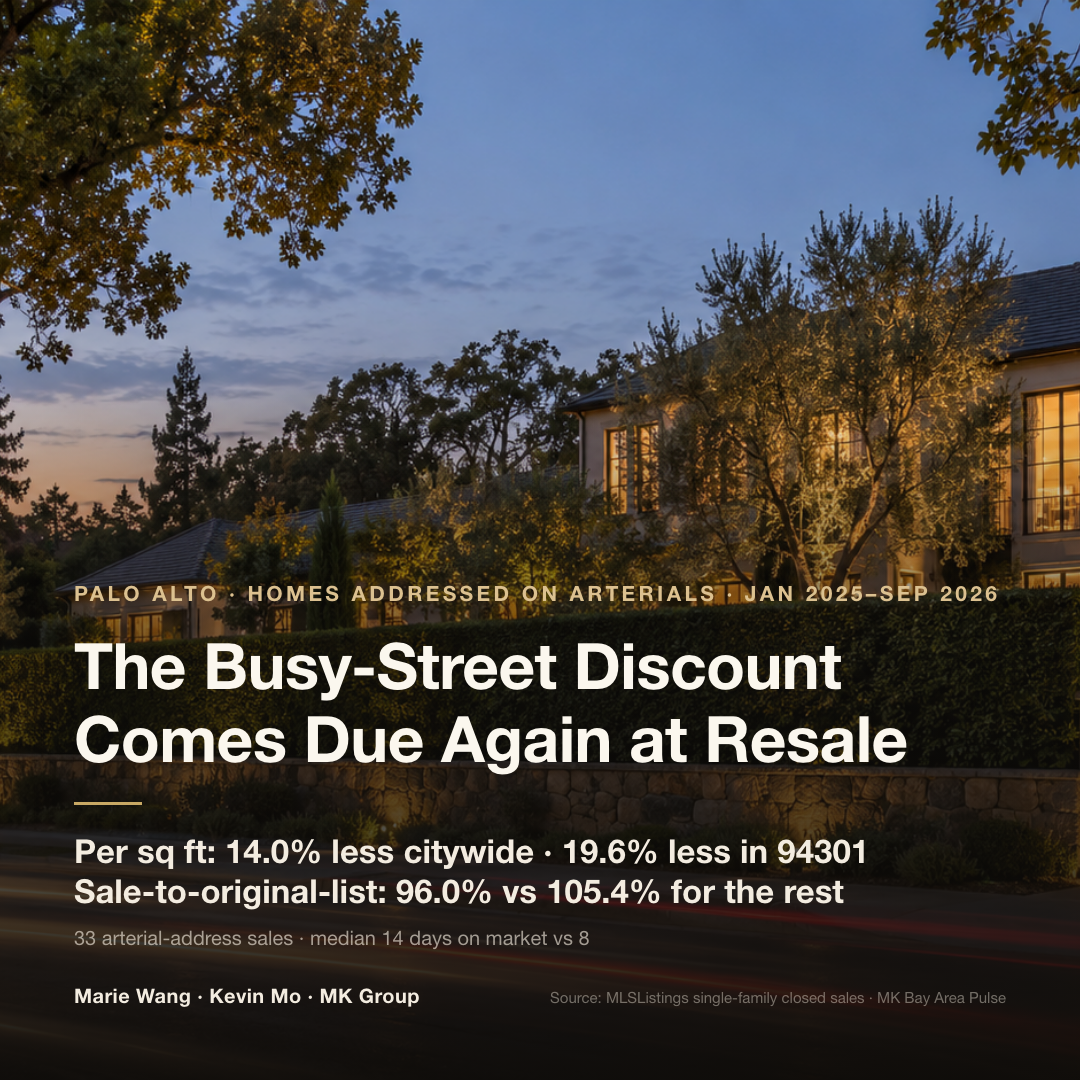
From January 2025 through September 2026, single-family homes in Palo Alto with an address on a major arterial sold for a median 14.0% less per square foot than the rest of the city, and 19.6% less within ZIP code 94301.
Whether it is worth buying depends on whether you can live with handing the same discount back when you sell. The home will sell, but more slowly and with less bidding. Across these 33 arterial-address sales, the median closed at 96.0% of original list price, against 105.4% for the city's other single-family homes. Median time on market was 14 days, against 8. 39% sold above original list, against 68% for the rest (MLSListings raw closings used by MK Bay Area Pulse, single-family homes, deduplicated by MLS number).
So the 10–20% is the price the market sets on a drawback that cannot be removed. Acoustic windows and a wall can improve indoor noise and the view from the front yard. The driveway, the guest parking and the traffic at the door stay put, and the next buyer will mark them down at the showing just as you did. Priced as a saving on the way in that you give back on the way out, the discount is fair.
Who this article is for
- Buyers who have found a Palo Alto home whose front door faces an arterial such as Middlefield Road, University Avenue or Embarcadero Road, listed well below the neighborhood in total price or per square foot, and who want to know whether the gap is fair
- Families shopping in the $4M-to-$5M-plus range around Crescent Park, Community Center and Professorville (94301) who notice that the same budget buys a few hundred more square feet on a main road
- Buyers who plan to sell or trade up in five to ten years and want to price the resale gap and the extra time on market before they make an offer
- Buyers looking at $10M-plus estates in Atherton or Menlo Park where the front door faces Middlefield Road or El Camino Real, who want to know what this markdown turns into at that price point
Three dimensions that decide whether the discount is fair
One: how big the discount is, and whether something else is inflating it
Compared citywide, the 33 arterial-address sales had a median $1,802 per square foot, against $2,094 for the other 669, 14.0% lower. A citywide comparison carries two distortions. Arterial sales cluster in a few ZIP codes, and ZIP codes carry their own price levels. Price per square foot also moves with size: smaller homes usually run higher per square foot, larger homes lower. Our article on what your home is worth after the house next door sold for $10M works through this; in its adjustment table, the busy-road line read "not yet quantified." This article supplies that number.
So two narrower cuts matter. Within ZIP code 94301 alone, the gap is 19.6%. Among homes of 1,200 to 2,000 square feet only, it is 10.4%. All three cuts land between 10% and 20%. With location and size held closer, the discount does not go away, and that is what makes it credible.
Two: what the discount buys, separating what you can fix from what you can't
A front door on an arterial shows up in daily life as a handful of specific things, and they fall into two groups.
What money can improve: indoor noise with the windows shut (acoustic windows, door and window seals, wall assemblies); sightlines and privacy in the front yard (a wall or hedge, at a height the city's rules allow); the bedroom layout (moving the main bedrooms to the side away from the street, at the cost of structural work).
What it cannot: every drive out of the driveway has to merge into arterial traffic. Guests can only park on the street, so getting out of the car, crossing the road and turning around after overshooting all happen in traffic. There is not enough curb parking when you host. And the traffic noise in the front yard and at the door remains. The first group is a renovation budget. The second is a property of the lot, and the next buyer will see it at the showing too.
Three: at resale the gap is still there, and the sale takes longer
The discount you take on the way in will most likely be given back on the way out. The 14% per-square-foot gap is itself the price these 33 sellers received. Closing at 96.0% of original list against 105.4% describes how the sale went, with less bidding and a few more days; it is not a second discount on top of the per-square-foot gap. In the same set of sales, only 39% sold above original list, against 68% for the rest. The buyer pool is narrower.
The sound way to model it: assume the home rises and falls with the neighborhood while you own it, sells at a similar per-square-foot discount to the neighborhood, and needs a few more days on market. This data compares sales side by side over the same period. It cannot show whether arterial homes appreciate at a different rate, so don't count the purchase discount as extra profit at resale.
How big the discount is: Palo Alto arterial-address homes, measured three ways
The core numbers first. From January 2025 to September 2026, 33 single-family homes with a Palo Alto arterial address closed at a median $1,802 per square foot, 14.0% below the city's other 669 sales. Within ZIP code 94301, the 23 arterial-address sales had a median $1,802 per square foot, against $2,241 for the other 230, 19.6% lower. Comparing only homes of 1,200 to 2,000 square feet, the gap is 10.4%.
| Comparison | Sales (arterial / rest) | Median $/sq ft (arterial / rest) | Gap per sq ft | Median sale price (arterial / rest) |
|---|---|---|---|---|
| Citywide | 33 / 669 | $1,802 / $2,094 | 14.0% lower | $3.22M / $4.00M |
| Same ZIP code, 94301 | 23 / 230 | $1,802 / $2,241 | 19.6% lower | $3.85M / $5.2625M |
| Same size band, 1,200–2,000 sq ft | 15 / 262 | $1,960 / $2,187 | 10.4% lower | $2.84M / $3.4225M |
What to remember: 94301 shows the widest gap, and it is the cut closest to a $5M buyer. Of the city's 33 arterial-address sales, all 7 at $5M and above and all 11 at $4M and above were in 94301, where the non-arterial homes had a median sale price of $5.2625M. Of the 23 arterial-address sales here, 11 were on Middlefield Rd and 9 on University Ave, with a median size of 1,979 square feet, smaller than the roughly 2,387 square feet for the rest of the ZIP code. Smaller homes usually carry a higher price per square foot, so the 19.6% gap is not an artifact of larger arterial homes spreading their price over more square feet. The first two rows share the same arterial median of $1,802 because the citywide median sale happens to sit in 94301.
How the sales were classified: a home counts as arterial-address if its street name is one of Alma St, Embarcadero Rd, Oregon Ave / Oregon Expy, Middlefield Rd, El Camino Real, San Antonio Rd, Charleston Rd, Arastradero Rd, Page Mill Rd or University Ave. In the sample, 12 sales were on Middlefield Rd and 9 on University Ave, with no other street above 3; El Camino Real and San Antonio Rd had no single-family sales in the period. An arterial address is close to, but not the same as, a front door on the arterial. Corner lots addressed on the side street are not counted, while quieter stretches of an arterial are. The 2 Page Mill Rd sales were large foothill parcels (MLS area Palo Alto Hills, lots of 10 acres or more), not a city home facing the street. Excluding them, the per-square-foot gap is still 14.0%, the median sale closed at 98.6% of original list (105.4% for the rest), 42% sold above original list, and median days on market stayed at 14. The 94301 and 1,200–2,000 sq ft cuts never included those 2 sales. Homes on Alma St also sit along the Caltrain tracks, so traffic is not the only source of noise; see whether homes along the tracks are still loud now that Caltrain runs electric.
Will it resell? Yes, but without the bidding
The core numbers first. Arterial-address homes closed at a median 96.0% of original list price, against 105.4% for the rest of the city. 39% sold above original list, against 68%. Median days on market were 14, against 8. Within 94301 alone, the median sale closed at 98.6% of original list against 101.7%, 39% sold above original list against 56%, and median days on market were 13 against 9.
| Measure | Citywide arterial (33 sales) | Citywide rest (669 sales) | 94301 arterial (23 sales) | 94301 rest (230 sales) |
|---|---|---|---|---|
| Sale price as share of original list (median) | 96.0% | 105.4% | 98.6% | 101.7% |
| Share sold above original list | 39% | 68% | 39% | 56% |
| Days on market (median) | 14 days | 8 days | 13 days | 9 days |
What to remember: these numbers describe one thing. Arterial homes sell; they just sell without the bidding. The 14% per-square-foot gap is itself the price these 33 sellers received. Closing at 96.0% of original list against 105.4% describes the process, with less bidding and a few more days, not another discount on top of the per-square-foot gap. Two-thirds of Palo Alto's other single-family homes sold above original list; fewer than four in ten arterial homes did. Excluding the two Page Mill Rd foothill parcels, the arterial median still closed below original list, at 98.6%. The 1,200 to 2,000 square foot band shows the sharpest gap: its 15 arterial sales closed at a median 95.5% of original list, against 108.5% for the rest, after 30 days on market against 8.
City by city: much smaller discounts in Los Altos, Menlo Park and Cupertino
The core numbers first. Over the same period and by the same method, single-family homes addressed on a Los Altos arterial sold for a median 5.2% less per square foot than the rest of the city, in Menlo Park 2.9% less, and in Cupertino 0.7% more, essentially no discount at all. Palo Alto's 14.0% is the largest of the four.
| City | Sales (arterial / rest) | Gap per sq ft | Sale price as share of original list (arterial / rest) | Median days on market (arterial / rest) |
|---|---|---|---|---|
| Palo Alto | 33 / 669 | 14.0% lower | 96.0% / 105.4% | 14 / 8 days |
| Los Altos | 23 / 462 | 5.2% lower | 99.1% / 104.9% | 13 / 8 days |
| Menlo Park | 25 / 479 | 2.9% lower | 100.0% / 102.1% | 16 / 10 days |
| Cupertino | 28 / 339 | 0.7% higher | 106.5% / 105.9% | 7 / 8 days |
What to remember: each city's arterial list was drawn from its own road network (see the source box), and the streets that count as arterials differ a great deal from city to city. More than 60% of Palo Alto's sample sits on Middlefield Rd and University Ave; more than 80% of Cupertino's sits on Stelling Rd, Blaney Ave and Tantau Ave; Menlo Park has 9 sales on Santa Cruz Ave. So the cross-city comparison shows direction only. In Palo Alto, the market marks a main-road address down hard. In Cupertino, a home on what is also called a main road sells at almost no visible discount. Atherton had fewer than 5 single-family sales on an arterial address in the period, too few to measure.
MK Group case: a $12M East Atherton estate, and the three problems its front door created
Above $10M, the main-road markdown turns into more concrete problems of daily life. In an August 2026 video on her YouTube channel @MarieWang (44K+ subscribers), Marie Wang (DRE# 02110980) walked through a home in East Atherton: near Middlefield Road, front door facing the main road, about one acre, more than 8,000 square feet, in near-new condition, with a gym, a sauna and a wine cellar. MK Group, the team she co-founded with Kevin Mo (DRE# 02127623), toured it in person with a buyer client.
On bedroom orientation, the house had already done everything it could. Apart from one study, every bedroom faced the backyard, and inside it was quiet. The client did not buy. The reasons tied to the road came down to three specific problems. First, noise: even with the bedrooms at the back, the front door still faced the traffic. Second, traffic safety: visiting guests could only park on the street outside, where the traffic was heavy and mixed, and a driver who overshot had to turn around. Third, parking: in a house of this scale, entertaining is ordinary use, and once enough guests arrive, the curb runs out.
All three sit on the can't-fix side described above. Guest parking, getting in and out of cars at the curb and turning around come with a lot whose front door faces a main road, and no budget changes that. According to MLSListings Q3 2026 closings, the home sold for $12M, about 88.9% of its $13.5M original list price. The list price on the sale record never changed, and the record shows 20 days on market. MK did not represent either side of the sale.
88.9% has to be read against its price band. Per MLSListings Q2 2026 data, Bay Area homes at $3M to $5M closed at a median 105.3% of original list price, homes at $10M to $20M at 96.3%, and homes above $20M at 91.5% (see why so many Atherton homes at $10M and up close below asking). Closing below list is normal at this price point, and how much of any single sale's discount comes from the main road cannot be separated out. What this case does show: above $10M, even with every bedroom but the study facing the backyard, some buyers treat a main-road address as a permanent markdown, not a flaw that renovation can negotiate away.
How to check it at a showing: three things to do on site
Listen at different times of day
On the same arterial, traffic at the weekday morning peak, in the early evening and late on a weekend night can be very different, and open houses mostly run on weekend afternoons, often not the loudest hours. Go back at least twice before you sign: once on a weekday between 7 and 9 a.m., once around 5 p.m. Stand for a few minutes each in the front yard, the primary bedroom and the backyard, and listen once with the windows shut and once with them open. Use a phone decibel app only to compare locations within the same house, not to compare absolute readings against other homes.
Drive the driveway yourself
At peak hour, in your own car, drive out of the driveway and back in once each. Do you have to back out into traffic? How long does a left turn out take? Is there a median that limits you to right in, right out, so that getting home means circling the block? Then walk through a dinner party in your head: where would five or six cars park, and would guests have to walk along the arterial to reach the door? This check belongs to what you can't fix, so do it yourself before you sign.
Check bedroom orientation and the sound work already done
Whether the primary bedroom and the children's rooms face the backyard or the street is the most important layout question in a home like this, and changing it means structural work. Then look at whether the windows have already been replaced with acoustic glazing, whether the front yard has a wall or hedge, and how well the doors and windows seal. Work already done is usually priced into the list price. Work not yet done belongs in the renovation budget; don't expect it to erase the discount.
Common mistakes
Mistake one: "More than 10% off per square foot means it's a bargain"
This discount is the price of a drawback you cannot remove. From January 2025 to September 2026, arterial-address single-family homes in Palo Alto sold for a median 14.0% less per square foot than the rest of the city and closed at a median 96.0% of original list price, against 105.4%, and only 39% sold above original list (68% for the rest). The 10–20% you save on the way in, the next buyer will deduct for the same reasons. It lets you into the same location at a lower total price; it does not turn into extra profit at resale.
Mistake two: "Install double-pane acoustic windows and the discount goes away"
Acoustic windows improve indoor noise with the windows shut. The traffic you hear in the front yard, at the door and with the windows open is still there. A driveway that merges into traffic, guests who can only park on the street and too little parking when you entertain have nothing to do with the windows. The East Atherton estate, with every bedroom but the study facing the backyard and a quiet interior, still lost a buyer in part over guests parking on the street and too little parking for entertaining. Soundproofing is worth doing, but count it as spending on comfort, not as a way to pull the sale price back to the neighborhood's level.
Mistake three: "Every main road in Palo Alto carries the same discount"
The current sample cannot support a street-by-street comparison. Of the 33 arterial-address sales, 12 were on Middlefield Rd and 9 on University Ave, and every other arterial had 3 or fewer; by ZIP code, none outside 94301 had more than 4. The 14.0% and 19.6% figures describe Palo Alto's arterial-address homes as a group. On a given street or stretch, traffic volume, speed, whether there is a median and whether the other side is homes or storefronts all differ, and the call has to come from checking on site and from individual sales on the same stretch.
Next steps
- Set your baseline before you offer: work out price per square foot from recent non-arterial sales in the same ZIP code at a similar size, take 10% to 20% off that to get a fair range for the arterial home, and see which end of the range the list price sits at.
- Put both on-site checks on your pre-contract schedule, listening at different hours and driving the driveway at peak, with at least one visit during the weekday morning rush.
- Pin down bedroom orientation and the sound work already done, and budget any acoustic windows or wall still missing as renovation, not as an offset against the discount.
- Estimate your net proceeds over your planned holding period: price per square foot at a gap similar to today's against non-arterial homes nearby, and extra time on market of a few days to a few weeks (median 14 days against 8 citywide, 30 against 8 in the 1,200–2,000 square foot band). Don't model your return on the neighborhood average.
- If you are looking at $10M-plus homes in Atherton or Menlo Park with a front door on a main road, put guest parking, curbside drop-off and turnaround safety on your must-check list, and check the parking against the number of guests you actually host.