Quick Answer
In Atherton, closing below asking above $10M is the convention of the band, not a signal about the house. In Q2 2026 the median $10M–$20M sale closed at 96.3% of original list, while the $3M–$5M band closed at 105.3%. So the question is not whether the seller ran out of room. It is which markdowns money can fix and which ones are permanent.
Who this article is for
- Buyers working a $10M–$14M budget across Atherton, West Atherton, and the stretch where Atherton meets Menlo Park
- High-net-worth families who see "closed $1.5M under list" and want to know whether that is an opening or a warning
- Atherton owners who want to know which features of their own property the market will actually price
- Anyone who has narrowed a short list from photographs and 3D tours and wants a markdown checklist in hand before the first showing
Three dimensions that decide what a home is worth here
After enough showings at this level, the order of judgment stops being a matter of taste. Location, then light, then layout. That order is not an aesthetic preference. It is the order of what money cannot change, then almost cannot change, then can.
First: location — unchangeable, so look at it first. Atherton holds roughly 2,500 housing units citywide (an estimate on the U.S. Census Bureau's ACS housing-unit basis). Inside that small inventory, the same house sited in a core position versus on the city boundary can differ in price by more than a factor of two — a working judgment from MK Group's own showings and buyer tours, not a published statistic. And "is it Atherton" is only the first cut. The rest of the location question is whether a school sits directly behind the lot, whether an arterial runs along the rear property line, whether the front door opens onto a main road, and where guests park when you entertain. On a $2M house those are footnotes. On a $12M house they are weekly friction.
Second: light — nearly unchangeable. Orientation, the angle at which light enters, and how light moves between floors are set by the building itself. A renovation can trade a heavy wall color for a pale one. It cannot buy a brighter house. The 1999 French château covered further down photographs beautifully; the first thing you register walking in is how dark it is, and the deep red dining room compounds it. That gap is the whole argument for seeing a $10M+ house in person no matter how good the photography is.
Third: layout and finish — purchasable, but it has to be priced on offer day. Rebuilding a kitchen, raising a fence, planting a hedge screen, replacing floor tile, repainting an interior: all of these are money problems. The real dividing line is whether the fix moves structure. Low ceilings, a dispersed ground-floor plan, and upstairs bedrooms with no ensuite bath all require touching floor plates and plumbing runs, at a cost far beyond an ordinary renovation. In practice most buyers accept them — which is the same thing as booking them as a permanent discount.
The data: above $10M, closing below list is structural
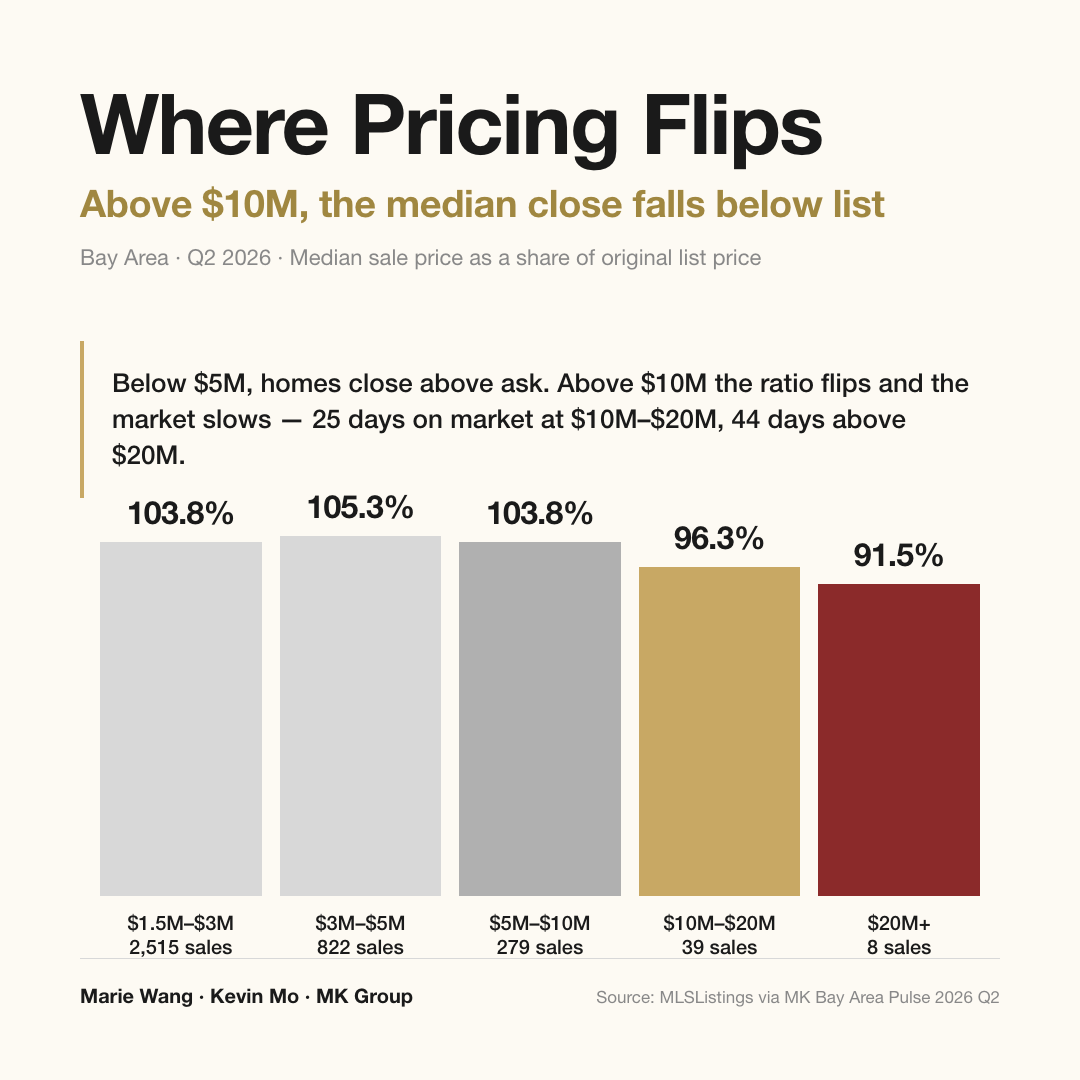
The core numbers first. In Q2 2026 the Bay Area's $3M–$5M band closed at a median 105.3% of original list price — that is, above ask as a rule. Cross $10M and the ratio inverts to 96.3%; above $20M it falls again to 91.5%. The expensive bands also sell more slowly: a median 25 days on market at $10M–$20M and 44 days above $20M, against 8 days from $3M to $10M.
| Price band | Closings | All-cash share | Median sale price | Median days on market | Sale price as share of original list |
|---|---|---|---|---|---|
| $1.5M–$3M | 2,515 | 15.7% | $1.965M | 12 | 103.8% |
| $3M–$5M | 822 | 26.8% | $3.6M | 8 | 105.3% |
| $5M–$10M | 279 | 44.4% | $6.0M | 8 | 103.8% |
| $10M–$20M | 39 | 71.8% | $12.75M | 25 | 96.3% |
| $20M+ | 8 | 75.0% | $22.375M | 44 | 91.5% |
| Atherton, city level, all price bands | 31 | 64.5% | $10.0M | 13 | 97.1% |
What to remember, because it runs against instinct. A below-list close above $10M is not evidence of a softening market. It is evidence that the band prices differently. Under $5M, list price is frequently set deliberately low as bait to manufacture a bidding contest, so the sale price usually exceeds it. Above $10M, sellers rarely bait. They put their real target on the board at launch and leave the remaining room to negotiation — which makes a discount the normal reading, not the exception. The second number worth holding onto is the cash share: 71.8% of $10M–$20M sales closed all-cash, and 64.5% citywide in Atherton. The counterparty you meet in this band carries no monthly payment, so "the seller couldn't hold on" is not a thing that happens. A below-list close is two sides agreeing on what a defect is worth, not one side buckling.
What MK Group saw on site: three $10M+ Atherton homes, markdown by markdown
All three homes below were walked in person with MK Group clients, and all three closed below original list. Marie Wang reviewed each one on YouTube @MarieWang (44K+); what follows reorganizes that review into two questions per house — what got marked down, and what kind of item each markdown is.
The core numbers first. The three closed at 96.3%, 88.9%, and 91.3% of original list. The first lands exactly on the median discount for the $10M–$20M band (96.3%). The other two ran materially deeper, which tells you their markdowns were priced individually by the market rather than absorbed as a band-wide convention.
| Home | Original list | Sale price | Share of original list | Lot / interior | Built | Principal markdowns |
|---|---|---|---|---|---|---|
| A · West Atherton | $10.38M | $10.0M | 96.3% | 1 acre / 6,000 sq ft | 1975, renovated once later | School behind the lot, arterial at the rear, neither-new-nor-old finish, poor front-yard privacy |
| B · East Atherton, Menlo Park line | $13.5M | $12.0M | 88.9% | 1 acre / 8,000+ sq ft | Nearly new, barely occupied | City boundary, front door onto Middlefield Road, house number, middle-of-the-road finish |
| C · French château | $11.995M | $10.95M | 91.3% | 0.92 acre / 4,766 sq ft | 1999 | Dark interior, protected redwood mid-yard, odd layout, dated finish |
What to remember. Home B was the newest and largest of the three — over 8,000 sq ft, gym and sauna and wine cellar, an owner who had barely lived in it — and it took the deepest cut of the three, $1.5M off. "Nearly new" has never been a guarantee of an easy sale. What the market marked down was a location and a number, not the condition of the house. Set B and C side by side and it gets sharper: Home B, over 8,000 sq ft and effectively new, closed at $12.0M; Home C, 4,766 sq ft and dated, closed at $10.95M. Nearly double the floor area for a gap of just $1.05M. What came off Home B was a boundary location and a house number, not its condition.
Home A · West Atherton, closed at $10.0M, about $380K under asking
West Atherton is one of the best addresses in the city. This house was 5 bedrooms, 6,000 sq ft of interior, on a full acre. It launched in spring, was marketed publicly for a stretch, and went into contract on day 39 — slow against the 25-day median for its band. (Atherton's 13-day citywide median in the table above covers every price band, and the city's sub-$10M half moves considerably faster, so 25 days is the right benchmark for a house at this level.) The listing agent is a colleague MK Group works with, and MK also took its own clients through it.
The positioning was awkward in four places. First, a school sits directly behind the property and Alameda de las Pulgas, an arterial, runs along the rear. Second, the house was built in 1975 and renovated once in the 1990s or early 2000s, which leaves it stranded in the middle: too good to tear down, too dated to leave alone, and a full redo is a major project. Third, the plan is dispersed, the ceilings run low, and the kitchen needed a complete rebuild — the gut-renovation budget quoted to the client at the time was $500K–$1M. Fourth, the front-yard privacy was thin: a single very low wall, and every car on the street could see straight into the yard. Privacy is the first thing an Atherton buyer is paying for.
It had real credits too. The grade sits well. And an NBA player once stayed next door for a stretch. To be clear about what that is worth: it is marketing color, not priceable value. You do not add a line to a valuation for who once slept next door.
At the time, $10.0M was a good outcome and the seller was pleased; four months on, the same house would likely do a little better. The interesting part is the sequel. The MK client who walked it hesitated and did not write. After the $10.0M close printed, his exact words were, "Looking at it that way, that house was actually pretty cheap." (Translated from Mandarin.) MK later bought him a different West Atherton house he liked considerably more, at $18M. Which confirms a hold-period pattern already in our case library: a 7,000 sq ft older home bought in the $12M range in 2023 carried an $18M-range value by 2025. In West Atherton, land is the real asset anchor, and a dated interior is what buys you a discount on a top-tier address.
Home B · East Atherton, $13.5M list to $12.0M close, and the most useful lesson of the three
This one sits on Atherton's east side, already touching the Menlo Park line, close to Middlefield Road, with the front door onto the main road. A full acre, more than 8,000 sq ft of building, condition effectively new, with a gym, a sauna, and a wine cellar.
At this price a front door on a main road resolves into three concrete problems. Noise is the first. The second is the safety of guests who can only park outside: traffic on the road is busy, drivers overshoot the house and have to turn around further up. The third is simply parking capacity when there are many guests at once. At this scale, entertaining is a routine use of the house, not an occasional event.
The credits were equally concrete. Every bedroom except one study faces the rear yard, so the interior is genuinely quiet. The rear yard is artificial turf with no large trees, which keeps upkeep low — on an Atherton lot, a stand of mature trees means real ongoing maintenance cost, and buyers routinely overlook it.
The most valuable information, though, was in the house number. The property was originally numbered 74 — a number many Chinese-speaking buyers avoid, because in both Mandarin and Cantonese it sounds close to a phrase meaning "certain death." MK Group's client passed on the house, citing the number alongside the main road. As the buy side, MK gave the listing agent the complete, unedited feedback on why the client passed. The listing agent used it to help the seller petition the Town of Atherton to change the number to 78, and the house then sold. Underline this: whether a house number can be changed depends entirely on the city, and in Atherton it can be petitioned, with a process that is not especially complicated. If a single digit is costing your property a markdown, check your own city's website for the change procedure before you do anything else. It may be the highest-return repair on the entire list.
Marie's read on this house: $12.0M for more than 8,000 sq ft is good value. You cannot have everything — inside a fixed budget, wanting big and new and grand and core-located at once means giving one of them up. When a house is already functionally complete, stop picking at the details. No house is perfect. A $30M house has $30M problems.
Home C · The French château, $11.995M list to $10.95M close
Built in 1999, so not old — 4,766 sq ft of interior on a 40,170 sq ft lot, about 0.92 acre — and it photographs like an estate. In person it reads differently: dark inside, and heavily personal in its choices — the dining room is a deep, saturated red, which amplifies the darkness rather than relieving it.
Dead center of the rear yard stands an enormous redwood. The client's on-the-spot reaction was, "How does this backyard have one tree that big, like a tree god?" (Translated from Mandarin.) It takes five or six people linking arms to reach around the trunk. It is a protected redwood, which means removal is not on the table. From the second-floor windows, the entire view is that one tree. It trips two rules at once: it occupies the middle of the yard permanently, and a tree that size carries a standing maintenance cost.
The layout is also strange. The ground floor is dispersed. Upstairs is two small rooms plus a yoga room, plus a bathroom that is neither properly private nor properly shared — the upstairs bedrooms have no ensuite bath, and reaching one means a short flight of stairs. Actually living on that floor is inconvenient. Add Tuscan floor tile, a dated finish level, and a heavy layer of personal color, and the same house will meet the same resistance the next time it changes hands.
Two other library cases are worth setting alongside it. One is a $20M+ new-build Atherton estate that a cross-border family office walked away from after a single showing; the honest read MK Group gave was that the workmanship was rushed, closer to a builder's spec home turned for speed than a house built to be held. At that level, new construction is not a proxy for quality. The other is an $18M off-market Atherton purchase where Marie Wang and Kevin Mo acted as buyer's agents, and where most of the value sat exactly where nobody looks: a full basement equipment room with dedicated heat-dissipation planning, wiring run inside the walls throughout, independent doorbell and camera systems on each of three floors, one integrated smart system tying lighting, security, irrigation, and access together, and two full boxes of equipment manuals. The offer that won was not the highest one on the table. Read together, the two cases make a single point: a markdown list only covers visible defects, and the credits that actually matter are usually invisible. Surfacing them is the core of buy-side work in this band.
The markdown list: what money fixes, what is permanent
The core numbers first. Across the three homes, only four of the ten markdown categories are purchasable — a full renovation on the order of $500K–$1M, privacy fencing and hedge planting, interior color, and a house-number change. The remaining six either cannot be changed at all or require moving structure, which in practice makes them permanent.
| Markdown item | Type | Order of cost |
|---|---|---|
| Kitchen and overall finish dated (1975 build plus one older renovation) | Purchasable | Full gut renovation roughly $500K–$1M; must be priced into the offer |
| Thin front-yard privacy (low wall, passing cars see into the yard) | Purchasable | Taller fencing plus a planted hedge screen; a landscape budget line |
| Heavy interior color (deep-toned dining room, Tuscan floor tile) | Purchasable | Paint and flooring, an order of magnitude below structural work |
| Unwelcome house number (74 to 78) | Can be petitioned | Atherton allows a petition to the town, process not complicated; rules differ by city |
| School directly behind the lot, Alameda de las Pulgas along the rear | Permanent discount | No renovation removes it |
| Sited on the Atherton boundary, front door onto Middlefield Road | Permanent discount | Noise, guest parking, and safety are ongoing costs |
| Protected redwood in the center of the rear yard | Permanent discount | Cannot be removed, and raises long-run maintenance |
| Low ceilings, dispersed ground-floor plan | Close to permanent | Requires structural work, far beyond one renovation |
| No ensuite bath for the upstairs bedrooms | Close to permanent | Requires replumbing and replanning the floor |
| Core position versus city boundary | Permanent discount | Comparable homes can differ by more than a factor of two |
What to remember. Purchasable items should be converted into cash and written into your offer model, not held back as a bargaining lever — the seller knows what a kitchen costs too. The items that should genuinely pull your ceiling down, or send you out the door, are the six permanent ones. They will be sitting there unchanged on the day you resell, and the buyer across the table will see them exactly the way you did.
Common mistakes
Mistake 1: "Closing below asking means something is wrong with the house, or the seller ran out of room"
Above $10M, a below-list close is the median reading for the band, not an anomaly. In Q2 2026 the median $10M–$20M Bay Area sale closed at 96.3% of original list, and above $20M at 91.5%. The reason is the pricing convention: homes above $10M are rarely listed at a bait price designed to manufacture a bidding contest, so sellers put their target on the board at launch. And 71.8% of buyers in this band pay all cash, which means the seller side usually has no monthly payment either. A discount reflects two parties agreeing on the value of a defect, not one party buckling.
Mistake 2: "It's all Atherton, so prices should be roughly the same"
Atherton holds only about 2,500 housing units citywide, and the internal spread is enormous. The same house sited in a core position versus in the boundary band along Menlo Park can differ in price by more than a factor of two. Home A sat in West Atherton, one of the strongest addresses in the city, and even carrying its mid-1970s vintage, dated finishes and a school behind the lot it sold well at $10.0M. Home B sat on the eastern boundary, was nearly new and over 8,000 sq ft, and took $1.5M off. The first move in evaluating any Atherton property is opening a map and confirming the sub-area, not reading the city name.
Mistake 3: "A nearly new house always sells easily"
Home B had barely been occupied by its owner and came with a gym, a sauna, and a wine cellar. It still went from $13.5M to $12.0M, the deepest discount of the three at 88.9% of original list. The $20M+ Atherton new-build in our case library makes the point more bluntly: a cross-border family office walked after one showing because the workmanship was rushed, closer to a spec home turned for speed than a house built to be held. "New" is a selling point, not a quality guarantee, and it does not offset a location markdown.
Mistake 4: "The photographs look good, so I can write the offer"
Home C reads as a proper French estate in photographs. In person it is dark, the dining room is deep red, the upstairs plan is awkward, and the rear yard is occupied by a redwood that cannot be removed. Photography captures angle and light. It does not capture ceiling height, it does not capture the first impression of walking in, and it certainly does not capture a second-floor window whose entire view is a single tree. At this price a home has to be seen in person, and that is the cheapest lesson of the three.
Mistake 5: "A big tree in the yard is a plus"
In Atherton, treat large trees as two separate questions. First, a protected redwood cannot be removed, so if it stands in the middle of the rear yard and is large enough to need five or six people to reach around, it is not landscaping — it is a fixed object occupying your entire yard. Second, a lot with many mature trees carries a high long-run maintenance bill. Home B's artificial-turf rear yard with no large trees was recorded explicitly as a credit. Low maintenance is real value in this band, not a compromise.
Mistake 6: "I'll renovate gradually — just buy it first"
You can renovate gradually, but the money has to be in the model on offer day. A house like Home A — 1975 construction, renovated once, dispersed plan, low ceilings, a kitchen needing a full rebuild — carries a gut-renovation order of magnitude of $500K–$1M. If you underwrite it as a $10.0M purchase, your real cost is $10.5M to $11.0M. Discovering that budget after you move in turns it into a two-year construction timeline plus one overrun. And separate out what money cannot solve: ceiling height and the absence of an ensuite bath upstairs both sit on the structural side of the line.
Next steps
- Confirm the sub-area before you look at the house. Open a map, plot your candidates, and establish whether each one sits in a core Atherton position or in the boundary band — and whether an arterial runs behind it or a school sits alongside. That single step decides whether the showing is worth your afternoon.
- Print a two-column markdown list before you walk in. Left column, purchasable: kitchen, fencing, hedge screen, interior color, house number. Right column, permanent: arterial frontage, boundary siting, ceiling height, protected trees, no ensuite bath upstairs. Tick items off as you walk. Every additional entry in the right column moves your ceiling down a notch.
- Write the renovation budget into the offer model, not into your head. For a mid-1970s house with one later renovation, reserve on the order of $500K–$1M for a full gut. Get a contractor on site for a real estimate before you release the inspection contingency.
- If you are on the sell side, check your own city's house-number rules first. Atherton permits a petition to the town and the process is not complicated; other cities differ. A property being marked down over one digit may be the cheapest repair on the entire list.
- Anchor your offer on the band's median discount. The current $10M–$20M median sale closes at 96.3% of original list after a median 25 days on market. A house discounting materially deeper than that usually carries one permanent defect the market has priced on its own. Find out what it is before you decide whether to take it on.
Further reading: Atherton Q2 2026 Market Deep Report | Atherton isn't one single luxury enclave — how different are its 7 sub-communities? | Atherton off-market: my offer wasn't the highest, so why did the owner choose it?