The Direct Answer
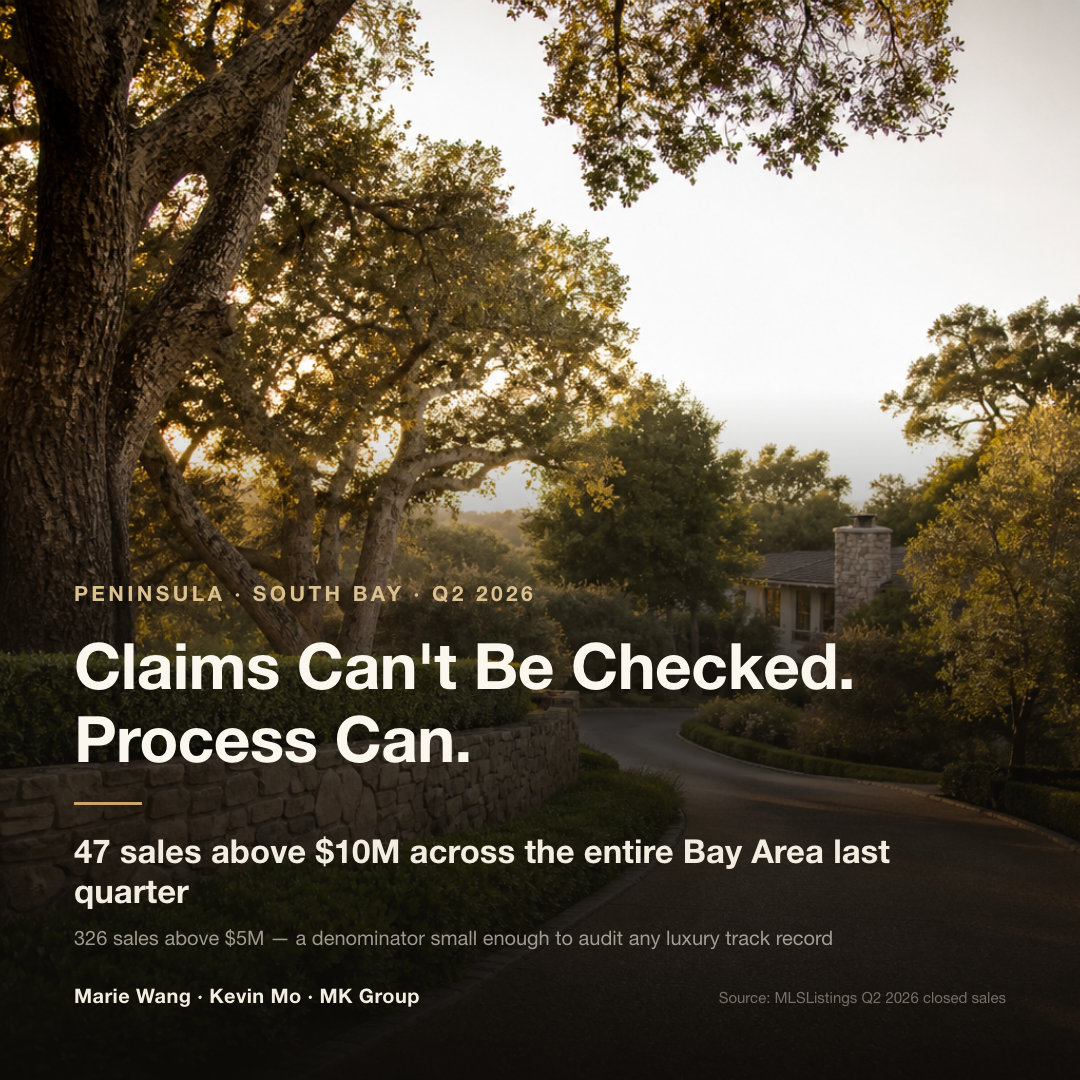
Verify three things a third party can check: the California DRE public license record, the street address and closing month of specific sales in your target price band from the last twelve months, and whether the agent can narrate one off-market transaction down to its mechanism. This tier leaves no room for vagueness — on MLSListings data, the Peninsula and South Bay recorded 47 closings above $10M in all of Q2 2026. Claims can't be checked. Process can.
Who this article is for
The first reader is a family buying above $5M on the Peninsula or in the South Bay for the first time. You have bought homes before and the process is not foreign to you, but you can sense that this tier runs on different rules — you just can't name which ones.
The second is the cross-border buyer, or the principal at a family office. Your window is short: you fly in, you tour, you leave. The agent has to be chosen inside one or two meetings. What you need is not a diligence checklist that takes three weeks to run, but a set of questions you can finish over one coffee, where the quality of the answer is obvious while you're still sitting there.
The third is already talking to two or three agents, is holding a pile of good-sounding statements, and is missing the one thing that would sort them: a column that maps each statement to a public record.
You will leave with three things. A question list you can read off a page. A public-record check that runs in twenty minutes. And the actual transaction volume of this market at the top — which exists here so that you can run an arithmetic test on the sentence "we do a lot of luxury."
For the general framework for choosing an agent — license, case library, team structure, bilingual capability, and the other eight dimensions — we've written that separately in How Do I Pick the Right Real Estate Agent in the Bay Area? and won't repeat it here. This article handles only the part specific to the $5M+ tier.
And if the question actually on your mind is how to evaluate a Mandarin- or Cantonese-speaking agent, that one is answered in How to Find the Best Chinese-Speaking Luxury Real Estate Agent in Silicon Valley — that article is about judging what one bilingual agent's language and service fit is worth to you; this article is about verifying any team's luxury execution against records a third party can check, whichever language the team works in. Different questions, different evidence.
Three dimensions that decide it
Start with the premise this method rests on: at this tier, you almost cannot decide on someone else's referral. Volume above $5M is small to begin with and the details are private. The people around you who can give you a useful referral are usually a single-digit sample, and the city, price band, and house type they bought may be nothing like yours. That pushes judgment back onto two things — public records you can check, and whether the person, in the room, can take one transaction down to structure.
The three dimensions below each take on one of the three sentences you will hear most often and can verify least: "I have off-market inventory," "I've worked this town for years," and "we do a lot of luxury."
Dimension one: off-market access — don't ask whether, ask how
Start with something rarely said out loud. Off-market sales, by definition, do not enter public listing statistics — so any figure of the form "X% of Bay Area luxury trades off-market" is an estimate, not a verifiable measure. Wherever you encounter a share like that, including when we cite one ourselves, treat it as an observation from a market participant. The direct consequence: you have no way to verify anyone's off-market access with a number. Someone who has never done one and someone who has done many produce the identical sentence — "I have access."
What you can verify is process. Four questions, in this order.
Question one: how many unlisted transactions have you handled in the past twelve months, and in which cities and price bands? You want the cities and the bands, not "a lot." If the answer is "Atherton and Palo Alto, both," follow up on which sub-neighborhoods and roughly what prices.
Question two: pick one of them — how did you first learn that house was going to sell? A true answer always points at a specific mechanism: a listing agent gave early word, a long-standing client had something change at home, a relationship on a particular street. A vague "everybody in the circle knew" is an empty answer.
Question three: why did the other side's agent believe I was a real buyer? This one separates most reliably. Anyone who has actually run this play will go straight to how specific a buyer profile has to get: target sub-neighborhood, square-footage range, the month you must be in the house, budget range, form of funds. Because the listing agent has to carry those details back and convince their own seller — and a fuzzy "I have a very strong buyer" carries no weight between professionals.
Question four: were any of these approaches failures, and why didn't they close? Someone who only tells you about the wins either has a bad memory or is selling you something. A person who has really done it will bring the tedious parts out unprompted: who never replied, which house stopped matching once the details came out.
The test is simple. People who have done it cannot help mentioning the tedium. People who haven't can only stop at the conclusion.
Dimension two: DRE and team structure — public facts you can clear in twenty minutes
The California Department of Real Estate runs a public license lookup at www2.dre.ca.gov/PublicASP/pplinfo.asp. Enter a name or a license number. It returns: license type (a Salesperson must practice under a Broker; a Broker may open a brokerage), current status and expiration date, date of issue, the current responsible broker, and whether there is any public disciplinary record (Disciplinary Action / Public Documents).
Three of those deserve particular attention at this tier.
First, check the year of issue against the years claimed. "More than a decade in the Bay Area" attached to a license issued three or four years ago is not necessarily a lie — the person may have been doing something else, or licensed in another state — but you want to know how many of those years were spent licensed and transacting in California. Asking is more useful than guessing.
Second, confirm the responsible broker matches the business card, the website, and the letterhead on the contract. Your representation agreement is with a brokerage, not with an individual. If they don't line up, resolve it before you sign.
Third, ask who on the team is licensed and who is not. A mature team usually has operations, marketing, and content roles, and those colleagues can absolutely help move a transaction along — but only a licensed person can make agency-level judgments and negotiate on your behalf. Get two names: who is my agent of record, and who will actually sit at the negotiating table.
Then there is one thing most buyers assume is unavailable and isn't: the closing record. Ask for three specific closings from the past twelve months in your price band — street address, closing month, and whether they represented the buyer or the seller. Recorded transfers are public files at the county recorder (Santa Clara County and San Mateo County both), and sale prices can generally be retrieved through public channels as well.
The corollary runs against intuition: an off-market transaction still leaves a public transfer record once it closes. "That one was private, I'd rather not say" is understandable as a matter of protecting a client's privacy. But if someone cannot give you a checkable coordinate for a deal that recorded a year ago, their off-market access is, as far as you are concerned, unverifiable — and you have to treat it as if it isn't there.
Dimension three: execution at the top of the market — four questions that measure depth
These four are not a knowledge quiz. They are depth probes. You don't need to know the answers yourself; you only need to hear whether the person is describing experience or describing a concept.
One, rebuilds, remodels, and subdivision. "If I wanted to tear this down and rebuild, or add a second structure later, what's the approval path? How many rounds of design review does this town run, and over how many months?" In the Peninsula's top communities, a meaningful share of high-tier buyers are ultimately buying land. Anyone who has closed a transaction with renovation intent will know whether the reviewing authority is the city or the county, roughly how long that town's review cadence runs, and which constraints — setbacks, protected trees, coverage ratios — will actually change your plan.
Two, holding structure. "If I want to take title through a family trust or an entity, what changes in the transaction? When was the last time you set one up that way?" Draw the line first: the structure itself belongs to a real estate attorney and a CPA, and an agent should not be making that call for them. What you are testing is two other things — whether he knows this has to be settled before the offer is written, and whether he can get the attorney and the CPA into the same conversation in time. "We can deal with that after closing" is the wrong answer.
Three, cross-border funds. "My money is coming from overseas. When was the last time you worked one of those, and what was the timeline? Where did it snag?" A person who has done it will name specific links in the chain: the pace of the bank's review, how the arrival of funds gets aligned with the escrow calendar, how signing is arranged when the buyer isn't in the country, and which step breaks most often. A person who hasn't will say "that's no problem" and change the subject.
Four, winning without the highest price. "In the deals you've handled, has your buyer ever won without being the highest bid? On what?" This is the highest-information question on the list, because it tests three things at once: whether the person has ever competed for genuinely scarce inventory, whether they understand what a seller at this tier cares about, and whether they reduce a transaction to "bid more." Many sellers in this band do not need the money and are not in a hurry; they are choosing who takes the house, and price is one variable among several. We took that mechanism apart in full in I Wasn't the Highest Bid on an Atherton Off-Market Estate — So Why Did the Owner Choose Me?.
Four red flags to keep an eye on alongside
Red flag one: self-reported numbers with no third-party source. Transaction counts, rankings, "families served" — if you can't trace it to something checkable, treat it as absent. You don't have to hold it against anyone, but you shouldn't credit it either. Credentials that can be verified — license number, responsible broker, recorded transfers, published work — always outrank adjectives that can't. That standard applies to us as well as to anyone else.
Red flag two: case stories with a dollar figure and no process. Specific number, vague mechanics — that is a remarkably stable negative signal. A real transaction always contains hesitation, reversals, and a point where the thing nearly fell apart.
Red flag three: a team that takes every price band but can't articulate how the ends differ. It is entirely normal for one team to work $1.5M and $8M at the same time. What you should hear, unprompted, is exactly where the two playbooks diverge.
Red flag four: never having talked a client out of a house. In a tier with almost no margin for error, an agent who has never said "this one isn't worth the price" gives you no way to tell whether he genuinely agreed with every house — or simply couldn't see it.
How big the Bay Area market above $5M actually is
Start with the number that matters. Per MLSListings Q2 2026 closed sales, the entire Bay Area recorded 47 residential closings above $10M for the whole quarter — 39 in the $10M–$20M band and 8 above $20M — and 326 above $5M. A denominator that small means "we do a lot of luxury" is a sentence you can check with arithmetic: a team doing 20 deals a year above $5M is running somewhere around one and a half percent of the region's annual volume in that band, which is an order of magnitude you can reasonably ask them to document.
| Price band | Closings this quarter | All-cash share | Median sale price | Median days on market | Sale price / original list |
|---|---|---|---|---|---|
| $3M–$5M | 822 | 26.8% | $3.60M | 8 days | 105.3% |
| $5M–$10M | 279 | 44.4% | $6.00M | 8 days | 103.8% |
| $10M–$20M | 39 | 71.8% | $12.75M | 25 days | 96.3% |
| $20M+ | 8 | 75.0% | $22.375M | 44 days | 91.5% |
What to remember is this: the higher you go, the slower the market gets, not the faster. The $5M–$10M band ran a median 8 days on market and closed at about 103.8% of original list — still, on the whole, above the original asking price. By $10M–$20M that becomes 25 days and 96.3%. Above $20M it is 44 days and 91.5% — at the very top, slow and below original list is the norm, not the exception. So an agent who describes the top of this market as "inventory gets taken the moment it appears, you have to bid up immediately" is describing some other market. Meanwhile the all-cash share climbs from 44.4% to 75.0% across those same bands, which is why "how does a financed offer compete against all-cash" is a genuine problem at this tier rather than a talking point — we wrote that one up separately in Buying an $18M Silicon Valley Estate With a $10M Loan — Can You Still Win When Nearly Every Rival Bid Is All-Cash?.
City by city, the same quarter looks very different from place to place. Atherton recorded 31 closings at a median $10.0M, 64.5% all-cash, with a median 13 days on market. Hillsborough recorded 48 at $6.5M, 52.1% all-cash, 8 days. Los Altos Hills recorded 32 at $5.725M, 34.4% all-cash. Woodside recorded 31 at $4.5M, 74.2% all-cash, 21 days. Palo Alto recorded 139 at $4.10M, 36.0% all-cash, 8 days. You can put these straight to work in a meeting: "Hillsborough had 48 closings last quarter — which of them were yours?" A question like that leaves no room for a fuzzy answer.
Field notes from MK Group: three sample answers
For the questions above, "what a passing answer sounds like" is harder to convey than the questions themselves. So here are three transactions MK Group — founded by Marie Wang (DRE# 02110980) and Kevin Mo (DRE# 02127623) — handled directly, each mapped to one of the probes. You should hold us to exactly the same standard you hold anyone else.
The first sample answers "how do you verify off-market access." A family relocating from another city had a purchase timeline that had to line up with their children's school enrollment, and they were focused on Palo Alto, Crescent Park in particular. The MK Group team first walked essentially everything available on the open market and concluded that very little of it actually fit — and the client had no time to wait. So the team went on offense: contacting Palo Alto luxury agents they knew, one by one, asking whether anyone had a property preparing to sell that hadn't gone public. The real texture of that process is tedious. Some agents don't reply. Some houses stop matching once you ask the detailed questions. And the whole time you are also working to convince the other side that this buyer is real and can close. Eventually one peer had exactly that: a Crescent Park property, roughly half an acre, owner willing to sell, not yet public. The transaction never appeared on the open market from start to finish. Service didn't stop at closing either — the team went on to help the family complete the enrollment arrangements at the corresponding school. Note what the answer does not contain: the phrase "I have access." It is all actions.
The second sample answers "winning without the highest price" and "cross-border funds and holding structure." In May 2026, MK Group closed an off-market Atherton purchase as the buyer's agent at $18M. The cross-border buyer had the means to pay cash but chose to finance for personal reasons: a loan of roughly $10M, requiring two bank appraisals and a 30-to-35-day window — against a seller who was not short of all-cash buyers able to close in 7 to 10 days. The deciding factor was not price. The offer MK submitted was not the highest on the table. The original owner was an architect who had spent four years building the house to his own occupancy standard, and a great deal of the value sat where nobody could see it: a whole-house equipment room in the basement with heat dissipation actually planned for, wiring run inside the walls with circuits pre-provisioned, and two full boxes of appliance and system manuals left behind. The buyer's agent's central job was to translate all of that for the buyer — and to translate the buyer into a figure the owner could recognize. The owner asked to meet in person, and accepted the offer that same evening, not the highest one. On execution: a loan of roughly $10M is more than most banks will underwrite, so the team locked in a lender able to fund at that size ahead of time and ran several alternates in parallel. How title would be held — individually, through an entity, or in trust — was determined by the professionals brought in for it; the team's job was to connect the buyer to those professionals early rather than backfilling it after closing.
The third sample answers "has he ever told anyone not to buy." Also in May 2026, a decision-maker at a cross-border family office was in Silicon Valley on a short trip, flying home the next day. MK showed him a newly built Atherton estate in the $20M class — good layout, fine community, close to flawless on paper. The client asked on the spot for an opinion, and got this one: everything about the house is good except the workmanship, which is too rough. For a $20M house, it reads more like a spec home a builder rushed out to sell than a work polished for long-term ownership. The client passed on it and said he would be back in August to keep looking. That deal never closed. It is here because the question "has he ever told you not to buy" only counts when the answer is specific.
Common mistakes
Mistake 1: "The agent with the highest transaction volume is the right one for me"
Volume is an aggregate. It tells you nothing about distribution. A team closing 40 deals a year with 38 of them between $1.5M and $2.5M, and a team closing 8 a year all above $6M, produce very different-looking numbers — and the second one has the closer muscle memory for your tier. The right question is not "how many did you do last year" but "how many did you do above $5M last year, and in which cities." With only 47 closings above $10M region-wide in a quarter, any self-reported figure at this tier should be read back against that denominator.
Mistake 2: "He says he has off-market inventory, so he must have channels"
Unlisted transactions do not enter public listing statistics in the first place, which means that sentence is literally unfalsifiable and worth close to nothing as a basis for judgment. What has value is the process: how he first heard about it, how he got the other agent to believe you could close, and whether any of the approaches failed.
Mistake 3: "Good reviews, a big following, lots of content — that's basically enough"
Content and reputation demonstrate reach, not execution depth. Someone publishing market analysis consistently is usually genuinely watching this market — but that is not the same as having closed in your price band. The right use is to treat the content as a free pre-screen, then cross-check against DRE records and verifiable closings. Both have to clear, not either.
Mistake 4: "A team that takes every price band is more flexible, so it's a safe pick"
Flexible is good. Stretching is not. The battleground at $1.5M is loan terms, inspection reports, and rounds of bidding. At $8M it is privacy management, non-public channels, holding structure, and building trust with the other side's agent from zero. In the meeting, you should hear him raise that difference himself, down to the level of "the first thing I do at your tier is different from what I do at $2M, because…" An agent who can't name the difference has usually carried the mid-market playbook straight up the ladder.
Mistake 5: "Hire a Chinese-speaking agent and the cross-border money side takes care of itself"
Speaking the language and executing a cross-border transaction are two different capabilities. The first determines whether you can follow the contract terms and stay aligned with the decision-maker back home. The second determines how the arrival of funds gets aligned with the escrow calendar, how documents get signed when the buyer isn't in the country, and which step tends to jam. The two often appear in the same person, but not necessarily. The verification method is unchanged: ask when he last did one, and where it snagged. For how to evaluate bilingual and cross-cultural communication in its own right, there is a more detailed breakdown in Mandarin / Cantonese / English-speaking Bay Area Realtor — Multilingual Buyer Support Across Peninsula and Silicon Valley.
Next steps
- Run the public records before you book the meeting. Put each candidate's name through the California DRE public license lookup (www2.dre.ca.gov/PublicASP/pplinfo.asp) and write down four things: license type and status, year of issue, current responsible broker, and any public disciplinary record. Five minutes per person, maximum.
- Ask for three closings you can look up. Send a message before the meeting: give me three transactions you completed above $5M in the past twelve months — street address, closing month, and whether you represented the buyer or the seller. Recorded transfers are public files at the county recorder, so you can check them yourself. Anyone who can't give you coordinates gets treated as unverified.
- Print the four questions from dimension one and the four from dimension three, and bring them. Don't improvise in the room. The eight together take about forty minutes, and the difference in the texture of the answers will be unmistakable.
- Build one specific question out of this quarter's numbers. For example: "Atherton had 31 closings last quarter at a median of $10.0M" — then ask which of those 31 were his, or how he reads that volume against the pace you should be setting on an offer. Specific numbers force specific answers.
- Confirm the contracting entity and who will actually execute. Before signing any representation agreement, confirm the brokerage named on it matches the DRE record, and ask plainly: who is my agent of record, and who will actually be present at showings, in negotiations, and at closing. If your target city is already settled, read the corresponding city guide first to fill in the background — Buying in Atherton: Complete $10M+ Luxury Buyer's Guide, Buying in Hillsborough: Complete Peninsula Apex-Tier Buyer's Guide, and Luxury Buyer Due Diligence: Building Quality, Security Systems, and Long-Term Holding Risk.