How much over asking do you really need in the Bay Area?
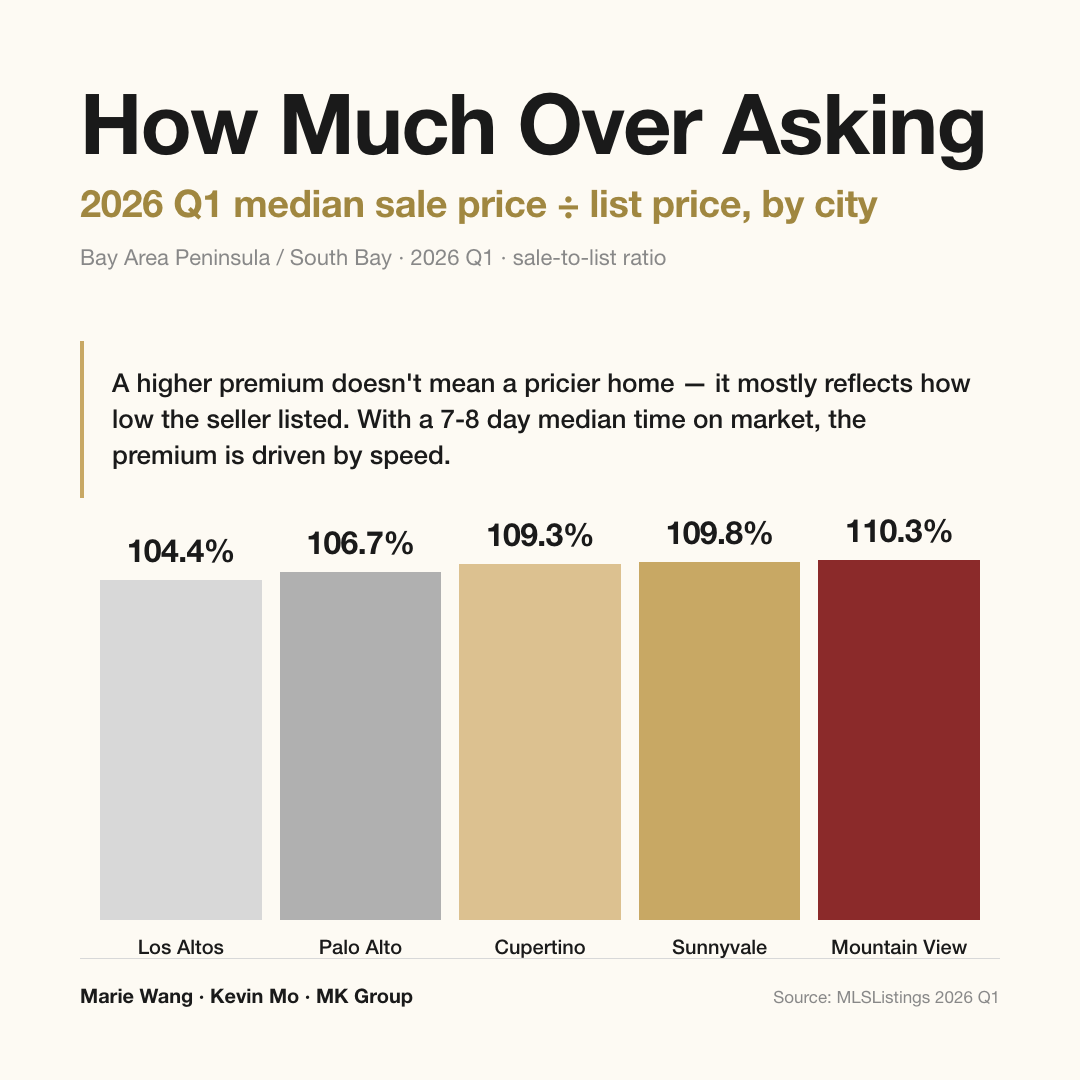
In 2026 Q1, median sale prices across the core South Bay / Peninsula cities landed between 104% and 110% of list: Sunnyvale at 109.8%, Mountain View 110.3%, Cupertino 109.3%, Menlo Park 109.1%, Palo Alto 106.7%, Los Altos 104.4% (source: MLSListings 2026 Q1). A Sunnyvale home listed at $2.0M closed, at the median, around $2.2M. But that premium is not something you choose to add — the market forces it out of you, because most homes go under contract in 7–8 days.
Who this article is for
This is for buyers with a budget in hand who are about to write an offer in the Bay Area — especially:
- First-time bidders who don't know what "normal" looks like, and are caught between offering too little to win and too much to feel good about it;
- Buyers who see a Zillow list price and quietly wonder whether the number can be trusted at all;
- Tech families relocating from out of state or overseas, unfamiliar with the local list-low-and-auction playbook;
- Move-up buyers homing in on a target neighborhood along the Sunnyvale–Mountain View–Cupertino–Palo Alto–Menlo Park corridor.
Three dimensions for reading "how much to offer"
"How much over asking?" is the wrong question. The right one is: "What is this home actually worth, and how far is the list price from that number?" Three dimensions answer it.
One: a high premium means the list was low, not that the home is expensive
When a sale-to-list ratio runs high, the first read should not be "this neighborhood is in a feeding frenzy." It should be "the seller listed low." Many Bay Area listing agents price deliberately below market as a hook — setting the list 5%–10% under true value to make the home look like a deal, draw heavy foot traffic, and force out multiple offers, so the sale price comes back to, or above, real market value. Mountain View's 110.3% premium does not mean its homes are pricier or more contested than Palo Alto's at 106.7%. It means Mountain View sellers, on the whole, list lower. The anchor for what to offer is always comparable sales from the past 90 days in the same neighborhood — never the list price.
Two: the premium is forced out by DOM (days on market)
Put the premium and DOM side by side and the logic snaps into focus. In 2026 Q1, median DOM in these high-premium cities sat at just 7–8 days: Cupertino, Mountain View, and Menlo Park at a 7-day median; Sunnyvale, Palo Alto, and Los Altos at 8 (source: MLSListings 2026 Q1). A home that goes under contract within a week means the first weekend's open house drew several buyers writing offers at once. The premium is not one buyer choosing to add money — it is several buyers racing each other inside a 7-day window and bidding it up. Shorter DOM and higher premium are usually two faces of the same thing.
Three: the higher tiers carry lower premiums — but are harder to buy
Here is the counterintuitive part: the $4M+ tier usually carries a lower premium than the mid-tier below it, not a higher one. Palo Alto's median sale price was $4.12M at a 106.7% premium; Los Altos came in at a $5.08M median and just 104.4% (source: MLSListings 2026 Q1). At the top, the dollar amounts are large, the buyer pool is smaller, and pricing already sits close to real value — there is less need to list low for foot traffic. The rule extends further up: into the $5M+ Stanford circle and the benchmark estates of Atherton, the price-up trend is even clearer — the higher the tier, the less it is an "add-money" game. But a low premium does not mean an easy buy. At the top, inventory is tighter and benchmark assets are locked within 24 hours, so "fast and certain" cuts deeper than "another 1–2%." MK Group (Marie Wang, Kevin Mo) has seen this confirmed again and again in the core of the Stanford circle (see the case below).
The full 2026 Q1 table: premium and speed by city
The headline numbers first: along the South Bay / Peninsula corridor in 2026 Q1, the highest premium belonged to Mountain View at 110.3%, followed by Sunnyvale 109.8%, Cupertino 109.3%, and Menlo Park 109.1%. The two priciest cities — Palo Alto ($4.12M median) and Los Altos ($5.08M median) — carried the lowest premiums, at 106.7% and 104.4%. Yet every one of these cities showed a median time on market of only 7–8 days. The speed is remarkably uniform.
| City | Median Sale Price | Premium (Sale ÷ List) | Median DOM (days) |
|---|---|---|---|
| Mountain View | $2.834M | 110.3% | 7 |
| Sunnyvale | $2.70M | 109.8% | 8 |
| Cupertino | $3.43M | 109.3% | 7 |
| Menlo Park | $3.40M | 109.1% | 7 |
| Palo Alto | $4.12M | 106.7% | 8 |
| Saratoga | $4.212M | 105.4% | 7 |
| Los Altos | $5.0815M | 104.4% | 8 |
The difference worth remembering: draw the line at a $4M median. Below it — Mountain View, Sunnyvale, Cupertino, Menlo Park, medians of $2.83M–$3.43M — premiums run 109%–110%. Above it — Palo Alto $4.12M, Saratoga $4.21M, Los Altos $5.08M — premiums sit at just 104%–107%. Judge "where is more worth fighting for" by premium alone and you will reach exactly the wrong conclusion. The premium reflects the seller's pricing strategy — how far below value they listed — not the home's scarcity or quality. The real measure of market heat is DOM, and across all these cities it holds steady at 7–8 days, which tells you the South Bay / Peninsula corridor remains, on the whole, a fast market.
What MK Group sees on the ground
When you put the premium-and-DOM data into a real transaction, the variable most often underrated is speed. In spring 2026, MK Group (Marie Wang, Kevin Mo) worked with an all-cash buyer at the $10M level in Palo Alto. The buyer found a benchmark estate where everything checked out — interiors, materials, the quality of the renovation — but wanted "one more night to think it over." By early the next morning, the home was under contract, taken by another buyer. The client's first reaction: "A $10M home moves that fast?"
This case is the third dimension in practice. At the top of the market, your competition is very likely also all-cash and quicker to decide — the capital advantage collapses to zero, and speed becomes the scarce resource. When Marie and Kevin walked the client through it afterward, the lesson was not "offer more next time." It was: judge the home's scarcity tier against the past twelve months of comparable competition on day one, and have inspection, disclosures, and proof of funds staged in advance — compressing the time from showing to a signable offer from 24 hours down to 4–6.
The other side of the coin is a win. An engineer with eleven years at Applied Materials was making a move-up purchase in spring 2026, settling on the Los Altos / Cupertino area. Kevin connected the dots for him — the supply-chain order backlog, his own RSU vesting schedule, and the mid-to-high Peninsula price trend — rather than letting him agonize in isolation over whether a single home warranted "8% over or 10%." On closing day he told Kevin, "Good timing, too." That line captures something essential: in a fast market, buying in the right window and anchoring to comparable sales matters far more than fixating on the premium itself.
Common mistakes
Mistake one: "the higher the premium, the pricier and harder to buy"
It doesn't hold. A high sale-to-list ratio mainly reflects how far the seller listed below value — not that the home is expensive or scarce. In 2026 Q1, Mountain View's 110.3% premium exceeded Palo Alto's 106.7%, yet Palo Alto's $4.12M median sale price far outran Mountain View's $2.83M (source: MLSListings 2026 Q1). To gauge "how hard to buy," look at DOM and inventory, not at the premium.
Mistake two: "add 10% over list and you're safe"
Dangerous. The list price is an anchor the seller set, not the market value. If the seller already listed 8% low, adding 10% over list may land you right around true value and just edge out the field. But if the seller listed an honest price near market, a blind 10% over makes you the overpayer. The right move is to compute true market value from comparable sales in the same neighborhood over the past 90 days, then back out what this specific home should command and how far that is from the list — not to mechanically multiply the list by some percentage.
Mistake three: "if I bid high enough, I'm guaranteed to win"
Especially false in the $4M+ tier — and more so up into the $5M+ Stanford circle and Atherton's benchmark estates. When your competition is also all-cash, quicker to decide, and cleaner on terms, another 1–2% won't rescue an offer that is half a step slow, carries contingencies, and runs an uncertain process. What sellers fear most is contingent, dragging, or shaky financing — not leaving a few hundred thousand on the table. In a market that goes under contract in 7–8 days, decision speed and the certainty of the offer often decide the outcome more than the headline number.
Next steps
- Swap your anchor from list price to comparable sales: when a home catches your eye, pull actual closed sales for the same neighborhood and floor plan over the past 90 days (not list prices, not Zillow estimates), use them to estimate true market value, and only then decide what to offer.
- Read premium and DOM together: premium alone will be skewed by the seller's pricing strategy; pair it with DOM to know whether a neighborhood is genuinely hot (7–8 day closings) or simply listing low.
- Know whether you're buying below $4M or above it: below $4M (Mountain View, Sunnyvale, Cupertino, Menlo Park, where most closings fall) premiums run high, so calibrate how far the seller listed low; above $4M (Palo Alto, Los Altos, and up into the $5M+ Stanford circle and Atherton) premiums are lower but inventory is tight, so put your weight on speed and offer certainty.
- Stage the "three essentials" before you walk in: inspection, disclosure review, and proof of funds ready in advance, so the time from showing to a signable offer compresses to a few hours — which beats bidding higher in a fast market.
- Further reading: for how to structure the offer and its terms, see Winning a Bay Area bidding war; for why "all-cash still loses" at the top, see The Stanford circle: 4BR inventory down to 1.1 months; to understand the seller's list-low-as-hook logic, see How much more can the right listing agent get you?.