Direct answer
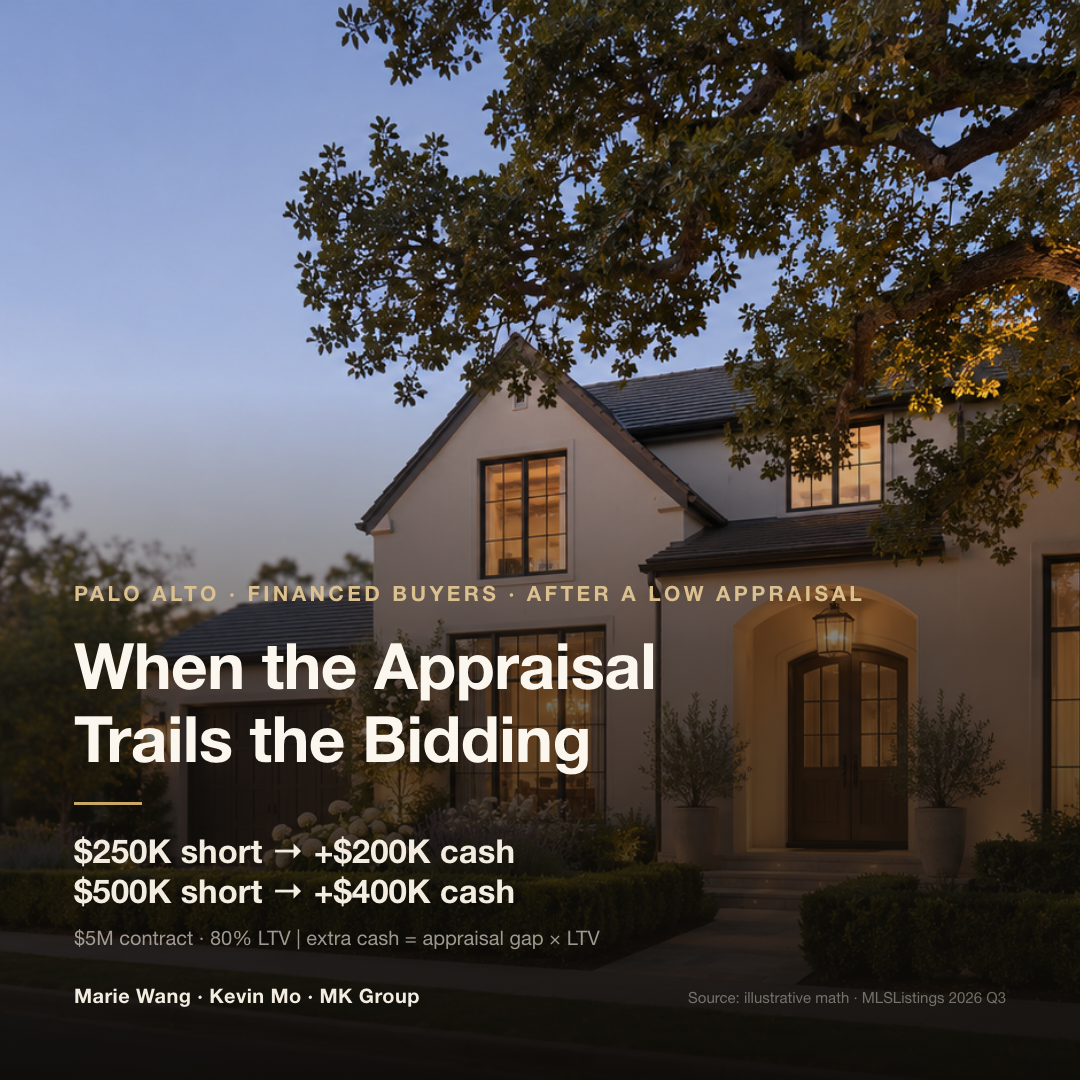
By default, yes. The lender sizes the loan on the lower of the contract price and the appraised value. On a $5M contract at 80% loan-to-value, an appraisal $250K short means $200K more cash. While the appraisal contingency stands, you can renegotiate or cancel; once it is waived or removed, you pay the difference or default.
On the same contract, an appraisal $500K short means $400K more cash. The extra cash equals the appraisal gap times your loan-to-value ratio, because the loan shrinks along with the appraisal. And once the appraisal contingency is waived or removed, the loan contingency can't be used to walk away over a low appraisal either. In the C.A.R. California Residential Purchase Agreement (RPA), the printed default for the appraisal contingency is 17 days after acceptance. Renegotiation and a reconsideration of value both have to fit inside that window, and switching lenders usually also takes the seller's agreement to an extension. The risk concentrates in the most heavily bid deals. Of 64 Palo Alto single-family homes bought with a loan in Q3 2026, 22 sold at 110% or more of list price, including 7 of the 9 in the $5M–$7M band (MLSListings). These numbers show where the risk sits, not that these deals all appraised short.
Who this article is for
- Buyers financing a $5M+ single-family home in Palo Alto, Los Altos or Atherton with a jumbo loan, already in contract and waiting on the appraisal report
- Families whose appraisal has just come back several hundred thousand dollars below the contract price, and who need to decide whether to pay, renegotiate or cancel before the appraisal contingency expires
- Buyers who won in multiple offers by bidding 10% or more over asking, or who waived the appraisal contingency to win, and want to know in advance how much extra cash a short appraisal would take
- Buyers holding part of the down payment in RSUs, a brokerage account or overseas, who need to confirm the extra cash can reach escrow on time
Three dimensions that decide the answer
When an appraisal comes in low, settle three questions in order. What number does the lender lend against? What rights does your contract still give you? And can the extra cash arrive in time?
Dimension one: the number the lender lends against
The denominator in loan-to-value (LTV) is the lower of the sale price and the appraised value. That is how Fannie Mae's Selling Guide (B2-1.2-01) defines it for purchase loans, and jumbo lenders generally use the same math. So when the appraisal comes in low, the loan shrinks with it. On a $5M contract appraised at $4.75M, the 80% loan ceiling drops from $4M to $3.8M. Keeping the loan at $4M would push LTV to about 84.2%, above the program's 80% cap, and most jumbo programs won't go there. The maximum jumbo LTV itself varies by lender and loan size. The larger the loan, the lower the cap tends to be.
A $4M loan is more than three times the 2026 conforming limit that FHFA set for Santa Clara and San Mateo counties, $1,249,125, which makes it a jumbo loan. Jumbo loans aren't sold to Fannie Mae or Freddie Mac, so the appraisal rules come from the lender (or its investors). Requiring two independent appraisals above a certain loan amount, and using the lower of the two, is common practice; the threshold varies by lender. If two appraisals come back at $5M and $4.75M, the lender will typically use $4.75M, the same result as a single appraisal at $4.75M. The roughly $10M loan in the case discussed later in this article required two bank appraisals.
Dimension two: the rights your contract still gives you
The C.A.R. RPA lists the appraisal contingency and the loan contingency as two separate items, with separate deadlines, and each can be removed on its own. The printed default for the appraisal contingency is 17 days after acceptance, with a blank for a different number. In a multiple-offer market like Palo Alto, buyers often shorten it or waive it. While the contingency stands and the appraisal comes in below the contract price, you can ask the seller to reduce the price. If you can't agree, you can cancel in writing, and your deposit is generally returnable, though its release still needs both parties' signatures on escrow instructions. One point is misread more than any other. The RPA's printed terms say that if there is no appraisal contingency, or it has been waived or removed, a failure to appraise at the purchase price does not let you cancel under the loan contingency, provided you otherwise qualify for that loan and can meet the lender's non-appraisal conditions for closing. An open loan contingency won't cover an appraisal gap. Check the version and the boxes checked on your own contract.
Contingencies have to be actively removed. If the deadline passes and the buyer hasn't delivered a signed removal, the contingency stays in place. The seller usually has to serve a Notice to Buyer to Perform (C.A.R. Form NBP) first, giving the buyer at least 2 days, and only if the buyer still doesn't act does the seller gain the right to cancel. The reverse also holds. Once you sign off on the appraisal contingency, a low appraisal is yours to absorb. You can ask the seller to come down, but they have no obligation to. If you can't fund the gap and can't close on time, you're in default; for how much of the deposit the seller can claim, see I Made an Offer on a Bay Area Home and Now Want Out — Can I Get My 3% Deposit Back, or Does the Seller Simply Keep It?
If your offer included an appraisal gap clause, read its exact wording first. The usual form commits you to cover a shortfall up to a stated dollar cap, and everything inside that cap is cash you've already agreed to pay. What happens above the cap, and whether the appraisal contingency was kept alongside the clause, depends on the clause's text. For how to structure that clause in an offer before signing, see I'm Buying With a Mortgage — How Do I Beat All-Cash Buyers in the Bay Area? 2026 Q1 Cash Share by City + What Actually Works. This article covers only how to read it once you're in contract.
Dimension three: whether the extra cash can arrive in time
Having the money is only part of the question. Jumbo lenders usually require a set number of months of reserves left in your accounts after closing, with the number depending on the lender and loan size. If covering the gap eats into that money, underwriting may not approve the loan. New funds also have to be sourced. RSU or stock sales have to settle before the proceeds can be wired, and overseas transfers have to clear compliance review at both the sending and receiving banks. Each step takes time, and each has to be scheduled backward from the appraisal contingency deadline and the closing date. The bigger the gap, the tighter that schedule gets.
How much more cash a $250K or $500K shortfall takes
The key numbers first. On a $5M contract at 80% LTV, an appraisal at the contract price means $1M in cash and a $4M loan. An appraisal $250K short drops the loan ceiling to $3.8M, so the cash needed rises to $1.2M, or $200K more. An appraisal $500K short drops the ceiling to $3.6M, and the cash needed rises to $1.4M, or $400K more.
| Scenario | Contract price | Value the lender uses | Loan ceiling (value × 80%) | Buyer cash required | Change vs. original plan |
|---|---|---|---|---|---|
| Appraises at contract price | $5,000,000 | $5,000,000 | $4,000,000 | $1,000,000 | $0 |
| $250K short, buyer covers it | $5,000,000 | $4,750,000 | $3,800,000 | $1,200,000 | $200,000 |
| $500K short, buyer covers it | $5,000,000 | $4,500,000 | $3,600,000 | $1,400,000 | $400,000 |
| $250K short, seller drops to appraised value | $4,750,000 | $4,750,000 | $3,800,000 | $950,000 | −$50,000 |
| $500K short, both sides split the gap | $4,750,000 | $4,500,000 | $3,600,000 | $1,150,000 | $150,000 |
What to remember: the extra cash equals the appraisal gap times your LTV, so a $500K shortfall costs $400K more in cash, not $500K. You pay the full gap yourself, but the down payment is now calculated on the lower appraised value, and the $100K saved there offsets part of it. Put another way, cash as a share of the contract price rises from 20% to 24% and 28%. The cash figures in the table exclude closing costs, loan fees and the reserves your lender requires you to keep. If your LTV isn't 80%, swap your own ratio into the formula. The last two rows show what renegotiation is worth. If the seller comes down to the appraised value, you actually need $50K less cash than planned; even a split down the middle cuts the extra cash from $400K to $150K.
Four ways out, and the time each one costs
The key numbers first. In Q3 2026, Palo Alto single-family homes bought with a loan at $4M or more took a median 21.5 days from going pending in the MLS to closing (32 sales), while all-cash purchases took 9 days (25 sales). In Los Altos the figures were 21 days (35 sales) and 10 days (21 sales). The RPA's default 17-day appraisal window falls late in that span, so by the time the appraisal report arrives, both the contingency deadline and closing are usually close.
| Option | What it involves | Effect on the timeline | Main risk |
|---|---|---|---|
| Cover the gap in cash | Recalculate the loan on the appraised value and wire the difference to escrow along with the down payment | Contract price and closing date stay the same, as long as the funds arrive before closing and clear the lender's sourcing review | Dipping into the reserves the lender requires can sink loan approval |
| Renegotiate | Use the appraisal report to ask the seller for a lower price, or split the gap | Has to be agreed and signed as a written amendment before the appraisal contingency expires; a new loan amount means the lender updates the loan documents | A seller with an all-cash backup has little reason to give ground; if talks fail, you're back to paying or cancelling |
| Reconsideration of value (ROV) with added comps | Through the lender, ask the appraiser to reconsider: add comparable sales that were missed and correct factual errors such as square footage or condition | Federal guidance sets no processing deadline; the appraisal contingency and rate lock keep running during the review | No guaranteed result; a lender's ROV rules can require any added comps to have closed by the appraisal's effective date |
| Switch lenders and reappraise | Apply with a new lender and order a fresh appraisal | Appraisal and underwriting start over, possibly with two appraisals again on a jumbo; closing usually slips, which needs the seller's written consent | The new appraisal may be no higher; the rate has to be relocked at current pricing; appraisal fees are paid again |
What to remember: paying the gap is the only option that leaves the timeline alone, and its cost is entirely financial. Renegotiation and an ROV are both racing the appraisal contingency deadline, and switching lenders pushes closing back, which needs the seller's written agreement first. The basis for an ROV is the Interagency Guidance on Reconsiderations of Value of Residential Real Estate Valuations, issued jointly in July 2024 by five federal agencies: the CFPB, FDIC, Federal Reserve Board, NCUA and OCC. The financial institution submits the request to the appraiser, and it can include comparable sales the appraisal didn't consider and property characteristics that were recorded incorrectly. The document is supervisory guidance. It has no force of law on its own and sets no processing deadline. Federal Regulation Z (12 CFR 1026.42(c)(3)) allows asking an appraiser to consider additional comparable sales, provide further explanation or correct errors. What it doesn't allow is pressuring the appraiser toward a particular number.
Switching lenders carries the steepest time cost. On the roughly $10M loan in the Atherton case discussed below, the loan cycle ran 30–35 days, while an all-cash rival for the same home could close in 7–10 days. Starting over with a new lender means running the appraisal and underwriting portion of that cycle again. Rates move in the meantime, too. Freddie Mac's PMMS 30-year fixed rate averaged 6.41% in Q2 2026 and 6.68% in Q3. Jumbo pricing is quoted separately, but once the original rate lock lapses, you relock at the new lender's pricing on the day. To compare closing timelines across financing types, see I'm Buying a $5M+ Home in the Bay Area — How Long From Signed Contract to Closing, and How Many Days Does All-Cash Actually Save Over a Loan?
Where the risk concentrates: overbidding among financed sales in Q3 2026
The key numbers first. In Q3 2026, 64 of Palo Alto's 103 single-family sales were financed, and 22 of those, about 34%, sold at 110% or more of list price. Among the 32 financed sales at $4M or more, 11 did. In Los Altos it was 10 of 35 financed sales at $4M or more; in Menlo Park, 1 of 11; in Saratoga, 3 of 23; and in Los Altos Hills, none of 15 (MLSListings, compiled by MK Bay Area Pulse).
| City | Single-family sales | Financed purchases | Of which sold ≥ 110% of list | Financed purchases at $4M+ | Of which sold ≥ 110% of list |
|---|---|---|---|---|---|
| Palo Alto | 103 | 64 | 22 (34%) | 32 | 11 (34%) |
| Los Altos | 72 | 42 | 12 (29%) | 35 | 10 (29%) |
| Menlo Park | 74 | 39 | 10 (26%) | 11 | 1 (9%) |
| Saratoga | 68 | 47 | 5 (11%) | 23 | 3 (13%) |
| Hillsborough | 33 | 15 | 2 (13%) | 14 | 2 (14%) |
| Atherton | 21 | 7 | 1 | 6 | 1 |
| Los Altos Hills | 28 | 16 | 0 | 15 | 0 |
What to remember: by price band, combining the 301 financed sales across ten Peninsula and South Bay cities (Palo Alto, Los Altos, Menlo Park, Saratoga, Cupertino, Los Altos Hills, Atherton, Hillsborough, Woodside and Portola Valley), 28 of 90 in the $3M–$4M band (31%) sold at 110% or more of list price, as did 15 of 54 in the $5M–$7M band (28%), but only 2 of 28 above $7M. Palo Alto on its own is more concentrated: 7 of the 9 financed sales in its $5M–$7M band. The sample is small, but this is exactly the kind of deal the title describes.
Two caveats apply to these numbers. First, appraisers don't work from list price. Across all of Palo Alto's single-family sales this quarter, the median ratio of sale price to original list price was 107.6%. List price here works more like an opening bid, and the appraiser relies on comparable sales that have already closed. Second, and for that reason, selling 10% or more over list doesn't mean an appraisal came in short. It only means these prices were set by that week's bidding, and the further a price moves from the list-price anchor, the more it needs recent comparable sales to back it up. For the 11 Palo Alto financed sales at $4M or more, the median amount paid over list was about $836K. At the other end, Los Altos Hills' median ratio of sale price to original list price this quarter was 98.0%, and none of its 15 financed sales at $4M or more went 10% over list.
MK Group in practice
Two transactions in MK Group's case library map onto the two ends of this article. One shows what a large loan demands of the appraisal; the other shows how a sale price gets bid up.
The first is the purchase of an Atherton home of about $18M in May 2026, with Marie Wang (DRE# 02110980) and Kevin Mo (DRE# 02127623) representing the buyer. Marie Wang later walked through the deal on her YouTube channel, @MarieWang (44K+ subscribers). The buyer chose to finance about $10M. A loan of that size required two bank appraisals and a 30–35 day loan cycle, while all-cash competitors for the same home could close in 7–10 days; an all-cash buyer has no lender, and so no lender appraisal. Most banks and lenders struggle to take on a loan that size, so the team connected the buyer with a lender able to handle it and kept several backup lenders moving in parallel. The case record doesn't cover the appraisal outcome, so it's used here for two points only. At this loan size, two appraisals are a real requirement. And for switching lenders to be a real option, the backups have to be lined up before you sign; starting the search after a low appraisal is too late. The full story is in Buying an $18M Silicon Valley Estate With a $10M Loan — Can You Still Win When Nearly Every Rival Bid Is All-Cash? and the case details.
The second is a four-bedroom single-family home in Midtown Palo Alto that MK Group sold for its owners in May 2026: listed at $3.88M, sold at $4.378M, about 12.8% over asking. Before it went on the market, the team matched it privately with interested buyers, and an off-market verbal offer of $4M came in. After it listed publicly, four straight days of open houses drew about 110 groups, and the final price landed about $380K above that verbal offer (case details). This is a seller-side case. The record carries no information about the buyer's financing or appraisal, so nothing about an appraisal outcome can be read from it. What it shows is where a sale price comes from. The $4.378M was set by competition among buyers that week, while an appraiser can only support a value with sales that have already closed. For a financed buyer who wins in that setting, the portion above list is precisely what the appraisal will need to find evidence for, and precisely what a cash backup plan should cover before signing.
Common mistakes
Mistake 1: "A low appraisal means I overpaid"
Not necessarily. An appraisal answers the lender's question: as collateral, what value can this home support, based on comparable sales that have already closed? It looks backward, at sales over a past period. Your contract price is the result of several buyers bidding against each other this week. Palo Alto's median ratio of sale price to original list price in Q3 2026 was 107.6%, and when bidding is intense and prices are still climbing, contract prices can run ahead of closed sales. A low appraisal is a reason to go back and check the comps, but it doesn't mean the market price is wrong. What actually costs a financed buyer is the lender's refusal to lend against the portion above the appraisal. On a jumbo loan that uses the lower of two appraisals, one low report is enough to create a gap.
Mistake 2: "I waived the appraisal contingency, but the loan contingency still protects me"
It doesn't. The RPA's printed terms say that if there is no appraisal contingency, or it has been waived or removed, a failure to appraise at the purchase price is not grounds to cancel under the loan contingency, provided the buyer otherwise qualifies for that loan and can meet the lender's non-appraisal conditions for closing. Where "No appraisal contingency" is checked, the terms go further: if the loan can't be obtained solely because the lender's appraisal came in below the agreed amount, the seller may be entitled to the buyer's deposit or other legal remedies. In other words, an open loan contingency covers problems other than the appraisal. Only the appraisal contingency covers an appraisal gap. Waiving it to win a Palo Alto multiple-offer situation means agreeing in advance to cover any gap yourself, so before you sign, run "gap × LTV" to see how much cash you might have to add. Check the version and the boxes checked on your own contract.
Mistake 3: "Once I signed an appraisal gap clause, I have no way out"
That depends on how far the clause goes. The usual form commits you to cover a gap up to a dollar cap. Within the cap, the cash is already promised. Above it, whether you can renegotiate or cancel on that basis depends on the clause's text, and on whether the appraisal contingency was kept alongside it or has since been removed. The clause doesn't change the lender's math, either. The loan is still sized on the lower appraisal; the clause commits you to the gap, and the 20% down payment on the appraised value is paid on top of it. If you didn't read the clause closely before signing, read it word for word now and confirm its meaning with your agent and your attorney.
Mistake 4: "After 17 days, the appraisal contingency simply expires"
It works the other way. Under the RPA, contingencies have to be removed in writing by the buyer, and if the deadline passes without a signed removal, the contingency survives. To cancel, the seller usually has to serve a Notice to Buyer to Perform first, giving the buyer at least 2 days. That's no license to stall: once an NBP arrives, the window is counted in days. And 17 days is only the printed default. Your contract may have a shorter number written in, or the contingency may have been waived in the offer, which has the same effect as removing it. The contract's own text governs.
Mistake 5: "Requesting a reconsideration of value will get the appraisal changed"
An ROV is a request, nothing more. The July 2024 guidance from the five federal agencies says a reconsideration can include comparable sales the appraisal didn't consider and property characteristics that were recorded incorrectly. It is supervisory guidance with no force of law and no processing deadline, and the conclusion still rests with the appraiser and the lender. Useful ROV material is factual: errors in square footage or bedroom and bathroom count, an addition whose permitted status was recorded wrong, or a closer, more recent comparable sale that was left out. Arguing that you paid more, or that this is simply what the market pays, rarely moves the result, because your own contract is not a comparable sale.
Mistake 6: "A new lender will reappraise at the contract price"
A new appraiser looks at the same set of comparable sales, and the result may be no higher. On a jumbo, you may again face two appraisals with the lower one used. Switching lenders means reapplying, re-underwriting, relocking the rate and paying appraisal fees again, and closing often has to slip, which needs the seller's written consent. In Q3 2026, all-cash purchases of Palo Alto homes at $4M or more took a median of just 9 days from pending to closing. That is the comparison sitting next to your request when the seller decides whether to wait for you.
Next steps
- Pull out your contract today and confirm three things: the number of days in the appraisal contingency and its deadline; whether the appraisal and loan contingencies are both still in place; and whether your offer included an appraisal gap clause, and if so its dollar cap. Waiving the appraisal contingency in the offer is the same as removing it, so a short appraisal can no longer be grounds to exit under the loan contingency.
- Check the appraisal report's comps and property characteristics line by line: square footage, bedroom and bathroom count, lot size, whether additions and remodels are recorded correctly, and whether a closer or more recent comparable sale was left out. If you find factual errors or better comps, submit an ROV through your lender the same day and ask how long their review takes.
- Use "gap × LTV" to work out the extra cash, then add closing costs. Confirm with your lender that your reserves still qualify once the gap is covered and which documents they need to source the funds, and schedule any stock sales or cross-border transfers backward from the appraisal contingency deadline.
- Within the deadline, send the appraisal report to the listing agent with a specific proposal: reduce the price to the appraised value, or split the gap. Put every change in a signed written amendment.
- If you plan to switch lenders or need to push closing back, get the seller's written extension before you make the move. If you decide to cancel, do it in writing before the appraisal contingency is removed, and sign the release instructions escrow requires.
This article is for decision education and is not legal, tax or lending advice. Appraisal and loan contingencies, appraisal gap clauses and cancellation rights depend on the version, checked boxes and actual wording of your contract; LTV limits, reserve requirements and two-appraisal thresholds vary by lender. Confirm any action with your California real estate attorney, your lender and your CPA. C.A.R. standard forms are revised from year to year, and the default deadlines and printed terms cited here are subject to the contract in your hands.