Direct answer
Usually, yes. Palo Alto's municipal code has no permanent ban on demolition; what varies is process and time. A Category 1–2 home, or any home inside a historic district, faces a demolition delay of at least 60 days and as long as one year. An unlisted home more than 45 years old may need a historic resource evaluation first.
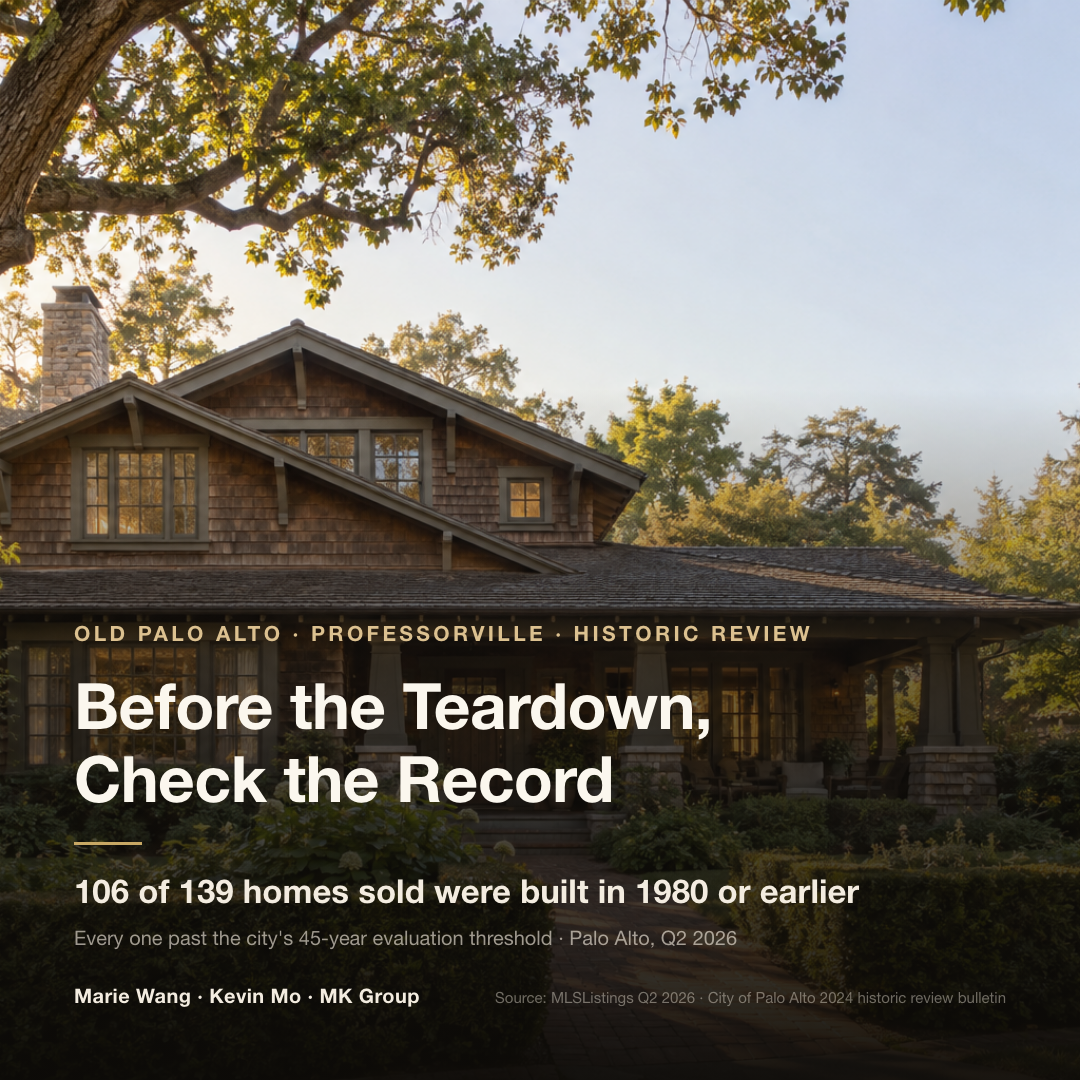
Which process applies turns on three layers of status: whether the home is on the city's historic inventory, and in which category; whether it sits in the Professorville or Ramona Street historic district; and, if it is more than 45 years old, whether the city will ask for an evaluation. Homes in that position are the norm in Palo Alto, not the exception. Of the 139 single-family homes that sold citywide in Q2 2026, 37 were built in 1945 or earlier and 106 (about 76%) in 1980 or earlier. Every one of them is now past the 45-year threshold the city uses for evaluation (MLSListings).
Under the historic resources review bulletin the city issued in 2024, a Category 1–2 home or a home in a historic district sends every permit application involving exterior change to the historic preservation planner first, including routine permits that need no discretionary approval. For older homes that are not on the inventory, an evaluation is triggered mainly by discretionary applications for demolition, new construction, or additions. Even a plan built entirely on objective standards cannot be guaranteed to avoid evaluation; step three below explains why.
Who this article is for
- Buyers with $8 million or more set aside for a century-old home in Old Palo Alto, Professorville, or Crescent Park, who plan to buy the lot and rebuild
- Families who intend to keep the original house and add at the rear or below grade, and want to know how much of the exterior can still change
- Cross-border and out-of-state buyers purchasing their first single-family home in Palo Alto, who need the historic review layer mapped before they make an offer
- Buyers already in due diligence who have to judge whether a rebuild is feasible before their contingencies expire
Three things that decide the answer: a three-step check on historic status
Order matters. Check the inventory first, the district second, and the home's age last. The first two steps confirm status the city has already assigned. The third asks about status the city could still assign, and it is the step buyers most often skip.
Step one: is it on the city's Historic Inventory, and in which category?
Palo Alto's Historic Inventory, established in 1979, is the city's official list of historic buildings. It has four categories. Category 1, "Exceptional Building," carries outstanding significance at the national or state level. Category 2, "Major Building," carries regional significance. Categories 3 and 4, "Contributing Building," are good local examples that reflect a neighborhood's scale, materials, and proportions (city Historic Registers page; 2023 survey FAQ).
The category matters because it decides which review group the home falls into. Under the city's 2024 bulletin, Historic Resources & Permit Review Requirements, Category 1–2 buildings, wherever they stand, and Category 3–4 buildings in Downtown belong to Group A. They are governed by the city's historic preservation ordinance, Municipal Code Chapter 16.49, and every permit application involving exterior change goes to the historic preservation planner first, including routine permits that need no discretionary approval. Category 3–4 buildings outside Downtown and outside the historic districts belong to Group B. The ordinance's review procedures do not apply to them; they are reviewed under the California Environmental Quality Act (CEQA), and only on discretionary applications.
How to check: pull the Parcel Report for the lot from the city's website, or request it from the Planning department. Do not rely on the listing description.
Step two: is it inside the Professorville or Ramona Street historic district?
The city has designated only two historic districts: Professorville and Ramona Street. Ramona Street is in Downtown, and single-family buyers rarely encounter it. Professorville is a residential area of about 65 acres. It was added to the city's historic inventory in 1979 and extended east to Embarcadero Road in 1993; the enlarged district holds nearly 200 residential properties (city Professorville Historic District Design Guidelines). Every home inside it is Group A, whether or not it carries a Category of its own.
On demolition, homes in the district are treated the same as Category 1–2. Municipal Code §16.49.020 defines every building in a historic district as a "significant building," so a demolition application is subject to the same 60-day delay under §16.49.070, which the City Council can extend to as long as one year. A 2022 memo to the HRB from Page & Turnbull, the city's preservation consultant, also notes that such demolitions go through HRB review and City Council action, and may come with a delay period or a public notice offering the building for relocation.
The district is also reviewed at a different scale from a single building. The city's historic resource review FAQ states that historic review generally covers only permanent exterior work, not interiors or landscaping. Professorville is the exception: review there considers the whole streetscape. Three principles in the design guidelines bear directly on a rebuild plan. A historic building should not be demolished unless it is too deteriorated to repair. An addition should be subordinate to the original building in placement, massing, and detail. And a new house should not overshadow the homes of the historic period around it.
Neither Old Palo Alto nor Crescent Park is a city historic district. For older homes there, historic status has to be checked house by house, which is exactly the work of steps one and three.
Step three: not on the inventory but over 45 years old — could it be evaluated as a potential historic resource?
The 2024 bulletin states that a property not yet evaluated or designated may still be a historic resource for CEQA purposes. When two conditions are both met, the city can require a Historic Resource Evaluation (HRE) before it proceeds. First, the application is discretionary and covers demolition, new construction, an addition, or another substantial exterior alteration. Second, the existing building is more than 45 years old. The bulletin lists seven discretionary application types: Architectural Review, Design Enhancement Exception, Home Improvement Exception, Neighborhood Preservation Exception, Single Family Individual Review, Site and Design Review, and Variance.
The evaluation is done by the city's historic preservation planner, or by an architectural historian the city retains at the applicant's expense (city historic resource review FAQ). It reaches one of two conclusions. A building eligible for the California Register of Historical Resources is reviewed as Group B; one that is not eligible is treated as a non-historic resource. The 1997–2000 survey discussed below also flagged about 2,000 properties as "potentially eligible," neither listed nor determined eligible or ineligible, and they are the typical case at this layer (city historic resource review FAQ). One nuance: the 2018 FAQ listed three triggers, including a zoning qualifier — the property is a single-family residence in any non-single-family residential zone, or a non-single-family residence in any zone. The 2024 bulletin no longer includes it. This article follows the newer bulletin; whether a single-family home in an R-1 zone will be asked for an evaluation is a question for the city, answered case by case.
One more group of homes is off the city inventory yet already in Group B: properties listed on the National Register or the California Register, and properties found eligible for either in the city's 1997–2000 historic survey update, carried out by Dames & Moore. In 2023 the city had a consultant re-review the 154 homes that survey had found eligible for the National Register, plus 13 evaluated as eligible for the California Register. It concluded that 147 were still eligible. Of 146 owners, 83 opposed being added to the city inventory, and planning staff ultimately recommended only 13 private properties and 3 city-owned properties to the City Council (Palo Alto Online, April 17, 2024). Under the 2024 bulletin's classification, the homes that were not added remain in Group B on the strength of the survey record or the evaluation.
If the rebuild plan needs no discretionary approval at all — a new two-story home designed entirely to the city's two-story objective design standards (ODS), for example, with no Individual Review — the bulletin's CEQA evaluation trigger does not apply. But the same bulletin cites Comprehensive Plan Policy L-7.2. When a project would substantially affect the exterior of an unevaluated potential historic resource, that policy still requires the city to consider whether the building is eligible for a state or federal register before it issues a demolition or alteration permit. So "objective standards means no evaluation" is not a promise anyone can make. Ask before you buy. For how Palo Alto's objective-standards route differs from Individual Review, see same plans, seven towns: which approval path your Bay Area remodel will take.
Local data: how many Palo Alto homes that sell are already past 45 years
The core numbers first. 139 single-family homes sold in Palo Alto in Q2 2026. Of those, 37 (26.6%) were built in 1945 or earlier, at a median sale price of $3.6 million, and another 69 (49.6%) were built between 1946 and 1980. Together that is 106 homes, about 76%, all more than 45 years old in 2026. Among the 44 sales at $5 million and above, 19 were built in 1980 or earlier.
| Year built | Homes sold | Share | Median sale price | Median interior | Median lot | Age in 2026 |
|---|---|---|---|---|---|---|
| 1945 or earlier | 37 | 26.6% | $3.6M | 1,692 sq ft | 6,000 sq ft | 81+ years |
| 1946–1980 | 69 | 49.6% | $3.702M | 1,690 sq ft | 7,400 sq ft | 46–80 years |
| 1981 or later | 33 | 23.7% | $7.005M | 3,753 sq ft | 7,840 sq ft | 45 years or less |
| All | 139 | 100% | $4.1M | 2,019 sq ft | 7,200 sq ft | — |
What to take from this. First, older homes make up the bulk of what sells in Palo Alto. The 37 pre-1945 homes are not concentrated in the two best-known neighborhoods, either: by MLS area they are spread across 10 areas, and those labeled Old Palo Alto and Professorville account for only 6 between them. Second, the $3.6 million median for pre-1945 homes sits below the $4.1 million citywide median, because their median interior is only 1,692 sq ft, against 3,753 sq ft for homes built in 1981 or later. A small house on a strong lot is where the urge to tear down and rebuild runs highest, and where historic status most needs checking first. Third, 45 years is a moving line. Homes built in 1980 crossed it this year; next year it will be 1981.
Status by status: demolition, additions, and SB 9
The short version. Of the six situations below, Category 1–2, homes in a historic district, and Downtown Category 3–4 are Group A, and every exterior permit goes to the historic preservation planner first. For Category 1–2 and district buildings, the municipal code gives the city a 60-day delay on demolition, which the City Council can extend to as long as one year. SB 9's by-right approval does not apply to historic properties listed under a city or county ordinance, or to contributing buildings in a historic district.
| Status | Demolition | Additions | Exterior changes | SB 9 | Review path |
|---|---|---|---|---|---|
| Category 1–2 (any location) | §16.49.070: no decision for 60 days after a complete application is accepted; single-family and duplex homes go to the HRB for a recommendation; City Council can extend the delay to as long as one year. Discretionary applications also go through CEQA | Reviewed against the Secretary of the Interior's Standards for Rehabilitation; the city FAQ notes additions generally go on secondary elevations or below grade | Changes to the primary street facade generally discouraged; anything beyond minor exterior alterations, or not meeting the Standards, goes to the HRB | Generally not available (state law excludes historic properties listed under a local ordinance) | Group A: preservation ordinance, plus CEQA on discretionary applications |
| Inside the Professorville or Ramona Street historic district | §16.49.070 applies here too: 60-day delay, HRB recommendation for single-family and duplex homes, City Council can extend to one year. Guidelines principle: a historic building should not be demolished unless too deteriorated to repair | Should be subordinate to the original in placement, massing, and detail; new homes should not overshadow historic-period houses | Same as Group A; in Professorville, review considers the whole streetscape | Two-unit projects not available for contributing buildings; a lot split cannot require demolishing or altering exterior structural walls of a building in the district | Group A |
| Category 3–4 (outside Downtown and the historic districts) | Preservation ordinance neither prohibits demolition nor requires City Council approval (City Attorney's Office, 2015); discretionary applications go through CEQA and may be referred to the HRB | Reviewed under CEQA only on discretionary applications | Routine building permits are not reviewed under the preservation ordinance | May not be available; per the city's determination | Group B: CEQA on discretionary applications |
| Not on the city inventory, but listed on the National or California Register, or found eligible in the 1997–2000 survey | CEQA on discretionary applications; demolishing a historic resource is a "substantial adverse change" under CEQA | Reviewed on discretionary applications; work meeting the Secretary's Standards is generally considered less than significant | Routine permits are not reviewed under the preservation ordinance | Not available if individually listed on the State Historic Resources Inventory; survey-eligible only, per the city's determination | Group B |
| Not listed, not evaluated, over 45 years old | On a discretionary application, the city can require an HRE first (applicant pays when a consultant is retained); without one, Comprehensive Plan Policy L-7.2 still lets the city consider eligibility before issuing a demolition permit | Evaluation triggered only by discretionary applications | Minor exterior alterations exempt | Age alone is not an exclusion | Set by the HRE: California Register–eligible means Group B; otherwise non-historic |
| 45 years old or younger, no historic listing of any kind | Routine demolition permit | Standard zoning and building review | Routine | SB 9's general conditions apply | No historic review triggered |
What to take from this: the rows most often misread are the fourth and fifth. The home is not on the city inventory, so buyer and seller alike assume there is no historic issue. But a survey record, or simply the home's age, pulls it into CEQA the moment a discretionary application is filed. Under CEQA Guidelines §15064.5, demolishing a resource found to be historic is in itself a substantial adverse change, and after that a streamlined path is hard to come by. Rows one and two carry the opposite risk: the process is written into the code, so a delay of 60 days to one year can at least be built into the schedule from the start. The SB 9 column rests on the current text of state law (Gov. Code §65852.21(a)(5) and §66411.7(a)(3)(E)–(F)). What the statute excludes are landmarks individually listed under a city or county ordinance. Category 1–2 fall clearly inside that exclusion; whether Category 3–4, which the city inventory labels "Contributing Building," also count is for the city to determine. Palo Alto's own objective standards for SB 9 projects are set out separately in the municipal code.
Work that usually does not trigger historic review
"On a historic house, even a new window means going to the HRB" overstates it. The 2024 bulletin exempts minor exterior alterations that do not affect a potential historic building's overall integrity. Its examples include repair or replacement in kind, and other changes that leave character-defining features intact. Ordinary maintenance and repair, interior work, and landscaping generally need no historic review. The exception is Professorville, where review considers the whole streetscape.
The operative words are "in kind." The character-defining features listed in the Professorville design guidelines include wood-sash windows, wood shingle, and wood clapboard siding. Replacing them with the original material, dimensions, and profiles is routine repair. The guidelines expressly advise against covering original walls with vinyl, aluminum, or other synthetic siding; a change like that is no longer in kind. On a Group A property, even a minor change is routed to the historic preservation planner first. If it is minor and meets the Secretary of the Interior's Standards, it is approved at staff level and never goes to the HRB.
How much longer approval takes: the milestones the city puts in writing
The short version: the city has not published a single figure for how many months historic review adds to a project. What its official documents do fix are four milestones:
- After an alteration application that requires HRB review is filed, planning staff tell the applicant within 30 days whether it is complete. Once it is deemed complete and passes a zoning compliance check, it goes on the next available HRB agenda (city HRB Application Review Process, 2018).
- The HRB holds one regular meeting a month, on the second Thursday at 8:30 a.m. (city HRB page). It can recommend approval, approval with conditions, or denial, or continue the item to a later meeting.
- Demolition of Category 1–2 buildings and buildings in a historic district: no decision for 60 days after a complete application is accepted; single-family and duplex homes go to the HRB for a recommendation; the City Council can extend the delay to as long as one year (Municipal Code §16.49.070, applying to "significant buildings" as defined in §16.49.020).
- Historic Resource Evaluation: the city has not published a standard duration. It depends on whether the planner does the work or the applicant funds a consultant, and the city's answer on the specific case governs.
What a buyer can control is sequence. With the HRB meeting once a month, a single continuance usually costs a month. An evaluation that was skipped before purchase, and is only requested once the application is filed, pushes the whole schedule back by a length of time the city does not commit to. Settle the home's status before you sign, and both kinds of delay can at least be priced into carrying costs in advance.
Historic status also comes with incentives
Historic status is not only a constraint. According to the city's Preservation Incentives page, single-family homes on the city inventory can draw on several zoning and building code allowances:
- Bonus floor area: Category 1–4 homes and contributing buildings in the city's historic districts (in R-1, R-E, R-2, and RMD zones) can exceed maximum floor area by up to 250 square feet (Municipal Code §18.10.110, §18.12.120). The bonus requires a Home Improvement Exception, which is itself a discretionary application and goes through CEQA historic review. The changes must substantially conform to the Secretary of the Interior's Standards, and the owner must record a covenant to maintain the home to those Standards.
- A flag lot: once the owner of a historic home records a preservation covenant on the historic building, a flag lot can be created in R-1 and certain other zones without meeting the usual minimum lot size (Municipal Code §21.20.301).
- The California Historical Building Code: alternative ways to comply on safety, seismic, energy, and accessibility requirements, available to buildings designated historic at the local, state, or federal level.
Two points are often misunderstood. The first is property tax. Listing on the city inventory does not change a property's tax assessment (city 2023 survey FAQ). The Mills Act contract, which can lower property taxes, had not been implemented in Palo Alto as of 2023; an April 2024 city report still listed it as an option to explore and noted that lower property taxes would affect PAUSD revenue (Palo Alto Online, April 17, 2024). Confirm the current status with the city. The second is the federal historic rehabilitation tax credit, which does not apply to owner-occupied homes. These incentives matter to buyers who plan to keep the original house and expand at the rear or below grade. For buyers planning to tear down and rebuild, they offer little.
What MK Group sees in the field
In July 2026, Marie Wang (DRE# 02110980) and Kevin Mo (DRE# 02127623) ran the numbers for a buyer client on a 1926 home in Old Palo Alto. It was listed above $8 million, its condition left a teardown as the only path, and total investment after rebuilding came to about $12 million to $14 million. The conclusion: to build and sell, the purchase price would have to come down to about $7 million to leave any margin; to build and live there, $8 million is roughly break-even. Marie Wang walked through this math in an episode on her YouTube channel, @MarieWang (44K+ subscribers). The full calculation is in a developer's offer on an old Bay Area house: is the number high or low?
That math rests on one assumption: that the house can be demolished on schedule. The case record does not cover historic review of this property, and this article draws no conclusion about it. But a house that turns exactly 100 in 2026 is far past the 45-year threshold, and if the rebuild plan includes any discretionary application, the city can require a historic resource evaluation first. So the order should run the other way. Complete the three-step status check, confirm which process the demolition and rebuild will follow and whether a delay or evaluation stands in the way, and only then work through construction cost, holding period, and resale price.
On the same street, another MK Group client took a different route: a home built after 2000, about 5,000 sq ft, negotiated through an off-market channel before it formally listed, with about $700,000 taken off the price. At under 30 years old, it is nowhere near the 45-year line, and historic status is essentially a non-issue. For how buying a finished home compares with buying a lot to rebuild, see a 100-year-old house at $8M or a 1-year-old house at $5M in Palo Alto: which one to buy.
Common mistakes
Mistake one: "It's not on the historic inventory, so I can demolish on my own schedule"
The inventory is only the first layer. A property found eligible for the National or California Register in the 1997–2000 survey is Group B under the 2024 bulletin, even if it never made the city inventory. In the 2023 re-review, 147 were still found eligible. Of 146 owners, 83 opposed being listed — but opposing a listing does not erase a survey record. And a home that appears in neither, once it is more than 45 years old, can still be required to undergo a historic resource evaluation when a discretionary application is filed. "Not on the inventory" tells you, at most, that you have cleared step one.
Mistake two: "Once it's on the historic inventory, it can never come down"
The municipal code contains no permanent ban on demolition, and inventory categories are not fixed. In December 2025, the Palo Alto City Council unanimously overrode an HRB recommendation and moved a 1914 Category 2 home in Old Palo Alto to Category 3. The HRB had voted 3–1 to keep the original category; the owner's side argued that the house had been substantially altered since it was built. At the hearing, the planning director explained that the lower category allows more flexibility for remodeling, additions, and even full demolition (Palo Alto Online, December 29, 2025). The case reached a public City Council hearing only because the HRB vote was split. A downgrade is not routine, and the owner's argument rested on the building having been substantially altered. Still, it shows that categories can be adjusted through a legal process.
The process and time costs, on the other hand, are real. For Category 3–4 outside Downtown and the historic districts, the City Attorney's Office told the press in 2015 that the preservation ordinance neither prohibits demolition nor requires City Council approval; those homes still go through CEQA on discretionary applications. For Category 1–2 and district buildings, the code sets a 60-day delay on demolition that can be extended to as long as one year. The city's HRB process guide (2018) states that for single-family and duplex homes on the inventory, following the HRB's recommendation is voluntary for the owner. Yet under CEQA Guidelines §15064.5, demolishing a historic resource is in itself a substantial adverse change. Whether a house can come down, and how much time it will cost, are two separate questions. Ask both before you buy.
Mistake three: "On a historic house, replacing a window or repairing the roof means going to the HRB"
Too broad. The 2024 bulletin states that repair or replacement in kind, ordinary maintenance and repair, interior work, and landscaping generally need no historic review. What does trigger review is an exterior change to character-defining features: replacing street-facing wood-sash windows with windows of a different material and profile, for instance, or covering original shingle with synthetic siding. Exterior permits on Group A properties go to the historic preservation planner first, but minor changes that meet the Secretary of the Interior's Standards are approved at staff level, without the HRB.
Mistake four: "Old Palo Alto and Crescent Park are historic districts"
The city has designated only two historic districts, Professorville and Ramona Street. However many older homes Old Palo Alto and Crescent Park contain, historic status there has to be checked house by house. Some homes are on the inventory, some appear in the survey, and more are simply over 45 years old. On the same street, the house next door may be Category 2 while this one carries no status at all, or the reverse.
Mistake five: "A house in this condition is obviously coming down"
Poor condition is indeed the precondition the Professorville design guidelines set for considering demolition: a historic building should not be demolished unless it is too deteriorated to repair. But whether a building is beyond repair is the city's call, made on professional reports rather than impressions from a showing. Termite damage, a musty smell, structural failure — to a buyer, they spell teardown. In review, a structural engineer and a historic preservation professional have to establish them as documented fact.
Next steps
- Before making an offer, pull the lot's Parcel Report and confirm three things: whether the home is on the city's Historic Inventory, and in which category; whether it lies in the Professorville or Ramona Street historic district; and whether it is listed on the National or California Register. Save screenshots.
- Ask the city's historic preservation planner directly whether the address appears in the 1997–2000 survey or the 2023 re-review list, whether a historic resource evaluation has been done before, and whether its category has ever changed. PAST Heritage's independent inventory (pastheritage.org/inventory) is a useful reference; the city's answer governs.
- Settle the rebuild route before judging whether an evaluation will be triggered. Will the new two-story home follow the objective design standards entirely, or will it need a discretionary application such as Individual Review, a Variance, or a Home Improvement Exception? Take the proposed route to a pre-application meeting with the planner, and confirm while you are there whether, under current rules, this house would be asked for a historic resource evaluation.
- Check the preliminary title report for any recorded preservation covenant or historic-home maintenance covenant, and review the lot's past permit and review history.
- Run the full rebuild numbers only once status is clear. If it cannot be settled within the due diligence period, talk with your attorney about reserving a corresponding contingency or additional time in the contract.
This article is general information to support your decision and is not legal advice. Historic resource determinations, CEQA review paths, SB 9 eligibility, and approval timelines vary by parcel and by application, and city rules change. For any specific project, rely on a written response from the City of Palo Alto Planning & Development Services department, and confirm with your attorney.