Quick Answer
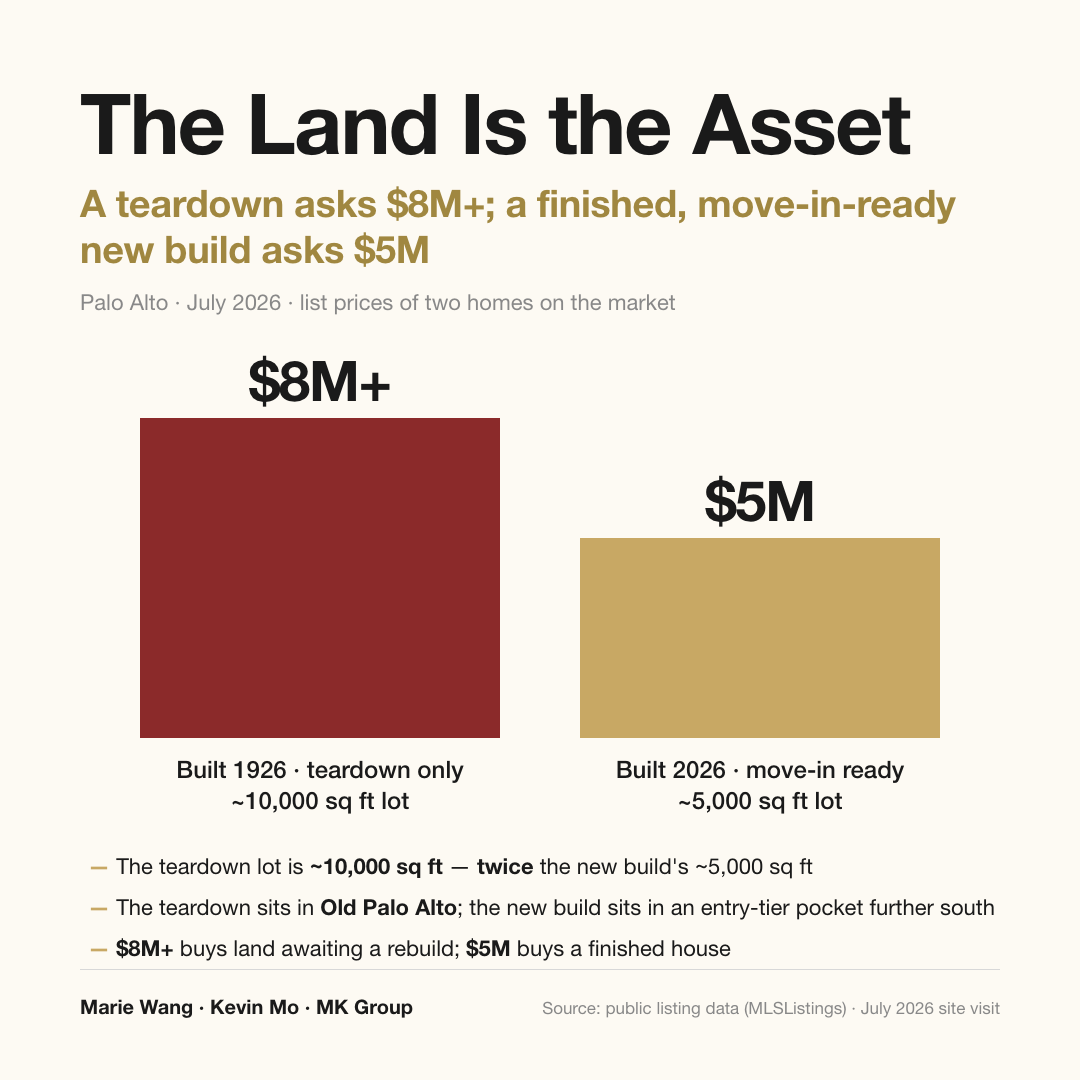
$8M buys roughly 10,000 sq ft of Old Palo Alto land with a house that can only be torn down. $5M buys generous finished living space you can move into, on a lot half that size. Decide first whether you are buying land or square footage — only then does comparing the two prices mean anything.
Who this article is for
- Buyers with a $5M–$10M budget looking at both older homes and new construction in Palo Alto
- Families who want to lock in a top-tier Old Palo Alto address and don't mind building the house themselves
- Buyers running the math on whether a buy-the-land-and-rebuild play actually pencils
- Families on a tight timeline who would rather buy a finished new home outright
- Readers who want to understand what puts $3M between two homes in the same city
Three dimensions to judge it by
The two homes are both in Palo Alto, but they sit in two different location tiers. One was built in 1926 and turns 100 in 2026; it asks more than $8M. The other was completed in 2026 and asks $5M — $3M less, with an entire house more of living space. Three things produce that counterintuitive result.
Dimension one: are you buying land, or living space?
From the curb the century-old house does not read as old. Inside, the first thing you register is the smell of mildew. The threshold has been eaten hollow by termites and worn down by decades of sun and rain, and the read Marie Wang and Kevin Mo gave on site was blunt: there is no point discussing how to reconfigure the floor plan. The house has exactly one use — teardown. The same structure in another American city in the middle of the country might be worth $200K. In Silicon Valley it asks $8M, roughly 40 times more. That 40× does not buy lumber and a roof. It buys the ground underneath.
Lot shape is its own quantifiable discount. This parcel runs about 10,000 sq ft, narrow and deep. A square lot in the same location could support a $10M ask. Narrow-and-deep is a common form in Old Palo Alto: the cost is constrained width, the compensation is a deeper and more usable back yard.
Dimension two: location tiering, and whether you can dig a basement
The largest slice of that $3M is not age. It is address. Old Palo Alto is the most expensive pocket in Palo Alto. The new build sits further south, in a relatively entry-tier pocket, on half the land — about 5,000 sq ft against about 10,000.
Then there is a question discussed far less often that decides the sale price directly: can you dig a basement? In Palo Alto that is a property of location, not a design choice. Crescent Park sits in a flood zone, so a basement cannot be built. Barron Park is not in a flood zone, so it can. The boundary does not follow neighborhood names cleanly, so verify any specific parcel against the city's published flood map. That is exactly how the new build produces its square footage: first-floor ceilings run 14–15 ft, about the height of two floors in the older house, so the area it cannot gain upward it goes looking for below. The basement holds three more rooms and a second living area, lit and ventilated through lightwells with an egress opening built in, and the design accounted for sun angle.
Dimension three: the rebuild math has two different break-even prices
If you plan to buy land and rebuild, run the number all the way through: land, construction cost, holding cost, and the realistic resale three years out. All four, or the answer is meaningless (the walkthrough is in the next section). The figure most often underestimated is construction. Kevin Mo's caution is that true cost is likely to land above the paper estimate, because excavating a basement and finishing landscaping to the standard a $10M+ home gets judged by has enormous range. Build a $10M+ house with a $2M approach and you hand the savings back at resale.
And the same asking price is not the same question for two kinds of buyer. What works for someone building to sell at a profit and what works for someone building a home to live in are two different ceilings.
The two homes and the two paths, in numbers
Start with the numbers. The century-old house asks more than $8M on a ~10,000 sq ft lot with effectively zero usable living space. The new build asks $5M on a lot half the size, around 5,000 sq ft, and still delivers generous living space. The expensive one has twice the land and no house you can live in.
| Comparison | 1926 century-old house | 2026 new build |
|---|---|---|
| List price | $8M+ | $5M |
| Lot size | ~10,000 sq ft (narrow and deep) | ~5,000 sq ft (narrow and deep) |
| Usable living space | Effectively zero — teardown only | Generous (14–15 ft first-floor ceilings plus three rooms and a living area below grade) |
| Micro-location | Old Palo Alto (most expensive pocket) | Southern Palo Alto (entry tier) |
| Ceilings and basement | Older two-story structure, no basement | 14–15 ft on the first floor; basement with three rooms and a living area, lit by lightwells |
| Condition | Threshold eaten hollow by termites, clear mildew indoors | Brand new, whole-house Hunter Douglas motorized shades |
What to take away: twice the land does not automatically mean twice the house. The new build reaches generous living space on half the parcel by pairing 14–15 ft ceilings with a full basement level. Put that same 5,000 sq ft lot inside a flood zone and the basement cannot be built — that entire level simply does not exist. Whether you can dig is worth far more than most buyers price it at.
Now the rebuild path. Start with the numbers again: at an $8M land basis, building roughly 5,000 sq ft with no basement runs about $4M in construction, for about $12M all-in. Add a basement and full landscaping and construction runs about $6M, for about $14M all-in — before holding cost.
| Rebuild path | Land | Construction (on-site estimate) | All-in | Best-case resale in three years |
|---|---|---|---|---|
| ~5,000 sq ft, no basement | $8M | ~$4M | ~$12M | $21M–$22M |
| Basement plus full landscaping | $8M | ~$6M | ~$14M (before holding cost) | $21M–$22M |
Two things to take away. First, both paths top out at the same resale figure while the spend differs by $2M — the single decision to dig or not eats a large share of three years of profit. Second, the only certain number in the table is the $8M land basis. $21M–$22M is a best case, not a promise, and the real question is whether the gap covers three years of construction risk and cost overrun.
Source: List prices from public listing data (MLSListings). Construction cost, all-in spend, and the three-year resale range are on-site estimates and market judgment from Marie Wang and Kevin Mo, given during a July 2026 walkthrough in Palo Alto — not third-party statistics.
Updated: 2026-07
Scope: Palo Alto single-family buyers, $5M–$10M
What MK Group saw on the ground
One client was genuinely interested in that $8M+ century-old house. MK Group did not stop at whether it was worth touring; the team ran the whole rebuild through — real construction cost, holding cost, and what the finished house could sell for. The answer split by purpose. To build and sell at a profit, $8M+ does not work; the price would have to come down to around $7M before there is room. To build it and live in it, $8M is roughly the break-even line — neither a gain nor a loss.
At almost the same time, on the same street, the team bought another client a finished home off-market: built after 2000, about 5,000 sq ft, with roughly $700K negotiated off the price. One variable surfaced mid-deal. Before signing the offer, the seller saw the $8M+ teardown next door hit the market and called specifically to ask about it — a high list price on the same street turns very easily into the anchor a seller uses to price their own house. That step held only because the persuasion work got done. Marie Wang's description of it: there is a lot of work in the middle.
Two other reference points are worth carrying. The first is that finish level in new construction has a price: one client custom-ordered whole-house Hunter Douglas motorized shades for a 7,000 sq ft Atherton interior and spent about $100K. New builds rarely include window coverings at all, and almost never at that tier. The second is that there is a third path between old and new. The team recently bought two off-market homes for clients — twenty to thirty years old, sound condition, generous living space — and separately sold an Atherton property off-market to a developer, never listed, at $8M. None of those homes ever reached the open market, which is exactly why buyers who only watch MLS listings rarely see this middle lane at all.
Common misconceptions
"The new build is cheaper than the old house, so the new build must not be worth much"
The largest slice of that $3M is not age; it is location and land. Old Palo Alto is the most expensive pocket in the city, the new build sits further south in a relatively entry-tier pocket, and its lot is half the size. Move that same new build onto the Old Palo Alto parcel and the price sits in a different order of magnitude.
"Higher ceilings are always better — 14 ft has to beat 10 ft"
Not necessarily. The volume 14–15 ft ceilings create is real, and so is the trade-off: the insulation layer above becomes relatively thin, hot air collects up high, and large glass areas add solar gain, so the interior heats up more easily. Palo Alto homes twenty to thirty years old already run 9–10 ft ceilings and live comfortably. Extreme ceiling height is a choice with a cost attached, not a strict upgrade.
"Basements have poor light and ventilation, so avoid one if you can"
Bay Area new construction solves this with lightwells, and there are three things to judge. More and larger lightwells generally mean better living quality below grade. Whether the design actually accounted for sun angle matters as much as the size. And wall color matters more than buyers expect — pale or white surfaces read brighter, while a deep gray reads as stronger design but softer light; Marie Wang and Kevin Mo point to a $16M Professorville home where the basement walls carry exactly that gray tone. Over the past several months, many of the new builds we toured in Menlo Park, Palo Alto, and Atherton were designed with lightwells.
"Land in a top-tier location is never a mistake — buy it with your eyes closed"
The land can be right and the price still wrong. An $8M land basis plus $4M–$6M of rebuild cost puts you at $12M–$14M all-in before holding cost, against a best-case resale of $21M–$22M three years out. Whether that gap covers three years of construction risk and cost overrun is the only thing that decides whether to buy.
"An owner-occupier and an investor can pay the same price"
Same house, same asking price, two different answers. To build and sell at a profit, $8M+ does not work — the number would need to come down to around $7M before there is room. To build it and live in it, $8M is roughly the break-even line. Run that sequence backwards, settling on a price before settling on the purpose, and you walk into the negotiation with nothing to argue from.
Next steps
- Answer one question first: do you want the land, or living space you can use immediately? On the same street, those two answers can differ by an entire house.
- When touring an older home, judge "can this be remodeled" separately from "is this worth tearing down." Once a compromised threshold, termites, and mildew show up, all that remains is the land valuation.
- If living space is what you care about, check whether your target parcel sits in a flood zone before anything else — Crescent Park cannot build basements, Barron Park can — and verify the specific lot against the city's published flood map, since the boundary does not follow neighborhood names cleanly.
- Before committing to a rebuild, run land, construction cost, holding cost, and the three-year best-case resale together, and leave headroom in the construction line for overrun.
- If your timeline is tight and construction risk is not something you want to carry, look seriously at the third path: homes twenty to thirty years old, in sound condition, with ample square footage. Those usually surface through off-market channels rather than open listings.