Direct answer
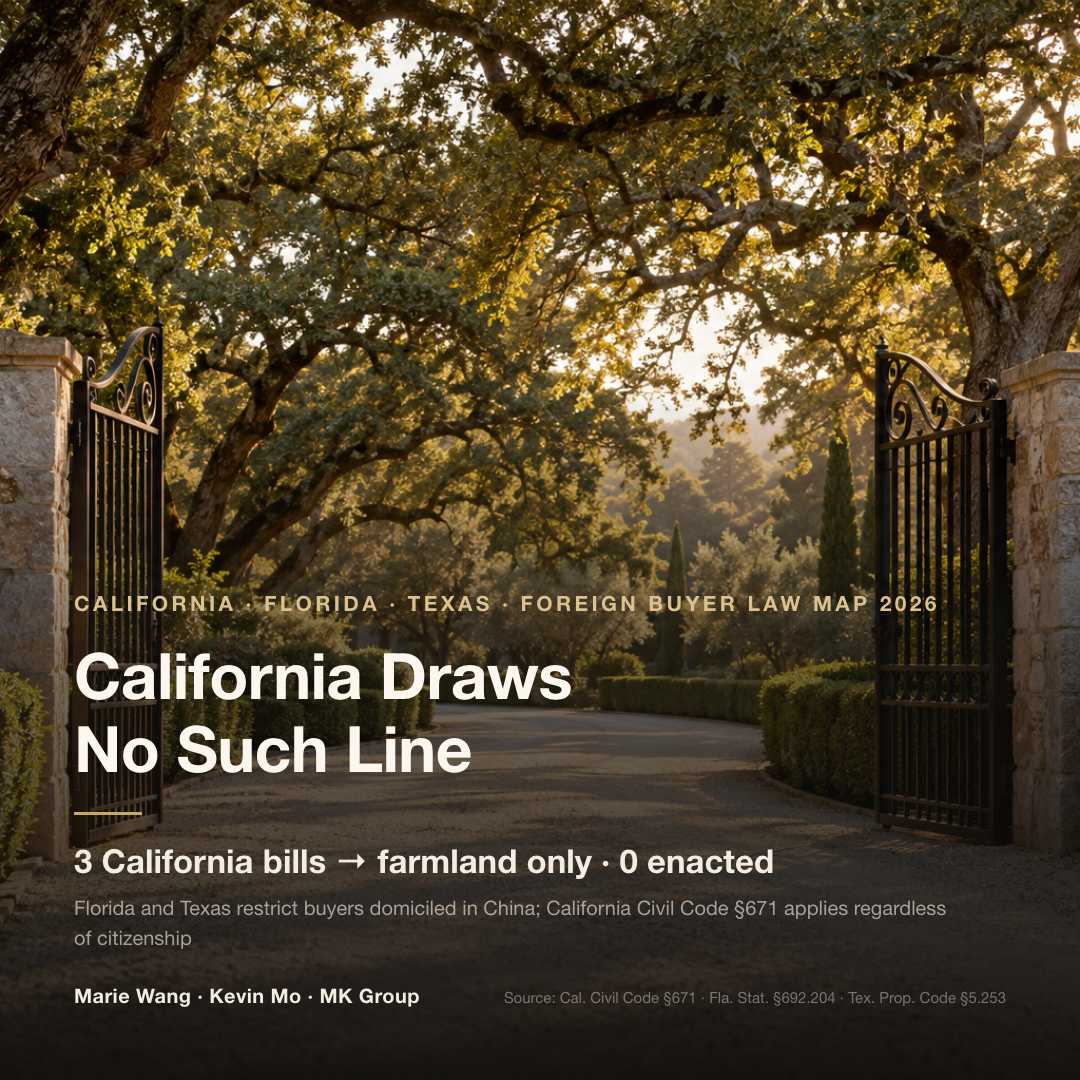
Yes. California Civil Code §671 and Article I, Section 20 of the state constitution give noncitizens the same property rights as citizens, and a California purchase does not turn on nationality or domicile. Florida and Texas restrict individuals domiciled in China. California has no comparable law.
Will California follow? As of October 2026, the Legislature has taken up three related bills in recent years: SB 1084 (vetoed by the governor on Sept. 27, 2022), SB 224 (dead as of Feb. 1, 2024), and SB 1176 (failed 2–6 in the Senate Judiciary Committee on April 14, 2026). All three dealt only with farmland, all three targeted foreign governments or companies, and none became law. In late 2025, the federal appeals courts over Florida and Texas each found that Chinese citizens already domiciled in those states fall outside the restrictions. Read the other way, a buyer whose life is still in China is exactly who those two laws reach.
Who this article is for
- Families who hold Chinese passports and live in China, planning a purchase of $5 million or more in Atherton, Palo Alto, Los Altos Hills, or a similar city, who want the legal risk cleared before they write an offer
- Buyers who have read the coverage of Texas SB 17 and Florida SB 264, worry California will follow, and are weighing whether to put their plans on hold
- Cross-border families comparing Bay Area homes with property in Florida or Texas, who need the rules laid out state by state
- Adult children and family advisors vetting a Bay Area purchase for parents or relatives in China, who first need a clear grasp of domicile as a legal concept
Three things that decide it
Whether you can buy comes down to three layers of rules. Does the state's law restrict you? If so, where does it draw the line? And is there a separate federal review? Work through them in order, and stop wherever one of them blocks you. In California, all three are clear.
One: state law, where California's standard is "regardless of citizenship"
The current text of California Civil Code §671 reads: "Any person, regardless of their citizenship status, may take, hold, and dispose of property, real or personal, within this state." AB 1096 revised the section's wording in 2021, effective Jan. 1, 2022, without changing what it protects. Above the statute sits a constitutional guarantee. Article I, Section 20 of the California Constitution, added by Proposition 7 in 1974, is a single sentence: "Noncitizens have the same property rights as citizens."
Legislators in Sacramento have introduced bills to limit foreign landholding in recent years, but each one stopped at farmland. SB 1084 (2021–22 session) would have barred foreign governments from buying or holding California agricultural land. It passed both houses, and the governor vetoed it on Sept. 27, 2022. The veto message reasoned that federal law already requires foreign governments to report the farmland they hold, and that the reporting the bill assigned to the state Department of Food and Agriculture went beyond that department's role. SB 224 (2023–24) took the same direction. The Senate Appropriations Committee held it on May 18, 2023, and it was returned under Joint Rule 56 and died on Feb. 1, 2024.
SB 1176 (2025–26) widened the target to companies, governments, and their agents from nonmarket economy countries, or from countries named in the U.S. Director of National Intelligence's annual threat assessment. The subject was still controlling interests in farmland. It failed 2–6 in the Senate Judiciary Committee on April 14, 2026. None of the three bills restricted a foreign individual buying in their own name, and none touched residential property.
This article makes no prediction about where California legislation goes next. Two things are certain. The constitution as it stands gives noncitizens the same property rights as citizens. And none of the recent bills reached an individual's purchase of a home.
Two: other states draw the line at domicile, not passport
Florida's SB 264 was signed on May 8, 2023 and took effect July 1, 2023. Its core provision, Florida Statutes §692.204, bars any individual who is domiciled in the People's Republic of China and is not a U.S. citizen or lawful permanent resident from acquiring any interest in Florida real property, directly or indirectly. There is one exception. A natural person who holds a current non-tourist U.S. visa (or has been granted asylum) and is lawfully present in Florida may buy one residence of up to 2 acres, more than 5 miles from any military installation, in their own name. At every closing, the buyer signs an affidavit stating that they are not a restricted person or that they qualify for the exception. Property acquired in violation can be forfeited to the state, and the violation is a third-degree felony.
Texas SB 17 was signed on June 20, 2025 and took effect Sept. 1, 2025 (Texas Property Code §5.251–§5.259). It bars individuals domiciled in a "designated country" from buying any type of Texas real property, and it names residential property explicitly. Designated countries are set by the U.S. Director of National Intelligence's annual threat assessment and include China, Russia, Iran, and North Korea. The statute defines domicile as an individual's true, fixed, and permanent home and principal residence, the place the person intends to return to whenever absent (§5.251(4)). U.S. citizens and permanent residents are not restricted, and a person lawfully present and residing in the U.S. at the time of purchase may buy a residence homestead to live in.
Texas adds a category Florida does not have. A citizen of a designated country who lives in a third country, neither the U.S. nor the designated country, and has not become a citizen there is restricted too (§5.253(4)(B)). For property acquired in violation, the attorney general can bring an in rem action against the property itself (§5.255). A court can then order the interest divested and appoint a receiver to sell it (§5.257); the proceeds go first to liens and the state's enforcement costs, and only what remains goes back to the buyer. An individual covered by §5.253(4) who buys intentionally or knowingly commits a state jail felony, the lowest grade of felony in Texas (§5.258).
Both laws have been challenged, and in both the courts' answer turned on domicile. Florida's Shen v. Simpson was brought by several Chinese citizens living in Florida. On Nov. 4, 2025, the Eleventh Circuit ruled 2–1 that the plaintiffs, who had lived in Florida for years and intended to stay, were domiciled in Florida rather than China. The purchase restriction did not reach them, so they lacked standing to challenge it. The plaintiffs dismissed the case on Dec. 30, 2025. In Texas, the Chinese American Legal Defense Alliance (CALDA) filed Wang v. Paxton on July 3, 2025. The U.S. District Court for the Southern District of Texas dismissed it on the same ground on Aug. 18, and the Fifth Circuit affirmed on Dec. 11, 2025. The opinion opens by noting that the plaintiff had lived in Texas for 16 years, had studied there, and planned to stay and work in Texas after graduating. His domicile, the court concluded, was not China.
For readers of this article, the conclusion runs the other way. The courts placed those plaintiffs outside the restrictions because their homes were already in Florida and Texas. A buyer who holds a Chinese passport, lives in China, and plans to buy remotely from there is usually domiciled in China, which puts them inside the scope of both laws. Domicile turns on specific facts, so anyone considering property in those two states needs a local attorney to assess it case by case.
Three: the federal layer, where CFIUS expressly excepts a single housing unit
At the federal level, the main review of real estate purchases by foreign persons is the Committee on Foreign Investment in the United States (CFIUS), which under 31 CFR Part 802 examines transactions near military installations and other sensitive sites. Section 802.216 lists the "excepted real estate transactions" CFIUS does not review. Paragraph (d) is the purchase of a single housing unit, together with its fixtures and surrounding land, provided those fixtures and that land are incidental to use as a residence. The regulation's own Example 9 is specific. A foreign person buys a single-family home on 1 acre, half a mile from a military installation, in an area where homes typically sit on about an acre. The acre is incidental land, and the purchase is not covered. Example 10 picks up from there: if the same person buys the adjacent 5 acres of vacant land a year later, that purchase falls within CFIUS review.
In communities like Atherton and Los Altos Hills, where lots of around an acre are common, buying a single-family home to live in generally does not trigger CFIUS. The case that deserves a second look is buying a large separate parcel on top of the house.
Four states and the federal rules: who is restricted, which property, what the courts said
The core facts first. Florida since July 1, 2023 and Texas since Sept. 1, 2025 have restricted individuals domiciled in China from buying homes in those states. The federal appeals courts over each state found, on Nov. 4 and Dec. 11, 2025 respectively, that Chinese citizens already domiciled there fall outside the restrictions. California's three related bills between 2022 and 2026 reached only farmland, and none became law. Georgia's restriction covers only farmland and land within 10 miles of military installations, and it expressly excludes residential property.
| State / level | Legal basis | Restricted individuals | Property covered | Effective date and legislative status | Litigation |
|---|---|---|---|---|---|
| California | Civil Code §671; California Constitution, Art. I, §20 | None: any person, regardless of citizenship, may take, hold, and dispose of property | Not applicable | SB 1084 vetoed Sept. 27, 2022; SB 224 died Feb. 1, 2024; SB 1176 failed in committee April 14, 2026 (all three farmland-only, aimed at foreign governments or companies) | — |
| Florida | SB 264; Fla. Stat. §692.204 | Individuals domiciled in China who are not U.S. citizens or permanent residents | Any real property in the state; exception: a person with a current non-tourist visa who is lawfully present in Florida may buy 1 residence of up to 2 acres, more than 5 miles from a military installation, in their own name | Signed May 8, 2023; effective July 1, 2023 | Shen v. Simpson: Eleventh Circuit held 2–1 on Nov. 4, 2025 that plaintiffs domiciled in Florida are outside the purchase restriction and lack standing; plaintiffs dismissed Dec. 30, 2025 |
| Texas | SB 17; Tex. Prop. Code §5.251–§5.259 | Individuals domiciled in China or another designated country; citizens of a designated country who live outside both the U.S. and that country and have not naturalized where they live | Real property of any type, residential named explicitly; exception: a person lawfully present and residing in the U.S. at purchase may buy a residence homestead to live in | Signed June 20, 2025; effective Sept. 1, 2025 | Wang v. Paxton: district court dismissed Aug. 18, 2025; Fifth Circuit affirmed Dec. 11, 2025, finding that a plaintiff who had lived in Texas for 16 years was not domiciled in China |
| Georgia | O.C.G.A. §2-1-7 | Individuals who are not U.S. citizens or lawful residents, act as agents of a foreign adversary government, and in the past 12 months spent more than 6 months outside the U.S. or more than 2 months outside Georgia | Farmland, and land within 10 miles of a military base, installation, or airport; expressly does not apply to residential property | In force (enacted by SB 420 in 2024) | — |
| Federal (CFIUS) | 31 CFR §802.216(d) | Foreign persons (review of transactions near military installations and other sensitive sites) | A single housing unit and its incidental land are expressly excepted | In force | — |
Note: the litigation column concerns only the plaintiffs' standing to challenge the purchase restrictions. It is not a final ruling on whether the state laws are constitutional. Other states' rules are not listed.
What to remember: these laws all turn up in the same news stories about "restrictions on Chinese buyers," but they draw different lines. Florida and Texas look at domicile, and they cover homes. Georgia looks at whether a person acts as an agent of a foreign adversary government, and it expressly excludes homes. California's row is empty. For a reader who lives in China, the deciding item is where you are domiciled. It works against you in Florida and Texas, and in California it does not come into play at all.
What MK Group sees in practice: where the work goes for a buyer flying in from China
One Atherton purchase from May 2026 in the MK Group case library is worth reading against this map. The buyer was a cross-border client who flew more than ten hours from China to the Bay Area for the deal and had never bought property in the U.S. before. The home had never been publicly listed; its owner, an architect, had spent four years building it to the standard he wanted to live in himself. It closed off-market at $18 million, with the team's co-founders, Marie Wang (DRE# 02110980) and Kevin Mo (DRE# 02127623), representing the buyer.
The difficulty in the case record sat with funding and certainty. The buyer could have paid all cash but, for personal reasons, chose to finance about $10 million, which meant two bank appraisals and a 30–35 day timeline. The seller turned the offer down at first: here was a buyer who had never seen the house and needed a very large loan, while the seller had no shortage of all-cash buyers. The buyer canceled a planned trip to Japan and Korea and took the first flight out the next morning to see the home. MK connected him with a lender able to carry a loan of that size and ran several backup lenders in parallel. The team also advised on whether to hold title individually, through a company, or in a trust, and brought in the right professionals. The offer was not the highest on the table at the time. The owner accepted it anyway.
Now put the deal back on the legal map. California has no checkpoint for where a buyer is domiciled, and nothing in California law corresponds to the affidavit Florida requires a buyer to sign at every closing. The work in the case record went into placing a loan of roughly $10 million, deciding which entity would hold title, and convincing the seller the deal would close on time, which is the same ground the next section covers. When Marie Wang walked through the deal on her YouTube channel, @MarieWang (44K+ subscribers), the details she added were exactly these: the funding structure, the timeline, and where the buyer came from.
A second case involves an entrepreneur in China who planned to relocate to Silicon Valley in June 2026. He had settled on a new-construction estate in Atherton on a 2-acre lot at about $13.5 million, but after two showings he was still hesitating. His worry was that two acres of garden would be more than he had the time or energy to look after. MK read the hesitation as unfamiliarity with how things run locally, not a concern about price. The team explained that Atherton estate grounds are typically kept by local crews on monthly contracts, and called the Atherton planning department directly to confirm whether the lot could later be split under SB 9. The two sides then signed, and the deal went into escrow. For a cross-border buyer, the last hurdle is often a local question like these, the kind that never appears on a listing page.
The real hurdles: funds, structure, and tax at exit
The core numbers first. According to NAR's 2026 International Transactions in U.S. Residential Real Estate (released July 29, 2026, covering April 2025 to March 2026), buyers from mainland China, Hong Kong, and Taiwan bought about 7,400 existing U.S. homes, 11% of all foreign buyers, worth $7.6 billion at an average price of about $1 million. That was the largest dollar volume of any origin. California drew 19% of foreign buyers, second only to Florida at 20%. Among foreign buyers, 48% paid all cash, compared with 28% of all existing-home buyers nationwide. Now look at all buyers, of any nationality, at the top of the Bay Area market. MK Bay Area Pulse data for Q2 2026 show 39 single-family sales between $10 million and $20 million across Santa Clara, San Mateo, and Alameda counties, with 71.8% of buyers paying all cash. Atherton recorded 31 single-family sales in the quarter at a $10 million median, 64.5% of them all cash. Those two shares count every buyer, on a different basis from NAR's foreign-buyer figure, and should not be compared with it directly.
What to remember: at this price level, the money usually has to arrive whole and on schedule. Eligibility is not the issue. For a buyer living in China, each of the three hurdles below fits in a sentence or two, with the details in a dedicated guide:
- Funds: A Chinese individual's annual foreign exchange quota of US$50,000 equivalent cannot be used to buy property abroad (State Administration of Foreign Exchange, individual foreign exchange purchase application form). Work out a compliant path for moving large sums out, and the source-of-funds documentation U.S. banks will ask for, before you write an offer; the steps are in the cross-border buyer's guide to the Bay Area.
- Structure: In California, choosing between holding title individually, in a revocable living trust, or through an LLC trades off privacy, succession, and ease of financing. Switching after the purchase can bring transfer costs and a property tax reassessment; the decision logic is in the holding-structure decision to make before escrow.
- Tax at exit: When a seller who is not a U.S. tax resident sells for more than $1 million, the buyer withholds 15% of the sale price under FIRPTA (IRS); how to apply for a reduction and recover the money is covered in how FIRPTA withholding comes back to a foreign seller. For property held directly in an individual's name, the U.S. estate tax exemption for nonresidents who are not U.S. citizens is only $60,000 (IRS); see U.S. estate tax on a foreign national's Bay Area home.
Common mistakes
Mistake one: "Holding through an LLC or a BVI company gets around state restrictions"
It does not. Florida's §692.204 extends the restriction to partnerships, companies, trusts, and other entities formed to hold Florida real property in which a restricted individual has a controlling interest. Texas §5.253(2)(C) likewise covers companies majority-owned or controlled by restricted individuals, and keeps the exemption for companies owned or controlled by U.S. citizens or permanent residents with no restricted individuals involved (§5.252(2)). An entity in violation faces a civil penalty of $250,000 or 50% of the market value of the property interest, whichever is greater (§5.259). In California, there is no restriction to get around in the first place, and an entity solves a different problem. One buyer in the MK Group case library, who valued discretion, set up a new LLC held through a BVI company to buy a home in the $8 million-plus range. Public title records show the company's name, not the buyer's. But when banks, escrow, title companies, and tax authorities verify identity as the law requires, the real person still appears. An LLC is a privacy tool. It is not anonymity, and it is certainly not a way around the law. Whether a company or trust buying all cash must report its beneficial owners at the federal level changed in 2026; see FinCEN reporting for all-cash purchases by an LLC or trust.
Mistake two: "California has already passed a ban on foreign home buyers"
It has not. The three California bills reviewed here all concerned farmland: the governor vetoed SB 1084 on Sept. 27, 2022, SB 224 died on Feb. 1, 2024, and SB 1176 failed in the Senate Judiciary Committee on April 14, 2026. Each targeted foreign governments or companies, not individuals buying homes. Civil Code §671 and Article I, Section 20 of the state constitution remain the rule. The most direct way to check a rumor is to enter the bill number at the Legislature's site, leginfo.legislature.ca.gov. Only a bill marked Chaptered, meaning signed into law, is law.
Mistake three: "Buying in California on an H-1B or F-1 brings restrictions"
It does not. California's title recording and closing process does not check visa category, and H-1B and F-1 holders buy under the same rules as U.S. citizens. What they actually have to work through is loan terms and tax residency; see buying in Palo Alto on an H-1B without a green card. Even in Texas, the Fifth Circuit found that a Chinese citizen on an F-1 visa who had lived in Texas for 16 years was not domiciled in China, so SB 17's purchase restriction did not reach him.
Mistake four: "As long as it's a home I'll live in, the Florida and Texas restrictions don't apply to me"
For a buyer living in China, they usually do. Florida's owner-occupant exception requires a current non-tourist U.S. visa and lawful presence in Florida, a home of no more than 2 acres located more than 5 miles from any military installation, and title in the visa holder's own name. Texas's exception covers only someone lawfully present and residing in the U.S. at the time of purchase, buying a residence homestead to live in. A buyer in China placing the purchase remotely generally meets neither. Whether an exception applies depends on visa status and domicile, and a locally licensed attorney needs to assess both point by point.
Next steps
- Settle the domicile question first: where you live long-term, and where you intend to return when you are away. If you are buying only in California, it has no bearing on your eligibility. If you are also considering property in Florida or Texas, it decides whether you are restricted, so get a local attorney's written confirmation before signing.
- Settle the holding entity before you make an offer: individual, revocable living trust, or LLC. Lay out privacy, succession, financing, FIRPTA, and estate tax side by side with your attorney and CPA.
- Plan the funding path early: how large sums leave China compliantly, and how you will document their source to a U.S. bank. If you are financing, line up a lender that can carry the loan amount, and have backups ready.
- If you cannot be there in person, prepare the signing plan in advance: a specific power of attorney, either notarized and apostilled or executed at a U.S. embassy or consulate in China. Confirm the POA will still be valid on closing day.
- Decide only on law that is in force. Check status by bill number at leginfo.legislature.ca.gov; only bills marked Chaptered are law. Bills in the news, committee votes, and political statements do not change your eligibility today.
This article is for decision education and is not legal or tax advice. Whether a state's law applies, how domicile is determined, and how to arrange a holding structure and cross-border funds all depend heavily on individual facts; confirm with a licensed attorney and CPA before signing. For property in Florida or Texas, consult an attorney licensed in that state. The California, Florida, Texas, and Georgia statutes and 31 CFR §802.216 cited here reflect the current text as reviewed in October 2026, bill and case status is as of the same month, and the law may change.