Direct Answer
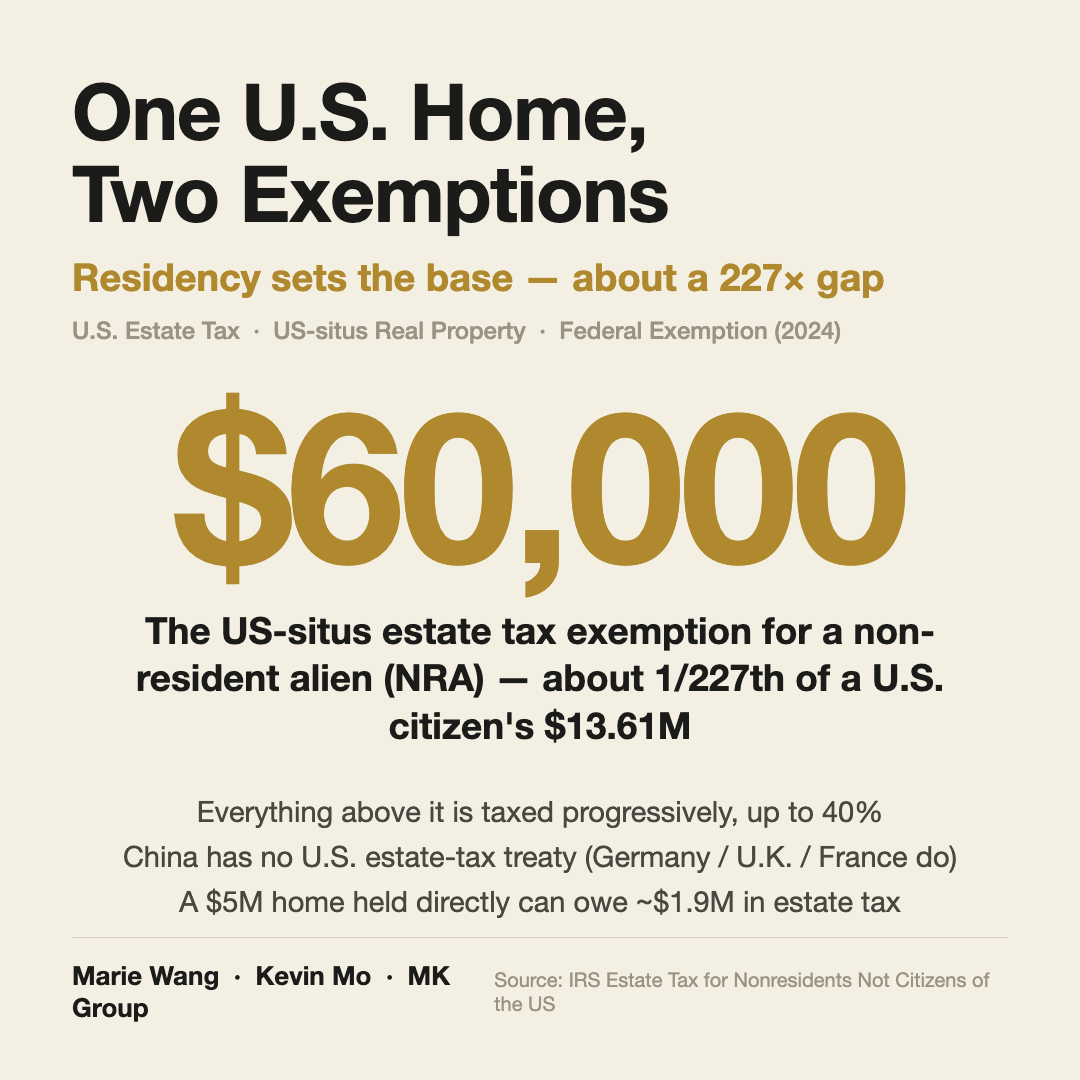
Yes. U.S. real estate is a US-situs asset, so it falls inside the U.S. estate tax net whether or not the owner is a U.S. tax resident. A non-resident's exemption is only $60,000—against $13.61M for a U.S. citizen. On a $5M home held directly in an individual's name, the estate can face roughly $1.9M in federal estate tax, with the top bracket at 40%. Ownership structure can change that outcome—but "all-cash, individual name, direct title" is the most expensive default of all.
Who This Article Is For
This is written for a very specific reader. You—or a member of your family—are a non-resident alien (NRA) under U.S. tax law: you hold a foreign passport, carry no U.S. tax residency, and already own, or are about to buy, a Bay Area home above $5M. You may be an entrepreneur allocating capital across borders from Shenzhen, Shanghai, Hong Kong or Singapore. You may be a high-net-worth family buying in Atherton, Palo Alto or Los Altos Hills for a child's education. Your question is simple: if this home stays in your own name, and one day you are no longer here, will the U.S. government treat it as an estate and tax a large slice of it? And—can that still be managed now, through how the property is held? If your instinct has always been "all-cash, straight into my own name, least fuss," this article is here to explain why, for a cross-border buyer, that is the most expensive default. It is also the single question Marie Wang and Kevin Mo field most often—and see overlooked most often—among cross-border $5M+ buyers.
Three Core Dimensions
Federal estate tax is nothing like the property tax or sale-time withholding you already know. It is a one-time transfer tax levied, at death, on the "U.S.-based assets" held in the decedent's name. For a cross-border buyer, three things come first.
One: your U.S. home is almost certainly a US-situs asset—there is no getting out of it. For non-residents, U.S. estate tax reaches only "US-situs" (U.S.-located) assets—and real property located in the United States is the most typical, least contestable US-situs asset there is. If the house is in Palo Alto, it is a U.S. asset, full stop—independent of whether the owner is American, where the money came from, or whether there is a green card in the picture. Some asset classes (certain U.S. bank deposits, specific securities) carry situs relief for non-residents. Directly held real estate does not. So the question is never "does it enter the estate tax net"—it is "through what structure does it enter, and how much of the excess gets taxed."
Two: the exemption turns on "citizen/green card" versus "non-resident," and the gap is about 227-fold. This is the anchor of the entire article. A U.S. citizen or tax resident (domiciliary) had a 2024 federal estate tax exemption of $13.61M. A non-resident alien's US-situs exemption is only $60,000—delivered through a $13,000 unified credit. The two differ by roughly 227 times. (That $13.61M is a 2024 figure, used here to convey the order of magnitude: the citizen/green-card exemption is indexed to inflation annually, and after OBBBA passed in 2025 it rises to roughly $15M for 2026, while the non-resident's $60,000 is a separate statutory amount that is not indexed. So what actually decides this question is never any single year's number—it is the near-two-orders-of-magnitude gap between the two residency positions.) The same $5M home held by a U.S. citizen may owe zero federal estate tax—still inside the exemption—while in a non-resident's name roughly $4.94M is taxed on the progressive schedule. Establishing the owner's tax status is step one, and the step cross-border buyers most often assume their way past.
Three: whether an estate tax treaty exists decides whether your threshold can rise. The U.S. has signed estate and gift tax treaties with a set of countries, and residents of those treaty countries can often claim exemption treatment far above $60,000 (for example, a pro-rated credit approaching that of a U.S. citizen). Germany, the United Kingdom, France and Japan are among them—but there is no estate tax treaty between China and the United States. For a non-resident buyer from mainland China, the exemption effectively stops at $60,000, with no treaty dividend to draw on. This point is routinely missed: two people can both be "foreign nationals," yet a different passport can produce a very different ending.
A $5M+ Home Held Directly in One Name—What It Actually Owes: Start With These Numbers
The core numbers first. A non-resident alien's US-situs estate tax exemption is only $60,000, and everything above it is taxed on the federal estate tax progressive schedule, topping out at 40%. By IRS-schedule magnitudes, a $5M home held directly by a non-resident, in their own name throughout, faces federal estate tax on the order of $1.9M at death; $8M around $3.1M; $15M around $5.9M—all six- to seven-figure sums. The same homes, held by a U.S. citizen or green-card holder with a total estate inside the $13.61M exemption, can carry $0 in federal estate tax.
The table below takes several common Bay Area luxury price bands and lays out the estate tax magnitude that "non-resident, directly held in one name" implies (the taxable amount is the purchase price less the $60,000 exemption; the tax figure is estimated from the IRS federal estate tax progressive schedule, offered to convey magnitude—not any real transaction, and not a precise tax computation):
| Property value (held directly by individual) | Taxable US-situs estate (less $60K) | Federal estate tax magnitude (IRS schedule estimate) |
|---|---|---|
| $5M | ~$4.94M | ~$1.9M |
| $8M | ~$7.94M | ~$3.1M |
| $10M | ~$9.94M | ~$3.9M |
| $15M | ~$14.94M | ~$5.9M |
The thing to hold onto: the rightmost column is not "tax owed when you sell." It is the one-time federal tax levied on the home as an estate the moment the owner passes—and heirs frequently have to marshal that cash first (sometimes forced to sell the house to fund it) before title can transfer at all. At the $5M+ band, the $60,000 exemption is close to a rounding error, so what decides the burden is never the exemption—it is how the home is held. There is also a rule that works in heirs' favor: U.S. real property generally receives a step-up in basis at inheritance (cost basis reset to fair market value at death), which lifts the capital-gains basis on a future sale—but that addresses "capital-gains tax on a later sale," not "the estate tax owed now."
Data source: The non-resident $60,000 exemption, the $13,000 unified credit, the 40% top rate, Form 706-NA, and the list of estate tax treaty countries all come from official public IRS rules (Estate Tax for Nonresidents Not Citizens of the United States / Estate & Gift Tax Treaties). The U.S. citizen/green-card $13.61M exemption is the 2024 figure and is indexed to inflation annually (raised and locked by OBBBA in 2025; roughly $15M for 2026), used here as an order-of-magnitude anchor; the non-resident $60,000 is a separate statutory amount that is not indexed.
Last updated: 2026-07
Scope: Bay Area real property above $5M held by a non-resident alien (NRA) under U.S. tax law. Table figures are magnitude estimates from applying the IRS progressive schedule to purchase price less the exemption—not real transaction data, and not a tax computation for any specific transaction or individual.
From the MK Group Desk: Settle the Structure Before the Offer Goes In, Not After the Owner Is Gone
MK Group—Marie Wang (DRE# 02110980) and Kevin Mo (DRE# 02127623)—works with a large volume of $5M+ buyers allocating across borders from mainland China, Hong Kong and Singapore, and sees the same pattern repeat: the ownership structure sets this home's future estate tax exposure, and it has to be on the table before the offer goes in—not deferred to closing, and certainly not left until the owner is gone.
In one acquisition for a cross-border ultra-high-net-worth buyer (anonymized), the client's paramount concern was privacy—keeping their name off the public title record. The team's read was that the holding entity had to be locked down before the offer. The buyer ultimately formed a brand-new LLC, held through a BVI (British Virgin Islands) offshore entity, dedicated to holding a single $8M+ property. The immediate aim was privacy (the name disappears from the public record), but the same move forced the "through what entity, with what situs, do we hold U.S. real estate" question onto the table early—and the holding entity is precisely the lever that shapes estate tax exposure. A caution: a disregarded U.S. LLC holding directly does not automatically change the estate tax result—the IRS looks through to the member's tax status. What can actually shift the US-situs determination is a more complex arrangement such as a foreign corporate layer, each with its own trade-offs, designed case by case by an attorney and a CPA.
Another familiar profile: the entrepreneur who flew in from Shenzhen and, in half a day of touring four homes in the $7M–$9M range, locked onto a $9M+ single-level in Los Altos; or the buyer who purchased a newly built 2-acre Atherton estate at $13.5M and prepared to move the whole family in. Their first instinct is almost always "all-cash, clean, straight into my name—simplest." Simple it genuinely is—but for a non-resident it is also the choice that exposes the home's entire value beyond a $60,000 exemption and under a 40% top estate tax bracket. What a cross-border buyer actually needs is not to patch things after the purchase, but to think through—before the offer goes in—who holds it, under what structure, and how it passes on. For more on cross-border compliance and capital pathways, see the Cross-Border Buyer's Guide to Bay Area Real Estate and Buying a Multi-Million-Dollar Silicon Valley Home Without Your Name on the Public Record.
Common Mistakes
Mistake 1: "I'm not American, so the U.S. government has no reach over my U.S. house"
The opposite is true. What U.S. estate tax reaches from a non-resident is precisely "US-situs (U.S.-located) assets," and real property located in the United States is the most typical, least contestable US-situs asset there is. Whether the owner is American, holds a green card, or where the money came from—none of it changes the fact that this home is a U.S. asset. Citizenship offers no help here; if anything, because the non-resident exemption is only $60,000, the exposure is far larger than an American's.
Mistake 2: "Hold it through an LLC and the estate tax just disappears"
It does not hold up. If it is a disregarded U.S. LLC (looked through for tax), the IRS looks straight through to the member's tax status, and the estate tax exposure is no different in substance from holding directly; an LLC mainly addresses privacy and liability boundaries, not estate tax. What can actually change the US-situs determination is a more complex arrangement such as a foreign corporate layer—but those carry their own income tax, compliance and maintenance costs and trade-offs, and are nothing like "wrap it in an LLC and it's tax-free." They must be designed case by case by an attorney and a CPA.
Mistake 3: "All-cash, in my own name—simplest and safest"
For a cross-border non-resident buyer, this is precisely the most expensive default. "Simple" it genuinely is—but it exposes the home's entire value beyond a $60,000 exemption and under a 40% top estate tax bracket. A $5M home implies estate tax exposure on the order of $1.9M; $15M around $5.9M. The value of a structure is not that it saves effort at purchase—it is that, when the property later passes on, heirs are not forced to sell the house to fund the tax.
Mistake 4: "Estate tax and the 15% FIRPTA withholding at sale are the same thing"
They are not. FIRPTA is a 15% income withholding (a prepayment, refundable) taken by the transferee on the sale price when a foreign national sells—it happens at the "sale" moment. Estate tax is a one-time transfer tax levied on the decedent's U.S. assets when the owner passes—it happens at the "transfer" moment. Different stages, different mechanisms, different math. How the sale-time withholding gets refunded is a separate rulebook—see A Foreign Seller in the Bay Area Had 15% of the Sale Price Withheld and Stranded in the U.S.—How FIRPTA Actually Gets Refunded.
Next Steps
- Confirm the owner's tax status first: U.S. citizen/green-card holder (domiciliary, $13.61M exemption), or non-resident alien (NRA, $60,000 exemption)? This step sets the magnitude of the entire question—and is the one most often assumed wrong.
- Settle the ownership structure before the offer goes in, not before closing: direct individual title, LLC, irrevocable trust and foreign corporate layer each carry their own trade-offs and costs; deferring the structure to escrow—or worse, after death—sharply narrows the options.
- Have a cross-border tax attorney and a U.S. CPA build the plan jointly: estate tax, income tax, home-country tax regime, and treaty availability all have to be read together—and China has no estate tax treaty with the U.S., which matters most of all for mainland buyers.
- Keep step-up basis and estate tax separate in the math: the basis reset at inheritance lowers "capital-gains tax on a future sale," but does not reduce "the estate tax owed now"—don't conflate the two.
- View this home inside the whole cross-border succession plan: a single $5M+ home is only one part of a family's U.S. assets; the estate tax exposure should be coordinated with other US-situs assets, insurance, and gifting arrangements.
This article is for decision-making education and does not constitute legal or tax advice; the specific holding structure, estate tax planning and cross-border capital arrangements should be confirmed case by case with your cross-border tax attorney and CPA.