Quick answer
If you are buying an $8M+ Silicon Valley estate and privacy matters to you, the decision that counts is made before you write the offer, not before closing: an LLC keeps your name off the public title record, and a Trust arranges family succession and helps your heirs avoid probate. They solve different problems and are not interchangeable. Leaving the choice until closing directly affects your lender, escrow, title, and the timeline you close on.
Who this article is for
This is written for buyers shopping the Silicon Valley Peninsula and South Bay at $8M and up — eight figures and, in some cases, $20M–$30M — for whom privacy and a low profile come first. In practice that is three kinds of people:
- Founders, tech executives, and entrepreneurs who value a quiet life — what they care about most is that their personal name never appears on the public title record.
- Families planning to live in the home for the long term and pass it to the next generation — their concern is who manages the asset if the owner becomes incapacitated or dies, how the handoff works, and how to reduce the burden on the family.
- High-net-worth families with complex, cross-border holdings — for them this house is one piece of a larger estate plan, and it has to be structured alongside equity, options, and assets held overseas.
If you recognize yourself in one of these, understanding the division of labor between an LLC and a Trust lets you settle the structure before you write the offer — instead of scrambling in the days before closing.
Three core questions to settle first
Many buyers treat "whose name the house goes under" as a closing-week detail. In a high-end estate purchase, that is far too late. Work through three questions before you start.
Question 1: Are you solving for private ownership, or for succession?
This is the step most often confused, and the most important. Do not reduce it to "want privacy, use an LLC; rich person buying a house, use a Trust" — that is a stereotype, not a rule. The two tools start from different places, fit different people, and affect the transaction differently. An LLC answers "who holds the property, how the public record reads, how liability is separated, and how a multi-owner or investment property is managed." A Trust answers "how family assets are arranged, who manages them next, how the property is handed over if the owner is incapacitated or passes away, and how to spare the family a long probate." Decide which problem you are actually solving, then pick the tool.
Question 2: Is this house an asset, or a long-term home?
If the house leans toward being an asset — you might rent it later, or several family members or business partners will co-own it — the direction leans LLC, because an LLC lets you set the ownership rules and liability lines in advance. If this eight-figure residence is your family's primary home and will eventually pass to your children, the direction leans Trust. The use of the home picks the tool; get this step backwards and the whole structure on top of it is wasted. The mechanics of estate tax and probate are involved on their own; we only touch them here. For a fuller treatment, read our companion piece on the holding-structure decision to make before you buy in the Bay Area.
Question 3: Have you locked the structure in before the offer?
The third question is timing. Whether you choose an LLC or a Trust, it has to be settled before you write the offer, because it directly touches the lender, escrow, title, and the recorded deed. If the offer names an LLC, the bank will ask for a full set of LLC documents, an authorized signer, and a clear path for the funds. If the property is meant to land in a Trust, you confirm the deed is recorded correctly with the lender, escrow, and title in advance. Discover the problem at the last minute and the effect on your closing timeline is severe.
What an LLC and a Trust each solve
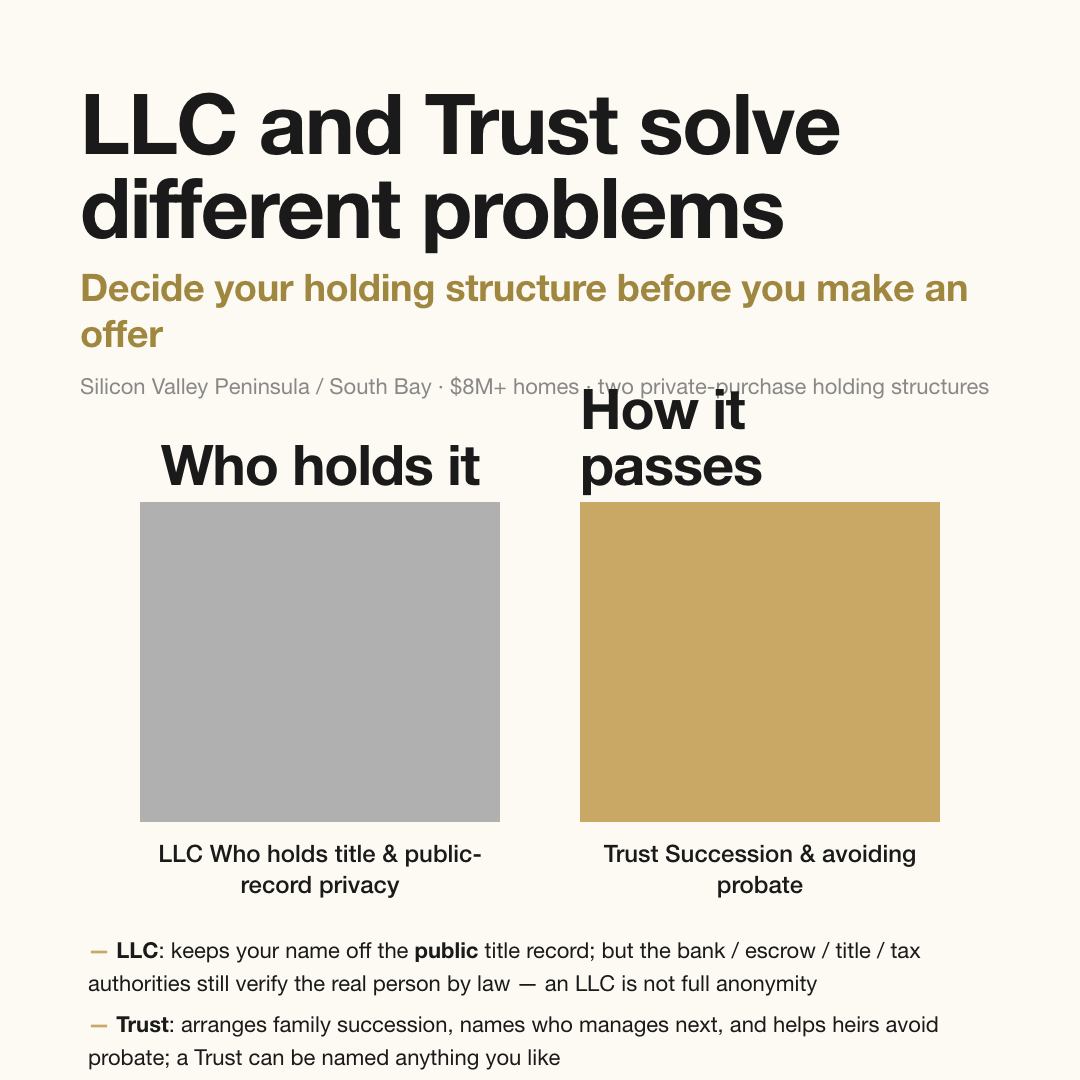
The conclusion first: the main job of an LLC is to make your personal name disappear from the public title record, and it is mostly for low-profile founders and tech executives. The main job of a Trust is to arrange family succession, make clear who manages and hands over the property next, and help the family avoid a drawn-out probate — mostly for long-term homes meant to pass down. The two are not interchangeable. The table below lays their roles, their fit, and their effect on the deal side by side.
| Dimension | LLC (limited liability company) | Trust |
|---|---|---|
| What it mainly solves | Who holds the property, how the public record reads, liability separation, the management rules for a multi-owner or investment property | How family assets are arranged, who manages them next, how the property is handed over on incapacity or death, reducing the family's probate burden |
| Privacy mechanism | The personal name disappears from the public title record, which shows the company name instead; the bank, escrow, title, and tax authorities still verify the real person by law | The Trust can be named anything and does not expose personal information directly (one seller named a Trust after a wild animal) |
| Who it mainly fits | Low-profile founders, tech executives, entrepreneurs; investment, rental, or co-owned property | Families living in the home long term and planning to pass it down; complex estates with cross-border succession |
| Effect on the deal | Triggers heavy lender diligence (LLC documents, authorized signer, source of funds); LLC financing is far more complex than personal financing, which pushes buyers toward all-cash | Requires confirming the deed is recorded correctly with the lender, escrow, and title in advance; timing matters — close in a personal name first and then transfer, and the earlier record does not disappear |
The difference to remember: an LLC makes your name vanish from the public record, but it is not full anonymity — wherever the real person is required by law to appear (bank, escrow, title, tax), they still appear. Deeper privacy does not come from a single LLC; it comes from an offshore layer and a nested structure — for example a BVI entity holding the LLC, which a real case below illustrates. The line most often misread on the Trust side is "just add a name before closing." You cannot. A Trust's deed has to be coordinated in advance, and once the timing slips, the public record left under a personal name does not go away.
Data source
Source: MK Group field observation (based on participation in $8M+ Peninsula / South Bay estate transactions) plus the general legal background on U.S. LLCs and Trusts and on County Recorder public title records. Updated: 2026-06. Scope: privacy-focused buyers of $8M+ homes on the Silicon Valley Peninsula and in the South Bay. Specific LLC / Trust structures and tax consequences should be confirmed with your attorney and CPA.
What MK Group sees in the field
Working on ultra-high-net-worth estate purchases and sales, Marie Wang and Kevin Mo see the same request recur on high-end deals in Atherton, Los Altos Hills, and Palo Alto: the buyer's first concern is not price, it is "keep my name off the public record." The anonymized case below shows exactly where the privacy that an LLC provides ends.
A group of buyers MK Group recently closed were privacy-focused, ultra-high-net-worth buyers fitting the founder / tech-executive profile, in the $8M+ tier. They had one core requirement: not to have a personal name appear in the public title record at the County Recorder. Because the house leaned toward being an asset rather than a long-term family home, the direction landed on an LLC. On the ground, the buyers formed a brand-new LLC created solely to hold this one house, and held that company through a BVI (British Virgin Islands) entity; before writing the offer they had the LLC documents and authorized signer ready and the funds path spelled out (how the money enters escrow and who has authority to move it). The result: the public title record shows the company name rather than a personal one, the buyers' real identity appears only where the bank, escrow, title, and tax authorities verify it by law, and the deal was not slowed by the LLC ownership. This is the point the case keeps returning to — privacy is not full anonymity. Selling "use an LLC and disappear entirely" is misleading; to hide the holder more deeply you need an offshore entity and a nested structure. Quiet purchases like this often close off-market as well; for more, see Silicon Valley's elite circles and how the best homes close off-market.
The Trust side carries an often-overlooked privacy function too: a Trust can be named anything and need not expose personal information — MK Group once worked with a seller who named their Trust after a wild animal. Kevin Mo also flags an execution detail: financing through an LLC entity, which he has tried himself, is far more complex than personal financing — so at this tier, buyers who can pay all-cash should, which sidesteps LLC financing, the step most likely to go wrong. Buyers moving funds across borders should first read our cross-border guide to funds and holding structures to get the funds path in order.
Common misconceptions
"Want privacy, use an LLC; rich buyer, use a Trust."
This is the most common stereotype. An LLC and a Trust start from completely different places: an LLC handles "who holds it, how the public record reads, and liability separation," while a Trust handles "arranging family assets, who manages them next, and how succession is handed over." Privacy-focused founders are more likely to use an LLC, but a family living in the home long term and planning to pass it down needs a Trust rather than an LLC, however wealthy they are. Decide which problem you are solving, then pick the tool — do not map it to "how much money you have."
"Once I use an LLC, my identity is fully anonymous."
It is not. An LLC makes your name disappear from the public title record, but the bank, escrow, title company, and tax authorities still surface the real person wherever the law requires it — an LLC is not full anonymity. On top of that, a company registered in the U.S. has public filings that can show who the holder is. To hide the holder more deeply you need an offshore entity and a nested structure (for example, holding the LLC through a BVI entity), not a single LLC and a sense that the job is done.
"The holding structure can wait until just before closing."
Too late. Once the offer names an LLC, the bank asks for LLC documents, an authorized signer, and a funds path; if the money is still in a personal account, you have to explain the relationship between you and the LLC in advance, who has authority to move it, and how it enters escrow. Prepare all of that in the days before closing and it is the easiest way to slow or stall the deal. The same is true for a Trust — to have the property land in a Trust's name, the deed has to be confirmed with the lender, escrow, and title in advance. The right moment is before you write the offer.
"The more complex the structure, the safer — I'll build my own LLC-and-Trust setup."
A structure is not better for being more complex; what matters is whether it fits your situation and whether the deal can close cleanly. The logic is actually clear: leaning investment or rental, use an LLC directly; long-term home, use a Trust directly; only when a single property is both an investment and a future inheritance do you consider a combination like "multiple LLCs held under a Trust." But do not rig it yourself — decide the use first, then have a professional team (including an attorney who specializes in Trusts) check that it works on the ground. A complex structure you assembled yourself tends to expose its problems at the last moment, when no one can untangle it — which is the most dangerous outcome of all.
Next steps
- Decide the holding direction before you tour or write an offer: ask whether this house is an asset or a long-term home, which maps to an LLC or a Trust — don't wait until closing week to think about it.
- If you go the LLC route, have three things ready in advance: the LLC formation documents, the list of authorized signers, and a clear funds path (how the money enters escrow and who can move it).
- If you go the Trust route, confirm the deed with the lender, escrow, and title in advance: make sure the deed is recorded correctly and the timing is arranged, so you don't leave a public record under a personal name.
- When you need deeper privacy, ask about an offshore plus layered structure: a single LLC only removes your name from the public record; an offshore entity (such as a BVI company) holding the LLC is what hides the holder more deeply.
- Run the holding structure together with the whole estate plan: have the Trust attorney, the CPA, and the brokerage team aligned, confirming the structure protects privacy and still lets the deal close cleanly.
This article is for decision-making education and does not constitute legal or tax advice; confirm specifics with your attorney and CPA.