The short answer
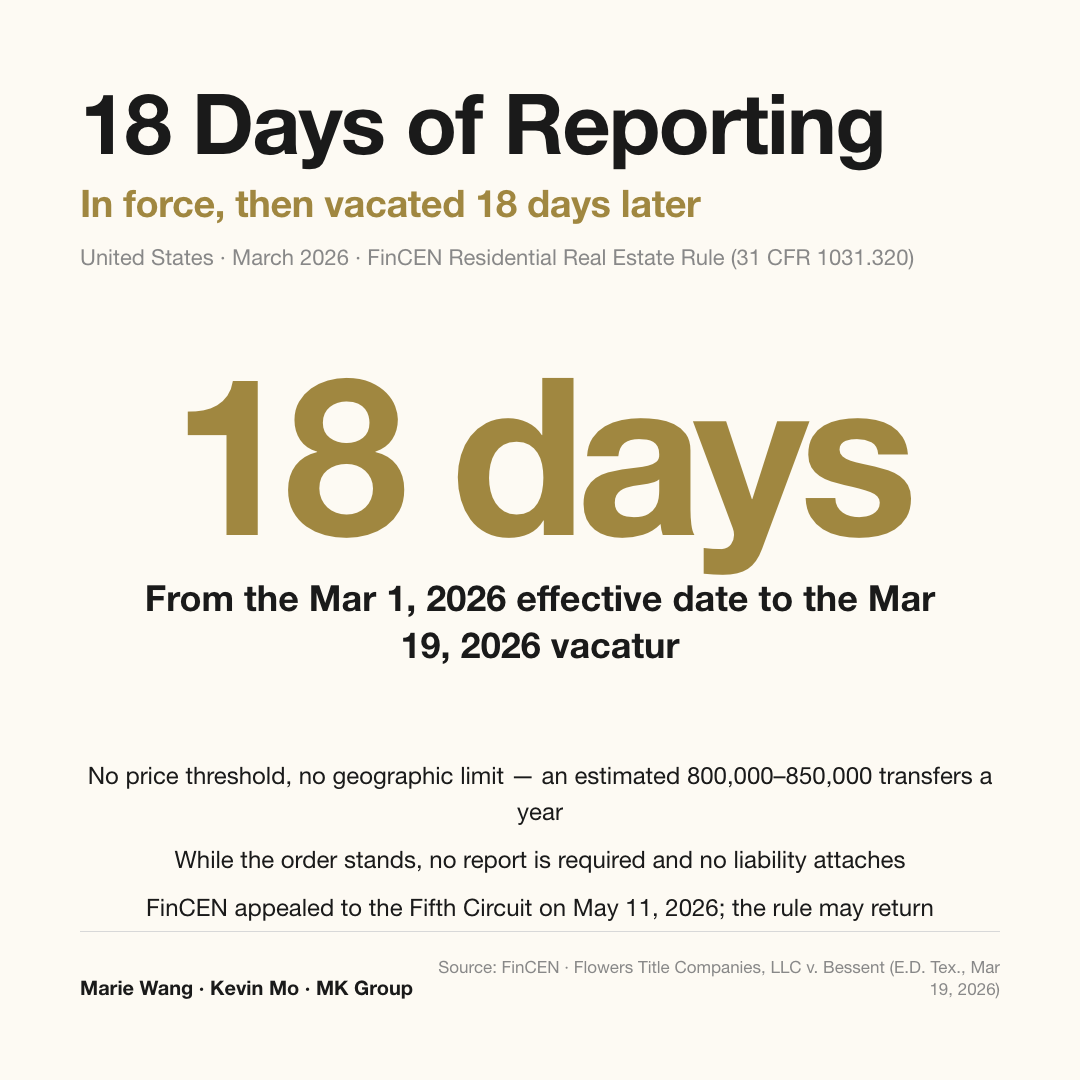
The rule (31 CFR 1031.320) did take effect on March 1, 2026 — and it survived 18 days. On March 19 a federal court vacated it in full. As of July 2026, a Bay Area all-cash closing taken in the name of an entity or a trust requires no FinCEN filing. But FinCEN has appealed, two other federal district courts have upheld the same rule, and it could come back at any point.
While it was live, its reach worked like this. Any transfer of U.S. residential property that was non-financed and taken in the name of a legal entity or a trust required a Real Estate Report, filed with FinCEN by a designated reporting person in the settlement chain. The report named the transferee, its beneficial owners, the individual signing on the buyer's behalf, the transferor, the property, the total consideration, and every payment method with its amount. There was no price floor and no geographic limit; FinCEN estimated the rule would capture roughly 800,000 to 850,000 transfers a year nationwide. On March 19, 2026, the U.S. District Court for the Eastern District of Texas held in Flowers Title Companies, LLC v. Bessent (No. 6:25-cv-127) that the rule exceeded the authority granted by the Bank Secrecy Act, and vacated it in full, nationwide. The judicial record, however, is not uniform. Before that judgment, the Middle District of Florida (Fidelity National Financial, Inc. v. Bessent, February 19, 2026) and the Lubbock Division of the Northern District of Texas (Corley v. U.S. Dept. of the Treasury, February 25, 2026) had each upheld the rule as lawful, and the plaintiffs in the first of those have appealed. FinCEN then confirmed that while the vacatur stands, reporting persons need not file a Real Estate Report and incur no liability for not filing. On May 11, 2026, through the Department of Justice, FinCEN appealed to the Fifth Circuit; in an FAQ updated May 18, 2026, it added that even if the vacatur is later reversed, it will not require retroactive filing for transactions closed during the gap.
Who this article is for
This is written for a buyer with a very specific profile. You are purchasing a residence above $5M on the Peninsula or in the South Bay — Palo Alto, Atherton, Los Altos Hills, Menlo Park, Hillsborough — and the transaction has two features at once: no mortgage, and title that will not be taken in an individual's name. Instead it goes to an LLC, a holding company, a family trust, or a longer offshore chain. You may be buying through a corporate entity or from a family-office background, or you may have just formed a single-purpose holding entity for privacy and liability separation.
What you actually want to know is not whether the rule is good policy. It is four concrete things: whether this closing falls inside the reporting perimeter, who files if a filing is due, what documents you have to hand over to get there, and where your name ends up once the filing is made. This article answers those four as they stand in July 2026 — including where the rule sits today, and why the file you would have needed is worth assembling even while the rule is dormant. It applies equally to family offices and cross-border tax advisors evaluating a holding structure on a client's behalf.
Three dimensions that decide what you actually do
It is easy to read this rule as a yes-or-no question. What determines your work is three different layers: whether the structure of the transaction triggers coverage at all, who carries the duty and what they need from you, and how far the reported information travels once it is filed.
One — the four questions that decide coverage
While the rule was in force, four independent conditions had to hold simultaneously for a transfer to be covered. Fail any one of them and the transaction sat outside the perimeter.
First: is there a mortgage. The rule targeted non-financed transfers — acquisitions that did not rely on credit extended by a financial institution subject to anti-money-laundering obligations and secured by the property. All-cash is the classic form; seller financing and private lending can also count as non-financed. Conversely, if the buyer used institutional mortgage financing from a lender with AML and suspicious-activity reporting duties, the transfer was outside the rule — because that lender had already performed diligence inside a separate regime. This is also why the rule was always denser at the Bay Area luxury tier than the national average would suggest: the higher the price, the higher the cash share.
Second: is the transferee an individual. A transfer taking title directly in a person's name did not trigger the rule. What triggered it was a transferee entity — LLC, corporation, partnership — or a transferee trust. The rule itself also carved certain already-regulated parties out of the transferee-entity definition, including public reporting companies under the securities laws, regulated banks, and certain regulated financial institutions. The test is plain: does the deed name a person, or an entity.
Third: is it residential. Coverage ran to single-family houses, townhouses, condominiums, cooperatives, apartment buildings and units within them, mixed-use property with a residential component, and vacant land intended for construction of any of the above. Land transactions at the Bay Area luxury tier — particularly the teardown-and-rebuild category — needed a separate look.
Fourth: does an exemption apply. The rule listed a set of transfers treated as lower risk and excluded from reporting: transfers on death; transfers incident to divorce or dissolution of marriage; transfers into a bankruptcy estate; court-supervised transfers; a transfer by an individual, without consideration, into a trust of which that individual or their spouse is the settlor; easement transfers; 1031 exchanges involving a qualified intermediary; and any transfer where no reporting person of any kind appears in the chain.
Four yeses meant the transfer had to be reported while the rule was live. Note what that last exemption implies: moving your own home into your own living trust for succession purposes and buying a $10M house all-cash through a newly formed LLC were never the same transaction in this rule's eyes.
Two — who files, what goes in it, and by when
The duty does not sit with the buyer. That is the single most misread feature of the rule. It set out a seven-tier reporting cascade, landing on the first role that exists: the settlement agent named on the closing statement; then the person who prepared the closing statement; then the person who files the deed for recording; then the title insurance underwriter; then whoever disburses the largest amount of funds from the escrow account; then whoever performs the title examination; then whoever prepared the deed. The parties could also designate a reporting person among themselves by written agreement. In Bay Area practice, this lands on the title and escrow side in the overwhelming majority of transactions.
But the duty sitting elsewhere does not mean the buyer has nothing to do. The report called for information about the reporting person, the transferee entity or trust, the transferee's beneficial owners, the individual signing on the transferee's behalf, the transferor, the property, and the total consideration together with every payment method and its amount. Beneficial owner carries the same definition as FinCEN's beneficial ownership information (BOI) reporting rule: an individual who directly or indirectly exercises substantial control over the transferee entity, or who owns or controls at least 25% of its ownership interests. There is only one place title and escrow can get any of that — from you. The filing deadline was the later of the final day of the month following closing, or 30 days after closing.
So what the buyer actually assembles is three stacks. Entity proof: formation documents, a certificate of good standing, the operating agreement or trust instrument, and authorizing resolutions. Controlling-party identity: passport or other identification, and tax identification numbers. Source and path of funds: which entity's account the money leaves, who has authority to move it, and what each cross-border hop consists of. The moment an offer is written in an LLC's name, the bank, escrow, and title all begin asking for a full document set, signature authority, and a funds path — and assembling that on short notice slows a transaction down. Those three stacks have destinations well beyond a FinCEN filing, which is the subject of a later section.
Three — where the reported information stops
This is the layer that matters most to the buyer whose priority is privacy. A Real Estate Report goes to FinCEN and into its secure BSA reporting database, searchable by authorized users in law enforcement, intelligence, and national security under strict use and re-dissemination restrictions. Those reports are not open to the public and are exempt from disclosure under the Freedom of Information Act. They do not enter the County Recorder's public land records — what appears there is still the entity named on the deed.
Put differently: the layer of public-record privacy you buy by holding through an entity or a trust does not disappear because of this rule. What changes is something else. Inside a non-public database, one more searchable line now connects you to this house. Holding both of those sentences at once is more useful than memorizing any date.
The rule's own timeline: 18 days
The number first. The rule was finalized in the Federal Register on August 29, 2024, and did not land until March 1, 2026, having been postponed once along the way. From its effective date to its nationwide vacatur, 18 days passed. Its present state is suspended, not repealed — FinCEN appealed to the Fifth Circuit on May 11, 2026, and before the vacatur two other federal district courts had upheld the rule in parallel litigation, with the plaintiffs in one of those appealing to the Eleventh Circuit. The rule can come back.
| Date | What happened | What it means for an entity or trust all-cash buyer |
|---|---|---|
| 2024-08-29 | Final rule published in the Federal Register, codified at 31 CFR 1031.320, originally effective 2025-12-01 | First national reporting framework with no price floor and no geographic boundary |
| 2025-09-30 | FinCEN issues exemptive relief, moving the compliance date to 2026-03-01 | The rule was neither amended nor withdrawn; only the duty was deferred |
| 2026-02-19 | M.D. Fla. upholds the rule in Fidelity National Financial, Inc. v. Bessent; plaintiffs later appeal to the Eleventh Circuit | Two district courts upheld the rule first — the judicial record is split |
| 2026-02-25 | N.D. Tex., Lubbock Division, likewise upholds the rule in Corley v. U.S. Dept. of the Treasury; the same day Puerto Rico Privacy Association v. Treasury is filed in D.P.R., later stayed pending the Flowers appeal | Vacatur is not the only judicial conclusion available; do not read it as final |
| 2026-02-28 | The prior residential real estate GTO (in effect from 2025-10-10) expires | The older metro-area-plus-price-threshold framework gives way to the new rule |
| 2026-03-01 | The rule takes effect | Covered transactions closing in the next 18 days genuinely did carry a filing duty |
| 2026-03-19 | E.D. Tex. holds in Flowers Title Companies, LLC v. Bessent (No. 6:25-cv-127) that the rule exceeds Bank Secrecy Act authority; vacated in full, nationwide | Reporting persons need not file and incur no liability for not filing |
| 2026-05-11 | FinCEN, through the DOJ, appeals to the Fifth Circuit | The rule may return; confirm with title and escrow at the opening of each escrow what they are collecting |
| 2026-05-18 | FinCEN updates its FAQ | Confirms that even if the vacatur is reversed, no retroactive filing will be required for gap-period transactions |
What to take away: the most operationally useful cell in this table is not the vacatur date. It is the 2026-02-28 row. The older GTO program ran on metro areas and price thresholds, with title insurers carrying the collection duty, and that is the framework our earlier articles on this site described. It expired at the end of February 2026 and handed off to the new rule, which was struck down 18 days later. As of late July 2026 we see no publicly announced new residential real estate GTO from FinCEN (fincen.gov announcements govern). So at this moment neither the old "over $300K all-cash gets reported" narrative nor the new "everything nationwide gets reported" narrative applies. The correct posture is to treat this as unsettled, and to ask your title and escrow company directly, at the opening of escrow, what standard they are collecting to on this particular file. Until the Fifth and Eleventh Circuits rule, that cell can flip again.
Which Bay Area closings sit inside the rule's range
The numbers first. Cash density rises sharply with price. MLSListings data for the second quarter of 2026 shows that of 279 closings between $5M and $10M in the Bay Area, 44.4% were all-cash; between $10M and $20M, 71.8% of 39 closings; above $20M, 75.0% of 8. In the market's highest-volume band, $1.5M to $3M, only 15.7% of 2,515 closings were all-cash. By city, Atherton recorded 31 closings that quarter at a $10,000,000 median and a 64.5% cash share; Hillsborough 48 closings at 52.1%; Palo Alto 139 at 36.0%; Los Altos Hills 32 at 34.4%.
| Group | Closings this quarter | All-cash share | Median closing price |
|---|---|---|---|
| $1.5M–$3M | 2,515 | 15.7% | $1,965,000 |
| $3M–$5M | 822 | 26.8% | $3,600,000 |
| $5M–$10M | 279 | 44.4% | $6,000,000 |
| $10M–$20M | 39 | 71.8% | $12,750,000 |
| $20M+ | 8 | 75.0% | $22,375,000 |
| Atherton | 31 | 64.5% | $10,000,000 |
| Hillsborough | 48 | 52.1% | $6,500,000 |
| Palo Alto | 139 | 36.0% | $4,100,000 |
| Los Altos Hills | 32 | 34.4% | $5,725,000 |
What to take away: this table measures one condition — the absence of a mortgage — not the reporting perimeter itself. The rule required all four conditions at once, and a substantial share of cash closings are still individuals taking title in their own name or in a living trust; of the latter, the transfer of a home without consideration into a trust settled by the individual or their spouse sat inside an exemption. So these percentages are a ceiling on coverage, not coverage. Read them for the gradient instead: only 15.7% of transactions in the $1.5M–$3M band clear even the first condition, against 71.8% in the $10M–$20M band. Almost the entire weight of this rule fell on the Bay Area luxury tier — which is why its practical texture in a city like Atherton or Hillsborough looks nothing like its national average portrait.
Data source: The text of the FinCEN residential real estate rule (Anti-Money Laundering Regulations for Residential Real Estate Transfers, 31 CFR 1031.320) — its coverage, exemption list, reporting cascade, report contents, filing deadline, and the beneficial-owner standard (substantial control or at least a 25% ownership interest, identical to FinCEN's BOI reporting rule) — comes from the final rule published in the Federal Register on August 29, 2024, together with FinCEN's official Fact Sheet and RRE FAQ. The compliance date moving from December 1, 2025 to March 1, 2026 rests on FinCEN's exemptive relief order of September 30, 2025. The nationwide vacatur rests on Flowers Title Companies, LLC v. Bessent (U.S. District Court for the Eastern District of Texas, No. 6:25-cv-127, final judgment March 19, 2026). The two parallel cases upholding the rule are Fidelity National Financial, Inc. v. Bessent (M.D. Fla., February 19, 2026; the plaintiffs have appealed to the Eleventh Circuit) and Corley v. U.S. Dept. of the Treasury (N.D. Tex., Lubbock Division, February 25, 2026); a fourth case, Puerto Rico Privacy Association v. Treasury (D.P.R., filed February 25, 2026), is stayed pending the Flowers appeal. Case posture is compiled from the published decisions and from June 2026 law-firm practice summaries. FinCEN, through the Department of Justice, appealed to the Fifth Circuit on May 11, 2026; the confirmation that no report is due while the vacatur stands and that no retroactive filing will be required for the gap period comes from FinCEN's FAQ as updated May 18, 2026. The estimate of 800,000–850,000 covered transfers a year is FinCEN's own, stated in the rule. The point that a Real Estate Report is not public, is exempt under FOIA, and is stored in the BSA reporting database for authorized users under use and re-dissemination restrictions also comes from the rule. The effective period of the prior residential real estate GTO (October 10, 2025 through February 28, 2026) comes from FinCEN's announcements. Closing counts and all-cash shares come from MLSListings, compiled in MK Bay Area Pulse 2026 Q2, measured as closed single-family sales in that quarter grouped by price band and by city.
Updated: 2026-07
Scope: Peninsula and South Bay residential property at $5M+, taken in the name of a legal entity or a trust without institutional mortgage financing. The status of the rule moves with the Fifth Circuit and Eleventh Circuit appeals; before acting, rely on the current announcements at fincen.gov and on what your title and escrow company is collecting at the time of your transaction.
This article is decision education. It is not legal or tax advice.
What MK Group has seen on the ground: the file has three other destinations
Taken on its own, this rule reads like something policy requires you to do. But in a real transaction above $10M, the three stacks of paper it asked for were already unavoidable. The filing was only their fourth destination.
In May 2026, MK Group represented a buyer on a roughly $11M all-cash purchase in Los Altos Hills. The buyer was a corporate entity with a family-office background, and the deal was locked in two weeks. What is worth noticing is what the team did not do: it did not advise the client to write an ultra-short close. At this price a house behaves more like an ultra-luxury asset — where the money comes from, which entity pays, whether authorizing documents are needed, all of it has to be resolved in advance. The approach was to settle the ownership structure, the funds path, and the document coordination first, and only then push the transfer forward, working through the legal terms and the corporate ownership chart alongside it. Three questions came up over and over on that file: whose name are we buying in, how does the money travel, and how will this be held going forward. (See the case study: A ~$11M all-cash purchase in Los Altos Hills — two-week lock, entity ownership, and two independent circles of referral.)
Set those three questions against the second dimension above and you will see that their answers are very nearly the fields a Real Estate Report asked for — the transferee entity, the payment methods and amounts, the beneficial owners. Which means a team that has worked at this tier does not have to change how it works because of this rule. The only thing that changes is that those answers, already going to the bank, escrow, and title, acquire one more recipient. The real risk on a deal where the structure was not settled early was never one extra form. It is starting to explain the relationship between an individual and an entity to a bank and an escrow officer a week before closing.
On the privacy layer, another MK Group cross-border transaction draws the line more precisely. A privacy-focused ultra-high-net-worth buyer acquiring an $8M+ luxury home formed a brand-new LLC for the sole purpose of holding that house, and held that company through a BVI (British Virgin Islands) entity. The judgment Marie Wang (DRE# 02110980) and Kevin Mo (DRE# 02127623) reached was that the holding structure has to be fixed before the offer goes in — because once an offer is written in an LLC's name, the bank, escrow, and title will require a full document set, a signature authority, and a funds path, and assembling that late slows the deal. They were equally explicit with the client about where privacy ends: an LLC removes the name from the public record, but where a bank, escrow, title company, or tax authority is required by law to verify a real individual, the individual still appears. An LLC is not anonymity. (See the case study: A privacy-focused UHNW buyer acquires a luxury home through a newly formed LLC held via a BVI entity — keeping the name off the public record.)
That boundary has nothing to do with whether the FinCEN rule is alive, and that is exactly why it explains what the rule actually changed. Whether the reporting duty exists changes how many institutions sit on the verify-by-law list. It has never changed the underlying structure — your name is absent from the public land record and present wherever verification is legally required. Treating FinCEN's on-or-off status as the switch for privacy mistakes one variable for the whole system.
Common mistakes
Mistake 1: "This is a new tax on foreign buyers, or on cash buyers."
It is not a tax. It is a reporting obligation, and the two are different in kind. The rule creates no liability, changes no rate, and turns on neither the buyer's nationality nor their tax residency — it is an information-reporting requirement under the Bank Secrecy Act, built so that law enforcement can see the individuals behind non-financed transfers held by entities and trusts. Not one of the four coverage conditions asks whether you are foreign. What genuinely touches tax is a set of separate regimes: FIRPTA withholding when a foreign person sells, the U.S. estate tax exposure a non-resident carries on U.S. real property, and the reporting requirements attached to cross-border fund movement itself. Each has its own thresholds and its own forms, and none of them moves with the status of this rule. Separately, beneficial ownership information (BOI) reporting under the Corporate Transparency Act is another independent regime whose scope has been adjusted several times in recent years; confirm it on its own terms rather than inferring it from this one.
Mistake 2: "The buyer has to go file it on FinCEN's website."
Generally not. The rule places the duty on a reporting person in the settlement chain, landing through a seven-tier cascade on the first role that exists: the settlement agent on the closing statement, the preparer of the closing statement, the person filing the deed for recording, the title insurance underwriter, whoever disburses the largest amount from escrow, whoever performs the title examination, whoever prepared the deed — with the parties free to designate a filer in writing. In Bay Area practice this is almost always the title and escrow side, and the buyer never opens an account or submits anything. But the information can only come from the buyer: entity formation documents and authorizing resolutions, the identification and tax numbers of the beneficial owners, the individual signing on the entity's behalf, and the total consideration along with each payment's method and amount. The right posture is therefore not "not my problem," but "not my filing, my documents" — and the documents want to be ready before the offer is written, not the week before closing.
Mistake 3: "The rule was struck down, so nobody is watching these transactions anymore."
This does not hold, and it is currently the most dangerous misreading available. First, a vacatur is an appealable interim state, and the judicial record is far from settled: shortly before the Eastern District of Texas vacated the rule, the Middle District of Florida (Fidelity National Financial, Inc. v. Bessent, February 19, 2026) and the Lubbock Division of the Northern District of Texas (Corley v. U.S. Dept. of the Treasury, February 25, 2026) had each upheld it, and the plaintiffs in the first have appealed to the Eleventh Circuit. FinCEN appealed the vacatur to the Fifth Circuit on May 11, 2026, and its only commitment is that gap-period transactions will not be reported retroactively — not that it will stop asking. Two federal district courts have said this rule stands up; the one that vacated it simply happened to do so nationwide. Second, before this rule the same category of information was collected through FinCEN's GTO program by metro area and price threshold; the most recent round expired February 28, 2026, and whether another is issued is FinCEN's call. Third, and most easily forgotten: a bank's account-opening and inbound-wire diligence, escrow's source-of-funds verification, and title's signature-authority and entity-capacity review have never depended on this rule existing. A $10M payment made through a newly formed offshore structure gets questioned at every link whether or not FinCEN wants a form. The real compliance work lives in those links, not in the form.
Mistake 4: "Holding through an LLC or a trust means nobody knows the house is mine."
Two sentences, and they have to stay separate. "The name does not enter the public land record" is true — hold through an entity or a trust and what the County Recorder shows is the entity's name, which is the central reason privacy-driven buyers take this route at all. "Nobody knows" has never been true: banks, escrow, title companies, and tax authorities all verify a real individual where the law requires it, and the individual appears there. While it was in force, a Real Estate Report added exactly one recipient to that list, and it went into FinCEN's non-public BSA database, exempt under FOIA, searchable only by authorized users under use restrictions — never into a land record anyone can pull. If your privacy requirement is that a neighbor, a competitor, or a reporter cannot find you in public records, entity ownership still works. If your expectation is that no institution can find you, that expectation never existed in U.S. real estate, and any advice sold on it deserves scrutiny.
Next steps
- Fix the holding entity before the offer is written, not before closing. This is the one action in this article that holds whether or not the rule is alive. The moment an offer names an entity or a trust, the bank, escrow, and title all start a full document and authorization sequence at once, and forming an entity or chasing an authorization mid-deal is the fastest way to break a timeline.
- Assemble the three stacks in advance. Entity proof (formation documents, certificate of good standing, operating agreement or trust instrument, authorizing resolutions); beneficial-owner identity (passport or other identification and tax numbers, tested against the substantial-control or 25%-ownership standard); and source and path of funds (paying entity, accounts, and an explanation of each hop). Beyond any filing, these same stacks go to the bank, to escrow, and to title. Prepare once, use four times.
- At the opening of escrow, ask title and escrow what standard they are collecting to on this file. The vacatur is on appeal and firms are handling it differently, so confirm it file by file rather than assuming it matches your last transaction. Better asked at the front than added as a requirement later.
- Evaluate this rule and your privacy plan separately. How ownership appears in the public land record, how much is disclosed in legally required verification, and what is searchable inside a non-public database are three different things. Decide who you actually need to be shielded from before deciding how many layers the structure needs.
- Put your CPA and your cross-border attorney at the same table on structure. Once a holding structure involves an offshore entity, it moves reporting, income tax, estate tax, and the exit path all at once; consulting on those separately is how clients end up with conclusions that contradict each other. For background, see Buying a Multi-Million-Dollar Silicon Valley Home Without Your Name on the Public Record and Trust or LLC: how to hold a Bay Area home.
The status of the FinCEN residential real estate rule moves with the Fifth Circuit and Eleventh Circuit appeals; everything described here reflects the position as of July 2026. Coverage, exemptions, the identification of a reporting person, and the beneficial-owner standard all apply as published in the current announcements at fincen.gov and in the text of the rule. Where holding-structure design, cross-border fund movement, offshore entities, or estate-tax planning are involved, work through each item with your CPA, a cross-border tax attorney, and a California real estate attorney before acting.
Further reading: Buying a Multi-Million-Dollar Silicon Valley Home Without Your Name on the Public Record, Trust or LLC: which structure should hold your Bay Area home, A Non-Resident Foreign National Bought a $5M+ Bay Area Home — Does the Estate Owe 40% U.S. Estate Tax?.