The short answer
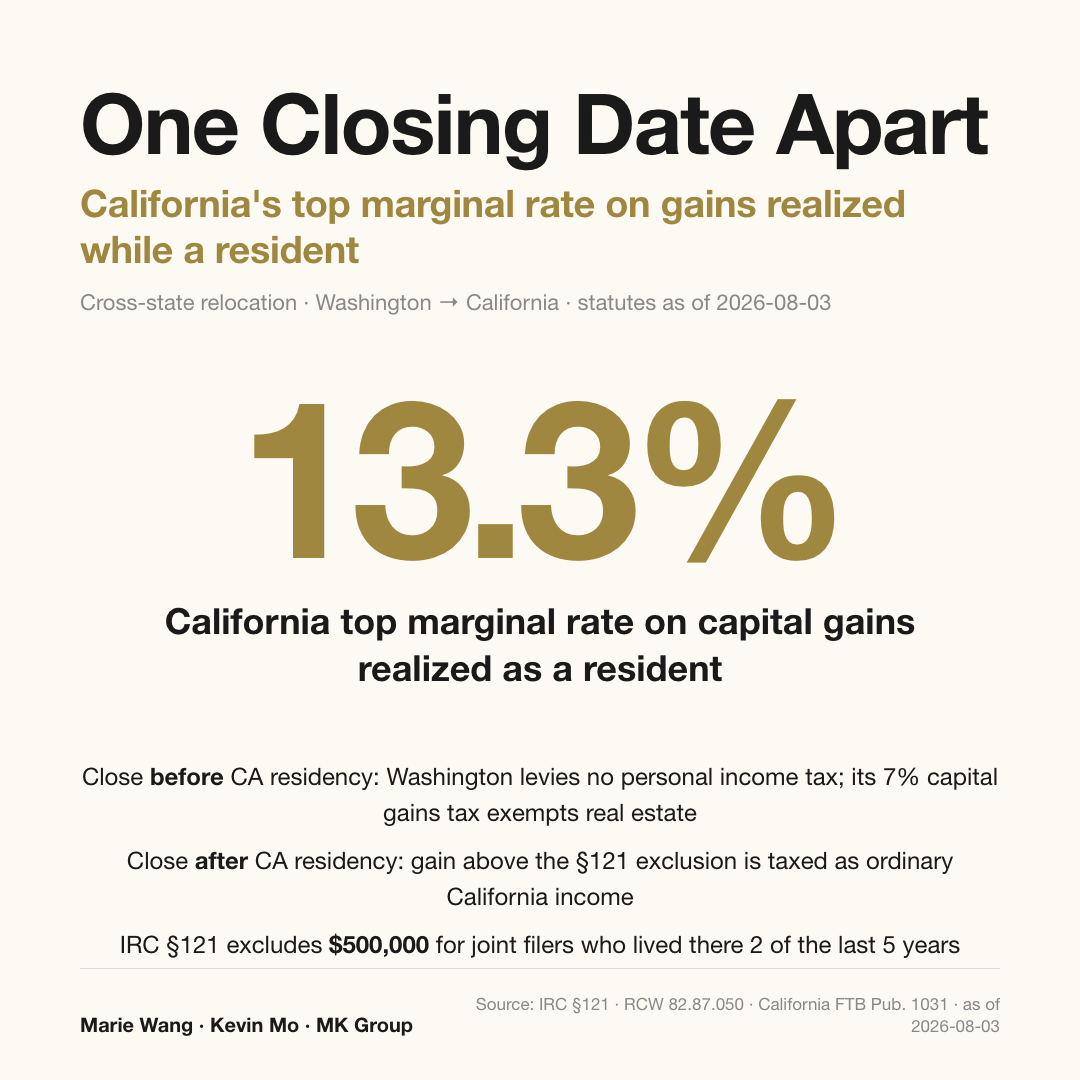
Sell first. Close the Seattle house before you become a California tax resident and the gain above the §121 exclusion is taxed by neither state. Close after, and California folds that same gain into your state return at a top marginal rate of 13.3%.
How much that sentence is worth depends on how far the house ran. Take an illustrative set of numbers: bought in 2016 for $1.1M, sold in 2026 for $2.6M, with roughly $1.4M of taxable gain after capital improvements and selling costs. A married couple filing jointly applies the $500,000 §121 exclusion and about $900,000 remains. The federal layer is owed no matter where you live; sequence cannot move it. The state layer is a clean switch. Close while you are still a Washington resident and the state income tax on that $900,000 is zero. Close after California residency has attached and the same $900,000 joins your California ordinary income, landing in the 11.3%-13.3% marginal band under the 2026 California rate structure — a state tax bill in the low six figures. That band reflects the excess gain stacked on top of two tech salaries in a single year, not the gain standing alone; viewed in isolation, $900,000 of gain would not necessarily reach the 11.3% bracket for a joint filer. This is not a tax strategy. It is a question of which side of a line the closing date falls on. (Illustrative arithmetic, not any actual transaction; your own figures turn on basis, improvements, other income that year, and filing status.)
Who this article is for
This is written for a household in a very specific position. You and your spouse live in Seattle. You own a home you have lived in for years and it has appreciated substantially. Because of your children's schooling, a transfer at work, or both, you have decided to move the whole family to the Peninsula — Palo Alto, Menlo Park, Los Altos — with a landing budget somewhere between $4M and $8M. This is not portfolio allocation. It is one relocation, done once.
What you want to know is not whether Bay Area prices are high. It is four questions about sequence: whether the Seattle house should sell before or after the move; what each state taxes and expressly does not; where the line called "California tax residency" actually sits and who draws it; and, if you rent the house out instead of selling, which year the bill quietly arrives. Those four are the whole scope of this piece.
The same logic applies to families arriving from Texas, Nevada, Florida, or any other state without a personal income tax. The rate figures differ; the question of which side of residency the closing date falls on does not.
Three dimensions that decide the outcome
One: the §121 two-of-five-year clock decides whether you qualify for zero at all
This is the first layer, and the only one that can take your tax to nothing. IRC §121 provides that if, during the five years before the sale, you owned the property for two years (the ownership test) and lived in it as your principal residence for two years (the use test), a single filer may exclude $250,000 of gain and a married couple filing jointly may exclude $500,000. The two years need not be continuous — 24 months in aggregate is enough — and the exclusion may be claimed only once every two years.
For a family that has just moved out of Seattle, the test is almost automatically satisfied at the moment of the move; you were living there weeks ago. The risk is not now, it is later. The five-year lookback rolls forward from the day you move out, and after three years away the two-of-five test fails and the $500,000 exclusion goes to zero — not reduced, gone. How the excess is actually taxed, and which costs may be added to basis, is covered in a companion piece, when the $500K exclusion is nowhere near enough. This article uses only its conclusion.
Two: Washington and California treat the identical gain in opposite directions
The Washington side is clean. The state levies no personal income tax. In 2022 it began collecting a 7% long-term capital gains tax, but real estate was carved out from the start — RCW 82.87.050 expressly exempts gains from the sale of real property. In other words, selling a Seattle primary residence as a Washington resident produces no state income tax on the portion of the gain above the §121 exclusion.
California runs the other way, twice over. First, California taxes a resident's income from all sources (R&TC §17041), regardless of where that income arises. Second, California grants no preferential capital gains rate — long-term gain is taxed as ordinary income, topping out at 12.3% plus the 1% Mental Health Services surcharge on taxable income above $1M, for 13.3% combined. Note that these brackets look at combined taxable income: the excess gain does not queue separately, it stacks on top of your wages for that year. For a dual-income tech household, salary alone has already raised the starting point, and adding a seven-figure gain realized in a single year pushes the marginal rate to the upper end of that 11.3%-13.3% band almost by construction. The same gain standing alone, with no salary beneath it, would land materially lower.
On part-year residency: California's rule is that all income received while you are a California resident is reported to California, whatever state it came from (FTB Publication 1031). A capital gain is realized on the day escrow closes. So this is not a proration you can adjust after the fact. It is a binary decided by the closing date.
One cost worth naming that has nothing to do with sequence, because people leave it out of the math: Washington's real estate excise tax (REET) is paid by the seller, assessed by the state on a graduated scale by sale price — roughly 1.1%-3%, with local add-ons, per the brackets published by the Department of Revenue at the time of sale. You owe it whether you sell first or last. Keep it out of the sequencing column.
Three: California residency is a finding of fact, not a square on the calendar
This is the point most often misjudged. California has no "stay under 183 days and you are safe" line. R&TC §17014 defines a resident as someone in California for other than a temporary or transitory purpose, and also as someone domiciled in California who is outside the state for a temporary or transitory purpose. The method the FTB sets out in Publication 1031 is to weigh a full set of facts to see which state the closer connections point to: where the home is, where the spouse and children live, where the children attend school, where vehicles and driver's licenses are registered, where you are registered to vote, where the primary bank and professional advisors sit, and where your professional activity is centered. R&TC §17016 adds a presumption — more than nine months in California during a tax year presumes residency — but that is a presumption, not the only threshold, and certainly not an assurance that nine months or less is safe.
For a household relocating in full, that line tends to arrive earlier than expected. Enrolling a child in Palo Alto, a spouse transferring to a Bay Area office, furniture moved into the new house, new driver's licenses — stacked together, those facts point "closer connections" at California quickly, even while you are still flying back and forth. The dependable sequence, then, is not "sort it out once the move is finished." It is to put the Seattle closing date ahead of that chain of facts.
Sequence comparison: closing before California residency vs. after
The headline number first. The two paths diverge in exactly one row — California. Close before, and the gain above the $500,000 exclusion carries zero state income tax. Close after, and the identical gain enters California ordinary income at a top marginal rate of 13.3%; on the illustrative $900,000 of excess gain above, the difference runs into the low six figures. Federal tax, Washington REET, and the §121 exclusion itself are identical on both paths.
| Decision variable | Close before California residency | Close after California residency |
|---|---|---|
| Federal capital gains tax | Zero within the §121 exclusion; long-term rates above it | Identical — sequence is irrelevant |
| §121 $500,000 exclusion | Just moved out; two-of-five test comfortably met | Still met, but zero after three years away |
| Washington personal income tax | None levied by the state | None levied by the state |
| Washington 7% capital gains tax | Real estate sales exempt; does not apply | Real estate sales exempt; does not apply |
| California income tax | Nonresident; non-California-source income not taxed | Realized as a resident; taxed in full, up to 13.3% |
| Washington REET (seller) | Graduated by sale price | Identical — sequence is irrelevant |
| Cash rhythm for the purchase | Net proceeds in hand; supports all-cash or a large down payment | Requires bridge financing or carrying two homes |
| Prop 19 base-year transfer | Not available (inbound from another state) | Not available (inbound from another state) |
What to take away: exactly one row in that table moves, and it is the California row — it converts a gain that could have landed with no state tax into a California bill in the low six figures. The second thing worth holding onto is the last row. Prop 19 base-year transfer operates only within California, and only for owners over 55, severely disabled owners, or owners of disaster-damaged property transferring the base year value of a California principal residence to a California replacement principal residence, county to county. A household arriving from another state gets no base transfer in any form; the Peninsula home you buy is reassessed under Prop 13 at the price you pay. How that reset flows into the annual bill, and why a supplemental assessment notice lands a few months after recording, is covered in Bay Area property tax, the Prop 13 reset, and the supplemental bill.
What that costs in practice is clearest against current Peninsula pricing. Headline numbers first: in Q2 2026, Palo Alto single-family homes closed at a $4.1M median, a median 8 days on market, and 36.0% all-cash. Menlo Park closed at a $3,793,500 median, 9 days, 34.0% all-cash. The $3M-$5M band recorded 822 closings for the quarter at a $3.6M median, with a median close-to-original-list ratio of 105.3%. All-cash ran 26.8% in that band, while the $5M-$10M band recorded 279 closings at 44.4% all-cash — the higher the price, the denser the cash field, and the more a financed offer gives away at the same table.
| Landing reference (2026 Q2) | Closings | Median close price | Median days on market | All-cash share |
|---|---|---|---|---|
| Palo Alto | 139 | $4,100,000 | 8 | 36.0% |
| Menlo Park | 94 | $3,793,500 | 9 | 34.0% |
| $3M-$5M band (MLSListings coverage) | 822 | $3,600,000 | 8 | 26.8% |
| $5M-$10M band (MLSListings coverage) | 279 | $6,000,000 | 8 | 44.4% |
What to take away: at Palo Alto's $4.1M median and a Santa Clara County effective rate of roughly 1.1%-1.3% including voter-approved bonds, a reassessed annual property tax bill runs about $45,000-$53,000 (estimate; the county bill governs). That is a cost an inbound household absorbs in full from day one, with no transition mechanism. And a market clearing in a median 8 days with more than a third of buyers paying cash points at the second fact: whether your sale proceeds have already landed decides whether you can write a clean offer inside that 8-day window. Tax sequencing and bidding power point at the same answer here.
Sources: MK Bay Area Pulse 2026 Q2 (underlying data MLSListings); IRS Publication 523 / IRC §121; Washington State Department of Revenue — Capital Gains Tax / RCW 82.87.050; California FTB Publication 1031 / R&TC §17014, §17016, §17041; California Prop 19 (Cal. Const. art. XIII A §2.1); Santa Clara County Assessor / Tax Collector
Updated: August 2026
Scope: Owner-occupant households relocating from Washington State to the San Francisco Peninsula with a $4M-$8M landing budget; price-band figures cover MLSListings reporting range; rates and statutory status as published on the check date of August 3, 2026
What MK Group sees in the field
Among the cross-state families Marie Wang (DRE# 02110980) and Kevin Mo (DRE# 02127623) meet on the Peninsula, one profile repeats. A real case in MK Group's records (case-015): two AI researchers at a large Seattle employer, both working, with an eight-year-old daughter, moving to Palo Alto. Their employer ran teams of comparable size in Seattle and the Bay Area, so a transfer or long-term remote arrangement was straightforward — meaning the opportunity cost of the move was close to zero: same salary, same benefits, same work. What pushed them was education. They judged the density of California higher education — Stanford, UC Berkeley, UCLA, UC San Diego — to be materially deeper than Washington's, and their daughter's elementary-to-middle-school window was already in view. They landed in Palo Alto rather than Atherton or Los Altos Hills because four conditions held at once: both parents still working, public schools as a floor, walking distance to Stanford, and no need for an acre.
The value of that case here is not tax. It is tempo. Families like this have a brutally compressed touring window — three to five days per trip from Seattle, with no possibility of working through open houses weekend after weekend the way a local buyer does. The MK Group approach is to run a round of remote walkthrough video and data screening before they land, so that on-the-ground time is spent on the five to ten homes that genuinely fit.
Put that tempo next to the tax sequence and the real scheduling problem for a cross-state family comes into focus. Four dates are pressing on each other: the Seattle closing, school enrollment on the Peninsula, touring trips of three to five days each, and the speed of decision imposed by a median 8 days on market. They are not parallel. They run in order:
- School enrollment is the ceiling. It is set by the academic calendar and barely moves — and it is simultaneously one of the hard acts that pulls "closer connections" toward California. So it is both the endpoint and the trigger for the tax line.
- The Seattle closing must sit ahead of enrollment. Of the four dates, this is the only one with no remedy if missed. A house you tour a few weeks late can be toured again; a residency line, once crossed, is crossed.
- Touring moves earlier, not into the moving window. The couple above spent several months from first contact to landing, against a market median of 8 days on market — finding the house is a process measured in months, while your turn to decide lasts days. Starting to tour after the move is finished forces a monthly rhythm into a weekly window.
- Funds timing comes last, and still matters. When the Seattle net proceeds land decides whether you can write an offer free of a financing contingency inside those 8 days — 26.8% of buyers in the $3M-$5M band pay cash, and 44.4% in the $5M-$10M band.
What most families need is not a philosophical answer on selling versus buying first. It is one sheet with all four dates on a single timeline — with the CPA involved before the listing paperwork is drafted, not after a contract is signed.
This article is for decision education and is not legal or tax advice. Cross-state residency determinations, §121 eligibility, and the mechanics of a California part-year resident return should be confirmed with your CPA and licensed attorney. Statutes and rates cited reflect the public versions available on the check date of August 3, 2026 and are subject to change.
Common mistakes
Mistake one: "Washington has no income tax, so my home sale is state-tax-free no matter what"
The first half is right; the second half holds only while you are still a Washington resident. State income tax does not follow the house, it follows which state you are a tax resident of when the gain is realized. With the house in Seattle and you already a California tax resident, California taxes the gain all the same — a resident is taxed on income from all sources (R&TC §17041), and out-of-state real property is not an exemption. Don't overlook the federal layer either: whatever happens to residency, gain above the §121 exclusion is taxed at federal long-term capital gains rates, and sequencing does nothing for it.
Mistake two: "I'm safe until I've been in California 183 days"
California has no 183-day rule. R&TC §17014 defines residency by stay for other than a temporary or transitory purpose plus domicile, and FTB Publication 1031 supplies a full set of factual factors — principal family home, where the spouse and children live, where children attend school, driver's license and vehicle registration, voter registration, primary bank and advisors, professional center of gravity. R&TC §17016 does contain a presumption of residency for more than nine months in-state during the year, but that is one route into residency, not a safe harbor against it. In practice, enrolling a child on the Peninsula, a spouse's transfer to a Bay Area office, and furniture moved into a new house point the determination at California earlier than most people expect.
Mistake three: "I can carry my low Seattle tax basis to Palo Alto under Prop 19"
You cannot. Prop 19 base-year transfer works within California only: a qualifying owner — over 55, severely disabled, or the owner of disaster-damaged property — may transfer the base year value of a California principal residence to a California replacement principal residence, including across county lines. It never covered out-of-state property, and an inbound household from another state has no base transfer of any kind. The Peninsula home you buy is reassessed under Prop 13 at the price paid — at Palo Alto's Q2 2026 median close of $4.1M, roughly $45,000-$53,000 a year in property tax (estimate; the county bill governs). Budgeting that as a fixed cost of relocating beats discovering it afterward.
Mistake four: "We'll rent it out for a couple of years — the $500K exclusion is still there"
Two halves, and most people misremember where the cliff sits. The exclusion does not lapse at year two. It lapses at year three. §121 tests two years of use within the five years before sale, so moving out and renting for two years still qualifies; the exclusion zeroes only after three years away. The practical problem is that "we'll rent it for a couple of years" rarely stops on schedule — the market is soft, a tenant renews, the family's attention is entirely on the new city — and year three tends to slide past quietly. After that day, the $500,000 is gone in full.
Even if you time it correctly, the rental years generate two separate bills. First, depreciation taken during that period is taxed separately at sale under the unrecaptured §1250 rules, at a federal rate of up to 25%, and the §121 exclusion does not shelter it. Second, by then you are most likely a California tax resident, so both rental income and the eventual excess gain fold into California income. The full hold-or-sell decision after moving out is covered separately in keep it or sell it after leaving the Bay Area; this article answers only the question of sequence.
Next steps
- Put two dates on the same page. The projected closing date for the Seattle house, and the date of the first hard act that tightens your California connections — school enrollment, a spouse's transfer effective date, a new driver's license, furniture moved in, whichever comes first. The order of those two dates is where everything above lands.
- Have a CPA confirm the residency timeline before you list, not after a purchase contract is signed. Three things to settle: which day your planned sequence of moves starts the California residency clock, whether you must file as a part-year resident that year, and which marginal bracket the excess gain lands in once stacked on your other income.
- Pull the cost records on the Seattle house. Assemble original basis and every capital improvement over the years — renovations, additions, roof, major system replacements — into one documented schedule for your CPA. Those costs add directly to basis, and this is the only lever that lowers taxable gain purely through paperwork rather than timing.
- Check whether your sale proceeds can keep up with Peninsula pace. Palo Alto ran a median 8 days on market and 36.0% all-cash in Q2 2026, and the $5M-$10M band ran 44.4% all-cash. If proceeds will not land until two months after you find the house, negotiate a bridge arrangement in advance rather than improvising.
- Re-sequence your limited touring days around fit, not coverage. Three to five days per trip means narrowing candidates to five or ten homes through remote walkthroughs and data screening first, then spending every on-site hour on those — work done before you fly, not after you land.