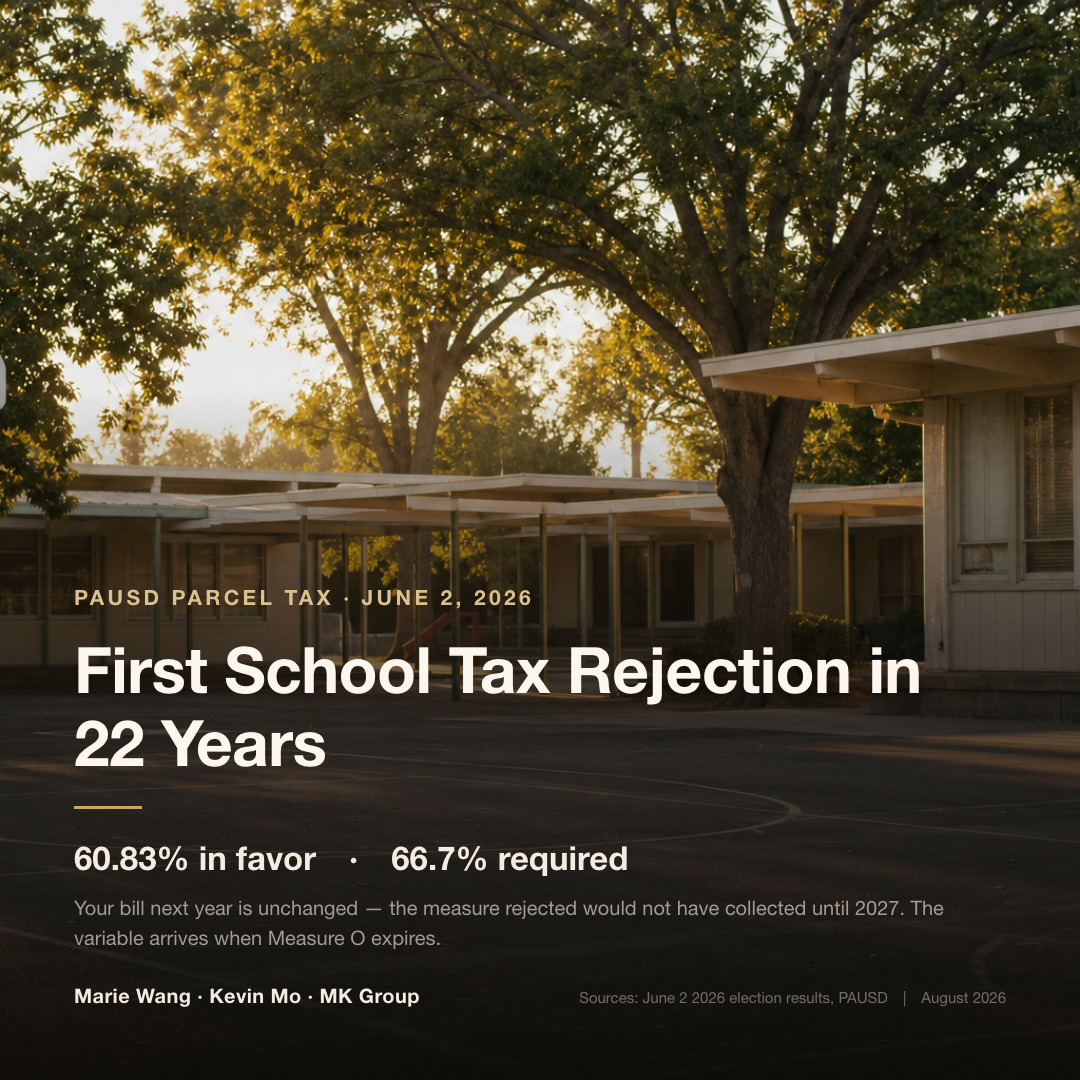
No. What voters rejected was Measure B, a renewal that would not have started collecting until June 1, 2027. The parcel tax you pay today is authorized by Measure O — $904.92 per parcel for 2025-26 — and it continues to be collected until it expires on its own terms. Your current bill is unchanged. The real variable arrives in 2027, when Measure O lapses and nobody yet knows whether this line item continues, or at what amount.
It is worth five minutes because the parcel tax is the one line on your bill that has nothing to do with what you paid for the house. Proposition 13 means the neighbor who bought in 1985 pays a fraction of your ad valorem tax. On this line, the two of you pay exactly the same.
Who this is for
- Buyers shopping Palo Alto who want the carrying cost right. You want to know what sits on the bill besides the 1%.
- Current owners in PAUSD. You want to know what changes after 2027.
- Families and family offices looking at more than one property. A parcel tax is charged per parcel — three homes means three of them, regardless of price.
- Owners aged 65 and over. The exemption described at the end goes unclaimed by plenty of people who qualify.
Three things that decide the answer
One: the bill has three layers, and only one tracks your purchase price
A California property tax bill is not a single figure. It is three things stacked.
The first layer is the 1% base ad valorem tax, assessed on assessed value. Under Proposition 13 a newly purchased property is reassessed at fair market value — normally your purchase price — after which assessed value may rise no more than 2% a year. This layer tracks your purchase price completely, and it is where new and long-term owners diverge most.
The second layer is voter-approved bond debt, also charged as a percentage of assessed value, so it scales the same way. Taken together, San Mateo County's published figures work out to roughly 1.11% countywide.
The third layer is fixed special charges and parcel taxes, levied as a flat amount per parcel and entirely independent of value. The school district parcel tax is the largest of these; flood control, water and open space districts add more. San Mateo County's special charges totaled $338.6 million in FY 2020-21.
The nature of that third layer decides two things: it is a light burden relative to a high-value home and a heavy one relative to a low-basis long-term owner — and it has to be renewed by voters periodically. Which is what happened in June 2026.
Two: what actually happened on June 2, 2026
PAUSD put the Measure O parcel tax up for renewal as Measure B: $800 per parcel, a four-year term, collections beginning June 1, 2027, and — notably — a frozen amount with no inflation escalator, making it milder than the version in force.
It failed. The measure drew 60.83% in favor (7,289 to 4,694), against the two-thirds (66.7%) supermajority California requires for a parcel tax. It fell short by roughly six points.
This was the first time in 22 years that Palo Alto voters rejected a school tax. The last was 2004, and a revised version passed the following year — a precedent that matters, because it shows rejection is not necessarily the end of the line.
The opposition's reasoning is worth knowing, because it bears on how 2027 plays out. Opponents including former board members Todd Collins and Ken Dauber argued that rising home values have already driven a substantial increase in the district's regular property tax revenue, and that the district holds roughly $100 million in reserves. The argument was about sufficiency, not about whether to fund schools.
Three: three scenarios for your carrying cost
Once Measure O expires, three paths are plausible. For long-range planning, underwrite the middle one.
Scenario one: the district returns with a revised measure and it passes. That is the 2004-to-2005 script. The amount may come in below the current $904.92, or may restore an inflation adjustment. For a buyer this means the line item essentially continues at a similar magnitude.
Scenario two: renewal ultimately fails and the line goes to zero. Your annual carrying cost falls by roughly nine hundred to a thousand dollars. That sounds like good news until you read the second-order effect: the district loses about $16.5 million a year in local funding, and any change in service levels eventually shows up in the price premium attached to this attendance area — a premium that matters far more to a PAUSD home's value than a thousand dollars of tax.
Scenario three: a gap. Measure O lapses, a new measure comes later, and the bill changes in between. Of the three, this is the one most likely to produce a surprise on a tax statement.
Whichever path, keep the scale straight: this line is in the thousands, while the ad valorem layers are in the tens of thousands. Do not misallocate attention — but do not drop it from the model either, particularly across multiple properties.
The numbers: three layers, and how the PAUSD parcel tax got here
Start with the headline comparison. Palo Alto's median annual property tax bill is $23,007 — the highest of any city in the United States, against a national median of $3,211. Yet Palo Alto's median effective rate is just 0.657%, below the national average of 0.888%. A low rate on very high values still produces an enormous bill, and that median is pulled down by a large population of decades-long owners on old assessments. A new buyer's arithmetic looks nothing like it: at a blended rate of roughly 1.1% to 1.25%, a $5M purchase carries about $55,000 to $62,500 of ad valorem tax in year one. The school parcel tax sits on top of that, unrelated to price.
| Line | Amount | How it is calculated | New vs long-term owner |
|---|---|---|---|
| 1% base ad valorem tax | 1% of assessed value | Reassessed at purchase price, then capped at 2% growth a year | Widest gap — can reach 10x |
| Voter-approved bond debt | Percentage of assessed value | Scales with assessed value | Same proportional gap |
| PAUSD school parcel tax | $904.92 per parcel, 2025-26 | Flat, per parcel | No gap — everyone pays the same |
| Other fixed charges (water, flood, open space) | Fixed per item | Flat, per parcel | No gap |
| Palo Alto median annual bill (all owners) | $23,007 | Highest of any US city; median effective rate 0.657% | Median depressed by low-basis owners |
| $5M buyer, year-one ad valorem (estimate) | About $55,000–$62,500 | At a blended 1.1%–1.25% | — |
The history of the PAUSD parcel tax is the context for the 2027 question. The tax in force was authorized by Measure O: $836 per parcel in FY 2021-22, rising 2% annually across a six-year term, generating more than $15 million a year in local funding for the district. The 2025-26 amount is $904.92, producing roughly $16.5 million; the district's renewal page cites a current amount of $941 expiring in 2027. Those three figures do not reconcile cleanly across public sources, so for long-range modeling treat the line as being in the nine-hundred-dollar range and take the exact number from the bill you actually receive.
What we see in the field: what gets underestimated is fixed charges times properties
MK Group has a documented case of a family office client who bought three Silicon Valley homes at once — one to live in, two as investments — and concluded six months later that the plan did not hold together. One of the problems Kevin Mo identified in the debrief was that carrying cost had been underestimated across the board: in many of these submarkets the rent-to-price ratio is unremarkable, and once property tax, maintenance and insurance are counted, an owner is frequently just waiting for appreciation.
The parcel tax is the most easily overlooked item in that set, precisely because of how it is computed: it does not scale with price, it multiplies by parcel. On one house the school parcel tax is an unremarkable nine hundred dollars at the bottom of the bill. On three houses it is three of them, identical in size, whether those homes are $3M or $10M. Add water, flood control and open space charges and the fixed component of a multi-property position stacks linearly — and that component vanishes entirely from any back-of-envelope estimate built as price multiplied by a rate.
It is why Marie Wang and Kevin Mo work from the actual tax bill for a target address in buyer due diligence, rather than a figure derived from a rate. Those last few lines of fixed charges are only fully visible on a real statement. A separate bill also arrives after closing to true up against your purchase price; that mechanism is covered in detail in our piece on Bay Area property tax and the supplemental assessment.
Common Misconceptions
"The measure failed, so my tax bill drops next year"
It does not. Measure B would not have begun collecting until June 1, 2027 and never took effect. The Measure O parcel tax continues to be collected until it expires under its own terms, unaffected by this vote. Only when Measure O lapses does this line change — and what happens then depends on whether the district returns with a new measure and whether that measure clears two-thirds.
"School tax is charged on home value, so an expensive house pays more"
The opposite. A parcel tax is a flat charge per parcel, unrelated to value, square footage or age. A $2M house and a $12M house pay the same amount on this line. That is a large part of why parcel taxes are politically contested: they are regressive, weighing more heavily relative to a lower-value property. Recognizing this also prevents a second error — estimating this layer on the assumption that an expensive house makes everything proportionally expensive.
"Two-thirds failed, so the community has turned against its schools"
The measure drew 60.83% in favor — a clear majority. California requires a two-thirds (66.7%) supermajority for a parcel tax, well above a simple majority, so "did not pass" and "most voters opposed" are different statements. The stated opposition case was not against school funding but that rising home values had already lifted the district's regular property tax revenue and that reserves stood near $100 million. Reading the result as a shift in community sentiment will lead you to misjudge 2027.
"It was rejected, so this tax is gone for good"
The last Palo Alto school tax rejection was 2004; the district returned with a revised version the following year and it passed. Twenty-two years on, the district can likewise adjust the amount, the term or the conditions and go back to voters. Treating this rejection as final in a ten-year cash flow model probably understates the odds that the line continues. The defensible assumption is that it persists in some form, in the nine-hundred-dollar range.
"There is a senior exemption, but the paperwork is not worth it"
PAUSD exempts owners aged 65 and over, along with recipients of SSI and SSDI. The detail that matters: you apply once and it renews automatically each year — there is no annual refiling. Plenty of qualifying owners have never applied. This is roughly nine hundred dollars a year for a single filing.
What to do next
- Pull the actual tax bill for the target address rather than estimating from a rate. County Assessor and Tax Collector sites return current assessed value and bill composition by address; those last lines of fixed charges are only fully visible on the real statement.
- Model the parcel tax by property count, not by price. If you are looking at more than one home, this layer stacks linearly and each property carries the same amount.
- Put the 2027 uncertainty in your long-range model without overweighting it. Assume continuation in some form around nine hundred dollars; this line is in the thousands while ad valorem is in the tens of thousands.
- If you or a co-owner is 65 or over, file for the exemption. One application, renewed automatically — do not skip it on the mistaken belief that it has to be redone annually.
- Watch for the district's next measure. Before Measure O expires the district will likely return with a revised proposal; its amount, term and whether it restores an inflation adjustment will set this line for years afterward.
This article organizes public information for decision-making purposes and is not tax or legal advice. Specific liability, exemption eligibility and filing should be confirmed with a CPA or a real estate attorney, and against the bill you actually receive and current notices from the district and county tax authorities. The Measure O figures cited ($836 / $904.92 / $941) do not reconcile cleanly across public sources, and the 1.10%–1.25% Santa Clara County blended rate is a third-party figure that could not be read directly from the county site.