Direct answer
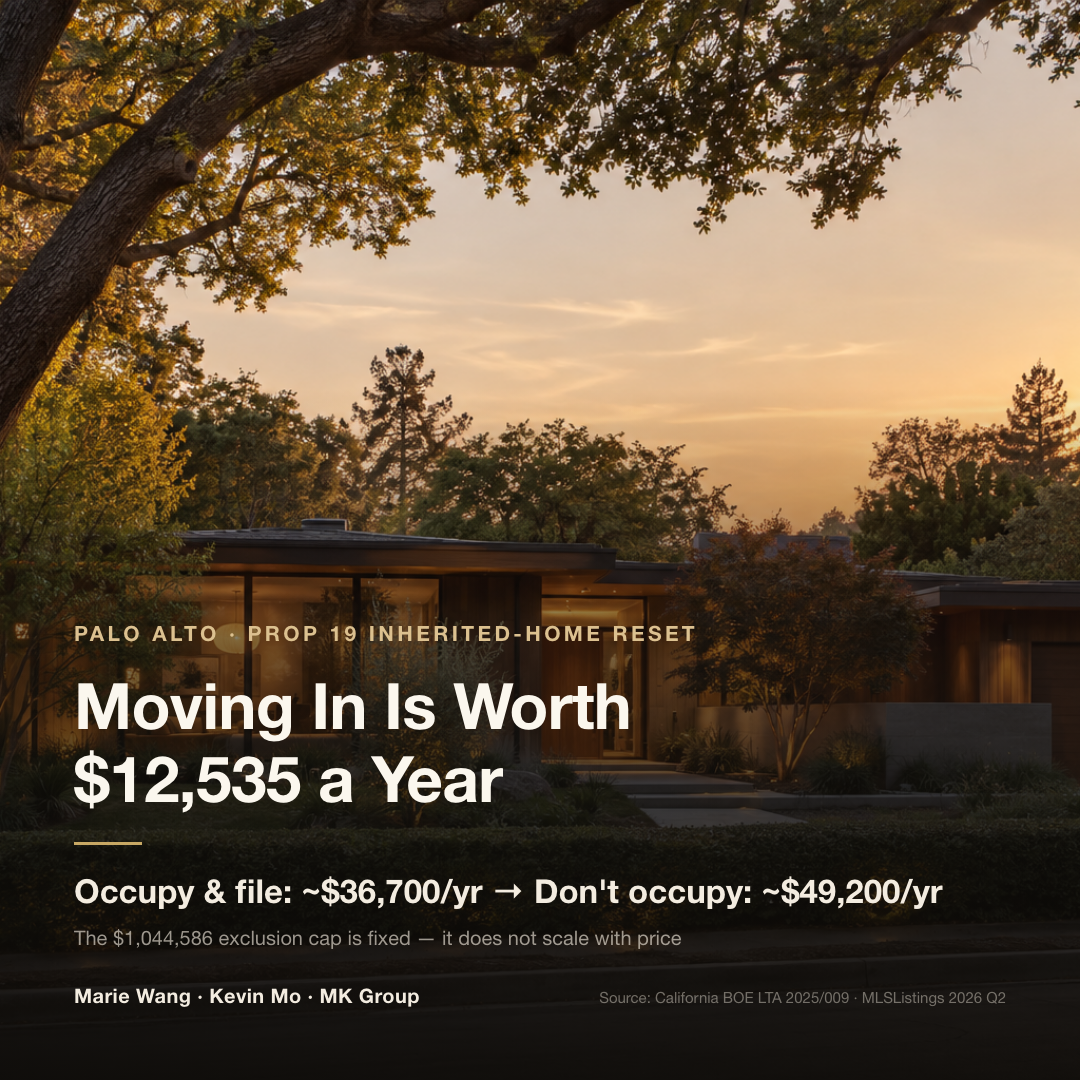
Don't move in and the house is reassessed in full at date-of-death market value: roughly $49,200 a year at the Palo Alto median. Move in within a year and file for the homeowners' exemption and it is roughly $36,700 — a gap of $12,535. The exclusion is capped at the prior taxable value plus $1,044,586.
One boundary first. Whether this house can be sold, whether probate comes first, and who holds the power to sign is a different subject, handled in My Parents Have Passed — Does the Bay Area House Have to Go Through Probate Before We Can Sell It? This article answers one question only: if you keep it, what does it cost in property tax each year, and which single action brings that number down.
Who this article is for
- Families whose parents — or whose family trust — already hold a house in Palo Alto, Menlo Park, Los Altos, Los Altos Hills, Atherton or another Peninsula city, with adult children now living and working in the Bay Area.
- Families where the parents own more than one Peninsula property and at least one of them is a rental or a second home. Those properties follow completely different reassessment rules than the principal residence does.
- Second-generation owners deciding among three paths — occupy, rent out, or sell. Most families see the difference in annual carrying cost for the first time on the first new tax bill.
- Families whose parents are still living and who want the ownership structure and the living arrangement planned together. Both Prop 19 conditions can be arranged in advance and are close to unfixable afterward.
- Families who placed the house in a revocable living trust and believe that settles the reassessment question, and siblings inheriting one house together who need to agree early on who lives in it and who takes cash.
Three dimensions that decide the answer
Dimension one: how low your family's old tax base is decides whether this exclusion is enough
The Prop 19 parent-child exclusion is not relief from reassessment. It is capped relief from reassessment. Article XIII A, §2.1(c) sets out the arithmetic: take the property's taxable value immediately before the transfer — the factored base year value, the number Prop 13 has been compounding at no more than 2% a year — and add an inflation-adjusted cap. That sum is a line. Date-of-death market value below the line, and the tax base carries over untouched. Above it, the excess is added back.
The California State Board of Equalization republishes that cap every two years, indexed to the Federal Housing Finance Agency's California House Price Index. The current figure appears in Letter to Assessors No. 2025/009 and news release NR-25-02: for transfers occurring between February 16, 2025 and February 15, 2027, the cap is $1,044,586, up 2.15% from the prior period's $1,022,600.
Put those two numbers together and a Peninsula family's position becomes clear fast. A Palo Alto house bought in the late 1980s may still carry a taxable value near $400,000 today. Add $1,044,586 and the line sits around $1.44M — against a market value that is almost certainly north of $4M. Satisfy every condition perfectly and the new tax base still gets pulled up to market value minus $1,044,586. Run it the other way: if the parents bought in 2019 and the taxable value is already near $3.4M, the line lands at $4.44M, above market value, and the house is not reassessed at all. Same statute, two entirely different meanings for two families. Look up the property's current assessed value on the county assessor's site before you conclude anything.
Dimension two: the exclusion covers one principal residence — rentals and second homes are outside it
Before the occupancy question comes a step families routinely skip: this exclusion covers a principal residence and nothing else. Section 2.1(c) fixes the scope in its own words — "a family home that is the principal residence of the transferor and becomes the principal residence of the transferee, or a family farm." Family farms are not a Peninsula residential matter, which leaves exactly one house: the parents' principal residence. A parent's rental, vacation home or second home receives no exclusion at all, whether or not a child ever lives there, and is reassessed in full at date-of-death market value. The BOE's comparison chart compresses the change into a single line: Prop 19 "eliminates exclusion for other real property other than the principal residence." The relief Prop 58 granted to non-principal-residence property before 2021 is gone. So a family holding several Peninsula properties should start by confirming, property by property, which one carries a recorded homeowners' exemption — that is usually the principal residence — and then estimate every other one straight off the full-reassessment column in the table below.
Now back to that one house. The San Mateo County Assessor states the test in five words: "Principal residence of transferor and transferee." The parents must have lived there as their principal residence, and the child must go on to do the same. The BOE's Filing Requirements Checklist fixes the deadlines: the homeowners' exemption must be filed "within 1 year from date of death or transfer," and BOE-19-P "within 3 years from date of death or transfer, or before transfer to 3rd party, whichever is earlier."
The word families underweight here is "continually." The BOE's Intergenerational Transfer FAQ states it directly: "At least one eligible transferee must continually live in the property as their family home for the property to maintain the exclusion. Thus, once the property is no longer your principal residence, it will receive a new taxable value as of the lien date following the date you no longer occupy the property as your principal residence." Move out and a new taxable value is set at the following lien date, with the county assessor determining the figure. This is not a gate you pass once. It is a condition you keep meeting for as long as you want to keep the benefit.
Where several children inherit together, the BOE's position is that at least one eligible transferee must continually occupy the home as a principal residence. How the exclusion amount is allocated across fractional interests, and how the non-occupying siblings' shares are handled, varies in application from county to county. That is a box for an attorney and the assessor's office to settle case by case, not one to reason out from the statutory text on your own.
Dimension three: put the annual cost of keeping, renting and selling on one page
Once you decide not to occupy, the question stops being "how much extra tax" and becomes "is this house worth what it costs to hold." Reassessed in full at the Palo Alto median, the annual property tax runs roughly $49,200 before insurance, maintenance and vacancy. Whether rent covers that is an arithmetic question worth doing honestly — rent-to-price ratios across much of Silicon Valley are thin, and once property tax, upkeep and insurance are stacked on top, an owner is frequently just waiting on appreciation. That is precisely the trap the family-office investment properties in our case library fell into.
The tax picture on the sell path points the opposite way. IRC §1014 resets basis to date-of-death market value, so capital gain on a near-term sale is often close to zero, and reassessment is barely a cost factor on that route at all. For how the Prop 13 base and the supplemental bill after a closing actually work, see You Bought a $10M+ Bay Area Home—Why Does a Second Property-Tax Bill Arrive Months After Closing?
Converting the rules into dollars: annual property tax by city
The headline numbers first. Per MLSListings Q2 2026 closed records, Palo Alto's single-family median closed price was $4.10M across 139 sales. Assume the parents' house carries a current taxable value near $400,000 and apply a blended rate of roughly 1.2%: while the parents are living, the annual bill is about $4,800. A child who moves in within a year and files for the homeowners' exemption inherits a new tax base of roughly $3.055M and an annual bill of about $36,700. A child who does not move in — renting it out or leaving it empty — is reassessed in full at market value, and the bill is about $49,200. The difference is $12,535 a year. And that same difference, on a $10.0M median-priced Atherton house, is still $12,535.
| City | Q2 2026 single-family median closed price | Closed sales | Inherited, occupied and filed within one year (annual tax) | Not occupied, reassessed at full market value (annual tax) | Annual value of the move-in |
|---|---|---|---|---|---|
| Menlo Park | $3,793,500 | 94 | ~$33,000 | ~$45,500 | ~$12,535 |
| Palo Alto | $4,100,000 | 139 | ~$36,700 | ~$49,200 | ~$12,535 |
| Los Altos | $4,920,000 | 97 | ~$46,500 | ~$59,000 | ~$12,535 |
| Los Altos Hills | $5,725,000 | 32 | ~$56,200 | ~$68,700 | ~$12,535 |
| Atherton | $10,000,000 | 31 | ~$107,500 | ~$120,000 | ~$12,535 |
What to take from this: the last column is one repeated number, not a formatting error. Once market value clears the old taxable value plus $1,044,586, the annual gap between occupying and not occupying is exactly $1,044,586 times your rate — $12,535 a year at roughly 1.2%. The cap is a fixed dollar amount and does not scale with the house, which means the move-in is worth far less, proportionally, on a $10.0M Atherton estate than on a $3.79M Menlo Park house. The real jump sits one column to the left. A Palo Alto house that cost about $4,800 a year in property tax under the parents costs about $36,700 after a flawlessly executed inheritance — more than seven times as much. So the question this family actually has to answer is not whether to save the $12,535. It is whether $36,700 to $120,000 a year in carrying cost is worth trading a real living arrangement for.
One reconciliation note. This article converts everything at a blended rate of roughly 1.2%, while the companion article, "My Parents Have Passed — Does the Bay Area House Have to Go Through Probate Before We Can Sell It?", runs the same Palo Alto house at the 1% constitutional base rate alone, excluding local bonds and special assessments. That is why its figures — roughly $30,600 and $41,000 — sit below the $36,700 and $49,200 here. Both articles land on the same new tax base of roughly $3.055M; only the multiplier differs. Which number applies to your house depends on the current-year rate in your tax rate area.
Four deadlines that all run from the date of death
The clock does not start at recording. The BOE's formulation is flat: "The date of death is the date of change in ownership." The reassessment date, the version of the law that applies, and the day market value is measured are all anchored to the death. Four deadlines then run in parallel:
- Within 150 days of death: file form BOE-502-D, Change in Ownership Statement — Death of Real Property Owner, with the assessor of the county where the property sits, per R&T §480(b). If the estate goes into probate, it must be filed before or at the same time as the inventory and appraisal is filed with the court clerk. Late filing carries a statutory penalty.
- Within 1 year of death: the transferee occupies the home as a principal residence and files for the homeowners' exemption (or the disabled veterans' exemption). This is the load-bearing wall of the entire exclusion.
- Within 3 years of death, and before any transfer to a third party, whichever comes first: file BOE-19-P. Filing within six months after the assessor mails a supplemental or escape assessment notice also counts as timely.
- Continually thereafter: at least one eligible transferee must keep the home as a principal residence, or a new taxable value is set at the lien date following the move-out.
What we see in the field
In inherited-property situations the hard part is rarely the inheritance. It is that the ownership structure gets its first serious discussion only at the moment action is forced. One transaction in the MK Group case library illustrates it well. A family-office client bought three Silicon Valley houses at once — one to live in, two as investments — and bought decisively, mostly on the strength of "this is a famous address" and "expensive means good." The problems surfaced six months later. The school commute from the primary house ran 30 minutes each way and longer in traffic, and the family's daily routine never stopped feeling awkward. The two investment properties sat in submarkets with unremarkable rent-to-price ratios; once property tax, maintenance and insurance were stacked on, the owner was simply waiting on appreciation. Marie Wang (DRE# 02110980) and Kevin Mo (DRE# 02127623) later distilled that one into a standing caution for high-net-worth families: the higher the budget, the less the thing being matched is the house, and the more it is the family's daily movement and its long-term cost of ownership.
That caution transfers to the inheritance context nearly word for word. Prop 19 does not ask for a document. It asks for a real living arrangement — who moves in, for how long, where the children go to school, whether the commute is survivable. Leave those questions until after a parent has died, to be settled under the pressure of a 150-day window and a one-year window, and the only option still standing is usually the most expensive one.
The other situation that needs an early start is second-round planning on a large parcel. MK Group once evaluated a subdivision for an owner holding a 2-acre Atherton estate — keep one acre, sell the other separately. The team went directly to the City of Atherton for conditions and came back with two hard constraints: the new parcel could not share the existing driveway and required an independently designed access point, and two protected trees on the parcel could not be removed, which set limits on the footprint and orientation of any new house. Feasibility had to be rerun under those two constraints rather than assumed from "two acres, so two parcels." Succession planning runs on the same logic. Lay out the rules and the restrictions first, then decide who the house goes to and how it will be held.
Common mistakes
Mistake one: "The house is already in a revocable trust, so it won't be reassessed"
A trust settles whether probate is required and who has the power to sign. It does not settle whether a change in ownership occurred. The BOE's position on trust-held property is that the date of death is considered to be the date of change in ownership. Which means a house sitting in a living trust is judged for reassessment exactly as one that isn't. It needs the same parent-child principal residence exclusion to shield it, the same occupancy plus homeowners' exemption filing within one year, and the same BOE-19-P within three. Putting the house in a trust is worth doing. What it buys is process efficiency and privacy, not a tax base.
Mistake two: "We'll rent it out for two years and move in once things settle on my end"
That does not qualify. The BOE Filing Requirements Checklist requires the homeowners' exemption to be filed within one year of the date of death or transfer, and requires the home to become the transferee's principal residence. Miss the one-year window and the exclusion does not apply — the new tax base is fixed at date-of-death market value, and moving in later does not walk it back. The same FAQ states the reverse case as well: where the exclusion was granted and the home later stops being the transferee's principal residence, a new taxable value is set at the following lien date, with the county assessor determining the figure. This rule tests whether you can move in now, not whether you intend to someday.
Mistake three: "The cap is market value minus $1.04M, so the first $1.04M of difference doesn't matter"
The cap is measured from the prior taxable value, not from market value. The arithmetic is prior taxable value plus $1,044,586, which produces a line. Market value below the line means no reassessment at all. Market value above it means the excess is added back at date-of-death value. The BOE's own published illustration: a home with a $300,000 taxable value and a $1.5M market value, under a $1M cap, lands at an adjusted taxable value of $500,000 — the $300,000 plus the $200,000 of excess. The common Peninsula fact pattern is a very low old tax base, which puts that line far below market value. What $1,044,586 does here is shave a fixed amount off the new tax base. It does not keep the house out of reassessment.
Mistake four: "My parents own three houses, so each one gets its own $1,044,586"
Only one does. Section 2.1(c) applies to the one family home that is the parents' principal residence and becomes the child's principal residence — plus the family farm, which is not a Peninsula residential concern. The BOE comparison chart says it outright: Prop 19 "eliminates exclusion for other real property other than the principal residence." Rentals, vacation homes and second homes have had no parent-child exclusion since February 16, 2021 and are reassessed in full at date-of-death market value, regardless of whether a child ever lives in one. For a family holding several Peninsula properties, that means the tax jump in the year of inheritance has to be calculated in two parts: market value minus $1,044,586 on the principal residence, and market value times the rate on everything else.
Mistake five: "We filed BOE-19-P, so we're covered"
BOE-19-P is one of four deadlines. Without the homeowners' exemption inside the one-year window, filing the claim on time accomplishes nothing. BOE-502-D within 150 days of death is a separate, independent obligation carrying a statutory penalty for late filing. And after the exclusion is granted, the continuing condition still applies: at least one eligible transferee must keep occupying the home. It is also worth keeping this separate from the 55-and-over replacement-home rules. Both are called Prop 19, but the replacement-home half moves an existing low tax base to a new house, works statewide, and is available up to three times — a completely different set of conditions from the inheritance half. See Prop 19 in the Bay Area: How Much Property Tax Can a 55+ Move Actually Save?
Next steps
- Look up the property's current taxable value and confirm which house is the parents' principal residence. Search by address on the Santa Clara County Assessor or San Mateo County Assessor site for the assessed value and the recorded homeowners' exemption. Add $1,044,586 to the principal residence's taxable value to get the line, then compare it against today's market value. Estimate every other property straight off full market value.
- Settle the living arrangement while the parents are still living. Who moves in, when, what happens with schools, and how the other children receive equivalent value. The one-year Prop 19 window gives you time to execute, not time to deliberate.
- Price keeping, renting and selling on one page. Reassessed annual property tax, insurance and maintenance, achievable rent, and the tax result of a near-term sale under the IRC §1014 basis reset — put all four side by side before deciding.
- Put all four deadlines on a calendar: BOE-502-D at 150 days, the homeowners' exemption at one year, BOE-19-P at three years (or before any transfer to a third party, whichever is earlier), and the continuing occupancy requirement. They involve different forms and different offices, and not one of them will remind you.
- Take these specific numbers to an estate attorney and a CPA. Allocation among several children, partial-interest occupancy, and the interaction between trust terms and exclusion eligibility all have to be determined case by case. Arrive with the taxable value, the market value and the occupancy intent already in hand, and the professional advice can actually land on your situation.