The short answer
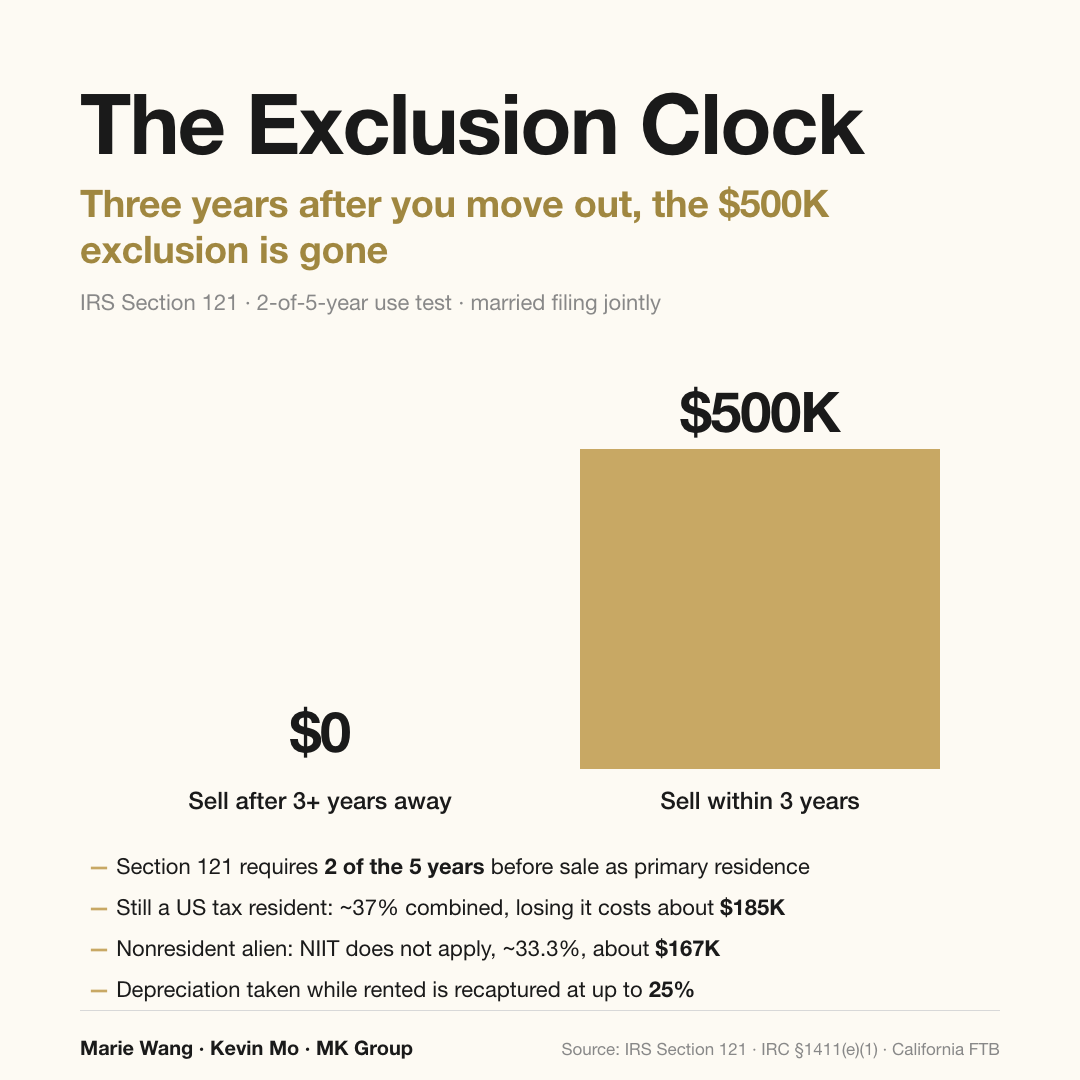
Keeping the house and renting it out is not a way of deciding later. It is a decision with an expiration date. IRS Section 121 requires that you occupied the home as a primary residence for two of the five years before sale, so once you have been gone more than three years, the $500,000 married-couple exclusion on primary-residence gain is permanently off the table.
In the Bay Area, what that expiration costs splits into two tiers depending on your tax status in the year you sell. Still a U.S. tax resident — citizen or green-card holder — and the top combined rate runs about 37% (federal long-term capital gains 20% + NIIT 3.8% + California 13.3%), so about $185,000. Already a nonresident alien, and the NIIT does not apply under the plain text of IRC §1411(e)(1), leaving roughly 33.3%, or about $167,000. That same house, rented for a full year and owned free and clear, will most likely produce somewhere between $30,000 and low-$50,000s of pre-tax net cash flow. Put those two numbers side by side before you discuss sell versus rent.
Who this article is for
This is written for a specific household. You or your spouse own a single-family primary residence on the Peninsula or in the South Bay — Palo Alto, Los Altos, Menlo Park on the Peninsula, or Cupertino on the Silicon Valley side — somewhere between $3M and $8M+, most often above $4M. A job transfer, a family obligation, or a decision about your children's schooling is now moving the whole household back to China or on to a third country for the long term. The mortgage is not the problem. What you are missing is one arithmetic sheet that puts sell and keep on the same scale: how much the house actually nets in a year, when the irreversible tax consequences trigger, and how much gets withheld from rent and from a future sale once you are no longer in the United States.
If you are leaning toward renting it out for a couple of years to see how things go, this article prices those two years. If you are carrying a mortgage locked in between 2020 and 2022, or a Prop 13 assessed basis far below market, it also sets out the conditions under which keeping the house is genuinely the better answer — and what you take on as a landlord to get there. In a cross-border relocation this is one of the most common questions on the table, and the hard part has never been attachment. It is the calendar.
Three questions that decide it
Sell or rent reads like an emotional question: attachment, fear of regret, wanting to keep an exit open. What actually settles it is three sets of arithmetic — the net cash flow on the rental side, the assets that only continued ownership preserves, and the withholding that begins the day your tax status changes. Work through all three and the answer usually surfaces without being argued.
One — the rental math: on the Peninsula, the return is land, not cash flow
Start with the conclusion. On the Peninsula, rental yields on high-end houses are far too low to carry the story that you are renting for income. Take the 2026 Q2 median single-family closing price in Palo Alto, $4,110,000 from MLSListings, as the denominator, and a benchmark rent of about $9,500 a month for a four-bedroom house. Gross annual rent is about $114,000, a gross yield of about 2.8%. That is already the best case — the whole house, rented.
The $9,500 benchmark deliberately sits at the low end of the public asking-rent sources. RentHop puts the Palo Alto four-bedroom asking average at about $9,495/month (June 2026); Rentometer's four-bedroom-and-up figure is about $9,004/month; Zillow's four-bedroom figure is about $11,472/month and Zumper's four-bedroom median about $12,525/month. The four sources span roughly $9,000–$12,500/month. That spread is itself part of the conclusion: rent is not a number you can copy from a median, and the effect of taking the upper bound is worked through below.
What consumes the return is the cost of holding. The table below breaks out the expense stack for a typical long-time owner who moves away and converts to a rental. Two premises need stating first. Long-time owners usually carry a Prop 13 basis well below market, so the property tax line is already the cheapest version of that number. And the entire table is computed free and clear, with no principal or interest.
| Line item | Annual amount | Basis and source |
|---|---|---|
| Gross rent | +$114,000 | $9,500/month × 12, at the low end of public asking-rent sources |
| Property tax | −$20,700 | Assumes a Prop 13 basis of about $1.8M at a Bay Area effective rate of about 1.15% |
| Landlord insurance | −$4,000 | Order-of-magnitude annual premium for a landlord policy |
| Maintenance and repairs | −$20,600 to −$41,100 | Standard industry rule of thumb of 0.5%–1% of market value per year |
| Vacancy reserve | −$5,700 | 5% of gross rent |
| Property management | −$9,100 | 8% of gross rent; not optional once the owner lives overseas |
| Principal and interest | Not included | The whole table is free and clear; see the first correction below |
| Pre-tax net cash flow | About +$33,400 to +$53,900 | Against $4.11M of market value, a net yield of about 0.8%–1.3% |
What to actually remember is the gap between a 2.8% gross yield and a 0.8%–1.3% net yield. That gap is the real price of the rental option. A $4.11M Palo Alto single-family home, held free and clear and worked for a full year as a landlord, puts roughly $33,400 to $53,900 in your pocket before tax — and that return asks you to absorb vacancy, non-payment, disputes, and management across time zones, none of which the same capital would face sitting in short-term Treasuries.
Three corrections belong to you, though, and without them the table reads optimistically.
First, there is no debt-service line. Put a $1.5M mortgage at 3% on a 30-year fixed against this house and annual principal and interest runs about $76,000 — roughly $45,000 of interest and $31,000 of principal in year one — which is enough to push the net cash flow above straight into negative territory. The principal portion is equity accumulation rather than a loss, but it occupies cash all the same. This matters because the next section argues that a low-rate mortgage is one of the strongest reasons to keep a house: the same loan is an asset in the irreplaceable-assets column and an expense in the annual cash-flow column, and you cannot count only one side.
Second, the numerator and the denominator are different specifications. The rent is a four-bedroom asking figure; the price is the median across all single-family closings, which corresponds to roughly a three-bedroom house. Four-bedroom rents run higher than the median configuration, so a matched gross yield can only be lower than 2.8%, never higher.
Third, the spread between rent sources changes the magnitude of the conclusion. At the upper bound of about $12,500/month, gross annual rent is about $150,000 and the gross yield about 3.7%; against the same expense stack, pre-tax net cash flow runs roughly $65,000–$85,000, and the payback period in the decision table further down compresses from 3–5.5 years to about 2–3 years. The direction holds; the margin does not. Which is why the useful step here is never to copy a median — it is to re-run this table with the real rent quotes and the real loan on your own house.
None of this argues against holding. It only makes the reason for holding explicit: on the Peninsula, what you earn by keeping the house is land appreciation, not rent.
Two — a low rate and an old tax basis are the two things you can never buy back
There is a genuinely irreplaceable side to keeping the house, but the reasons have to be specific. Two of them are real, and neither has anything to do with the building.
The first is the interest rate. Freddie Mac's Primary Mortgage Market Survey shows the 30-year fixed weekly average bottoming at 2.65% in early 2021, a historic low; for the week of July 23, 2026, the same series reads 6.58%. That distance cannot be reproduced. Sell the house and you permanently surrender the financing cost you locked in. This does not contradict the table above: a low rate is something you cannot get back in the asset column, and a real annual expense in the cash-flow column. Keep the two ledgers separate.
The second is the Prop 13 basis, which is the one people forget. When California property changes hands, the assessed basis resets to the new sale price and rises no more than 2% a year thereafter. An owner who bought around 2010 and has accreted a basis near $1.8M pays about $20,700 a year in property tax. The same house reassessed at Palo Alto's 2026 Q2 median closing price of $4.11M would carry about $47,300 — a gap of roughly $26,500 a year, and a gap that follows you for as long as you own. Selling and buying back later is a decision to hand that difference over voluntarily.
The cost of keeping deserves the same clarity. You convert from homeowner to landlord and take on the full set of obligations under California rental law. The Tenant Protection Act (AB 1482) caps annual rent increases at the lower of 5% plus local CPI or 10%, and just-cause eviction protections attach once a tenant has occupied the unit continuously for 12 months; the statute currently runs through January 1, 2030. One sequencing trap is worth flagging: if you intend to pull equity out through a HELOC to fund the next step, open it before you move. Most HELOC products carry an explicit owner-occupancy requirement, and applying after the house has become a rental produces materially worse terms and lower limits.
Three — once you stop being a U.S. tax resident, rent and sale each trigger their own withholding
This is the layer most often underestimated in a cross-border move, and it arrives twice.
On the rent side: U.S. rental income received by a non-U.S. tax resident defaults to FDAP treatment, meaning the withholding agent remits 30% of the gross rent to the IRS with no deduction of any expense (IRS Publications 515 and 519). You can elect to have the income treated as effectively connected — file Form W-8ECI with the withholding agent — and report on a net basis at graduated rates, with property tax, insurance, maintenance, and depreciation all deductible. That election requires a U.S. taxpayer identification number, SSN or ITIN, which has to be arranged in advance. California adds a layer: when a property manager pays a nonresident owner more than $1,500 of rent in a year, 7% must be withheld on the balance after the management fee, reported quarterly on Form 592 with a Form 592-B issued at year end; owners who qualify for an exemption file Form 590 (California FTB).
Put the numbers in and the weight is obvious. On $114,000 of gross rent, federal FDAP withholding at 30% is about $34,200 and California's 7% adds about $7,300, for roughly $41,500. Set that against the free-and-clear pre-tax net cash flow computed above, $33,400 to $53,900: in the default state, doing nothing, the withholding is close to or greater than everything the house nets in a year. The money is trued up on the annual return, but it is tied up for a full year, and in a cross-border setting currency movement and compliance costs sit on top.
On the sale side: when a nonresident sells U.S. real property, the buyer or settlement agent withholds 15% of the sale price under FIRPTA at the federal level, and California withholds 3⅓% of the sale price on Form 593 for non-exempt sellers. Both are prepayments rather than final tax, and how the money comes back is covered in A foreign seller's Bay Area sale and how the 15% FIRPTA withholding comes home. Note the timing logic, though: whether you sell today or five years from now, both withholdings apply. The only thing that expires is the $500,000 Section 121 exclusion — and it is on a clock.
Carrying cost, rent, and the exclusion clock, in one table
The core numbers first. If your primary-residence gain exceeds $500,000 — for a long-held Bay Area home it usually exceeds it by a wide margin — then selling more than three years after you move out costs the exclusion, valued at one of two rates depending on your status in the year of sale. Still a U.S. tax resident: roughly 37% combined (federal 20% + NIIT 3.8% + California 13.3%), so $500,000 × ~37% ≈ $185,000. Already a nonresident alien: NIIT's 3.8% does not apply under IRC §1411(e)(1), so roughly 33.3%, or $500,000 × ~33.3% ≈ $167,000. At the free-and-clear net cash flow computed above, you would need to rent the house continuously for about 3.1–5.0 years (nonresident) or about 3.5–5.5 years (U.S. tax resident) before cumulative cash flow even covers that one line. The table below places three things along the same axis — when you sell.
| When you sell | Section 121 exclusion | Cumulative pre-tax net cash flow (free and clear) | Cumulative depreciation recapture tax (up to 25%) |
|---|---|---|---|
| Before moving out | Full $500,000 (married) | $0 | $0 |
| Within 1 year of moving out | Full | About $33,400–$53,900 | About $5,000 |
| Within 2 years of moving out | Full | About $66,800–$107,800 | About $9,000 |
| More than 3 years after moving out | Zero | About $100,000–$162,000 | About $14,000 |
| More than 5 years after moving out | Zero | About $167,000–$270,000 | About $23,000 |
What to actually remember: at the three-year mark, cumulative net cash flow lands somewhere around $100,000 to $162,000, and roughly $14,000 of depreciation recapture tax comes off that — so against either $167,000 or $185,000, the rent has not covered the lost exclusion. The most favorable nonresident case still falls short; the U.S. tax resident case falls short by more. Put plainly, renting for two or three years and then selling lands precisely in the worst cell of the table: not enough years to earn the cash flow back, and just enough time to run the exclusion out. Add a low-rate mortgage to the house and the net cash flow across those middle years drops well below the table, toward zero or negative, which only deepens the hole. The table compares two things only — rental cash flow and the exclusion — with no price appreciation and no return on capital redeployed after a sale. Add an appreciation forecast and the answer can invert, but that requires a view on Peninsula land prices over the next five years that you are willing to bet on, rather than using "let's leave it for now" to avoid forming one.
Don't skip the depreciation column either. Once the house converts to a rental, the building — land is not depreciable — is written off straight-line over 27.5 years; assume a building basis around $500,000 and annual depreciation is about $18,000. At sale, unrecaptured depreciation is taxed separately at a federal rate of up to 25%, and the rule is "allowed or allowable" — even if you never claimed depreciation on a return, the IRS computes your gain as though you had. How the gain above the exclusion stacks up rate by rate is covered in Selling a primary home in the Bay Area, where a $500K exclusion is nowhere near enough, and is not repeated here.
Data source: Palo Alto's 2026 Q2 median single-family closing price of $4,110,000 (110 closings) is from MLSListings, compiled in MK Bay Area Pulse 2026 Q2. The $9,500/month rent benchmark sits at the low end of the public asking-rent sources: RentHop's Palo Alto four-bedroom asking average is about $9,495/month (June 2026; the same page also notes a roughly −41.6% month-over-month move in four-bedroom rents, a volatile month), Rentometer's four-bedroom-and-up figure is about $9,004/month, while Zillow's four-bedroom figure is about $11,472/month and Zumper's four-bedroom median about $12,525/month (July 2026 queries) — a four-source range of roughly $9,000–$12,500/month, all asking rents rather than a median of signed leases. This article uses a four-bedroom rent against an all-single-family median price, which are not matched specifications; matched like for like, the gross yield would only be lower. The Palo Alto all-property-type median rent of about $3,865/month synthesized from Zillow Observed Rent Index and ZHVI (Construction Coverage, April 2026) is condo-weighted and does not apply to single-family homes. The Section 121 exclusion and its 2-of-5-year use test, the up-to-25% rate on unrecaptured depreciation, FIRPTA's 15%, FDAP's 30% and the W-8ECI net-basis election all come from published IRS rules, including Publications 515 and 519; NIIT's 3.8% does not apply to nonresident aliens under IRC §1411(e)(1). California's 3⅓% under Form 593, 7% under Form 592, and the Form 590 exemption come from the California FTB. AB 1482's rent cap and just-cause rules come from the California Civil Code. The 30-year fixed rates of 2.65% (early 2021) and 6.58% (week of July 23, 2026) come from Freddie Mac's Primary Mortgage Market Survey (FRED series MORTGAGE30US). Bay Area effective property tax rates of roughly 1.1%–1.25% come from the published rate structures of Santa Clara and San Mateo counties. Property tax, insurance, maintenance, vacancy, management, and depreciation figures in the tables are generic estimates included to show the shape of the expense stack, computed free and clear with no principal or interest, and are not drawn from any single transaction.
Updated: 2026-07
Scope: Peninsula and South Bay primary single-family residences at $3M+ (typical sample $4M–$8M+), owned by families facing a keep-or-sell decision because of a cross-border relocation. Rates, withholding percentages, and landlord-tenant law apply as published by the IRS, the California FTB, and California statute in the year the decision is made.
This article is decision education. It is not legal or tax advice.
What MK Group has seen on the ground
MK Group — Marie Wang (DRE# 02110980) and Kevin Mo (DRE# 02127623) — has worked through this keep-or-sell judgment from two opposite directions, both of which held up. Neither client was relocating across a border, but the standard applied was the same, which is exactly why the pair reads clearly side by side.
The first came from a family office. The client bought three Silicon Valley houses in one stretch — one to live in, two held as investments. One of the problems that surfaced six months later was that the arithmetic on the two investment properties had been wrong: rent-to-price ratios across much of Silicon Valley are unremarkable, and once property tax, maintenance, and insurance stack up, the owner is frequently just waiting for appreciation while the real cash-flow return stays unattractive (see the case study: Family office bought three homes, realized six months later the plan didn't fit). That is not a conclusion against holding. It is a correction to the reason for holding. If the reason you keep this Bay Area house is "at least there's rental income," the reason is probably wrong. Only one reason carries weight on its own: you have a view on this land over the next five years, and you accept every inconvenience of being a landlord to act on it.
The second ran the other way. A Bay Area owner wanted a larger house in a stronger school district and consulted three agents, all of whom advised listing as soon as possible. Marie Wang and Kevin Mo walked the property and advised the opposite: do not sell now. The house had no defects in either location or schools, the mortgage rate was extremely low, and selling would surrender that rate permanently; meanwhile the client's next-step target and funding were both unresolved, so a sale would most likely end in waiting on the market. The alternative was to keep the low-rate property, raise the next down payment through a HELOC, and convert the current house to a rental — worth holding even at break-even rent, because rents rise year over year (see the case study: 94087 owner wanting to upgrade to Los Altos — MK recommends not selling). The client's own reaction afterward was that MK Group was the only team of the four to recommend against selling, and the only one to walk away from the commission.
Read together, the standard is straightforward. The reason to keep has to be something you can never buy back — a low rate, an old assessed basis, or a long-term view on the land. It cannot be "rental income" or "let's leave it for now." Note also that the second case's line about holding at break-even rent depends entirely on that low-rate loan, which is the same reason the free-and-clear table in the first section cannot be applied directly to a mortgaged house. And once you decide to keep, accept that the decision carries a clock, and get the tax status, the withholding arrangements, and the management plan in place before it runs out. For the broader version of the question — whether to sell at all this year — see Should You Sell Your Bay Area Home in 2026?
Common mistakes
Mistake 1: "If the house just sits empty instead of being rented, there's no tax issue."
Leaving it empty removes some of the tax mechanics. It does not press pause. The Section 121 2-of-5-year clock keeps running — it counts months of primary-residence use and has nothing to do with whether the house is rented, so it starts counting down the day you move out. Once you are a non-U.S. tax resident, a future sale still draws FIRPTA's 15% and California's 3⅓% under Form 593. Property tax still bills, and once the house is no longer your principal residence, California's Homeowners' Exemption ($7,000 off assessed value) also lapses. There is a purely operational trap as well: standard homeowner policies typically restrict coverage on homes left vacant or unoccupied for extended periods, which requires a separate vacancy policy or a claim can be denied. What sitting empty genuinely avoids is exactly three things — depreciation recapture, FDAP withholding, and Form 592 — at the cost of giving up the $33,400 to $53,900 of net cash flow along with them (sources: IRS Section 121 / IRS FIRPTA rules / California FTB).
Mistake 2: "Rent it out for a few years, then sell — collect the income and keep the exclusion."
This is precisely the worst cell on the board. Section 121 requires two of the five years before sale as a primary residence, so you have roughly a three-year window after moving out; past that, the $250K (single) / $500K (married) exclusion goes to zero. The cost splits by your status in the year of sale: still a U.S. tax resident, roughly 37% combined at the top, up to about $185,000; already a nonresident alien, NIIT's 3.8% does not apply under IRC §1411(e)(1), leaving roughly 33.3%, or about $167,000. Against that, the Palo Alto $4.11M free-and-clear pre-tax net cash flow is $33,400–$53,900 a year, so three full years of renting accumulates only $100,000–$162,000, less about $14,000 of depreciation recapture tax. Neither tier is covered, and you have given up something on both sides; with a mortgage on the house the shortfall only widens. One detail worth untangling: the rental period after you move out is not the "non-qualified use" that reduces the exclusion proportionally — that rule targets non-primary use before you occupied the home. What kills the exclusion is the hard 2-of-5-year threshold. Either sell inside the three-year window or plan to hold well past five years. The middle is the expensive part (sources: IRS Section 121 / IRC §1411(e)(1) / IRS unrecaptured depreciation rules).
Mistake 3: "I live overseas and the rent lands in an overseas account, so there's nothing to report."
It does not work that way, and the default position is the one that hurts you most. Rent from U.S. real property is U.S.-source income regardless of which country the receiving account sits in or where the tenant wires the money, and it is reportable to the IRS. The default treatment is FDAP: the withholding agent remits 30% of gross rent, with no deduction allowed for property tax, insurance, maintenance, or depreciation. To report on a net basis at graduated rates you must affirmatively file Form W-8ECI with the withholding agent to make the effectively-connected election, and that requires a U.S. taxpayer identification number, SSN or ITIN. Many owners discover only after leaving that the number cannot be obtained easily and that a full year has already been withheld. California works the same way: a property manager paying a nonresident owner more than $1,500 of rent in a year must withhold 7% and report on Form 592, unless you file Form 590 and qualify for an exemption. The correct move is to set up the taxpayer number, the W-8ECI, and the manager's withholding instructions in one pass before you leave the country (sources: IRS Publications 515 and 519 / California FTB Form 592 and Form 590 instructions).
Mistake 4: "A single-family house is exempt from California rent control."
Single-family homes do have an exemption path, but it carries two conditions, and cross-border owners most often miss the second. Under AB 1482, the exemption for single-family homes and condos requires, first, that the owner is not a corporation, a REIT, or an LLC with a corporate member — and many cross-border owners hold title through an LLC precisely for privacy or asset separation, so the moment a corporate entity appears among the members, the exemption fails; and second, that a statutory-form notice of exemption has been delivered to the tenant using the language specified in California Civil Code §1946.2(e)(8)(B), whether written into the lease or sent separately, since a boilerplate clause in an ordinary lease does not satisfy it. Miss either condition and the house falls back under AB 1482: annual rent increases capped at the lower of 5% plus local CPI or 10%, just-cause eviction protection once a tenant has occupied for 12 continuous months, and, in recent years, tightened documentation and enforcement requirements for recovering possession on owner-move-in grounds. In other words, recovering the house later for your own use or to deliver it vacant for sale may not be as simple as sending a letter — which is a question to put to a California attorney before you decide to rent, not when you decide to sell (sources: California Civil Code §1946.2 / §1947.12).
Next steps
- Write two dates on the same page: the day you move out, which starts the Section 121 clock, and the day 36 months later. Then settle one more question: if it does come down to selling on that later date, will you be a U.S. tax resident or a nonresident alien at that point? That answer decides whether the lost exclusion converts at roughly 37% or roughly 33.3%. Every sell-or-rent conversation has to sit on that timeline, not on "once we're settled over there."
- Compute your own net cash flow — not gross rent, and not a median: use your real Prop 13 assessed basis (it's on the county assessor's bill), a real market rent quote for the same bedroom count in the same pocket rather than a citywide median, a landlord policy quote, a maintenance reserve at 0.5%–1% of market value, 5% for vacancy, and 8%–10% for management. If there is a mortgage, subtract annual principal and interest as well — this is the step at which many owners discover that renting is cash-flow negative. Divide the result by current market value to see the net yield.
- Close out the cross-border compliance before you leave: obtain the SSN or ITIN, file Form W-8ECI with the property manager for the federal net-basis election and Form 590 for the California exemption if you qualify, and confirm the withholding agent knows which basis to apply. Each of these gets substantially harder to arrange after you have moved.
- If you will need the equity, open the HELOC before you move out: most products carry an owner-occupancy requirement, and terms deteriorate noticeably once the house becomes a rental.
- Before committing to rent, walk the AB 1482 exemption conditions with a California attorney: confirm the ownership entity (individual versus LLC, and whether any LLC member is a corporation) and the delivery method for the statutory exemption notice, so you don't discover the path is closed at the moment you want the house back.
This article is decision education. It is not legal, tax, or investment advice. Section 121 eligibility, the application of NIIT to nonresident aliens, FIRPTA and California withholding rates, AB 1482 exemption conditions, and just-cause rules all apply as published by the IRS, the California FTB, and California statute in the year the decision is made. Where cross-border fund movement, tax-residency determination, treaty positions, or trust and corporate holding structures are involved, work through each item with your CPA, a cross-border tax attorney, and a California real estate attorney before acting.
Further reading: Selling a primary home in the Bay Area, where a $500K exclusion is nowhere near enough — how much tax the excess actually carries, A foreign seller's Bay Area sale, 15% of the price withheld and stranded in the U.S. — how FIRPTA money actually comes home, Should You Sell Your Bay Area Home in 2026? Three scenarios where we'd tell you to wait.