Quick Answer: The Six Core Decisions in a Bay Area Home Purchase
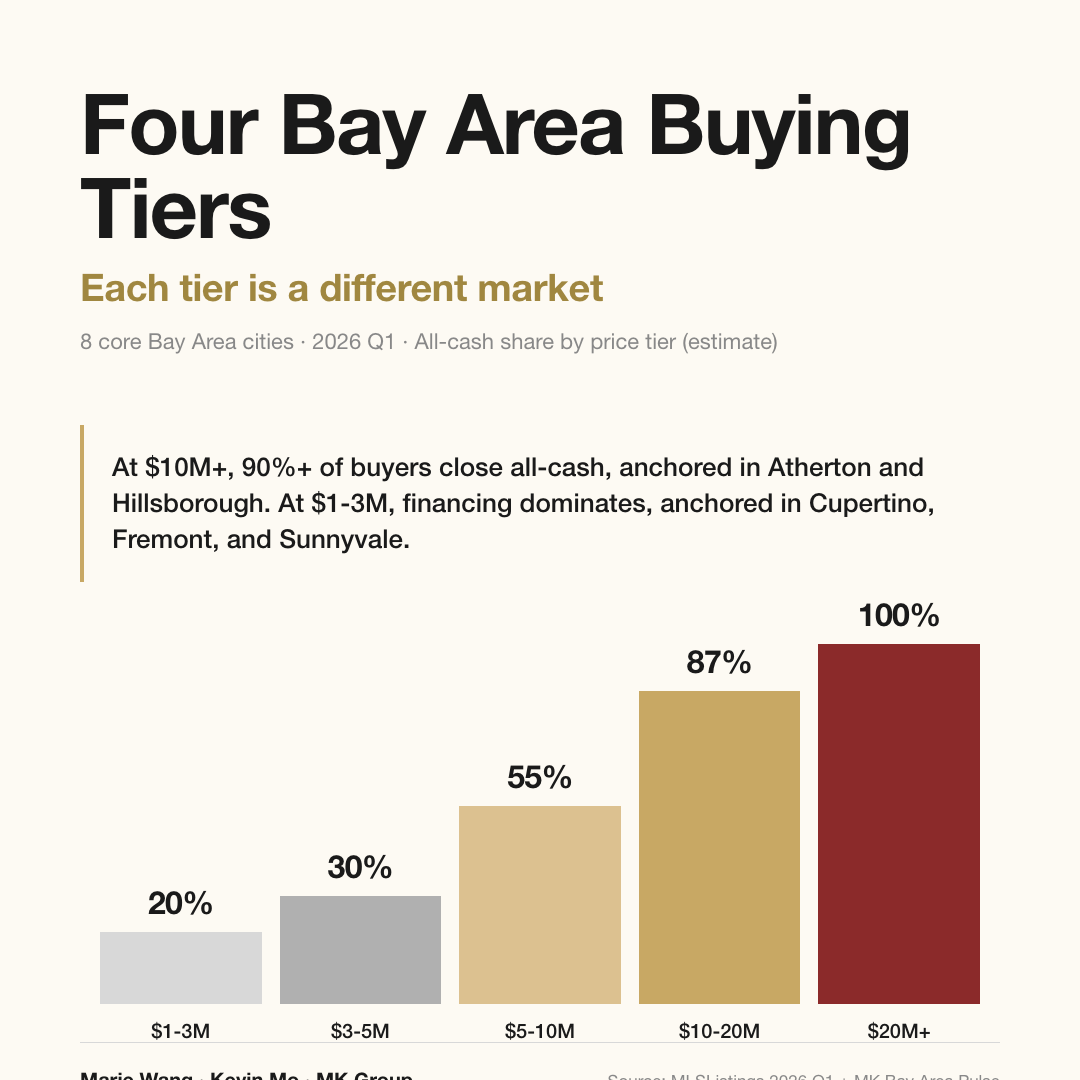
Bay Area home buying is not "set a budget, then pick a city." It is a multi-dimensional decision driven by submarket, school attendance zone, and tier — each of which rewrites the playbook. Six core takeaways: (1) budget defines submarket, and vice versa — $1-3M anchors in Cupertino, Fremont, and Sunnyvale; $10M+ locks into Atherton, Hillsborough, and Old Palo Alto; (2) school zones tightly couple with price tier — top-tier public attendance (Las Lomitas, PAUSD) adds a $1-3M premium; (3) on-MLS vs. off-market access shifts by tier — $1-3M is nearly all on-MLS, $10M+ runs 50%+ off-market; (4) all-cash share follows a K-curve, from ~20% at $1-3M to ~90%+ at $10M+; (5) multi-offer is the norm in core Bay Area submarkets, with sale-to-list ratios of 105-115%; (6) end-to-end timeline runs 60-120 days, with cross-border buyers adding 30-60 days of upfront preparation. This article is a decision framework for buyers across all tiers, not a first-time-buyer weekly calendar — for that, see our 8-week roadmap, or for process detail see the complete Bay Area home-buying process guide.
Who This Guide Is For
This Bay Area buying guide is written for five buyer profiles:
- Bay Area first-time buyers with pre-tax household income of $300K-$600K, targeting $1.5M-$3M in Cupertino, Fremont, Sunnyvale, or Mountain View. Core questions: how much, where, how do school zones map.
- Cross-border families arriving from mainland China, Hong Kong, Singapore, or Taiwan with $3M-$15M+ budgets, who need 30-60 days of front-loaded prep on FinCEN AML compliance, remote showing cadence, and school-attendance verification.
- Pre-IPO and AI-wealth families whose OpenAI, Anthropic, xAI, Applied Materials, or Nvidia tech package has unlocked materially, jumping budget from $2M to $5-20M within 2-3 years. Their network and agent-selection criteria look nothing like a traditional move-up buyer's.
- Tech tier-jump move-up buyers who already own a $1.5-3M starter home and are upgrading to a $4-8M Palo Alto, Los Altos, or Menlo Park permanent family home. Core question: sell-first vs. bridge loan vs. simultaneous.
- Cross-state relocators from Seattle, New York, Austin, or Boston, where the employer permits remote or transfer and the decision is driven by school priorities — compressing the showing cadence 5x.
Step 1 — Tier Stratification: Four Tiers, Four Distinct Markets
The single most common Bay Area buying mistake is treating the region as one market — "Bay Area homes are expensive." The reality is that $1-3M, $3-5M, $5-10M, and $10M+ are four completely different markets in buyer composition, access channel, decision cadence, and risk profile.
Headline numbers first: the $1-3M tier carries the deepest listing liquidity Bay Area-wide — typical DOM of 7-15 days, 5-8 competing offers, sale-to-list of 102-110%, all-cash share around 20%. The $10M+ tier sees fewer than 100 Bay Area-wide closings annually (Atherton plus Hillsborough plus Old PA combined posted roughly 30-50 closings in the $10-20M band in 2025, and fewer than 15 in the $20M+ band), runs 50%+ off-market, with all-cash share above 87%. Both are "buying a home," but the first is a 4-6 week multi-offer sprint and the second is a 6-12 month circle-network operation.
| Tier | Anchor Submarkets | Typical DOM | Multi-Offer Intensity | All-Cash Share | Off-Market Share | Typical Buyer Profile |
|---|---|---|---|---|---|---|
| $1-3M | Cupertino, Fremont, Sunnyvale, Mountain View, Santa Clara | 7-15 days | 5-8 offers | ~20% | <5% | First-time tech dual-engineers, family-gift down payments, local young move-up |
| $3-5M | Peripheral Los Altos, West Menlo Park, Palo Alto Midtown, Cupertino Monta Vista | 10-21 days | 4-7 offers | ~30% | 10-15% | Senior IC / staff engineer, cross-border middle market, local move-up |
| $5-10M | Core Palo Alto, core Los Altos, Menlo Park Allied Arts, top-of-Monta-Vista Cupertino | 14-30 days | 2-5 offers | ~55% | 30-40% | Director / VP, cross-border entrepreneurs, AI-wealth move-up, pre-IPO secondary cash-out |
| $10-20M | Atherton, Hillsborough, Old Palo Alto, Los Altos Hills | 30-90 days | 1-3 offers | ~87% | 50%+ | Family offices, cross-border principals, AI top-tier team leads, founders |
| $20M+ | West Atherton, Lower Hillsborough, Woodside, Old PA trophies | 60-180+ days | 0-2 offers | ~100% | 60-80% | Top-tier family offices, cross-border UHNW, public-company founders |
The counter-intuitive point worth remembering: as tier rises, showing count, DOM, and decision window all extend — but multi-offer intensity actually declines. The reason is that the $10M+ pool is small annual volume, with real buyers filtered through circle, relationship, and trust. A $15M Atherton new-build may sit listed for 6 months and see three families tour it — but every one of those families is well-pre-qualified. At $1-3M, the inverse: a listing goes live, 30-50 families tour the open house in five days, 7-12 offers come in — and roughly half are speculative first-look submissions from buyers "just trying."
Two wrong starting points for budget-setting:
- Backing out monthly payment — this yields only the "upper bound of purchasing power" without accounting for closing cost ($30-60K on a $2M home), six-month reserves ($50-150K), or renovation budget ($100-500K). Core Bay Area listings run 8-25% over list — your $2M target may close at $2.4M, so down payment moves from $400K to $480K.
- Anchoring on family-gift releasable amount — many cross-border families assume "whatever family can wire becomes our down payment," but FinCEN AML review, the CTA BOI filing trigger, ongoing $300K+ wire monitoring, plus annual gift-tax exclusion ($18K/year) all constrain effective available capital. Use "theoretical mobilizable funds × 0.6" as a conservative estimate of actual usable down payment.
Step 2 — Submarket Selection: Peninsula vs. South Bay vs. East Bay
Bay Area submarkets are not city-defined — they are defined along three axes: commute, school zone, cultural character, and price tier. The three macro blocks and their trade-offs:
Peninsula — Luxury Anchor + School Premium + Old-Money / New-Money Mix. Includes Atherton, Menlo Park, Palo Alto, Los Altos, Los Altos Hills, Mountain View, Portola Valley, Woodside, Hillsborough, Burlingame. The $5M+ Bay Area anchor — Stanford circle plus old-Silicon-Valley founders plus new AI-wealth families coexist. School zones are top-tier public (Las Lomitas, Menlo Park City, PAUSD, Los Altos) plus top-tier private (Castilleja, Sacred Heart, Menlo School, Crystal Springs Uplands) dual-choice. Caltrain commute into SF runs 30-60 minutes. Core signature: comparable price tier runs $500K-$2M more in the Peninsula than in South Bay, but school zone, circle, and long-term resale advantages are decisive.
South Bay — Tech Driver + School Zone Stratification + Maximum Liquidity. Includes Cupertino, Sunnyvale, Santa Clara, Mountain View, Saratoga, Los Gatos, Campbell, and Fremont (technically East Bay but buyer pool overlaps heavily). Apple, Google, Nvidia, Intel, and Applied Materials HQ orbit — the $1-3M tier's deepest stream, the primary market for first-time buyers and tech move-up families. School zone stratification is most pronounced here: Cupertino Union + Fremont Union High (Monta Vista, Cupertino, Homestead) is the Chinese-American first-time-buyer public-school ceiling. Core signature: $1.5-4M in South Bay is the deepest, most transparent, fastest stretch — but at $5M+, the buyer pool begins migrating back to the Peninsula.
East Bay (Tri-Valley + Berkeley/Oakland Hills) — Relative Value + Commute Cost. Includes Fremont, Pleasanton, Dublin, San Ramon, Walnut Creek, Lafayette, Orinda, Moraga, Berkeley Hills, Piedmont. At $1.5-4M in Pleasanton, Dublin, or San Ramon, you can buy comparable square footage plus comparable school tier (Mission San Jose / Foothill / Lynbrook is peer-tier) for $300K-$800K less than equivalent South Bay. The core cost: crossing Dumbarton or San Mateo Bridge during morning rush hour is 40-90 minutes into the Peninsula (longer at peak), and school-zone access is constrained by Mission San Jose Unified or Pleasanton Unified attendance boundaries. Cross-border families and outside relocators consistently underestimate East Bay commute cost.
Three counter-intuitive submarket selection notes:
- Don't let "commute distance" alone drive submarket selection. Many buyers say "I have to live within 20 minutes of work," but under hybrid schedules, the cumulative cost of 2-3 commute days per week is far below the 7-10 year cost of "living close but in a weaker school zone."
- Separate land value from house value. The $/sqft number in Atherton or Hillsborough is intensely misleading — the decision driver is the lot (1+ acre), not the structure. In Palo Alto's Crescent Park, an 1,800 sqft old ranch trades at $4.5M not because the house is worth that — it's the land. At $5M+, you're buying lot, school zone, and circle, not building.
- Sub-community selection (street and neighborhood level) yields far higher returns than city selection. Within Atherton, West / Central / Lindenwood see internal value spreads up to 40%. Within Palo Alto, Old PA / Crescent Park / Midtown / Barron Park / Charleston see tier-equivalent price spreads of 30%. Picking the right city is only the first step — picking the wrong sub-community can cause your home to underperform the market by 20% on a 7-year resale horizon.
Step 3 — School Zone and Community Matching: Street-Level Attendance, Not Zip Code
Bay Area school zones are the most important non-budget decision dimension, but "school zone" is far more than "GreatSchools score 9-10." In practice it splits into four sub-layers.
Layer 1: Public school attendance area verification at the street level. This is where Bay Area buyers most commonly trip up — referenced in the MK Group case library is the Atherton Oaks boundary case where the buyer fell in love with a 94027 Atherton property. Atherton as a town spans three different elementary districts (Las Lomitas in the west and center, Menlo Park City in the southeast, and Redwood City in the north abutting Lindenwood) and elementary assignment is street by street. The buyer's first-choice home sat on the wrong side of the boundary; comparable homes one block over on the correct side were trading approximately $1.5M higher. Zip code does not equal school district, and city level is not granular enough — verification has to be at the street-level attendance area. AOR tools or the city's official GIS can confirm.
Boundary traps in top-tier Bay Area school zones:
- Atherton 94027 — Las Lomitas (west and center), Menlo Park City (southeast), Redwood City (north Lindenwood-adjacent) — three different elementary districts. Las Lomitas Elementary + La Entrada Middle is the most-pursued "soft luxury" combination in Chinese-American circles.
- Palo Alto PAUSD — superficially unified, but Walter Hays / Duveneck / Ohlone / Hoover differ materially in reputation tier, and street-level attendance area determines assignment.
- Cupertino 95014 — spans Cupertino Union School District plus Fremont Union High School District. Within Fremont Union High, Monta Vista High / Cupertino High / Homestead High differ dramatically — top-tier college matriculation rates span from Monta Vista's 92%+ to Homestead's 70%+, a full tier apart. Monta Vista attendance area is the Chinese-American Bay Area public-school ceiling — at the $5M+ tier, a meaningful share of buyers explicitly require "Monta Vista or nothing."
- Menlo Park — Las Lomitas Elementary (west, Stanford-adjacent) versus Menlo Park City Elementary (east, downtown / Allied Arts) splits two districts, with Hillview Middle vs. La Entrada Middle similarly split.
Layer 2: Private vs. public school decision. At $5M+, a meaningful share of families explicitly choose private school, which shifts the frame. Castilleja, Sacred Heart, Menlo School, Crystal Springs Uplands, Harker, and Nueva admissions run on a separate 8-12 month cycle and cannot be secured in the same year a home closes. If the family commits to a private-school path, the home's "school zone" dimension relaxes, expanding the selection space by 30-50% — but long-term resale value within the Stanford Circle still tracks public-school zoning because the next buyer may go public.
Layer 3: Private-school commute radius. Even with a private-school decision, the actual geographic location of the private school still constrains home selection — Castilleja is in downtown Palo Alto, Sacred Heart in Atherton, Crystal Springs Uplands in Hillsborough. Most families center a 15-25 minute private-school commute as their comfort zone.
Layer 4: Middle school and high school transition sequencing. Bay Area K-12 sweet spots are not "good elementary, done." Las Lomitas Elementary + La Entrada Middle + Menlo-Atherton High is one progression; Cupertino Union elementary + Fremont Union Monta Vista High is another. If the home you buy doesn't sit on a continuous progression, the child can hit 9th grade and be forced to change friend groups. Before buying, draw the full K-12 attendance area chain — not just the elementary.
Step 4 — Agent Selection: Five Core Dimensions
Bay Area agent selection is not "find someone with good reviews" — it's matching across tier, cross-border capability, school zone fluency, luxury experience, and bilingual capacity. A full 8-dimension framework lives in how to choose a Bay Area real estate agent; in this guide's "playbook" register, five quick-reference dimensions:
- DRE licensing plus tier-experience match — all California-licensed agents can be verified on the California DRE site. Licensing alone doesn't mean tier experience: $10M+ Atherton agents and $1.5M Cupertino agents work different circles. A floor of 5+ same-tier closings over the trailing 24 months is the baseline.
- Case library depth plus decision framework — a strong agent can name 2-3 real cases on the first intro call that match your profile: how the family entered the decision, how they navigated trade-offs, how they closed. MK Group maintains a 16-case anonymized library (buy / sell / cross-border / luxury), publicly visible at the cases page.
- Pre-MLS / off-market network depth — $5M+ off-market is 30-50% of inventory, $10M+ exceeds 50% — that inventory can only be reached through circle networks. Verification: ask the agent to show you specific pre-MLS / off-market listings from the trailing 90 days (under NDA) rather than accepting verbal claims of "I have off-market resources."
- Specialty match in cross-border, school zone, or luxury — at least one — generalist agents stall in cross-border wire / FinCEN compliance, Atherton boundary diligence, and $15M+ circle introductions. Marie Wang and Kevin Mo's core specialty is cross-border plus Peninsula luxury — public-market analysis on YouTube channels @MarieWang (44K+) and @KevinMoRE (23K+) validates depth.
- BRA transparency — post the August 2024 NAR settlement, the Buyer Representation Agreement is mandatory, and its three dimensions (duration, scope, compensation) must be laid out in the intro call, not surfaced at signing. First-engagement duration 30-90 days, scope covering all cities you are simultaneously touring, compensation 2-3% disclosed up front.
Kevin recently served an Applied Materials engineer with 11 years tenure (referenced in the case library). On signing day, the client said "I caught a good window." The case is not notable for transaction details — it's notable for the agent's job of integrating four variables for the client (individual decision plus company order backlog plus RSU unlock cadence plus Peninsula mid-to-high price trajectory) into a single coherent framing. Generalist agents rarely do this.
Step 5 — Access Channel: On-MLS, Pre-MLS, Off-Market
The true Bay Area buyer's market is not just the publicly listed MLS. Three channels, shifting by tier:
On-MLS (Multiple Listing Service publicly listed): feeds Redfin, Zillow, Realtor.com. Transparent, most competitive, most complete information. $1-3M is 95%+ on-MLS, $3-5M is 85%+, $5-10M about 60-70%, $10M+ about 30-50%, $20M+ about 20-40%. On-MLS's advantage is transparency; its disadvantage is competition — Bay Area's 8-25% over-list overwhelmingly happens on-MLS.
Pre-MLS (Coming Soon / Listing Preview 7-14 days): the listing is about to hit MLS but is still in prep (staging, photography, disclosure). Some buyer agents see the preview. Advantage: bid before multi-offer; disadvantage: incomplete information (disclosure may not be ready). Pre-MLS is increasingly formalized in the Bay Area, and some listings close in the pre-MLS stage without ever publicly hitting MLS.
Off-Market (no MLS at all): Peninsula $5M+ runs ~30-50% off-market, Atherton / Hillsborough / Old Palo Alto $10M+ exceeds 50% (MK Group industry-participant estimate). Off-market primarily serves two seller types: (1) privacy-first (notable founders, family offices, cross-border principals who do not want public marketing), and (2) market-price testing (off-market negotiation round first; if price falls short, then MLS). Off-market access depends entirely on agent circle network.
For mechanics of off-market, when to choose which channel, and how to evaluate channel value, see the dedicated Bay Area off-market listing guide.
Channel selection counter-intuitive: $1-3M first-time buyers in South Bay essentially don't need off-market (inventory is thin and typically lower-quality than mainstream on-MLS); $5M+ buyers who only look at MLS miss 30-50% of inventory; $10M+ buyers who don't enter circle networks through a well-connected agent may go 6-12 months without seeing a suitable property.
Step 6 — The 7-Step Process (60-120 Days — See Dedicated Guide for Detail)
End-to-end from pre-approval to keys (full phase-by-phase detail in the complete process guide; here's the playbook-level summary):
- Pre-approval (W -8 to W -4) — run 2-3 lender comparisons simultaneously on rate + closing cost; cross-border families simultaneously launch a $10K test wire to verify the FinCEN AML path; nail down DTI math (conservative monthly payment at 33% of after-tax income, aggressive at 35%).
- Agent + BRA (W -4 to W -2) — intro call to lock BRA's three dimensions (30-90 day duration, scope covering all target cities, 2-3% compensation transparent).
- Submarket + school zone screening (W -2 to Day 0) — lock submarket by tier, verify street-level attendance area, cap at 15-20 in-person showings. Cross-border families build a mental map via a half-day 4-property representative tour.
- Disclosure diligence (parallel to Phase 3) — TDS / SPQ / NHD / pre-listing inspection / HOA documents / street-level school verification as the five-piece kit. Don't push to post-offer — Bay Area's cadence doesn't grant rework time.
- Offer submission (Day 0-3) — price ladder + contingency decisions (inspection / loan / appraisal each binary keep or waive) + non-price levers (close date / rent-back / earnest money). Multi-offer occurs in 60-90% of cases.
- Escrow open (Day 3-7) — open escrow + wire earnest money (1-3%) + 17-day inspection window (if kept). Wire fraud is the single most severe risk: any "account change" email must be verified by phone calling escrow's main published number.
- Final underwrite + appraisal + walk-through → COE (Day 14-30) — during underwrite, don't change jobs, don't make major purchases, don't open new credit. If appraisal lands low, three options (negotiate down / cover in cash / walk away). Closing cost $30-60K on a $2M home; Friday submission may slip to Monday — avoid Thursday/Friday closings.
Five Common Judgment Traps in Bay Area Buying
Trap 1: "The school zone is great in this zip code, so any street works."
Wrong. Atherton 94027 spans Las Lomitas / Menlo Park City / Redwood City — three different elementary districts. The Atherton Oaks case shows comparable listings on opposite sides of the boundary differ by approximately $1.5M. Palo Alto PAUSD looks unified but Walter Hays / Duveneck / Ohlone / Hoover reputations differ materially. Within Cupertino 95014, Monta Vista High / Cupertino High / Homestead High college matriculation rates differ a full tier. Zip code does not equal school district, city level is not granular enough — verification has to be at the street-level attendance area. AOR tools or the city's official GIS confirm.
Trap 2: "Bay Area multi-offer is overstated — I'll wait for a better listing."
Wrong. Core Bay Area submarkets (Palo Alto, Los Altos, Cupertino, Menlo Park) see mainstream listings hit offer review within 5-7 days; 60-90% of strong listings see competing offers; sale-to-list ratios run 105-115%. "Waiting for the next one" in the core means at least 2-3 more weeks of search time with similar over-list intensity. The $5M+ annual deal volume is small; in Atherton, $10-20M tier closings are under 50 in a full year — passing on the right property may mean waiting 3-6 months for another credible candidate. Multi-offer is not exaggeration — it is the structural feature of core Bay Area submarkets.
Trap 3: "All-cash buyers don't need any contingency — strip them all."
Wrong. All-cash doesn't need loan contingency (no financing), but inspection contingency and appraisal contingency are independent. An all-cash buyer can still hit structural defects (roof, foundation, HVAC) and still overpay by $200-500K. At $5M+, all-cash buyers should keep at least informational (non-binding) inspection. In core Bay Area listings, sellers do require contingency waiver — but the buyer can pay $400-$800 for pre-offer pre-inspection, learn the risk profile, then waive with eyes open. All-cash does not mean "naked offer" — diligence still applies.
Trap 4: "Off-market is always cheaper than MLS — insider access equals discount."
Wrong. Off-market price can run above, equal to, or below MLS — driven by seller motivation. Privacy-first sellers (notable founders, family offices) typically price off-market 5-10% higher (no competitive bidding, but the buyer pays an "exclusive access" premium). Market-price-testing off-market may run comparable to MLS. Genuinely discounted off-market is usually atypical (estate sale, distressed, divorce). Off-market's real value is "wider inventory visibility," not "cheaper price." Choosing the wrong off-market channel (wrong agent circle, misread seller motivation) can leave you paying more than the MLS-equivalent listing.
Trap 5: "Cross-border buyers follow the same timeline as local — no front-loading required."
Wrong. Cross-border buyers must add 30-60 days of front-loaded preparation. Why: (1) FinCEN AML review triggers on large international wires (single transfer $300K+ or monthly cumulative $1M+) and requires a complete Source of Funds Declaration; (2) the Corporate Transparency Act BOI filing trigger kicks in at the $300K+ LLC beneficial-ownership threshold; (3) actual cross-border wire arrival ranges 1-15 business days depending on corridor — mainland China outflows often hit SAFE's $50K/person annual cap and need to be batched; (4) remote showing cadence requires the agent to do walkthrough video and data filtering ahead of time. "I'll start moving money once I find the home" is the single largest cross-border timeline mistake — referenced in the Shenzhen entrepreneur half-day 4-property case: the half-day decision was possible because the funds path was validated 30 days before the family flew over.
Frequently Asked Questions
What are the core steps in a Bay Area home-buying playbook?
The six core decisions: (1) tier defines submarket — $1-3M anchors in Cupertino, Fremont, Sunnyvale; $3-5M enters peripheral Los Altos, Menlo Park, Palo Alto; $5-10M reaches core PA, Los Altos, Menlo Park; $10M+ locks into Atherton, Hillsborough; (2) street-level school zone verification — zip code and city are insufficient; verify attendance area. Atherton 94027 alone spans three elementary districts; (3) tier-matched agent selection — DRE licensing + 5+ same-tier closings over the trailing 24 months + pre-MLS network depth; (4) channel selection shifts by tier — $1-3M is nearly all on-MLS, $10M+ runs 50%+ off-market; (5) offer strategy — multi-offer occurs in 60-90% of cases, with price ladder + contingency calls + non-price levers as the combined toolkit; (6) 7-phase process spanning 60-120 days — pre-approval → BRA → showings → diligence → offer → escrow → COE. Cross-border adds 30-60 days for FinCEN compliance and wire-path validation.
How much down payment do I need for a Bay Area home?
Bay Area down payment varies by tier, loan type, and buyer profile: (1) conventional loan — $1-3M mainstream first-time buyers typically 20% down ($300-600K); some lenders accept 10-15% down but require PMI; (2) jumbo loan — $2M-$5M typically requires 25-30% down ($500K-$1.5M), with portfolio lenders accepting 20% for strong borrowers; (3) $5M+ — most buyers choose 30%+ down or all-cash, because the jumbo loan rate premium makes financing ROI materially worse; (4) $10M+ — ~87% all-cash; the few financed deals run 50%+ down on relationship-based portfolio lending. Beyond down payment, plan for: 1.5-3% closing cost, six months of reserve payments, and $50-300K renovation budget. Cross-border families should estimate "theoretical mobilizable funds × 0.6" as conservatively usable down payment, given FinCEN review + SAFE caps + gift tax constraints on actual release amount.
What is the cross-border buyer's complete Bay Area process?
Cross-border buyers run a 90-150 day Bay Area process (local 60-90 days + 30-60 days front-loaded): (1) 30-60 day prep — FinCEN AML path design (typical corridor: mainland SAFE allowance batched → Hong Kong or Singapore holding account → US escrow), $10K test wire to validate channel, CTA BOI filing prep (if LLC vesting), remote walkthrough video showing cadence build, agent BRA signed; (2) post-fund-arrival buyer flow — half-day 4-property representative tour to build mental map (referenced in the Shenzhen entrepreneur case), street-level school verification, offer strategy (all-cash + short close date + flexible rent-back as competition signals); (3) Escrow + COE — POF preparation + Source of Funds Declaration + FinCEN report (if applicable), wire-fraud vigilance during escrow. Professional disclaimer: cross-border funds compliance spans multi-jurisdictional tax and AML regulation — actual execution requires cross-border counsel plus CPA confirmation.
Which Bay Area cities suit first-time buyers?
Bay Area first-time buyers ($1.5M-$3M) primarily target: (1) Cupertino — within Monta Vista / Cupertino High attendance, the public-school ceiling, $1.8-3M tier with deepest listing liquidity; (2) Sunnyvale 94087 — Cupertino Union extension, $1.5-2.5M tier with broader selection, commuting Apple/Google/Nvidia in 10-20 minutes; (3) Fremont Mission San Jose — second public-school choice in Chinese-American circles (Mission San Jose High is peer-tier to Monta Vista), $1.3-2M tier, Peninsula commute 30-60 minutes; (4) Mountain View — $1.5-2.5M, Google / LinkedIn commute 5-15 minutes, mid-tier schools (Whisman / Mountain View Whisman); (5) Santa Clara / North San Jose — $1-1.8M, mid-tier schools but closest commute to Nvidia / Intel / Cisco. First-time buyer pitfall: don't "stretch" into Palo Alto / Los Altos at marginal tier — the same budget buys a single-family in Cupertino but only a condo or 1,200 sqft ranch in PA, with poor long-term family fit. Detailed 8-week timeline at first-time buyer 8-week roadmap.
How long until COE (close of escrow) in the Bay Area?
Standard Bay Area COE timelines: (1) local all-cash buyer — 14-21 day escrow, total cycle 30-60 days (showings → offer → escrow → COE); (2) local financed buyer — 21-30 day escrow, total cycle 45-75 days; (3) cross-border all-cash — 21-45 day escrow (FinCEN AML review + wire timing), total cycle 75-120 days; (4) cross-border financed — 30-60 day escrow, total cycle 90-150 days. Bay Area escrows run 1-2 weeks faster than most other states, primarily because Bay Area buyers routinely waive contingencies to compress the contract. That speed trades for buyer risk (waived inspection means structural exposure; waived appraisal means low-appraisal cash cover). Closing day should avoid Thursday and Friday — title companies submit recording to the county recorder same-day in most cases, but Friday afternoon submissions can slip to Monday.
Next Steps
- Honestly assess your tier. Not "how much down payment can I produce" but "theoretical mobilizable funds × 0.6 + monthly payment capacity × 7 years" as the conservative purchasing power. $5M+ buyer pool and $1-3M buyer pool are two markets — picking the wrong tier means mis-matched submarket, mis-matched agent, mis-matched channel.
- Map tier to 2-3 candidate submarkets. Per Step 2 (Peninsula school premium / South Bay tech liquidity / East Bay value plus commute cost) — no more than 3, beyond which showing cadence dilutes and decision fatigue accumulates.
- Verify street-level attendance areas before the first showing. AOR tools or city official GIS — draw the K-12 progression chain (elementary → middle → high), not just the elementary.
- Launch 2-3 lender pre-approvals in parallel. Local families 4-8 weeks ahead; cross-border families 30-60 days ahead plus a simultaneous $10K test wire to validate FinCEN channel.
- Schedule 2-3 tier-matched agent intro calls. Verify DRE licensing + same-tier closings in trailing 24 months + pre-MLS network depth + presentable case library. BRA's three dimensions (duration / scope / compensation) get laid out in the intro call.
- Cap showings at 15-20. Past 25, decision fatigue erodes judgment. Log three strongest pros + three biggest concerns after each showing. Cross-border families: a half-day 4-property representative tour builds a stronger mental map than 10 same-neighborhood sequential showings.
- Lock maximum price ceiling and contingency strategy before submitting the offer. Highest-and-best windows compress decisions into hours — having the framework set in advance beats real-time response.