Direct Answer: What you must know before selling in Cupertino
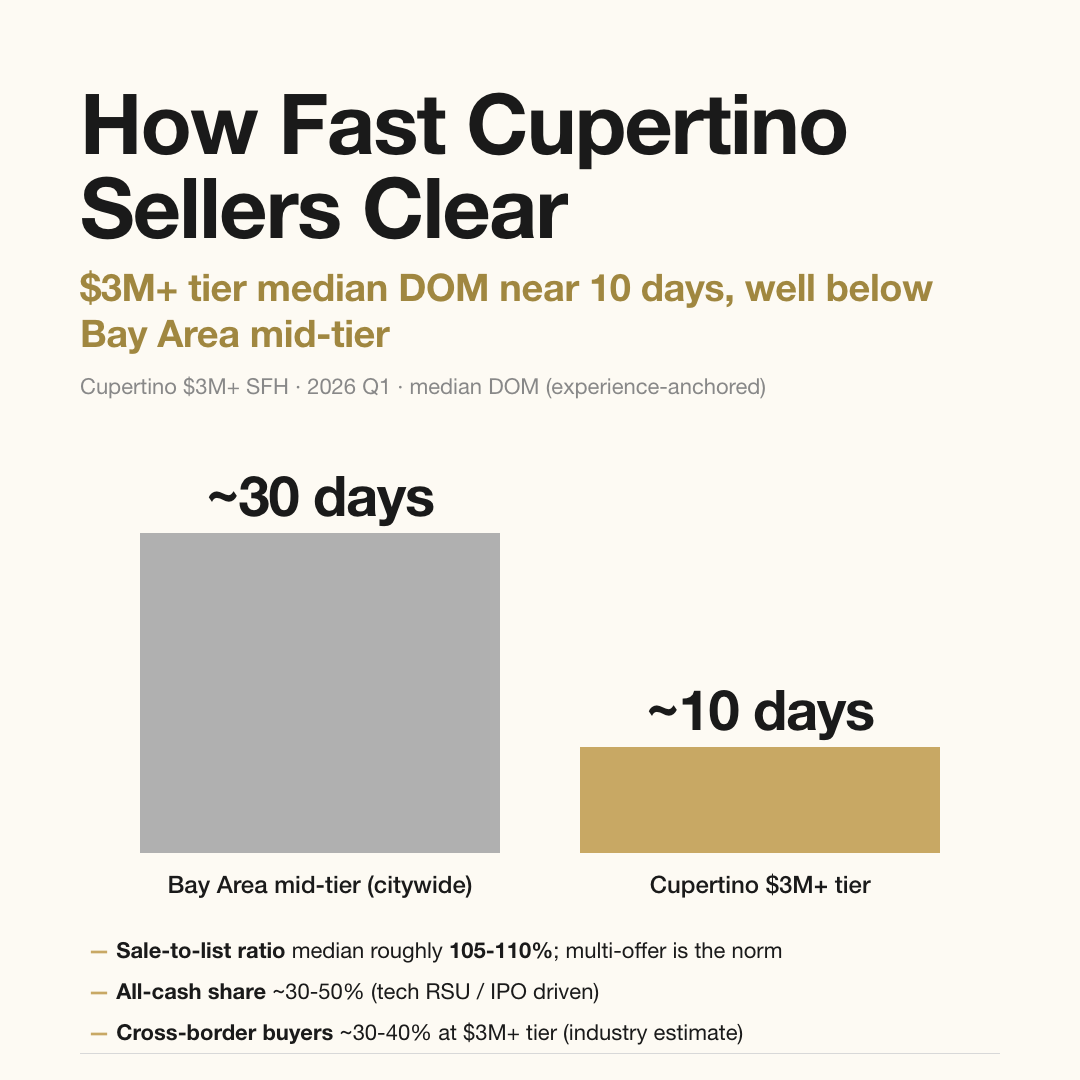
Selling in Cupertino means deploying it as the Silicon Valley tech-tier fast-paced multi-offer market — along a three-axis framework: list price, first-week rhythm, and Best & Final timing. Five core facts must be understood up front: (1) Cupertino $3M+ tier median DOM is roughly 10-15 days — materially faster than the Bay Area mid-tier's typical 30 days citywide, close to Palo Alto / Los Altos at the same tier, and well below Atherton $20M+'s 90+ days. This is Cupertino's defining sell-side feature. (2) Multi-offer is the norm and sale-to-list ratio sits 105-110% at the median, with apex Monta Vista / Inspiration Heights hot listings frequently 115-125%. This means accurate list pricing, tight first-week pacing, and right-timed Best & Final are the core levers for sale-to-list 110%+. (3) Cupertino $3M+ off-market share runs 15-25% per MK Bay Area Pulse 2026 Q1 estimates — materially below Atherton / Hillsborough $10M+'s 50%+; public MLS remains the dominant path. But $5M+ pre-MLS share rises to 25-40%. (4) The buyer pool: 30-50% all-cash + 30-40% cross-border + tech-engineer upgrades — the actual Cupertino $3M+ buyer pool consists of Apple / Google / semiconductor / AI company engineers and mid-senior management whose liquidity comes from RSU / IPO / secondary, plus cross-border first-time families. The listing agent must be wired into Chinese-broker private WeChat groups and cross-border referral networks. (5) Dual pricing weights: $/sqft + attendance-area high — Monta Vista High attendance carries a 10-20% premium at the same $/sqft; Homestead attendance inside Cupertino city carries a 5-10% discount. Zillow valuations run more accurate in Cupertino than in Palo Alto / Atherton but still typically 10-15% off. This is the framework Marie Wang and Kevin Mo at MK Group have refined across recent Cupertino seller engagements.
Who this article is for
This guide is written for five Cupertino seller profiles:
- Long-hold families at the $2M-$3.5M tier: 10-25 year Cupertino owners whose children are through high school, considering an upgrade to Saratoga / Los Gatos / Palo Alto, or a retirement downsize to Carmel / other California submarkets. Faria / Rancho Rinconada / Garden Gate at $2M-$3.5M is the dominant pool.
- Tech-family upgrade sellers at the $3M-$5M tier: 5-10 year Cupertino owners moving up to Palo Alto / Los Altos $5M-$8M due to remote-work policy changes, RSU liquidity, or second-child upgrade. Inspiration Heights / West Cupertino / Monta Vista entry is the dominant pool.
- Monta Vista / Inspiration Heights upper-tier sellers at $5M-$8M: long-hold Monta Vista High attendance families upgrading to Los Altos Hills / Atherton / Hillsborough $10M+. This tier requires more refined pre-MLS access and cross-border referral networks.
- Estate / inherited-property sellers: Cupertino long-hold families whose elder generation has passed, with children inheriting and selling. The stock typically is 1950s-1970s unrenovated mid-century / Ranch — requiring an "as-is" versus "pre-listing renovation then list" decision, with materially different ROI implications.
- Cross-border / trust / family-office sellers: cross-border families selling Cupertino property due to visa changes, return to domestic business focus, or family restructuring — adding FIRPTA withholding, California residency determination, and home-country tax treaty coordination to the complexity stack.
The core seller decision framework is the same across all five — only density, buyer-pool targeting, and cross-border compliance depth differ.
Cupertino seller core data: pace, pricing, buyer pool
The core number first: Cupertino $3M+ tier median DOM is roughly 10-15 days — about 1/3 of the Bay Area mid-tier's citywide typical 30 days, close to Palo Alto / Los Altos at the same tier, and materially faster than Atherton $20M+'s 90+ days. Sale-to-list ratio sits 105-110% at the median, with apex Monta Vista / Inspiration Heights hot listings frequently 115-125%. This means "accurate list pricing + tight first-week pacing" matters more than the list price number itself for sale-to-list 110%+ outcomes.
| Tier | Typical list | Median DOM | Sale-to-list median | All-cash share | Cross-border share | Off-market share |
|---|---|---|---|---|---|---|
| $1.8M-$3M (Faria / Rancho Rinconada / Garden Gate entry) | $1.8M-$2.8M | 7-12 days | 108-112% | 20-35% | 20-30% | 10-15% |
| $3M-$5M (Inspiration Heights / West Cupertino / Monta Vista entry) | $3M-$4.5M | 10-15 days | 105-110% | 30-50% | 30-40% | 15-25% |
| $5M-$8M (Monta Vista upper / Inspiration Heights upper) | $5M-$7M | 15-30 days | 103-108% | 50-70% | 35-45% | 25-40% |
| $8M+ (Monta Vista trophy / ground-up) | $8M-$12M | 30-90 days | 98-105% | 70-85% | 40-50% | 40-60% |
What to actually remember: Cupertino's entry tier ($1.8M-$3M) moves fastest with the highest sale-to-list (108-112% median) — because the entry-tier buyer pool is the deepest (local engineer first-time buyers + cross-border first-purchase + tech upgrades + Sunnyvale tier-up), competition the most intense. $8M+ moves noticeably slower with sale-to-list close to or below list — because the $8M+ Cupertino buyer pool is narrow (mostly Monta Vista High district core demand + cross-border family office outpost), competing with Atherton $10M-$15M. Data source: MLSListings 2025-2026 / MK Bay Area Pulse 2026 Q1 estimates. Updated: 2026-06. Scope: seller decision framework for single-family homes across Cupertino 95014 (including selected unincorporated Santa Clara County) at four core price tiers.
Cupertino seller pricing: dual $/sqft + attendance-area high weighting
Cupertino seller pricing is not single-axis $/sqft — it requires dual weighting of $/sqft (submarket baseline) plus attendance-area high (Monta Vista High versus Cupertino High versus Homestead). This is the largest pricing-structure difference between Cupertino and Atherton (which weights $/lot more heavily) and Palo Alto (which weights submarket culture more heavily).
Axis 1: $/sqft submarket baseline. Cupertino's 6 submarkets span $/sqft bands from Faria ~$1,500 to Monta Vista ~$2,400, a 1.6x range, so pricing must start from the submarket baseline. Within a submarket, $/sqft deviation typically runs ±10%, driven by build era (1950s-1970s Ranch lower, 1990s-2010s remodel middle, 2015+ ground-up higher), lot size (0.18-0.25 acre baseline, 0.30+ acre 5-15% premium), and facade condition.
Axis 2: attendance-area high weighting. Monta Vista High attendance properties carry a 10-20% premium at the same $/sqft — this is the core pricing driver at Cupertino's apex ($5M+). Cupertino High attendance is the baseline inside Cupertino (Garden Gate / Rancho Rinconada / Faria dominant). Homestead High attendance inside Cupertino city carries a 5-10% discount — because Homestead spans Cupertino / Sunnyvale / Los Altos boundary territory and is typically read by buyers as "third tier inside the Cupertino school system."
Dual-axis example: Monta Vista submarket + Monta Vista High attendance for a 2,500 sqft property prices at $5.5M-$6M baseline; West Cupertino submarket + Monta Vista High attendance for the same size prices at $4.5M-$5M baseline (lower submarket $/sqft but attendance premium); Faria submarket + Cupertino High attendance for a 2,200 sqft property prices at $3M-$3.5M baseline. All numbers must then be layered with the 105-110% multi-offer sale-to-list expectation — meaning the list price should sit in the 95-100% range of baseline to trigger multi-offer, not anchor directly at baseline 100-105%.
The actual Cupertino seller process (8 steps, 30-75 days)
The Cupertino seller process is shorter than Atherton's (30-75 days versus Atherton's 90-180) and close to Palo Alto's standard pace — primarily because DOM is short once the list price is set, buyer pool liquidity is high, and escrow is fast.
Step 1: Lock the listing broker + sign listing agreement (Day 1-3). Cupertino listing broker bar: 2-3+ years of Cupertino / Saratoga / Los Altos listing experience, direct knowledge of the six core submarkets' sale-to-list ratios and buyer pools, access to TAN / KW Exclusive Properties / local Chinese-broker private WeChat networks. Standard listing agreement is 6-12 months, commission 5-6% gross (buyer + listing).
Step 2: Pre-listing prep + valuation + submarket comp analysis (Day 3-14). Pre-listing prep typically includes professional photography ($1,500-$3,500), staging ($5,000-$15,000), and necessary cosmetic touch-ups (paint, carpet, landscape grooming, entry art). Pre-listing renovation decision point: estimate ROI (renovation cost vs. expected sale-to-list lift). In Cupertino, cosmetic touch-up plus staging is sufficient in most cases; major renovation typically lacks ROI (because buyers have multi-offer choice and prefer to remodel themselves). Comp analysis must use the dual $/sqft + attendance-area high framework.
Step 3: Disclosure prep + inspection report (Day 7-21). Cupertino pre-listing disclosure standards: Natural Hazard Disclosure (NHD), Statewide Buyer and Seller Advisory, Lead-Based Paint Disclosure (mandatory for pre-1978 stock), Mello-Roos disclosure (if applicable), HOA documentation (if applicable). Pre-listing inspection is common but not mandatory in Cupertino — its ROI: proactively disclose known issues at list (avoiding late-escrow buyer leverage for price reduction), and provide to buyers in multi-offer (saving them inspection-contingency negotiation space).
Step 4: MLS list + pre-MLS channel in parallel (Day 14-21). Cupertino $2M-$5M standard practice: MLS list plus synchronous push to TAN / KW Exclusive Properties / local Chinese-broker private WeChat groups / cross-border referral networks. $5M+ sellers may select pre-MLS 1-2 weeks + MLS hybrid mode; $8M+ sellers may select pure off-market (listing broker direct buyer sourcing). The listing week must schedule 1-2 broker tours plus weekend open houses.
Step 5: Open house + weekend rhythm + private showing (Day 14-30). Cupertino standard weekend open house rhythm: Saturday 1-4pm + Sunday 1-4pm (two consecutive weekends). Broker tour typically Tuesday morning. Private showings booked by buyer agents — Cupertino $3M+ first-week private showings typically run 15-30 sessions, weekend open houses typically 30-80 families (depending on submarket + list price + season).
Step 6: Offer collection + Best & Final timing control (Day 14-30). Cupertino offer-collection standard rhythm: set offer review deadline 7-10 days post-listing (typically Monday evening or Tuesday). Best & Final timing control is the core lever for sale-to-list 110%+ — announce 24-48 hours before opening offers via the listing broker to all buyer agents, giving buyers time to adjust best & final terms. Best & Final deadline: typically highest-and-best 48-72 hours, backup offers sourced in parallel.
Step 7: Accept offer + escrow + inspection (Day 21-50). All-cash Cupertino standard escrow is 14-21 days; financed runs 21-30. Buyer inspection at the Cupertino tier generally moves smoothly (most buyers have pre-offer inspection or waive inspection contingency). Disclosure contingency 5 days, appraisal contingency (financed) 17-21 days. Cupertino seller escrow risks: cross-border buyer funds delay (AML 5-15 business days), trust / LLC vesting documentation delay, FIRPTA withholding (when seller is a foreign person).
Step 8: COE + post-closing transition + rent-back (Day 30-75). Post-COE 14-45 day rent-back is common in Cupertino (sellers typically need 14-30 days to find the next home versus Atherton's 30-60). Rent-back agreement must specify in escrow: rent-back fees, insurance responsibility, damage liability, return schedule. Cross-border sellers need post-COE follow-through on FIRPTA refund (if applicable), California state tax filing, and home-country treaty foreign reporting. This section involves cross-border tax and FIRPTA withholding flow; consult an attorney or CPA before execution.
MK Group field notes: list pricing + first-week pacing as the Cupertino seller's core levers
Across recent Cupertino seller engagements, the team has repeatedly validated a core observation — accurate list pricing + tight first-week pacing matters more than the list price number itself.
In November 2025, Kevin's team worked with a Sunnyvale 94087 owner who originally planned to sell and upgrade to Los Altos. Kevin's recommendation after deep market analysis was "do not sell now" — the core reasoning was that the cross-area 94087 / Cupertino / Sunnyvale sell-buy coordination rhythm was unfavorable at that moment: selling 94087 might only achieve sale-to-list at list price, while buying Los Altos required over-list 10-15%, netting a 10-20% round-trip loss. The owner accepted the recommendation and held the Sunnyvale property. Full case → 94087 owner wanting to upgrade to Los Altos, Kevin recommends not selling
This case reversely illustrates a critical lever in Cupertino seller decisions: not every moment is the right moment to sell. Cupertino's multi-offer rhythm means sellers ostensibly "can sell at any time," but what sellers actually care about is not "can I sell?" but "can I sell at a reasonable sale-to-list ratio in a reasonable moment + buy the next home in coordination?" MK Group's multi-year observation in the Cupertino seller tier is that pricing 5% below baseline to trigger multi-offer is more reliable than pricing 5% above baseline waiting for buyers to chase — Cupertino $3M+'s 105-110% median sale-to-list is driven by multi-offer competition, and multi-offer requires a list price 5-10% below market expectation to trigger. This observation drives MK Group's list-price guidance: for Cupertino $3M-$5M, list at 95-100% of submarket baseline; for $5M+, list price can sit closer to baseline 100% because the buyer pool is narrower and multi-offer intensity lower.
5 Common Pitfalls
Pitfall 1: "List high — buyers will naturally negotiate down"
Wrong. Cupertino $3M+'s 105-110% median sale-to-list is driven by multi-offer competition, and multi-offer requires a list price 5-10% below market expectation to trigger. Listing 5% above baseline in Cupertino typically produces four outcomes: (1) first-week private showings drop materially (buyers see the list on Zillow / Redfin and skip); (2) open house attendance drops 30-50%; (3) no offers in the first week forces a price cut, by which point DOM has accumulated to 15-25 days and lost "new listing" momentum; (4) final sale-to-list lands at 100-103% rather than the 108-112% multi-offer-triggered outcome. Correct: list at 95-100% of submarket baseline plus attendance-area weighting to trigger multi-offer in the first week.
Pitfall 2: "Weekend open house timing doesn't matter"
Wrong. The Cupertino weekend open-house standard is Saturday 1-4pm + Sunday 1-4pm (two consecutive weekends). This cadence has been validated as the optimal rhythm across years — Saturday 1pm start ensures cross-border buyers (China time zones) and local dual-income families can attend; 4pm end gives the listing broker time to collect buyer feedback and sync to ListGenius or internal tracking systems. Deviating from this standard (e.g., Sunday 11am-1pm or Saturday 4-7pm) in Cupertino frequently causes attendance to drop 30-50% and first-week momentum to decay. Broker tour must be Tuesday morning (the Cupertino broker-tour standard slot); deviating causes local brokers to skip.
Pitfall 3: "Cross-border buyers are too few in Cupertino to specifically prepare for"
Wrong. Cupertino $3M+ tier cross-border buyer share runs 30-40% per MK Bay Area Pulse 2026 Q1 estimates — a core component of the actual Cupertino seller buyer pool. The listing agent must be wired into Chinese-broker private WeChat groups, cross-border referral networks, and local Chinese media (World Journal, Sing Tao Daily, WeChat community channels). Listing materials must be prepared in both Chinese and English (English MLS primary version, Chinese simplified version for Chinese-broker private WeChat groups). Cross-border buyers in Cupertino typically encounter listings through local Chinese broker contacts — listing agents using "English MLS primary + standard listing flyer only" in Cupertino miss roughly 30-40% of the potential buyer pool.
Pitfall 4: "Zillow valuations are more accurate in Cupertino than in Atherton — I can use Zestimate directly to set list price"
Wrong. Zillow Zestimate is more accurate in Cupertino than in Atherton (because Cupertino comps are deep, market liquidity is high, and the $/sqft model is relatively stable), but typical accuracy is still 10-15% off baseline market value — the core reason is that the Zillow model cannot precisely model attendance-area high (Monta Vista High vs Cupertino High vs Homestead), street-level micro-comps, recent multi-offer-triggered over-list premium, or submarket micro-trends (e.g., Monta Vista's recent 3-6 month sale-to-list rising to 112-115%). Setting list price directly from Zestimate in 90% of Cupertino cases either underprices (Monta Vista High attendance, where Zestimate under-models attendance premium — $5M baseline home becomes $4.5M Zestimate, listed at $4.5M, triggers multi-offer but only at sale-to-list 100% rather than 110%) or overprices (Homestead attendance, where the model treats Homestead as baseline Cupertino). Correct: list price determined by a listing broker with Cupertino field experience based on submarket + attendance-area + street-level micro-comp + recent multi-offer data.
Pitfall 5: "All Cupertino submarkets sell the same way"
Wrong. Monta Vista / Inspiration Heights / West Cupertino (Monta Vista High attendance) seller strategy versus Garden Gate / Rancho Rinconada / Faria (Cupertino High attendance) seller strategy differ in list-price methodology, first-week pacing, buyer-pool targeting, and cross-border promotion depth. Monta Vista list = baseline 95-100%, first-week multi-offer trigger, targeting Apple / semiconductor execs + cross-border $5M+ families; Faria list = baseline 92-97%, more aggressive first-week multi-offer trigger, targeting local engineer first-time buyers + cross-border $2-3M entry. "One Cupertino playbook fits all submarkets" is the most common Cupertino seller strategy error.
Frequently Asked Questions
What should I know before selling my Cupertino home?
Five core facts before selling in Cupertino: (1) Cupertino $3M+ tier median DOM is just 10-15 days, multi-offer is the norm, sale-to-list ratio median 105-110% (apex hot listings 115-125%). (2) Cupertino $3M+ off-market share runs 15-25% (well below Atherton/Hillsborough); public MLS remains dominant; $5M+ pre-MLS share rises to 25-40%. (3) Dual pricing weighting: $/sqft submarket baseline + attendance-area high (Monta Vista High premium 10-20%, Homestead discount 5-10%). (4) Buyer pool: 30-50% all-cash + 30-40% cross-border + tech-engineer upgrades dominant at $3M-$5M; the listing agent must access Chinese-broker private WeChat groups and cross-border referral networks. (5) Best & Final timing is the core lever for sale-to-list 110%+ — announce 24-48 hours before opening offers, set a highest-and-best deadline.
How long does selling in Cupertino take?
Cupertino $3M+ standard seller flow is 30-75 days: pre-listing prep 14-21 days + MLS list to offer accept 7-30 days + escrow 14-30 days + rent-back transition 14-45 days. $2M-$3M entry tier is typically faster (20-50 days); $5M+ runs slightly longer (45-90 days); $8M+ Monta Vista trophy 60-150 days. This is roughly 50-60% faster than Atherton's $10M+ standard 90-180 days and close to Palo Alto / Los Altos at the same tier.
What is the Cupertino listing commission?
Cupertino standard listing commission: 5-6% gross (buyer agent 2.5-3% + listing agent 2.5-3%). Post the 2024 NAR settlement, buyer agent compensation is no longer automatically disclosed in MLS, but Cupertino sellers still typically pre-set 2.5-3% buyer agent compensation in the listing agreement and disclose to buyer agents through broker-to-broker negotiation channels. Pre-setting buyer agent compensation in the listing agreement remains standard for Cupertino's multi-offer rhythm — refusing to pre-pay buyer agent compensation materially shrinks the buyer-pool density.
What tax issues should cross-border sellers watch for?
Cross-border sellers (non-US tax residents) need to prepare: (1) FIRPTA withholding — Title must withhold 15% of sale proceeds (10% in some cases) as federal income tax at closing; the seller files IRS Form 8288-B for refund (typical cycle 6-12 months). (2) California state tax — non-California-resident sellers face 3.33% state tax withholding via Form 593 at closing. (3) Home-country treaty coordination — mainland China, Singapore, Hong Kong, and Taiwan have different overseas reporting requirements; some countries allow US tax credit offset. (4) Repatriation — large cross-border outflows undergo US bank AML review (typical 5-15 business days); the receiving party in the home country needs source-of-funds documentation. This section involves cross-border tax and FIRPTA withholding flow; consult an attorney or CPA before execution.
Should Cupertino list price be higher or lower than Zestimate?
In most cases, lower than submarket + attendance-area weighted baseline market value by 5-10%, not aligned with Zestimate. Zillow Zestimate in Cupertino is typically 10-15% off baseline market value (the model under-models attendance-area high and recent multi-offer-triggered over-list premium) — using Zestimate directly to set list price typically under-lists in Monta Vista High attendance (Zestimate under-models attendance premium) and over-lists in Homestead attendance (model treats Homestead as Cupertino baseline). Correct: list price set by a listing broker with Cupertino field experience based on submarket $/sqft baseline + attendance-area high weighting + street-level micro-comps + recent multi-offer data, typically landing 95-100% of submarket baseline to trigger multi-offer.
Next steps
- Clarify the seller goal — is the target "highest sale-to-list ratio," "shortest DOM," "most flexible rent-back," or "sell-buy round-trip optimization"? Unclear goals at the Cupertino tier are the root cause of subsequent list-price methodology, first-week pacing, and Best & Final timing errors.
- Lock the listing broker — prioritize brokers with 2-3+ years of Cupertino / Saratoga / Los Altos listing experience, fluency with dual $/sqft + attendance-area high pricing, and access to TAN / KW Exclusive Properties / local Chinese-broker private WeChat networks. Standard listing agreement 6-12 months, commission 5-6% gross.
- $/sqft + attendance-area high dual-axis comp analysis — the listing broker determines the list-price range based on submarket baseline + Monta Vista High / Cupertino High / Homestead weighting + street-level micro-comps + recent multi-offer data. Do not set price from Zestimate directly.
- Pre-listing prep 14-21 days — professional photography + staging + cosmetic touch-up. Pre-listing renovation decision: estimate ROI (renovation cost versus expected sale-to-list lift); Cupertino typically only needs cosmetic touch-up plus staging. Pre-listing inspection is optional but recommended (to avoid late-escrow buyer leverage).
- MLS list + pre-MLS channel in parallel — $2M-$5M tier MLS list + synchronous push to TAN / KW Exclusive Properties / local Chinese-broker private WeChat groups / cross-border referral networks. $5M+ sellers may select pre-MLS 1-2 weeks + MLS hybrid. Listing materials must be prepared in both Chinese and English.
- Weekend open-house standard rhythm — Saturday 1-4pm + Sunday 1-4pm (two consecutive weekends) + broker tour Tuesday morning. Deviating from the standard frequently causes attendance to drop 30-50% and first-week momentum to decay.
- Best & Final timing control — set offer review deadline 7-10 days post-listing; announce 24-48 hours before opening offers via the listing broker to all buyer agents; set the highest-and-best deadline 48-72 hours. This timing point is the core lever for sale-to-list 110%+.
- Escrow risk anticipation — cross-border buyer funds delay, trust / LLC vesting documentation delay, FIRPTA withholding (when seller is a foreign person). The listing agent must confirm buyer funds timing and vesting documentation readiness within 7 days of escrow open.