The Direct Answer
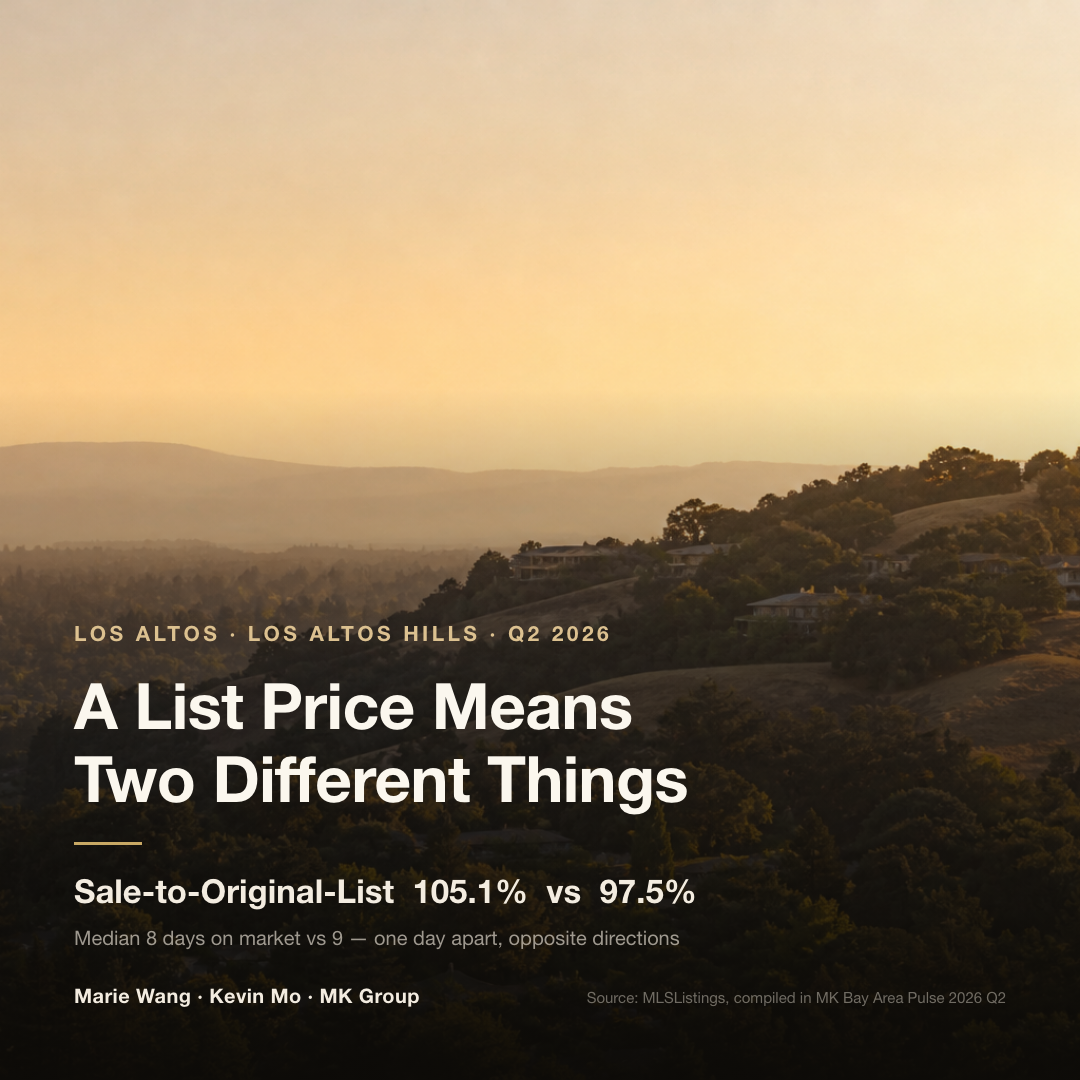
The difference isn't hot versus cold. It's whether the homes are comparable to one another. In the second quarter of 2026, the median Los Altos sale closed at 105.1% of its original list price and the median Los Altos Hills sale at 97.5% — while median days on market in the two towns were one day apart, 8 against 9.
Who this article is for
This is written for three kinds of readers currently looking at both towns at once.
First, buyers weighing the hills against the flatlands. You may be holding two homes at similar prices — one on a level Los Altos block, one on a Los Altos Hills slope — and you want to know why the same number on a listing carries a completely different negotiating meaning on each side.
Second, owners preparing to sell in one of the two. Pricing strategy does not port between them. Listing low to draw a crowd is a mature play in one town and, in the other, can cost you the only valuation anchor you control.
Third, anyone trying to work out what the relationship between these two places actually is. They share ZIP codes, their names differ by two words, and a set of institutions carrying "Los Altos" in their name sit on the Hills side of the line — which is why they get treated, for years at a time, as two halves of one place.
You will come away with three things: the land rules each town actually operates under, how those rules produce two different pricing mechanisms, and five consecutive quarters of same-basis closing data showing this is not one quarter of noise.
Three dimensions that decide it
Nearly identical speed, opposite direction. That tells you the thing being separated is not the strength of demand — it is how the number on the listing gets produced in each town. Three layers below, running from land rules down to the first asking price.
Dimension one: different land rules, so the housing stock grows differently from the ground up
Los Altos Hills incorporated on January 27, 1956. The town's official Town Facts page (retrieved 2026-08-14) puts the town at 9 square miles with "slightly over 8,000" residents — that is the town's own framing, not a census-year statistic. Its land rules live in the General Plan · Land Use Element (adopted May 8, 2008), and three of them carry most of the weight.
First, the town is low-density single-family, with a minimum lot of no less than one acre. Under "Existing Land Use" (¶108), the document states plainly that "there are no commercial or industrial uses within the city limits," and ¶109 immediately after lists the town's only non-residential uses as open space, parks and recreation, a pathways system, and schools, religious institutions, and private institutions.
Second, the minimum subdividable net lot rises with average slope. The same document, at page LU-7 under "Slope Density Standards for Subdivisions," requires at least one acre (43,560 square feet) of net land per primary dwelling unit in low-density residential areas: one acre at an average slope of 0-10%, scaling from one acre to seven acres as average slope runs from 10% to 50%, with slopes above 50% "generally not suitable for residential development." Note what that tier structure governs — whether a parcel can be split out in a subdivision. How much can be built on a single existing lot is a separate rule: ¶124-125 of the same document set the LUF (lot unit factor) by a Zoning Ordinance formula keyed to lot area and average slope, with MFA (maximum floor area) and MDA (maximum development area) then computed from average slope and LUF. The two rules use different slope brackets and are not interchangeable — don't collapse them into one when you research a lot. The conclusion: two parcels of identical acreage can differ substantially in what you may actually build.
Third, sewer service is not uniform. The same document records (¶146-148, page LU-17) that the Santa Clara County health department requires a new residence to connect to municipal sewer where a main already runs within 200 feet; after the town signed a new capacity agreement with the City of Los Altos in 2007, residences inside the town limits and its sphere of influence are structurally able to connect — yet the town still states its wish that as many homes as possible connect, which is to say septic-served homes remain in the stock.
Los Altos, by contrast, is a conventional incorporated city. It has a downtown commercial district, and single-family homes are governed by the R1 series under Title 14 (Zoning) of the municipal code, with the workhorse R1-10 district keyed to a 10,000-square-foot-class minimum lot (larger districts such as R1-20 and R1-40 also exist). Blocks are regular, terrain is largely flat, and net lots along a given street sit in the same order of magnitude.
Dimension two: translated into market language, the question is whether comparable sales exist
A parcel that starts at one acre, is tiered by slope, has its buildable area computed lot by lot, and may or may not sit on municipal sewer is, in effect, closer to a one-off good than a unit of inventory. Los Altos Hills recorded 32 single-family closings town-wide in the second quarter of 2026; Los Altos recorded 97 in the same quarter, roughly three times as many.
Now look at how comparable those 32 actually are. We have not walked all 32 parcels side by side, so what follows is inference from the rules rather than a measured finding: under a regime of one-acre minimums, slope tiering, and buildable area computed lot by lot from LUF and average slope, it is hard to expect any two sales to land in the same bracket on net area, average slope, LUF, easements, and sewer method simultaneously. The reasonable inference is that the number of sales genuinely usable as comps for any one specific property is meaningfully smaller than 32 — how much smaller can only be settled by screening sale by sale against that property's own lot parameters.
Los Altos runs the other way. Lot sizes within a block are consistent, house types are comparable, and buyer profiles overlap, so a given home can usually find a dozen or more recent like-for-like sales to price against. Comp density is the most fundamental market difference between these two towns.
Dimension three: comps decide whether the first price is compared or estimated
Where comps are dense, the first asking price can be a tactic. The seller knows where the market band sits, deliberately lists at the bottom of it as a traffic hook, and hands final pricing to the bidding process. That is where Los Altos's 105.1% comes from — multiple rounds of bidding transfer pricing power from the seller to the buyer pool. The play only works when the buyer pool is deep and the comps are dense; otherwise listing low is simply money given away. From the buy side, that mechanism means what you compete on is the certainty of your offer, not just the size of your number — see I'm Buying With a Mortgage — How Do I Beat All-Cash Buyers in the Bay Area? 2026 Q1 Cash Share by City + What Actually Works.
Where comps are thin, the first asking price can only be a valuation claim. Seller and agent each form a view on the parcel's usability, its slope deductions, and renovation cost, with too few market samples to calibrate against. Estimation error is therefore unavoidable, and that error is ultimately absorbed at closing — which shows up as a median sale price below the original list. The same below-asking mechanism holds at the eight-figure level across the Bay Area, and the line-item method for marking a house down is laid out in Buying at $10M to $14M in Atherton — Why Did Every One of These Homes Close Below Asking, and What Should I Be Marking Down at a Showing?
So the phrase "list price" carries different semantics in the two towns. In Los Altos it is closer to a marketing starting point. In Los Altos Hills it is closer to the seller's valuation quote on their own parcel — a claim that can be right or wrong. For a lateral view of premium behavior across Bay Area cities, see How Much Over Asking Do You Need to Win in the Bay Area? 2026 Q1 Premium Rates by City.
Five quarters on the same basis: this is not one quarter of noise
The core numbers first. Across the five consecutive quarters from Q2 2025 through Q2 2026, the median Los Altos sale never closed below 103.7% of original list, and the median Los Altos Hills sale never closed above 100.0%. Over the same stretch, median days on market in Los Altos was 8 in all five quarters, while Los Altos Hills ran between 9 and 15.
| Quarter | Los Altos closings | Los Altos sale/original list | Los Altos median DOM | LAH closings | LAH sale/original list | LAH median DOM |
|---|---|---|---|---|---|---|
| 2025 Q2 | 101 | 103.7% | 8 days | 28 | 100.0% | 10 days |
| 2025 Q3 | 73 | 103.7% | 8 days | 31 | 98.5% | 10 days |
| 2025 Q4 | 66 | 105.2% | 8 days | 28 | 98.2% | 15 days |
| 2026 Q1 | 51 | 104.3% | 8 days | 17 | 97.5% | 15 days |
| 2026 Q2 | 97 | 105.1% | 8 days | 32 | 97.5% | 9 days |
What to hold onto: 97.5% does not mean "hard to sell." Median days on market in Los Altos Hills in the second quarter of 2026 was 9 — faster than the town's own 15 days in the fourth quarter of 2025, and only one day behind Los Altos. Closing below asking and closing quickly happen at the same time up in the hills, because what gets conceded is the estimation error built into the first price, not demand. Read in reverse, Los Altos holding steady at 8 days for five straight quarters says its 105.1% is not evidence of a market heating up either — it is one list-low-and-bid mechanism running steadily.
One more reading trap worth flagging: quarter-to-quarter swings in closing volume are mostly seasonal. Los Altos Hills recorded only 17 closings and Los Altos only 51 in the first quarter of 2026, rising to 32 and 97 in the second — the ordinary Q1-to-Q2 expansion that happens every year, not a market turning stronger. What stays stable across quarters is the ratios and the days, not the counts.
Data source: MLSListings (compiled in MK Bay Area Pulse 2025 Q2-2026 Q2; single-family basis, condos and multi-family excluded); Town of Los Altos Hills, General Plan · Land Use Element (adopted May 8, 2008; source PDF at losaltoshills.ca.gov/DocumentCenter/View/148/General-Plan---2-Land-Use-PDF; cited passages are existing land use ¶108-109, subdivision slope density standards at page LU-7, LUF and MFA/MDA at ¶124-125, and sewer service at ¶146-148, page LU-17); Town of Los Altos Hills official Town Facts page (losaltoshills.ca.gov/217/Town-Facts — incorporation date, area, and population are that page's own phrasing rather than census-year statistics); City of Los Altos municipal code Title 14 (Zoning), including the minimum lot area provisions at 14.06.040.
Updated: 2026-08
Scope: Single-family closings in the City of Los Altos and the Town of Los Altos Hills. The planning documents and code provisions above were retrieved on 2026-08-14; zoning, slope, buildable area, and sewer conclusions for any specific parcel must come from the town or city planning department's determination for that address.
What MK has seen on the ground
Two Los Altos Hills transactions make that pricing chain easier to see end to end.
In November 2025, a Silicon Valley AI-company employee family working with MK Group closed an all-cash purchase in Los Altos Hills. Most of this family's wealth sat in stock in a company that had not yet gone public, so the team first brought in secondary-market specialists to convert the position into cash in tranches, then moved into negotiation — and took more than $1M off the seller's original price. In the case record, that spread came from the team's long-running read of luxury supply and demand and its handling of the seller's psychology. Placed inside this article's framework, it also had a structural precondition: in a market with dense comparable sales, a negotiating band of more than $1M generally does not exist, whereas a Los Altos Hills original list price contains, by construction, a stretch of valuation the market has never calibrated.
But negotiable does not mean slow. In May 2026, a different buyer — taking title through a corporate entity — closed an all-cash purchase in Los Altos Hills at roughly $11M, locked in two weeks. On that transaction the team did not chase a shorter closing; it settled the title structure, the funding path, and the authorization documents first, and only then moved toward close. At that price a house behaves more like an asset than a residence, and whose name buys, how the money travels, and how it will be held afterward decide the quality of the deal more than how fast it records. Put the two side by side and they make one point: in Los Altos Hills, negotiating room and closing speed are not in tension. Both buyers paid cash; one spent its effort prying open the valuation band, the other spent it on the holding structure.
MK Group co-founders Marie Wang (DRE# 02110980) and Kevin Mo (DRE# 02127623) work the $5M+ tier across the Peninsula and South Bay, and their YouTube channels — @MarieWang (44K+) and @KevinMoRE (24K+) — keep unpacking the pricing and negotiating logic of that tier. To place Los Altos Hills inside the wider top-tier map, see Same Silicon Valley Top Tier, a Nearly $10M Median Gap — How Do I Choose Between Atherton, Hillsborough, and Los Altos Hills?
Common mistakes
Mistake 1: "They share a ZIP code, so they're two halves of one market"
They aren't. Los Altos and Los Altos Hills are separately incorporated cities with their own councils, their own municipal codes, and their own zoning regimes — one with a one-acre minimum net lot and no commercial or industrial use inside town limits, the other with a downtown commercial district and single-family homes governed by districts like R1-10. They do share ZIP codes including 94022, and a set of institutions named "Los Altos" do sit on the Hills side of the line. But a ZIP code is a mail-delivery unit; it does not determine a city, and it does not determine a school attendance area or a zoning district. The only reliable way to know which rules apply to a property is to verify the specific address with the corresponding town or city.
Mistake 2: "97.5% means Los Altos Hills is cooling and 105.1% means Los Altos is hotter"
The data doesn't support that. Median days on market in the second quarter of 2026 were 9 and 8 — one day apart. If this were a difference in demand, speed would diverge before the ratio did. Lay the five quarters out and it gets plainer: median days on market in Los Altos Hills shortened from 15 in the first quarter of 2026 to 9 in the second, while the ratio held at 97.5% and did not move. Speed and ratio are independent variables here. Speed reflects demand; the ratio reflects the accuracy of the first asking price.
Mistake 3: "So in Los Altos Hills I just offer 10% under list and negotiate from there"
97.5% is a town-wide median, not a discount you can apply. It aggregates dozens of independent pricing errors: some listings are priced high and carry real room, others are priced close to market and the negotiating window narrows sharply — and for those, the median is simply the wrong instrument. What actually tells you whether one house has room is that parcel's own data: net area, average slope, LUF and MDA calculations, easements, sewer or septic, and sales over the last 12 months in the same slope band at the same net-lot scale. Not a town-wide median.
Mistake 4: "If listing low starts a bidding war in Los Altos, it will work up the hill too"
This one matters most to sellers. Listing low to trigger competition works because of buyer-pool depth and comp density — buyers have to be able to confirm quickly that a price is clearly below market before they'll converge on it. With 97 closings in a quarter and comparable homes on the same block, Los Altos meets that condition. Los Altos Hills, with 32 closings in a quarter and every parcel different, does not: buyers lack the samples to judge whether a low price is a bargain or a reflection of that parcel's real constraints, so listing low is more likely to be read as "something is wrong with this lot" — while also surrendering the only valuation anchor a seller gets to set. Pricing strategy does not transfer between these two towns.
Next steps
- Confirm which town the address is actually in. ZIP codes don't count. Use the Santa Clara County Assessor's APN to establish the parcel, then check the corresponding town or city's official zoning map to see which district it falls in — Los Altos Hills R-A, or one of the Los Altos R1 districts.
- In Los Altos Hills, get the lot data before you talk price. Ask the seller or the town planning department for that parcel's net area, average slope, LUF, and MFA / MDA calculations, and confirm the sewer method (municipal sewer or septic, and whether a main already runs within 200 feet). Those numbers decide whether the valuation claim inside the original list price holds up.
- Treat comparable sales as diligence, not background reading. Up the hill, require your agent to produce sales from the last 12 months in the same slope band, at the same net-lot scale, on the same sewer method — not a generic list of town sales. Down in the flatlands, require the same block, the same district, the same house type.
- Read the price history before you read the price. In Los Altos, treat the original list as a marketing starting point and study the bidding process that separates it from the final number. In Los Altos Hills, look at whether the price has been cut and how many times — the count of reductions is often a direct readout of the first valuation error.
- Sellers should choose pricing strategy by town, not by price point. At the same price level, Los Altos rewards listing low to draw competition, while Los Altos Hills rewards building the price on your own parcel's usability analysis — and being ready to walk a buyer through the lot data that produced it.