The short answer
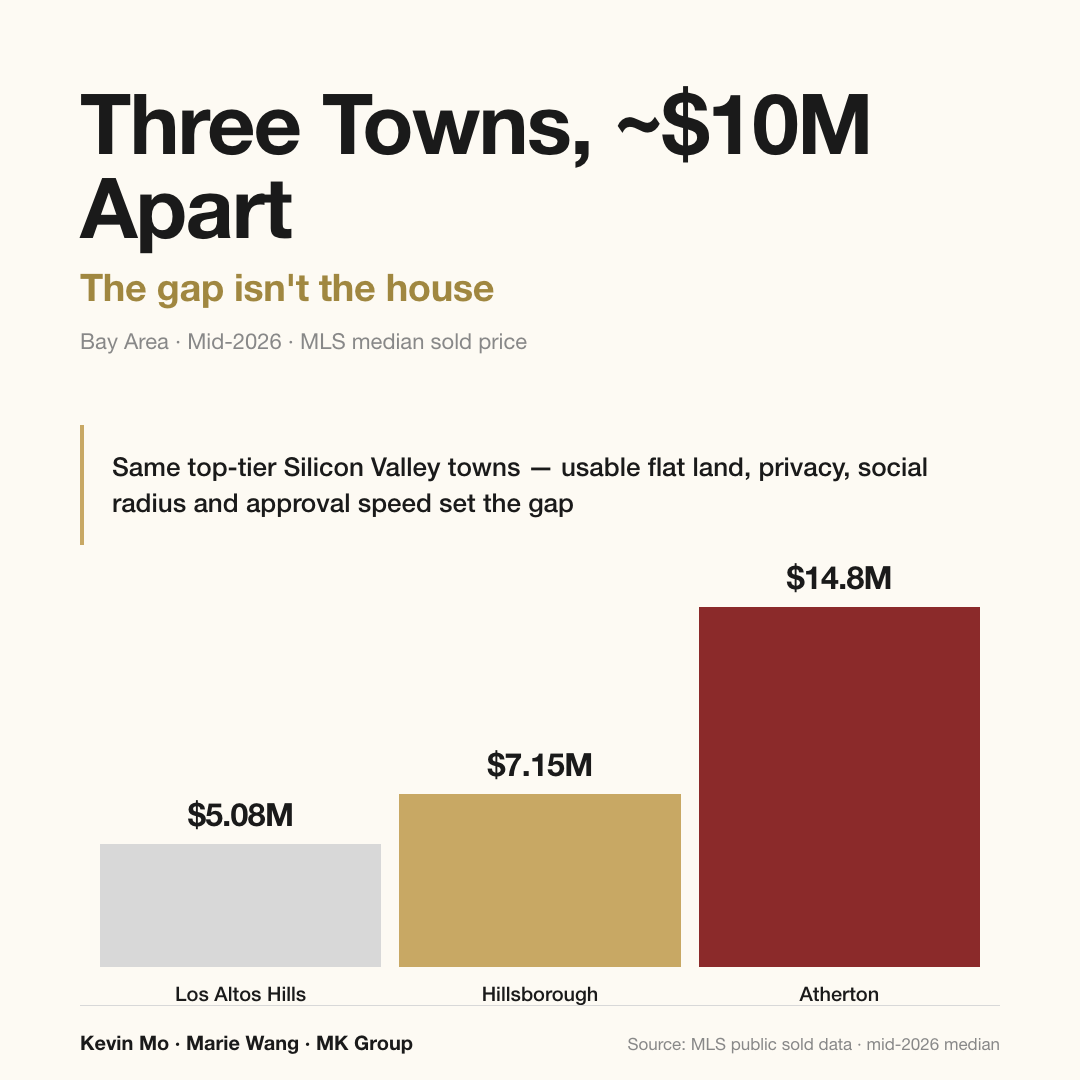
Across Silicon Valley's top luxury enclaves, the median sold price in Atherton, Hillsborough, and Los Altos Hills can differ by nearly $10 million. But that premium rarely buys a better house. It buys five things a listing page never shows clearly: the share of usable flat land, the kind of privacy on offer, how much inventory trades off-market, the social radius around the property, and how fast the city moves a land-use approval. Price isn't the answer — fit is. Don't reason backward from the price tag. Reason forward from the life you actually want to live.
Who this article is for
- Buyers at $8M+ weighing Atherton, Hillsborough, and Los Altos Hills against one another — people who want a single framework that lays the three side by side, rather than touring house by house and assembling an impression.
- Families who want a large lot — buyers who need to tell the difference between total acreage and the flat, buildable land they can actually use.
- Buyers with a hard privacy requirement — people who know they don't want to be disturbed but haven't yet named which kind of privacy they're after.
- Families for whom the social and commute radius is a real constraint — cross-border, post-liquidity, and family-office households where hosting, gatherings, the school run, and the workday route all have to line up precisely.
- Owners planning to buy land and subdivide, expand, or remodel — buyers who want to fold the city's approval timeline into the asset value of the parcel itself.
Three core decisions
Decision one: are you buying acreage, or usable flat land?
At the top of the luxury market, land is never judged by how large it is. It's judged by how much of it is flat and usable. Los Altos Hills is a one-acre-minimum enclave, and yet its median sold price is the lowest of the three — this is exactly why. Its zoning is strict: a single net lot generally can't fall below one acre (43,560 square feet). That sounds generous, but a meaningful share of many parcels is slope, hillside, and natural grade. Those portions deliver view, distance, and quiet — real value — but they aren't all efficiently usable. The part you can comfortably build on, the part that takes a garden, a pool, a guest house, a driveway, and room to move, may be smaller than the acreage suggests.
Atherton works differently. The same acre tends to sit flat, square, and highly usable, with far more of it visible and available to landscape. That is why, in Atherton, the land alone — before you count a single wall of the house — reaches the order of $10 million-plus per acre. Read that carefully: that figure is a standalone land value, not the city's overall median sold price. One is the dirt; the other is the closed median for house plus dirt together. Don't blur them. The first layer of the price gap isn't lot size. It's how much of the lot is genuinely usable.
Decision two: which kind of privacy do you want, and how short does your social radius need to be?
Buyers in all three enclaves care about privacy — but they don't want the same privacy. Atherton offers a protected privacy: tall hedges, a long driveway, deep setbacks, walls, and a town with almost no commercial district, so no one drifts past your front door. For a family that regularly hosts important guests at home, for public figures, founders, and investors, the point isn't only quiet — it's control. Hillsborough reads more like estate concealment in layers: slope, mature trees, curving roads, houses set back off the street. Its register is quieter, older-money, less on display. Los Altos Hills earns its privacy not with walls but with distance — a one-acre-minimum lot, native vegetation, and the natural spacing between you and a neighbor, so you don't need a high wall to feel secure.
The social radius gets overlooked and often decides everything. On the same $10 million budget, different families are not buying the same life. Atherton sits among Stanford, Menlo Park, Palo Alto, and Sand Hill Road — the last being one of the most concentrated venture and capital corridors in the world — and that compresses a certain person's whole radius down to almost nothing. Los Altos Hills sits closer to the South Bay tech core: Apple, Mountain View, Cupertino, Los Altos. Many founders and post-liquidity families want the hill view, the quiet, and the distance without leaving the workday radius behind. Hillsborough leans toward the northern Peninsula and suits families who move among San Francisco, Burlingame, and San Mateo — a little less of the Silicon Valley capital-circle label, a little more of the established estate character. Decide first which privacy you want and how short your radius has to be, and the answer points straight at the enclave you should be touring.
Decision three: will this land ever "move" — and have you priced the approval clock into the asset?
The most experienced luxury buyers look at one finer thing still: whether this land can move in the future. Many people buy land not just to live on it but to do something with it — split it, add to it, remodel it. When that's the plan, the speed of municipal approval directly sets how fast you can put shovels in the ground. That judgment can't rest on a map or a seller's narrative. It means reading the zoning, the lot size, the setbacks, the access, the utilities, and the city's own feedback. Atherton has a small population and a relatively limited caseload, so the rhythm of the conversation is often clearer. Take the same question to Hillsborough and the feedback rhythm can be slower and the process more involved. This isn't a verdict on which city is "better" — it's that you have to price time into asset value. An approval that slips by half a year or a year isn't just waiting for a luxury buyer; it can mean a delayed design, shifting construction costs, capital tied up, opportunity cost stacking, even a changed timeline for an eventual sale. That speed difference is buried in process. Not a word of it appears in a listing photo — and it's the thing that most shapes whether a plan ever lands.
Three enclaves, side by side
The numbers first. On a mid-2026 MLS closed-sale basis, Atherton sits around $14.8M, Hillsborough around $7.15M, and Los Altos Hills around $5.08M — a gap of nearly $9.7M between Atherton and Los Altos Hills, roughly the distance of one entire top-tier house. But hold one thing straight: Atherton's $10M-plus-per-acre is a standalone land value (dirt only), not the city's overall median sold price. The two are not interchangeable.
| City | Median sold price (mid-2026 basis) | Zoning / lot character | Privacy logic | Social / life radius |
|---|---|---|---|---|
| Atherton | ~$14.8M | Mostly flat, square, highly usable lots; land alone reaches the $10M+/acre order of magnitude (standalone land value, not median sold price) | Boundary type: high walls / long driveway / deep setbacks / almost no commercial district | Stanford–Menlo Park–Palo Alto–Sand Hill Road capital circle |
| Hillsborough | ~$7.15M | Slope, curving roads, and mature trees in an estate layout; low annual volume, small sample | Layered concealment: slope + vegetation + houses set back off the street | Northern Peninsula SF–Burlingame–San Mateo corridor, established estate character |
| Los Altos Hills | ~$5.08M | Single net lot ≥ 1 acre (43,560 sq ft), but a meaningful share is slope / hillside, not efficiently usable | Distance type: earned through lot and grade, not walls | South Bay tech core — Apple / Mountain View / Cupertino / Los Altos, post-liquidity families |
What to take away. The three medians are the easiest part of this table to misread. They are an aggregate snapshot on a mid-2026 basis, and each of these is a low-volume market — one or two large closings can pull a median up or down. For example, Atherton in Q2 2026 alone recorded just 23 closings at a roughly $10.5M median, several million dollars below the mid-year $14.8M figure (see the Atherton 2026 Q2 market deep report). That gap points at something else, too: above the $8 million tier, a large share of transactions go from private to closed without a single word appearing on a public portal. Sellers don't want it known they're selling, buyers don't want it known they've bought, and the whole chain runs through private networks. Hillsborough shows this most sharply — a low-volume estate market where the real question a luxury buyer should ask is how much quality inventory behind the public numbers never entered a search result at all. So don't take any single median as "this is what the enclave costs." It's a reference starting point, not the full hand.
What MK Group sees on the ground
MK Group — Kevin Mo (DRE# 02127623) and Marie Wang (DRE# 02110980) — works Silicon Valley's luxury market with a focus on high-end transactions around Stanford, and the same pattern shows up again and again: what really separates these three enclaves on price is rarely the house itself. It's the five things above that a listing page never shows clearly. Two anonymized observations from the field.
The first is about whether land can move. MK Group's team was approached by an Atherton owner holding a two-acre parcel who wanted to understand whether one portion could be separated and handled on its own. Work like this can't rest on a map or a seller's story — it means going line by line through zoning, lot size, setbacks, access, and utilities, and reading the city's own feedback. How fast those approvals move is itself part of what the land is worth.
The second is about fit. MK Group has worked with buyers whose brief was unusually precise: room to host investors at home, space for a private gathering of fifteen or twenty, a short school run, and easy access to Stanford, Palo Alto, Menlo Park, and Sand Hill Road — all while the house itself stays dignified and private. When those conditions land together, Atherton stops being merely the most expensive option and becomes the best-matched one. For a different family — one that wants hillside quiet and distance — the same Atherton address can read as the most expensive mismatch on the board. For a fuller look at how these cities trade off, see the earlier breakdown of the Atherton / Palo Alto / Los Altos Hills decision framework (Kevin Mo's related work is on YouTube at @KevinMoRE, 23K+ subscribers).
Common misconceptions
"The pricier the enclave, the better the house."
Atherton's median runs nearly $9.7M above Los Altos Hills, but that premium doesn't buy a thicker foundation, whiter walls, or newer finishes. What actually opens the gap is usable flat land, the type of privacy, the social radius, information completeness, and approval efficiency — all of it outside the listing photos. Translating "expensive" straight into "better house" is the most common and most costly misread there is.
"A bigger lot is automatically worth more."
The question is never how large the lot is — it's how much of it is flat and usable. Los Altos Hills starts at one acre yet posts the lowest median, precisely because a meaningful share of many parcels is slope, hillside, and natural grade that can't be built on and doesn't work well. That's a real discount. The same acre in Atherton, flat and square with high usable coverage, is worth something else entirely. Before you buy land, ask: of this one acre, how much is genuinely flat land you can build on, landscape, and live across?
"The median sold price is the enclave's real price."
These are low-volume markets, where one or two large closings can pull the median up or down. Add that above the $8 million tier a large share of transactions run off-market and never surface on a public portal, and the median hides a great deal of inventory you can't see. Atherton sits around $14.8M on a mid-year basis, yet Q2 2026 alone saw just 23 closings at roughly $10.5M — a several-million-dollar swing between a quarterly slice and the full-year basis. Treating any single median as "this is what the enclave costs" is an easy way to make a very expensive decision inside an incomplete market.
"Once you own the land, you can subdivide or build freely."
Whether you can split it or add to it turns on zoning, lot size, setbacks, access, utilities, and the city's feedback — none of it automatic once you close. And the approval rhythm varies widely by city: Atherton's limited caseload often makes the conversation clearer, while the same question in Hillsborough can meet slower feedback and a more involved process. An approval that slips by half a year or a year delays the design, raises the cost, ties up capital, and stacks opportunity cost — so fold the approval timeline into the land's asset value, and confirm feasibility with zoning and permitting professionals before you act.
Next steps
- Reason forward from your life, not backward from the price tag. First fix which privacy you want — boundary type, layered estate, or distance type — and how short your social and commute radius has to be. Then look back at which enclave matches. Fit matters more than "most expensive."
- When you view land, separate acreage from usable flat land. In Los Altos Hills especially, ask for the share of slope and hillside inside the lot, work out how much is genuinely buildable and livable, and judge the parcel's real value from there.
- Don't read the hand off public portals alone. Above the $8 million tier, actively ask which quality properties are trading off-market or haven't been released yet, and confirm you're seeing the complete choice set.
- Use the median as a reference, not a price. Compare multiple bases — a mid-year aggregate against a single quarter — and understand why medians swing so much in low-volume markets, so a single number doesn't anchor you.
- If you plan to move the land, confirm approval feasibility and timing first. Before you write an offer, check the zoning, setbacks, access, utilities, and city feedback, price the approval cycle into both your landing cost and the asset value, and have zoning/permitting professionals and your attorney confirm it alongside you.